In 1941, a 23-year-old woman was taken into an operating room by her own father, without her mother’s knowledge, and left permanently changed by a procedure meant to calm her. She was then hidden from public life for the next six decades. Rosemary Kennedy was the eldest of five daughters born to Joseph P. Kennedy Sr.
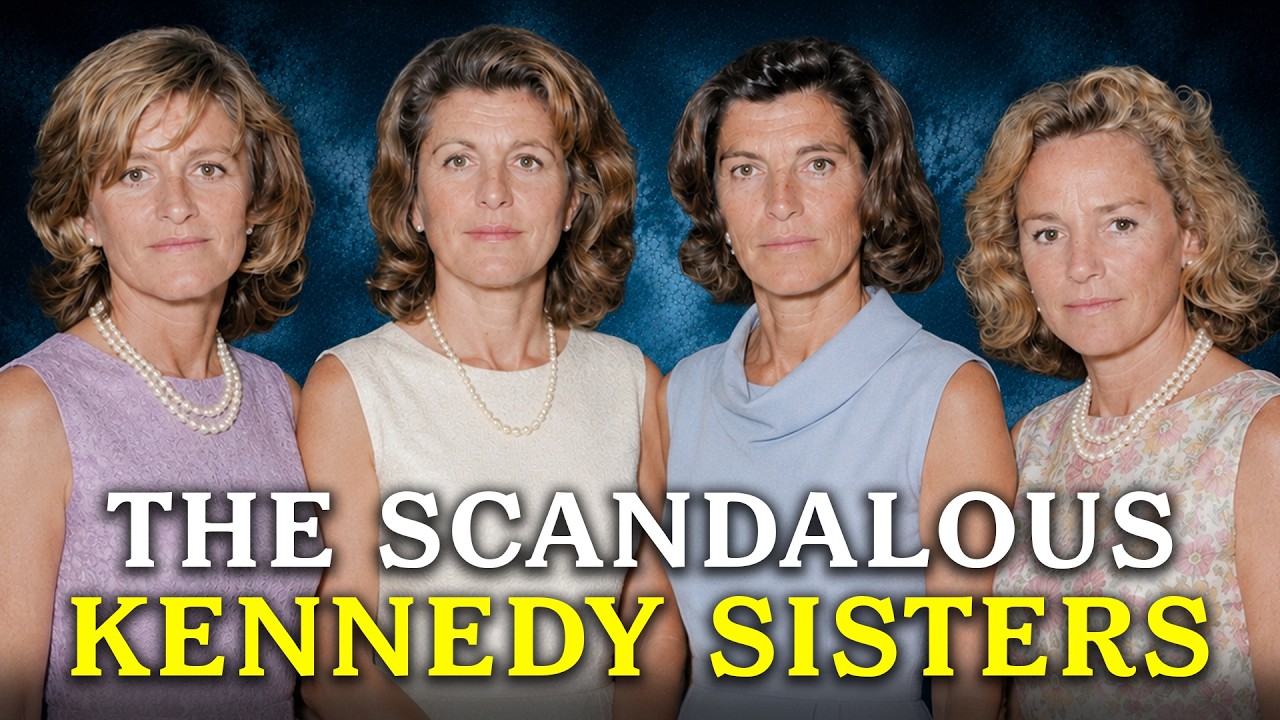
and Rose Fitzgerald Kennedy, children of one of the most closely watched political dynasties in American history. While her brothers—Joseph Jr. , John, Robert, and Edward—dominated the family’s public reputation, the five sisters lived out their own stories of scandal, achievement, heartbreak, and quiet endurance, largely outside the spotlight that followed their male relatives. Rose Marie Kennedy was born on September 13, 1918, the third child and eldest daughter of the family.
From her earliest years, she developed more slowly than her siblings, struggling with learning difficulties that doctors of the era could not precisely diagnose. She repeated grades in public school and struggled to keep pace with her achievement-obsessed household. Despite these challenges, she took part in family life, kept a diary describing dances and concerts, and accompanied the family on a visit to the Roosevelt White House. When her father was appointed United States Ambassador to Great Britain in 1938, Rosemary moved to London with the rest of the family and was formally presented at the British Royal Court alongside her mother and sister Kathleen.
There, she was enrolled in a convent school using Montessori teaching methods, an environment she reportedly found comforting and stable. When the family returned to the United States in 1940 as war engulfed Europe, relatives began noticing a troubling change. According to her sister Eunice, Rosemary seemed to be regressing, becoming increasingly irritable and volatile by age 22. Some accounts suggest she had also begun slipping out of the family’s Washington residence at night, alarming parents who were equally concerned about their daughter’s safety and the family’s carefully crafted public image.
In 1941, Joseph Kennedy authorized a prefrontal lobotomy for his daughter after being persuaded the procedure would calm her and prevent her mood swings. The operation, performed without Rose Kennedy’s knowledge or consent, proved catastrophic. Rather than calming Rosemary, it left her permanently and severely disabled, unable to walk or speak properly and requiring institutionalized care for the rest of her life. The family concealed the truth from the public and even from many of Rosemary’s own siblings for years, quietly explaining her absence as related to an unspecified intellectual disability.
Some of her younger siblings reportedly did not fully understand what had happened until they reached adulthood. Rosemary spent the following decades living largely out of public view, eventually settling at St. Coletta School in Wisconsin, where she remained for the rest of her life, visited periodically by her siblings once the truth became known within the family. She lived to age 86, passing away on January 7, 2005, surrounded by her sisters Joan, Eunice, and Patricia, along with her brother Ted, after being welcomed back into regular family life during her final years.
Her condition, however, went on to inspire one of the most significant humanitarian achievements connected to the entire Kennedy family through the tireless work of the sister closest to her. Eunice Kennedy, born July 10, 1921, channeled her energy and intellect toward a cause that traced directly back to Rosemary’s circumstances. After graduating from Stanford University with a degree in sociology, she worked in social welfare positions throughout the 1940s and 1950s, including with the US State Department and at a federal women’s prison. In 1953, she married Sargent Shriver, who would later become the first director of the Peace Corps and a vice presidential candidate in 1972.
The couple had five children. In 1962, deeply influenced by her sister’s exclusion from mainstream society, Eunice established a day camp on her own family farm in Maryland for children with intellectual disabilities. Camp Shriver brought together children with intellectual and typical development for shared activities including swimming and sports, an approach considered radical at a time when such children were frequently institutionalized. That camp became the direct foundation for the Special Olympics, formally launched in 1968 with its first official international games in Chicago.
The organization has since grown into a global movement supporting millions of athletes across more than 170 countries. Eunice received the Presidential Medal of Freedom in 1984 from President Ronald Reagan for her humanitarian work. She passed away on August 11, 2009, at age 88. While Eunice was building her legacy, another Kennedy sister lived a life defined by glamour, rebellion, and a love affair that would prove fatal.
Kathleen Kennedy, known within the family as Kick, was described as the most outgoing and socially magnetic of the sisters, considered by many accounts her father’s favorite among the daughters. During her father’s ambassadorship in Britain during the late 1930s, she became one of London’s most talked-about young women, earning the nickname debutante of 1938 from the English press. She fell in love with William Cavendish, known as Billy, heir apparent to the Duke of Devonshire, one of England’s oldest noble families. There was a complication.
The Cavendish family was staunchly Protestant, while the Kennedys were devoutly Catholic, and Rose Kennedy in particular threatened to disown her daughter if she proceeded with the match. Kick married Billy anyway in a civil ceremony in London on May 6, 1944, a wedding attended by only her eldest brother, Joseph Jr. , among the Kennedys. Just weeks after the wedding, Billy was called back to active military duty.
On September 10, 1944, he was killed by a sniper’s bullet near Heppen, Belgium, only about a month after Kick had also lost her brother Joseph Jr. , killed during a volunteer bombing mission over the English Channel. Widowed at 24, Kick chose to remain in England, continuing volunteer work with the Red Cross. In 1946, she met Peter Wentworth Fitzwilliam, the 8th Earl Fitzwilliam, one of the wealthiest men in British aristocratic society, and began a passionate relationship.
Fitzwilliam was not only Protestant but still married. Rose Kennedy again threatened to disown her daughter, but Kick remained determined to pursue the relationship. Once Fitzwilliam’s divorce was finalized, the couple flew to France in May 1948, hoping to meet with Kick’s father in Paris to secure his blessing before vacationing on the French Riviera. They never arrived.
On May 13, 1948, their small plane encountered severe turbulence over the Ardèche region of southern France and crashed, killing everyone aboard instantly. Kick was 28 years old. The Kennedys worked to keep the full circumstances of her death out of public view, given that she had been traveling with a married man, and newspaper accounts at the time made no mention of the true nature of her relationship. Joseph Kennedy was the only family member to attend her funeral in England.
Patricia Kennedy, born May 6, 1924, grew up as perhaps the most introverted and creatively inclined of the five sisters, harboring genuine ambitions of becoming a film producer at a time when such a career path was almost entirely closed to women. After graduating from Rosemont College in 1945, she moved into television production work, first with NBC in New York and later relocating to Los Angeles. She met the English-born actor Peter Lawford, a rising Hollywood star known for his work in musicals alongside Fred Astaire and later films such as Exodus. The two met through Patricia’s brother, the future president, in 1949.
They married on April 24, 1954, in a lavish New York ceremony attended by 250 guests, including prominent figures from Hollywood and American high society. Lawford went on to become closely associated with Frank Sinatra’s Rat Pack and helped bring Hollywood glamour to his brother-in-law’s presidential campaign in 1960. Behind the public image of a golden Hollywood marriage, the relationship grew increasingly strained over the next decade, weighed down by Lawford’s escalating struggles with alcohol and other substances. In 1965, Patricia filed for divorce, becoming the very first member of the entire Kennedy family to do so, a scandalous development for a family so publicly committed to its Catholic identity.
The divorce was finalized the following year. Lawford’s career and personal life declined, and he married three more times before his death in 1984. Following the divorce, Patricia largely stepped back from film production and threw her energy into New York’s arts and philanthropic communities, eventually founding the National Committee for the Liberal Arts. She also became involved in addiction-related philanthropic work through the National Center on Addiction and Substance Abuse, a cause that carried particular personal resonance given her own private struggles with alcoholism in her later years.
Patricia Kennedy Lawford died on September 17, 2006, at age 82, from complications related to pneumonia. Jean Kennedy, born February 20, 1928, was the youngest of the five Kennedy daughters. Throughout her early adulthood, she devoted considerable energy to campaigning for her brothers’ political ambitions, working behind the scenes during John, Robert, and Edward’s runs for office. In 1956, she married Stephen E.
Smith, a transportation executive who became one of the family’s most trusted financial and political advisers until his death in 1990. The couple settled in New York City and raised four children. Jean found her own charitable calling, shaped in part by her family’s history, establishing an organization called Very Special Arts in 1974, a program dedicated to providing arts education opportunities for people with disabilities. The organization operated programs across dozens of countries over the following decades.
Jean’s most significant public achievement arrived relatively late in her life. In 1993, President Bill Clinton appointed her the 25th United States Ambassador to Ireland, a position she held for five years. During her tenure, she played a meaningful behind-the-scenes role in supporting the peace process that eventually led to the landmark Good Friday Agreement in 1998, earning considerable respect within diplomatic circles for her quiet, persistent style. She significantly outlived all four of her siblings, becoming the very last surviving child of Joseph and Rose Kennedy after the deaths of her remaining brothers, including Edward in 2009, the same year Eunice passed away.
Jean died on June 17, 2020, in Manhattan at age 92. Together, the lives of the five Kennedy sisters offer a more complete and complicated picture than the one so often presented through the lens of their brothers’ political careers and repeated tragedies. Rosemary’s life, hidden away for decades, became inseparable from Eunice’s humanitarian achievements, accomplishments that arguably reshaped more lives around the world than any single piece of legislation her brothers ever passed. Kathleen’s brief, dramatic life revealed a young woman willing to defy her family’s expectations every turn.
Patricia’s quiet rebellion and private struggles added a layer of human vulnerability to a family often portrayed as impervious to ordinary difficulty. And Jean, outliving them all, demonstrated that meaningful public service could be built just as effectively through steady, unglamorous work as through dramatic political ascension. Their accomplishments and hardships, once treated as footnotes to their brothers’ more famous careers, deserve to be remembered as every bit as central to understanding the full weight and complexity of the Kennedy family’s extraordinary and often painful place in American history.