In May 1963, ten thousand people lined up for miles in Elmira, New York, waiting hours for just thirty seconds beside a coffin. Inside a building called Neighborhood House, a letter from the President of the United States was read aloud, and the room fell so silent that grown men could hear every word clearly. Eighteen months earlier, that same president had personally requested a handshake with the young man lying in that casket. What happened in between—the trophy, the team owner who never wanted him, and two months of adults lying to him about why he was so tired—is the part history rarely mentions.
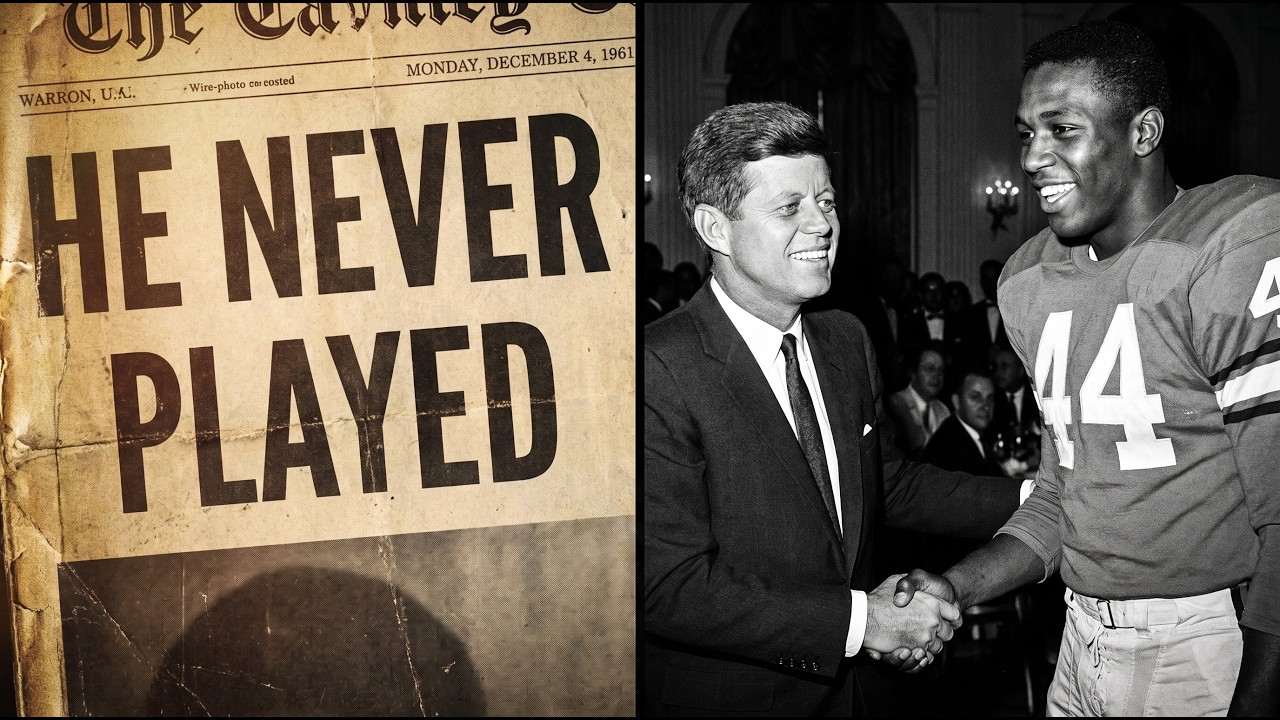
Ernie Davis is remembered as the first Black man to win the Heisman Trophy. What is often forgotten is everything that happened after he won it, most of which had nothing to do with football at all. To understand the scene at that funeral home, you have to go back to a time when an entire NFL team could openly and officially refuse to let a Black man wear its uniform. By 1961, every professional football franchise had integrated except one.
The Washington Redskins, owned by George Preston Marshall, remained the only all-white team in the league, and Marshall was proud of that fact. He told reporters he recruited players from Southern colleges to attract Southern fans—schools that, by his design, had no Black players. He once said the Redskins would sign Black players the day the Harlem Globetrotters signed white players. Marshall might have held that position indefinitely, except for one detail he hadn’t accounted for.
His team had just moved into a brand-new stadium built on federal land, placing it under the direct authority of the U. S. government. That gave Interior Secretary Stewart Udall all the leverage he needed.
The ultimatum was simple: sign a Black player or lose your 30-year stadium lease. Marshall had no legal way out. He tried anyway, arguing, stalling, and giving interviews defending his right to run his team as he pleased. The federal government did not budge.
So on December 4, 1961, after being humiliated and cornered, the most notoriously racist owner in American football used his first-round draft pick on a Black player. The man Washington selected that day was Ernie Davis of Syracuse, a young man who had grown up poor in a coal-mining town outside Pittsburgh, moved to Elmira, New York at age twelve, and turned himself into the greatest all-around athlete his high school had ever produced. Football, basketball, baseball—everything. At Syracuse, wearing the number 44 he inherited from legend Jim Brown, Davis led the Orangemen to an undefeated national championship in his sophomore year and won Cotton Bowl MVP honors before turning twenty-one.
Two days after the most racist owner in football history was forced to call his name, Ernie Davis stood in the ballroom of the Waldorf Astoria in New York and became the first Black athlete in history to win the Heisman Trophy. By then, he had broken nearly all of Jim Brown’s records at that school—rushing yards, total yards, scoring, touchdowns, everything. On the same day, President Kennedy, who had been following Davis’s career, sent a message requesting a meeting. Not the other way around.
The most powerful man on earth asked to shake hands with a 21-year-old college student. They met in front of the cameras, then did something no photographer captured: they rode in a limousine together, the Heisman Trophy along with them, while the president asked the young man about his plans. Davis later told reporters, “Imagine that, the President of the United States wanting to meet me! ” He added that it was almost as exciting as the trophy itself.
His teammates joked about it for years afterward—come shake hands with the man who shook hands with the President. Consider this: on Monday, the trophy belonged to George Preston Marshall’s team. On Wednesday, the winner sat beside the President of the United States. That was America in December 1961—both things at the same time, in the same week, happening to the same young man.
Davis already understood what America was ready to celebrate in him and what it was not yet ready to give him. Two years earlier, after the undefeated season, at a banquet in Dallas celebrating their Cotton Bowl victory, Davis and his Black teammates, John Brown and Art Baker, were asked to leave the celebration quietly. They were taken to a separate gathering while their white teammates stayed to eat. No one from Syracuse objected loudly enough to stop it.
That was simply how things were done. That’s why what Davis did next mattered so much. Marshall’s team held his rights, expecting a grateful rookie to be thankful for the opportunity. Instead, Ernie Davis looked at the most prominent segregationist in American football and made his position clear: he would not play a single down for him.
Marshall, trapped from every side, had no choice but to trade away the first overall pick. Davis went to Cleveland to play alongside his childhood hero Jim Brown on a contract reportedly worth $200,000—the richest rookie deal the NFL had ever seen. And there was a detail in that trade that closed a circle no one expected: the player Washington got back from Cleveland, Bobby Mitchell, became the first Black star in franchise history, a future Hall of Famer, wearing the uniform Marshall had sworn no Black man would ever wear. The owner who had fought integration for a quarter century lost his battle twice in the same deal.
For several months, the ending looked perfect: two of the greatest offensive backs in the history of the sport in the same backfield. Then, in the summer of 1962, while preparing for the College All-Star Game, Ernie Davis began feeling strange. Fatigue that sleep couldn’t fix. Bleeding gums.
One morning at breakfast, he mentioned sores in his mouth to teammates, who laughed at him, joking about where he’d been the night before. No one in that room had any idea what they were seeing. Weeks later, in Chicago, Davis woke up with a swollen neck and was taken immediately to the hospital. Doctors suspected mumps.
What they found instead was acute myelogenous leukemia, one of the deadliest forms of the disease. Here’s what almost no one tells you about what happened next. For two full months, no one told Ernie Davis what was actually killing him. Not his doctors, not the team, not even his mother, who was only told her son had a blood disorder requiring rest.
No one wanted to be the one to tell a 22-year-old athlete, a team star, that his career—and possibly his life—was already over. Browns owner Art Modell personally called reporters and begged them not to publish the true diagnosis, worried about the effect the truth would have on Davis, his family, and the team that had just paid the biggest rookie contract in league history to a player who might never play. When the doctor first called Modell with the results, Modell said he felt like someone had stabbed him with a knife. Decades later, people who knew him said he still couldn’t tell the story without his voice changing.
Still, the show continued. Weeks later, at an exhibition game in Cleveland, Ernie Davis walked onto the field under the lights before tens of thousands of cheering fans. They stood and applauded a man who did not know, at that very moment, the real name of the disease living in his blood. That autumn, after rounds of treatment, the leukemia went into remission.
Finally, hematologist Austin Weisburger sat down with Ernie Davis and told him the truth. By every account from those who knew him, Davis didn’t break down. He didn’t demand explanations. He simply continued living his life as he always had—quietly and for others.
That brings us to the decision that defines this entire story. It wasn’t a touchdown or a speech. In his final months, dying of a disease doctors had barely dared to name until recently, Ernie Davis spent part of his remaining life doing something that would never make headlines. He convinced a high school football player named Floyd Little to turn down Notre Dame and wear number 44 at Syracuse instead—the same number Jim Brown had given him, and which he now quietly returned.
No cameras, no ceremonies, no reporters waiting outside. Just a dying 22-year-old sitting across from a nervous high schooler, making sure the number and everything it represented would continue after he was gone. Little would become a Syracuse legend and, decades later, a Pro Football Hall of Famer. He never forgot who convinced him to wear that jersey in the first place.
Ernie Davis died on May 18, 1963, at a Cleveland hospital. He was 23 years old. He never played a single professional football game. Here’s what no one expected, and what highlight reels don’t mention.
Even after outside doctors confirmed Davis was healthy enough to play during his recovery, Paul Brown, Cleveland’s coach and one of the most respected and influential figures in sports history, refused to let him play—afraid that having a visibly sick man on the team would affect performance. Art Modell disagreed, and the dispute escalated until it became personal and bitter, leading Modell to fire Paul Brown outright before the next season began. Think about that: a rookie who never played one professional game ended up reshaping the top management of an entire NFL franchise, because one powerful man refused to give a dying man his chance, and another man refused to tolerate that. There’s another aspect, less significant but no less telling.
Two months before his death, Ernie Davis wrote his own version of the eulogy everyone assumed his illness had already written for him. He wrote: “Some say I’m a bad guy. I don’t believe that. When I look back, I can’t describe myself as unlucky.
”
The President agreed. In February 1963, when Elmira held a day in Davis’s honor, Kennedy sent him a telegram while Davis was still alive to hear it read. It called him an outstanding American, an example for the nation’s youth, and a man whose standards on and off the field reflected the highest qualities of competition and citizenship. Three and a half months later, a second message from the White House arrived in Elmira.
This time it was read over his coffin. More than 10,000 mourners lined the streets of the city that watched him grow from a stuttering sports-loving kid into a national symbol. Around 30 Browns players and staff traveled hastily—not because anyone asked them to, but because no one wanted to be absent. Both houses of Congress stood to eulogize a man who had never played a single professional game.
Jim Brown, his childhood hero turned teammate, was among the pallbearers, calling him the bravest person he ever met and adding that he never once heard him complain. Not once, over nearly a full year of hospitals, needles, and fading treatment options. The Cleveland Browns retired his number 45, a jersey he never wore in an official game. Six months after that funeral, the president who sent both messages—the man who once asked to shake a college student’s hand—was gone too, in Dallas, in the same American decade that seemed unable to stop burying its best young men.
This is a story that can’t fit in a trophy case. It isn’t a football story at all, in the end. It’s the story of a young man who was lied to about his own death, and who spent the truth, once he finally had it, on someone else’s future instead of his own fear.