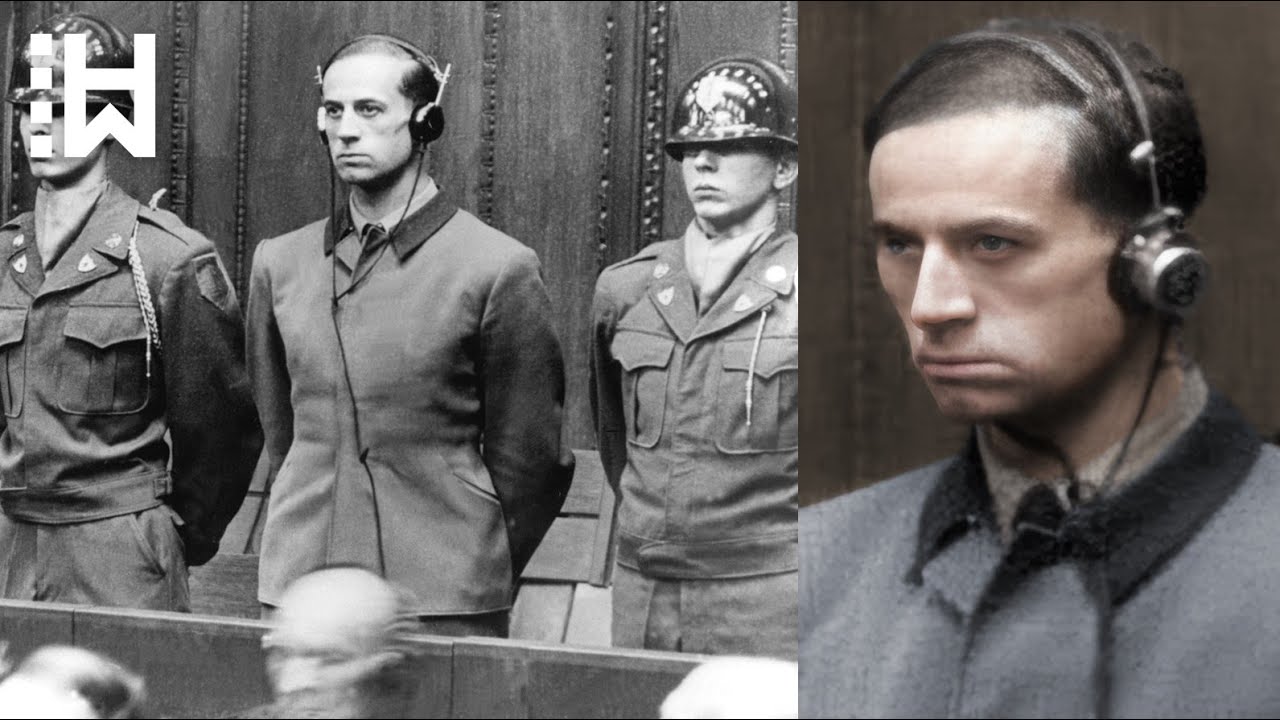
On August 20, 1947, in Lüneberg, Germany, the sentences were read out after more than eight months of trial. The defendants had either participated in a Nazi euthanasia program that killed mentally ill or physically disabled people deemed "unworthy of life," or had conducted painful and often deadly medical experiments on thousands of concentration camp inmates without their permission. Of the 23 defendants charged with ordering, supervising, or coordinating criminal activities, as well as participating in them directly, seven were sentenced to death by hanging. The only one among them directly responsible to Adolf Hitler himself was Karl Brandt.
Karl Brandt was born on January 8, 1904, in Mülhausen, then part of the German Empire. His father was a Prussian Army officer, but Karl decided to become a doctor and began studying medicine in Jena in 1922. He continued his studies in Munich, Berlin, and Freiburg, and in 1928 became a medical doctor and surgeon specializing in head and spinal injuries. In 1929 he received his doctorate.
Between 1930 and 1933, the mood in Germany was grim. The worldwide economic depression had hit the country hard, and millions of people were out of work. The unemployed were joined by millions of others who linked the Depression to Germany's national humiliation after defeat in World War I. Many Germans perceived the parliamentary government coalition as weak and unable to alleviate the economic crisis.
Widespread economic misery, fear, and perception of worse times to come, as well as anger and impatience with the apparent failure of the government to manage the crisis, offered fertile ground for the rise of Adolf Hitler and his Nazi Party, which Karl Brandt joined in January 1932. The following year, when the Nazis came into power, he joined the SA, a paramilitary organization associated with the Nazi Party, also known as the Storm Troopers and the Brownshirts, for the color of their uniform. On March 17, 1934, Karl Brandt married Anni Rehborn, a German swimmer, and the marriage produced one son. In July the same year, he joined the SS.
On August 15, 1933, while driving behind Hitler's car, Wilhelm Brückner, Adolf Hitler's chief adjutant, lost control of his vehicle and crashed. He suffered a broken leg, a fractured skull, and an injury to one of his eyes. Fortunately for Brückner, the driver of the car following him was Karl Brandt, who drove him to a hospital in Traunstein, where he operated on his skull and removed one of his badly injured eyes. Brandt spent the next six weeks at Brückner's bedside until his condition improved.
Brückner, who in his role supervised all of the Führer's personal servants, valets, bodyguards, and adjutants, and thereby counted among those in Hitler's innermost personal circle as one of Hitler's closest confidants, praised Karl Brandt to Hitler. Through this action, from the summer of 1934 onward, Brandt became Hitler's "escort physician."
Karl Brandt, along with one of his closest friends, Albert Speer, who was Hitler's chief architect, belonged to the core of the people who constantly surrounded Hitler at his private residence, the Berghof, Hitler's mountain residence on the Obersalzberg in the mountains of Bavaria. The Brandts had a residence near the Berghof and spent considerable time there when Hitler was present. Next to the Speers and Brandts, Hitler's inner circle also included Theodor Morell, the Führer's doctor who had him take psychoactive drugs such as heroin, cocaine, and methamphetamine, as well as Martin Bormann, Hitler's private secretary.
Many of Nazi Germany's racial policies were shaped by theories of eugenics, or "racial hygiene," a scientific movement of the late nineteenth and early twentieth centuries that aimed to improve the genetic quality of a human population. Medical professionals implemented many of these policies and targeted individuals the Nazis defined as "hereditarily ill": those with mental, physical, or social disabilities. Nazis claimed that these individuals placed both a genetic and a financial burden upon society and the state.
Nazi authorities resolved to intervene in the reproductive capacities of persons classified as "hereditarily ill." One of the first eugenic measures they initiated was the 1933 Law for the Prevention of Offspring with Hereditary Diseases, known as the "Hereditary Health Law." The law mandated forcible sterilization for nine disabilities and disorders, including schizophrenia. As a result of the law, 400,000 Germans were ultimately sterilized in Nazi Germany.
Along with the law, Adolf Hitler personally decriminalized abortion in cases where fetuses had racial or hereditary defects as determined by doctors, while the abortion of healthy "pure" German, "Aryan" unborn children remained strictly forbidden. Karl Brandt was one of the medical scientists who performed abortions in great numbers on women who had been deemed genetically disordered, mentally or physically disabled, or racially deficient, or whose unborn fetuses were expected to develop such genetic "defects."
In addition, eugenic beliefs shaped Germany's 1935 Marital Hygiene Law, which prohibited the marriage of persons with "diseased, inferior, or dangerous genetic material" to "healthy" German "Aryans." Eugenics not only provided the basis for the Nazi compulsory sterilization policy, but it also underpinned the murder of the institutionalized disabled in the clandestine "euthanasia" program.
The Euthanasia Program was the systematic murder of institutionalized patients with disabilities in Germany. It predated the genocide of European Jewry, the Holocaust, by approximately two years and was one of many radical eugenic measures that aimed to restore the so-called racial "integrity" of the German nation. It aimed to eliminate what eugenicists and their supporters considered "useless eaters" and "life unworthy of life." According to the Nazis, those individuals, because of severe psychiatric, neurological, or physical disabilities, represented both a genetic and a financial burden on German society and the state.
In the spring and summer months of 1939, a number of planners began to organize a secret killing operation targeting disabled children. They were led by Philipp Bouhler, the director of Hitler's private chancellery, and Karl Brandt. On August 18, 1939, the Reich Ministry of the Interior circulated a decree requiring all physicians, nurses, and midwives to report newborn infants and children under the age of three who showed signs of severe mental or physical disability.
Beginning in October 1939, public health authorities began to encourage parents of children with disabilities to admit their young children to one of a number of specially designated pediatric clinics throughout Germany and Austria. In reality, the clinics were children's killing wards. There, specially recruited medical staff murdered their young charges by lethal overdoses of medication or by starvation.
At first, medical professionals and clinic administrators included only infants and toddlers in the operation, but as the scope of the measure widened, they included youths up to 17 years of age. Conservative estimates suggest that at least 10,000 physically and mentally disabled German children perished as a result of the child "euthanasia" program during the war years.
However, "euthanasia" planners quickly envisioned extending the killing program to adult disabled patients living in institutional settings. In the autumn of 1939, Adolf Hitler signed a secret authorization in order to protect participating physicians, medical staff, and administrators from prosecution. The authorization was backdated to September 1, 1939, to suggest that the effort was related to wartime measures.

The Führer Chancellery was compact and separate from state, government, or Nazi Party apparatuses. For these reasons, Hitler chose it to serve as the engine for the "euthanasia" campaign. The program's functionaries called their secret enterprise "T4." According to Hitler's directive, Führer Chancellery director Philipp Bouhler and Karl Brandt led the killing operation.
Under their leadership, T4 operatives established six gassing installations for adults as part of the "euthanasia" action. The original plan was to kill people by injecting narcotics until it was realized that these would cause loss of consciousness, but death would not occur for some time. An alternative suggestion was made to use carbon monoxide gas. When Hitler asked Karl Brandt which was the most humane way, Brandt suggested the use of carbon monoxide gas, to which Hitler gave his approval.
The patients were transported by bus or by rail to one of the central gassing installations for killing. Within hours of their arrival at such centers, the victims were murdered in gas chambers. The gas chambers, disguised as shower facilities, used pure, bottled carbon monoxide gas. T4 functionaries burned the bodies in crematoria attached to the gassing facilities. Other workers took the ashes of cremated victims from a common pile and placed them in urns to send to the relatives of the victims. The families or guardians of the victims received such an urn, along with a death certificate and other documentation, listing a fictitious cause and date of death.
The most infamous of the killing centers was Hadamar. In the first phase of the killing operations between January and August 1941, around 10,000 men, women, and children were asphyxiated with carbon monoxide in Hadamar's gas chamber, which had been made to look like a shower room. The victims murdered at Hadamar psychiatric hospital were brought in by train and grey buses.
The victims were sent before physicians such as Adolf Wahlmann, who identified each person with different-colored sticking plasters for one of three categories: murder; murder and removal of brain for research; and murder and extraction of gold teeth. When in the summer of 1941 the staff celebrated the cremation of their 10,000th patient, they celebrated with beer and wine. Since the crematorium ovens were often filled with two corpses at a time, the cremation process was less than perfect, which often resulted in the thick, acrid smog that hung over the town.
The Euthanasia Program continued until the last days of World War II, expanding to include an ever wider range of victims, including geriatric patients, bombing victims, and foreign forced laborers. Historians estimate that the Euthanasia Program, in all its phases, claimed the lives of 250,000 individuals.
In September 1943, Hitler issued a decree which gave Brandt the title of General Commissioner for Sanitation and Health and empowered him to coordinate and direct the problems and activities of the entire administration for sanitation and health. This authority was explicitly extended to the field of medical science and research. In his position, Brandt was not only responsible for a number of painful and often deadly experiments on thousands of prisoners without their permission conducted by German physicians, but he himself conducted these experiments as well. Experiments centered around three topics: survival of military personnel, testing of drugs and treatments, and the advancement of Nazi racial and ideological goals.
Finally, in August 1944, Hitler appointed Brandt Reich Commissioner for Sanitation and Health, and stated that in this capacity Brandt's office ranked as the "highest Reich authority." Brandt was authorized to issue instructions to the medical offices and organizations of the government, to the party, and the armed forces in the field of sanitation and health.

In 1944, Karl Brandt developed a hostile rivalry with Hitler's physician Theodor Morell. When Hitler developed jaundice, Erwin Geising, an ear, nose, and throat specialist who had been brought in to treat the dictator after the damage done to his eardrums from the bomb explosion of the July 20 plot, began to be suspicious of Morell's treatment of Hitler. Suspecting that he knew the cause of the jaundice, Geising deliberately dosed himself with some of the pills which Morell had Hitler taking in large numbers every day, and found that they had effects that were mildly harmful. Having them analyzed, he found they contained strychnine and belladonna, the strychnine being the cause of the jaundice.
Geising reported his results to two of Hitler's other doctors, including Karl Brandt and Hanskarl von Hasselbach, who in turn told other members of Hitler's retinue. When word of this finally reached Hitler, he was furious. Declaring that he had total faith in Morell and his treatments, he dismissed all three doctors: Geising, Hasselbach, and Karl Brandt.
On April 16, 1945, despite his previous closeness to Hitler, Karl Brandt was arrested by the Gestapo after Hitler had learned that he had sent his wife Anni and their son toward the American lines in hopes of evading capture by the Russians. The Führer ordered him to be brought before a court-martial and sentenced to death. He was then sent to Kiel, and only the intervention of Heinrich Himmler, Speer, and the direct order of Admiral Karl Dönitz saved him from execution.
On April 30, 1945, after the suicide of Adolf Hitler and in accordance with his last will and testament, Dönitz was named Hitler's successor as head of state. Even though on May 2 Brandt was released from arrest by Dönitz's order, it did not help him escape justice. On May 23, 1945, Brandt was arrested by the British forces.
While in captivity, Brandt said: "I do not feel that I am incriminated. I am convinced that I can bear the responsibility for what I did in this connection before my conscience. I was motivated by absolutely humane feelings. I never had any other intention. I never had any other belief than that those poor miserable creatures—that the painful lives of these creatures were to be shortened. The only thing that I regret in this connection is that external circumstances brought it about that pain was inflicted on the relatives. But I am convinced that these relatives have overcome this sorrow today and that they themselves feel that their dead relatives were freed from suffering."
However, he was wrong. At the Nuremberg Doctors' trial, which began on December 9, 1946, Karl Brandt was the main defendant and the only one in the dock who was directly responsible to Adolf Hitler himself. In court, in relation to euthanasia practices, Brandt defended himself by saying: "I am deeply conscious that when I said 'Yes' to euthanasia I did so with the deepest conviction, just as it is my conviction today, that it was right. Death can mean relief. Death is life—just as much as birth. It was never meant to be murder. I bear this burden but it is not the burden of crime. I bear this burden of mine, though, with a heavy heart as my responsibility. Before it, I survive and prevail, and before my conscience, as a man and a doctor."
On August 19, 1947, the US Military Tribunal found Karl Brandt guilty of war crimes, crimes against humanity, and membership in a criminal organization, the SS, and sentenced him to death by hanging. Brandt was also convicted of participation in sulfanilamide experiments conducted at Ravensbrück between July 1942 and September 1943 for the benefit of the German armed forces, to test the effectiveness of sulfanilamide and other drugs as treatments for infected wounds; and epidemic jaundice experiments conducted on Polish prisoners at Sachsenhausen and Natzweiler camps between June 1943 and January 1945 for the benefit of the German armed forces, to investigate causes of and inoculations against epidemic jaundice. Brandt's explanation for ordering and conducting experimentation on human beings was that "any personal code of ethics must give way to the total character of the war."
Two days after receiving his death sentence, Brandt wrote a letter to the authorities in which he said: "In order to raise the significance of this death sentence above the level of mere execution of a judicial principle to the level of a deliberate act in the interest and to the benefit of mankind, I am of my free will willing to submit myself to a medical experiment offering no chance of survival." His offer was rejected.
On June 2, 1948, while on the gallows, Brandt, then 44 years old, remarked: "How can the nation which holds the lead in human experimentation in any conceivable form, how can that nation dare to accuse and punish other nations which only copied their experimental procedures? And even euthanasia! Only look at Germany, and the way her misery has been manipulated and artificially prolonged. It is, of course, not surprising that the nation which in the face of the history of humanity will forever have to bear the guilt for Hiroshima and Nagasaki, that this nation attempts to hide itself behind moral superlatives. She does not bend the law: Justice has never been here! Neither in the whole nor in the particular. What dictates is power. And this power wants victims. We are such victims. I am such a victim. It is no shame to stand upon the scaffold. This is nothing but political revenge. I have served my Fatherland as others before me."
Because he refused to stop talking, the hood was placed over his head while he still continued his speech. Then he was hanged. There were no tears shed for Karl Brandt.