ROME — Pietro Caruso, the notorious police chief of Rome under Benito Mussolini’s fascist regime, was executed by firing squad at dawn on 22 September 1944 in the courtyard of the Forte Bravetta prison, paying with his life for his role in one of the most horrific atrocities committed on Italian soil during the Nazi occupation.
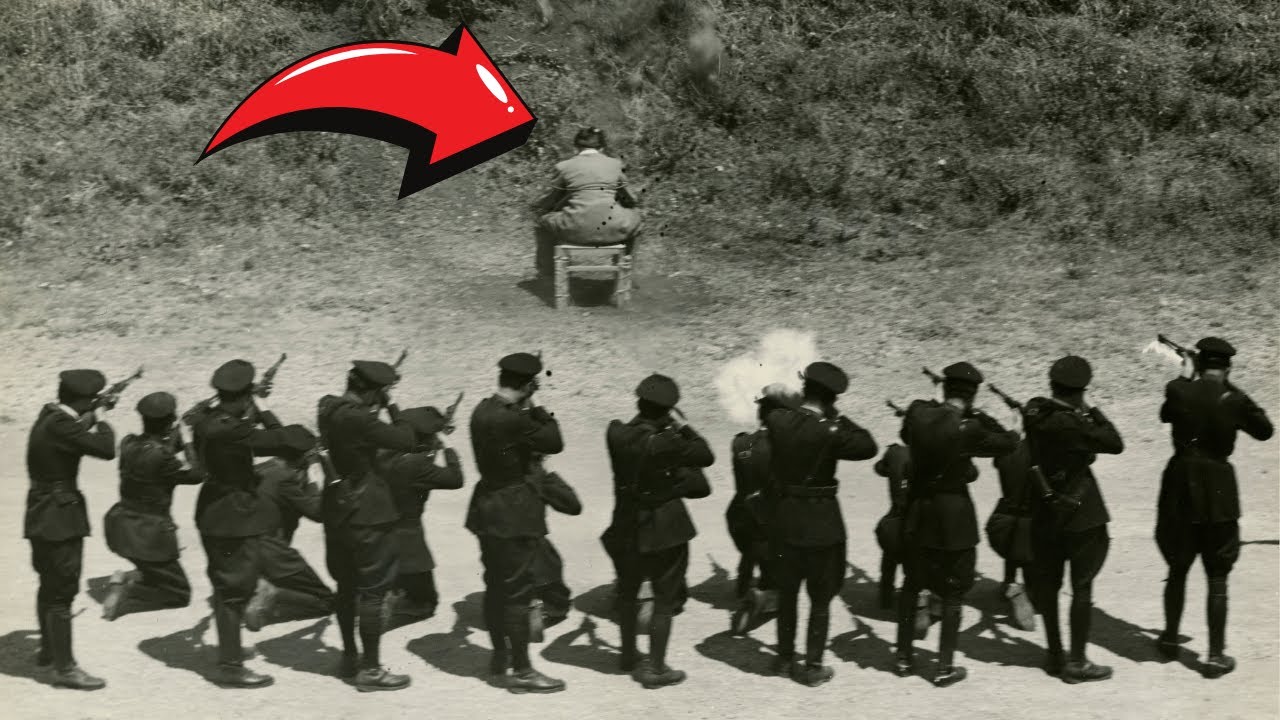
The former chief of police, who had once wielded brutal authority over the heart of occupied Italy, stood bound and silent as soldiers of the Italian liberation forces raised their rifles. There were no speeches, no crowds, no cheers — only the heavy stillness of a prison courtyard and the sharp crack of gunfire that ended the life of a man convicted of orchestrating mass murder.
Caruso’s fall from power to the execution wall marked the final chapter in a career that had transformed the Rome police force into an instrument of terror. A loyal supporter of Mussolini who had climbed through the ranks of the police and security services, Caruso became chief of police of Rome at the moment Nazi Germany occupied Italy in 1943, and he quickly established himself as a willing collaborator with the Gestapo.
His name became infamous following the Ardeatine Caves massacre in March 1944, one of the darkest episodes in Italy’s wartime history. The slaughter was carried out in retaliation for a partisan bombing attack that killed 33 Nazi officials in Rome. In response, Nazi-German authorities, with Caruso’s active cooperation, compiled a list of 335 Italian civilians and political prisoners who were randomly selected and secretly executed.
The victims were taken to the Ardeatine Caves outside Rome, where they were shot in groups and their bodies buried beneath the earth in an effort to conceal the crime. Caruso worked hand in hand with SS officer Herbert Kappler to ensure that the killings were carried out quickly, silently, and completely. The massacre shocked even those who had remained loyal to the regime, and it left an indelible stain on Italy’s wartime history.
Caruso’s signature was everywhere. His complicity in the atrocity was not merely administrative — he helped organize the machinery of death that delivered hundreds of innocent Italians to their graves. The victims included political prisoners, civilians, and Jews who had been swept up in the Nazi dragnet, none of whom had any connection to the partisan attack that triggered the reprisal.
After the fall of Rome and the Allied liberation of the city in June 1944, Caruso attempted to disappear. He understood that his role in the massacre was too visible, too damning to escape scrutiny. But his efforts to evade justice failed.
He was arrested by Italian partisans and handed over to the authorities to face the consequences of his actions.
During his interrogation, Caruso was questioned extensively about the Ardeatine massacre. He claimed that the killings had been a necessary measure — a reprisal demanded by the occupying German forces that he had no power to prevent. But the court rejected his defense.
 The judges saw the slaughter for what it was: cold-blooded murder, organized and facilitated by a man who had sworn to protect the people of Rome.
The verdict was death. The sentence was carried out with quiet efficiency on the morning of 22 September 1944, less than six months after the massacre he had helped orchestrate. Caruso was led into the prison courtyard at Forte Bravetta, where he had once been part of the system that condemned others.
This time, he was the condemned man.
There was no crowd to witness his final moments, no public spectacle. The execution was conducted in silence, with only a line of soldiers standing in position. When the rifles fired, justice was served for a man who had helped orchestrate mass murder.
The silence that followed was as heavy as the crimes that had brought him there.
Caruso’s execution was one of the first major war crimes trials to conclude in liberated Italy, and it sent a powerful message that those who had collaborated with the Nazi occupiers and participated in atrocities against Italian civilians would be held accountable. It was a moment of reckoning for a nation that had been torn apart by fascism, occupation, and civil conflict.
The former police chief is not remembered as a military man or a patriot. He is remembered as a symbol of fascist brutality — a man who turned the police force into an instrument of terror and who paid the ultimate price for his crimes. His name is associated not with honor or service, but with the betrayal of the very citizens he had been entrusted to protect.
The Ardeatine Caves massacre remains one of the most painful chapters in Italy’s wartime history. The 335 victims, whose ages ranged from teenagers to elderly men, were killed in a single day in a calculated act of vengeance that shocked the conscience of the nation. The caves where they died have since become a memorial, a place of remembrance for those who lost their lives at the hands of Nazi occupiers and their Italian collaborators.
Caruso’s role in the massacre was central. As police chief, he controlled the apparatus of detention and interrogation in Rome. He knew who was being held in the city’s prisons, and he provided the names and the access that allowed the Nazis to select their victims.
Without his cooperation, the massacre could not have been carried out with such speed and secrecy.

His trial and execution were watched closely by a nation still reeling from the trauma of war and occupation. Many Italians saw the proceedings as a necessary step toward justice and national healing. Others questioned whether the execution of one man could ever atone for the suffering of so many.
But for the families of the victims, the verdict brought a measure of closure.
The execution of Pietro Caruso also highlighted the broader question of accountability for the crimes committed during the Nazi occupation of Italy. While Caruso faced justice, many others who had collaborated with the occupiers escaped punishment or were never brought to trial. The pursuit of justice in post-war Italy was uneven and often incomplete, leaving deep wounds that would take decades to heal.
Herbert Kappler, the SS officer who had worked alongside Caruso in organizing the massacre, was also captured and tried. He was sentenced to life imprisonment in Italy, though he would later escape from prison in a dramatic episode that caused a diplomatic crisis between Italy and West Germany. His escape in 1977 remains a controversial chapter in the history of post-war justice.
Caruso’s execution, by contrast, was swift and final. There was no escape, no reprieve, no last-minute intervention. He faced his fate with the same cold silence that had characterized his cooperation with the Nazi occupiers.
The man who had once ordered the arrest and detention of countless innocent Italians now stood alone, bound and helpless, before the rifles of those who had liberated his country.
The Forte Bravetta prison, where Caruso met his end, had itself been a site of suffering during the occupation. Political prisoners had been held and executed there, and the walls of the prison bore witness to the brutality of the regime that Caruso had served. On the morning of his execution, those walls witnessed the final act of justice for one of the regime’s most notorious enforcers.
Historians have noted that Caruso’s execution was part of a broader effort by the Italian authorities to demonstrate that the crimes of the fascist regime and its Nazi allies would not go unpunished. The trials and executions that followed the liberation were intended to establish a new moral order in Italy, one in which the rule of law would replace the arbitrary violence of the fascist state.

But the legacy of Pietro Caruso is not only one of justice served. It is also a reminder of how ordinary institutions — police forces, security services, government bureaucracies — can be corrupted and turned against the people they are meant to serve. Caruso was not a soldier on a battlefield.
He was a police chief who used his authority to facilitate mass murder, and his story serves as a warning about the dangers of unchecked power and moral compromise.
The memory of the Ardeatine Caves massacre continues to be honored in Italy each year, with ceremonies and memorials that bring together survivors, families of the victims, and representatives of the Italian state. The names of the 335 victims are read aloud, ensuring that they are not forgotten and that the crimes committed against them are never erased from the national consciousness.
Caruso’s name, by contrast, is remembered with contempt and condemnation. He is a symbol of the collaboration and complicity that allowed the Nazi occupation to inflict such terrible suffering on the Italian people. His execution, while just, cannot undo the harm he caused or bring back the lives he helped to destroy.
The events of 22 September 1944 were not a moment of triumph or celebration. They were a moment of somber reckoning, a necessary act of justice in the aftermath of unspeakable crimes. The silence that filled the prison courtyard as the shots rang out was a silence that spoke of the gravity of what had been done and what was being done in response.
As Italy continues to grapple with its wartime past and the legacy of fascism, the story of Pietro Caruso serves as a stark reminder of the consequences of collaboration and the importance of accountability. The execution of the former police chief was not the end of Italy’s reckoning with its past, but it was a crucial step in the long and difficult process of justice and national healing.
The man who had once been the most powerful police official in Rome, who had worked hand in hand with the Gestapo and helped to orchestrate the murder of 335 innocent people, was reduced in his final moments to a solitary figure standing before a firing squad. There were no grand speeches, no final declarations of remorse or defiance. There was only the silence, the rifles, and the finality of death.
For the families of the victims of the Ardeatine Caves massacre, the execution of Pietro Caruso was a moment of justice long awaited. For the nation of Italy, it was a reminder that the crimes of the past must be confronted and that those who commit atrocities in the name of power or ideology will ultimately be held to account. The memory of the victims lives on, and the name of Pietro Caruso is forever associated with the darkness of a period that Italy has vowed never to forget.