A British surveyor who prided himself on empirical thinking recorded a decades-long account from a Himalayan monk about unexplained presences in a remote mountain range—testimony that remained unpublished for years and was eventually filed under a note reading “no suitable category. ”
The surveyor was Aldis Peton, who in the autumn of 1947 spoke with a 64-year-old monk named Dorje Wangchuk at a monastery east of the Khumbu Glacier. Peton had spent 11 years doing survey work across British India and Nepal and kept a separate journal for local stories, labeling entries “local accounts” while maintaining professional skepticism. Peton was directed to the monk by a guide named Pasang, who described Wangchuk as the most reliable person he had ever met.
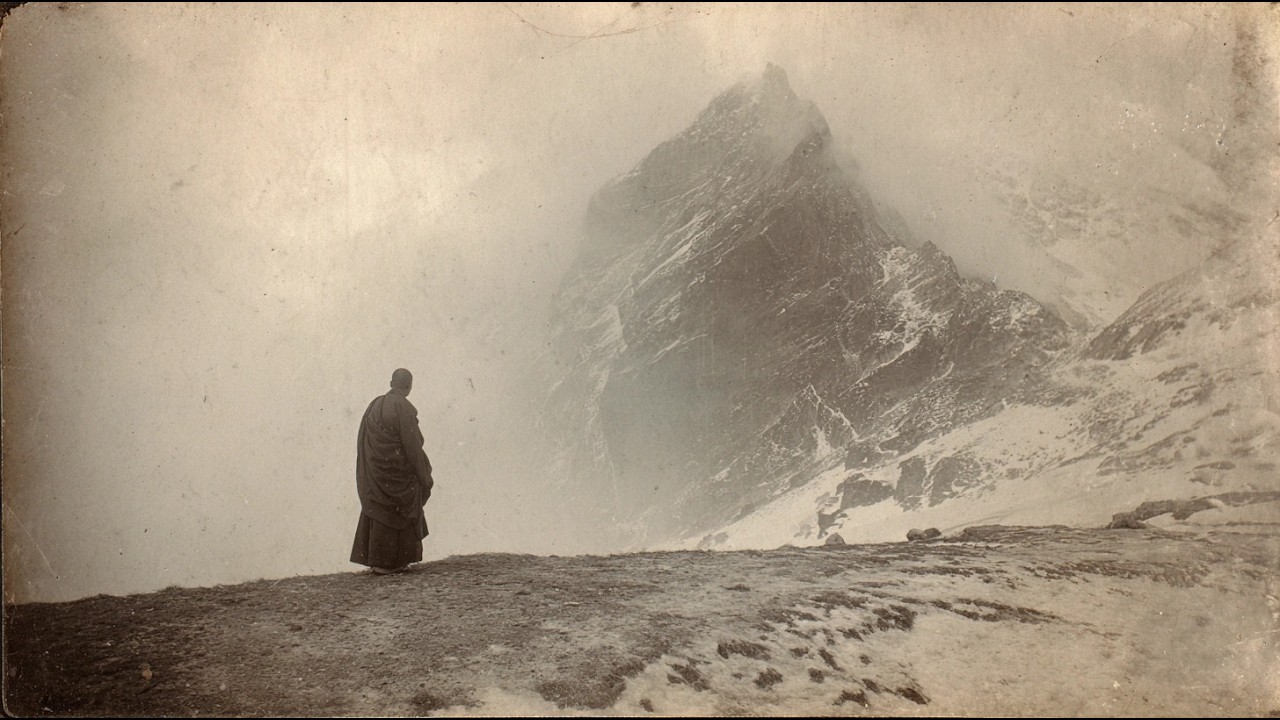
Wangchuk initially asked whether Peton wanted to go into the high ranges. When Peton said he wanted to understand what had happened to people there, the monk sat down and began to speak. According to Wangchuk’s account, the ranges in question were not the highest peaks that attracted expeditions, but lower mountains that had become a concern for the monastery sometime in the previous century. Herders reported animals refusing to cross certain passes.
A merchant described a feeling of something standing behind him, accompanied by a sudden stop in the wind and silence he called “the wrong kind. ”
Wangchuk said he first saw something in the ranges at age 26, while accompanying his teacher Gyalwa Renin and two other monks to a plateau. From about 300 meters away, he observed a large form moving laterally along an upper slope. He described its movement as operating under a different relationship to gravity than anything else on the mountain.
The upper portion of the figure, he said, did not resolve into anything recognizable, and the harder he focused, the less clearly it appeared. Gyalwa Renin told him that the things in those ranges were not new and had been observed for centuries. The old monk’s most important instruction, Wangchuk said, was that the dangers did not come from the figures noticing observers. The problem, as he translated it, was observers deciding they understood what they were watching.
Wangchuk described a German expedition in 1931 that entered the ranges after being warned the terrain was unpredictable in ways that did not appear on surveys. Three of four men returned. The fourth, a man named Heinrich, had seen something more directly than the others and afterward appeared outwardly normal but had, in the words of the expedition interpreter, stopped being surprised by anything. He reportedly lived to old age without ever discussing what he had seen.
According to Wangchuk, the monastery’s records contained accounts of people who had encountered the figures at close range. The descriptions were radically different in every case—one featured “all the wrong angles,” another a surface like water under cloud cover, another a figure casting shadows in every direction but the one the light came from. The only consistent detail was the effect on observers: a quality of receiving information without the normal mechanism for reacting to it. Wangchuk said he had spent 20 years tracking sightings and noticed a correlation between how often the monks visited the plateau and how often the figures appeared.
He initially suspected the figures were responding to being watched. In 1939, he went to the plateau alone to test this. Nothing appeared for four hours. As he began to leave, he heard the wind stop.
Standing with his back to the upper slope, Wangchuk said he felt three distinct impulses to turn around, each arriving with a quality he compared not to curiosity but to an instruction. He did not turn. He walked downslope slowly, and after about 50 meters the wind returned. He concluded that the correlation he had found was real, but that he had the causation reversed.
The monks were not drawing the figures out by observing them. Both the monks’ increased attention and the increased presence of the figures were effects of a third factor neither group controlled. Peton recorded Wangchuk’s testimony and left the monastery with a warning: look beside the upper slopes, not directly at them. “If you look directly and you see nothing, you will assume there is nothing,” the monk said.
“That assumption is the one that causes the most difficulty. ”
Peton’s survey logs from the northern ranges contain a single annotation for the morning of the third day: “Anomalous large form, upper slope, east, west, traverse, light poor, shape unresolved. ” In a letter to his sister, he wrote that he did what the monk told him and looked beside it, not at it. He said the thing was large in a way that was not about physical dimension and moved as if movement itself was a regional convention rather than a universal law.
Peton died in 1961. His sister donated his papers to a private archive, where the account of Wangchuk’s testimony was cataloged. The archivist added a note to the acquisition record: “Veracity unclear, significance unclear, no suitable category. ”
Wangchuk told Peton of one attempt, about 140 years earlier, by a monk who went to the plateau alone at noon and made himself as visible as possible.
The monk lived normally for many years afterward, but was never again able to sit in silence. When he did, he would describe what he was hearing in precise detail that was recorded by his students and kept in the monastery’s archive, never translated into any other language. The monk had declined to reveal the name of the monk in the records, for reasons his translator said he preferred not to articulate. Wangchuk said only that the descriptions were “very precise and entirely without reference.
”
Peton’s final journal entry from the monastery read: “I came here to be thorough. I leave less certain of what thoroughness means. ”
In his last journal before his death, Peton wrote a single sentence: “The monk was right about looking beside it. I wish I had learned that method earlier.
It applies to more things than mountains. ”
The account ends with an unresolved question Wangchuk posed to Peton as he was packing his notes: “In all the centuries we have been watching them, have they been watching back? ” Wangchuk said the question was not what the figures were, which he called a question with no useful answer, but what they might have been patient enough to wait to see.