Every vanilla pod on every shelf in every grocery store on Earth was pollinated by a human hand. No machine, no bee. A person uses their fingertip and a small wooden stick, pressing two microscopic parts of a flower together in a motion that takes about three seconds. That gesture, repeated billions of times on farms in Madagascar, Indonesia, and Tahiti, traces back to a single moment in 1841, when a 12-year-old boy on a small volcanic island in the Indian Ocean solved what the greatest botanists in Europe could not.
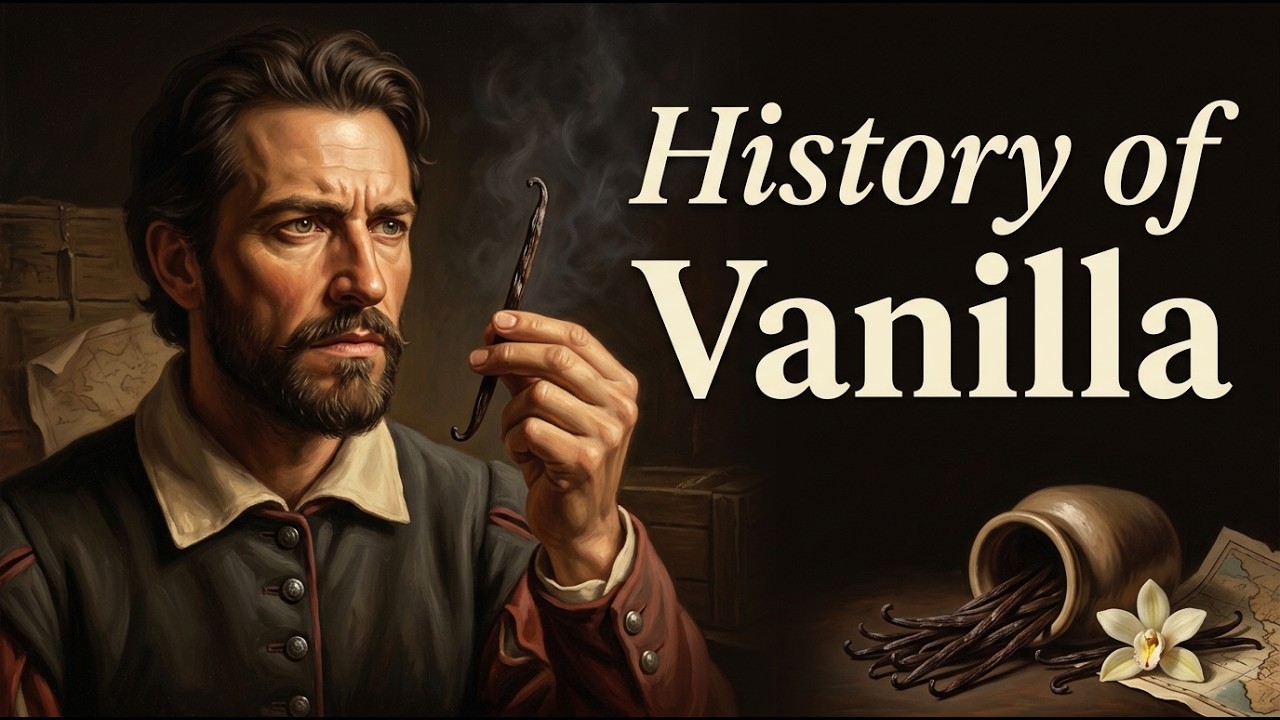
What no one knew at the time was that this boy, born into slavery and orphaned at birth, would crack a puzzle that had stumped scientists for 300 years, and would never live to see the credit he was due. But this story does not begin with that boy. It begins with an orchid flower in a forest, and a love story told by the people who first introduced vanilla to the world. Deep in the tropical lowlands along the Gulf of Mexico coast, in the region known today as Veracruz, a unique climbing plant grows, native only to the Americas.
It climbs the trunks of tropical trees, sometimes reaching 30 meters into the canopy, with thick waxy leaves and pale green flowers that last only a few hours before wilting and dying. This vine is vanilla planifolia. It belongs to the orchid family and holds a distinction no other orchid on Earth can claim: it is the only orchid that produces an edible fruit. Those long, dark, slender pods you see in the spice aisle, which smell of birthday cake and warmth and childhood memories, are the fruit of this singular species.
For thousands of years, only one group of people knew how to cultivate it. The Totonac people, inhabitants of the Veracruz coast, were the first to farm vanilla, carefully tending these vines in their shaded tropical forests as early as the 13th century. For the Totonac, vanilla was not just a crop; it was sacred. They used it in temple rituals, as perfume, in medicine, and as a charm for good luck.
They believed the plant was a gift from the gods and had a story to explain its origins. According to Totonac legend, a goddess princess named Zanet fell in love with a mortal man. Because the gods forbade their union, and because a goddess cannot live among humans, Zanet transformed herself into a vanilla vine to remain on Earth. Each year, the vine flowered and produced fragrant fruit, a reminder of her love and sacrifice.
The Totonac treated the vanilla flower with the reverence this story demands. For centuries, their relationship with vanilla remained secret, local, and unknown to the outside world. Then the story took an unexpected turn. In 1427, the Aztec Empire, expanding from its capital Tenochtitlan in the central highlands, conquered the Totonac people.
The Aztecs quickly took to what they found growing on the Totonac plains. They called vanilla tlilxochitl, meaning black flower, a reference to how cured vanilla pods turn dark and shrivel. And they soon found a use for it that would change its fate forever. The Aztecs began mixing vanilla with cacao beans, ground maize, chili peppers, and honey to make a drink called chocolatl.
If that word sounds familiar, it should. This drink was the ancestor of hot chocolate. But chocolatl bore little resemblance to the sweet milky drink we know today. It was bitter, spicy, frothy, and potent.
The Aztecs believed it gave strength, cured fatigue, and contained divine nectar, and it was not for everyone. Chocolatl was reserved for kings, priests, and elite warriors. Common people never tasted it. Vanilla, in its early days outside its Totonac homeland, was a luxury good.
The Aztecs forced the Totonac to cultivate vanilla as tribute, essentially a tax paid in the form of spice to the Aztec king. Year after year, the Totonac harvested their sacred vine and sent its dried pods to the highland capital. Vanilla was not just valuable; it was a currency. And the Aztec emperor Moctezuma, by all accounts, was obsessed with it.
Historical records suggest he drank dozens of cups of chocolatl a day, flavored with vanilla, from golden goblets. Pay attention to the next detail because it explains everything that followed. In 1519, a Spanish navigator named Hernán Cortés sailed from Spain to the coast of Mexico. His ship landed near what is now Veracruz, the heart of vanilla cultivation, and he marched toward the Aztec capital.
When Cortés reached Tenochtitlan, Moctezuma received him with hospitality and generosity, likely because he believed Cortés was the returning god Quetzalcoatl. Among the gifts Moctezuma offered was a golden cup of chocolatl, the chocolate and vanilla drink that had nourished the Aztec elite for generations. Cortés reportedly was fascinated by its flavor, having never tasted anything like it. The Spanish took detailed notes on both ingredients, the cacao and this mysterious dark pod that gave the drink its fragrant aroma.
They called the spice vainilla, a Spanish word meaning little sheath, a reference to the shape of the pod. When Cortés returned to Spain, he brought vanilla with him. Within decades, vanilla reached the royal courts of Europe. At first, the Spanish tried to keep vanilla a secret, hoarding it and blending it exclusively with chocolate for the royal family.
But secrets like that do not last. By the late 16th century, vanilla had spread across the continent. Queen Elizabeth I of England reportedly became so fond of vanilla that she requested it in her desserts without chocolate, making her one of the first Europeans to appreciate vanilla as an independent flavor rather than just an addition to chocolate. In France, the aristocracy regarded vanilla as a precious ingredient for perfumes, pastries, and luxury desserts.
Pharmacists in Paris described vanilla as a remedy for everything from headaches to impotence, which no doubt increased demand, effective or not. Vanilla quickly became a symbol of wealth and sophistication throughout Europe. Vanilla pods were so expensive that only the affluent could afford them. In the 17th century, a single vanilla pod in Europe cost the equivalent of a week’s wages for a laborer, and that exclusivity only increased its appeal.
The French court under Louis XIV consumed vanilla in enormous quantities, using it to flavor the ices, custards, and lavish multi-course desserts that defined aristocratic dining. Centuries later, after Thomas Jefferson had spent five years in Paris as America’s minister to France, he became so taken with vanilla that he wrote down one of the earliest known American recipes for ice cream that included a vanilla pod. In 1791, after returning to the United States and serving as Secretary of State, he requested a shipment of 50 vanilla pods from France, noting they were used to flavor ice cream. He later served vanilla ice cream at the White House during his presidency, and guests expressed amazement at this frozen dessert.
Jefferson did not invent vanilla ice cream, but he may have done more than anyone else to popularize it in America. Vanilla had conquered the tastes of the Western world, and demand was growing enormously, which created a problem. A big, strange, and stubbornly persistent problem. The vanilla flower refused to grow outside Mexico.
For 300 years, from the 16th to the 19th century, European colonial powers tried to grow vanilla in their tropical territories. They sent cuttings to the botanical gardens of Paris and London, and planted vines across the Indian Ocean islands, the Caribbean, and Southeast Asia. The vines grew beautifully, with green and thick leaves. The flowers bloomed right on schedule.
Then, suddenly, everything stopped. The orchid flower would bloom, its petals would fall, and no vanilla fruit would form. Imagine the frustration. Hundreds of botanists, decades of effort, entire colonial agricultural programs devoted to solving this puzzle, and every attempt failed.
The vines produced beautiful flowers, but not a single vanilla pod was produced outside Mexican territory. For a time, things looked manageable for Europeans. They could import vanilla from Mexico at great cost and sell it to the wealthy. That arrangement continued, but the price was staggering.
Vanilla was one of the most expensive spices in the world, and supply was limited to what Mexican farmers could produce. The colonial powers wanted their own supply. They needed to grow vanilla themselves, but the plant was not cooperating. Here is the detail that everyone missed at the time: the problem was not the soil, the climate, the water, the sunlight, or the altitude.
It was the bee. One bee in particular, the Melipona bee, a small species of stingless bee native to Central America and Mexico, was the only insect capable of pollinating the vanilla flower. The vanilla flower has a unique structure, with male and female parts, but a thin membrane called the rostellum separates them, preventing the flower from self-pollinating. The Melipona bee, small enough and persistent enough to breach this barrier, was the only creature that could push past the rostellum and deliver pollen to the stigma.
That was only part of the challenge. Each vanilla flower blooms for just one day, and in some accounts, the window is even shorter, just a few hours in the morning before the flower wilts and closes for good. If a Melipona bee did not visit the flower within those few hours, the flower would never produce a pod. This is why vanilla existed only in Mexico, and Melipona bees lived nowhere else on Earth.
Think about that for a moment. The entire world’s supply of vanilla, from the 16th to the 19th century, depended on whether a tiny stingless bee in a Mexican forest visited the right flower on the right morning. In 1836, a Belgian botanist named Charles Morren published a paper describing a method of artificial pollination for vanilla. He had theoretically figured out how to mimic the bee, but his technique was complicated and slow, better suited to greenhouse experiments than farms.
It was not practical for any kind of large-scale agriculture. The puzzle remained effectively unsolved. All the conditions were in place for a scientific breakthrough, but the scientific establishment had no idea where that breakthrough would come from. Then we arrive at Réunion Island in 1841.
Réunion, then known as Île Bourbon, is a small volcanic island in the Indian Ocean, about 900 kilometers east of Madagascar. French colonists had brought vanilla cuttings to the island in the 1820s, hoping to start commercial production. The vines grew, the flowers bloomed, but as everywhere outside Mexico, no fruit appeared. The vines remained barren for twenty years.
On a plantation in the town of Saint-Suzanne, a man named Ferréol Bellier-Beaumont tended his gardens. Bellier-Beaumont was a settler and an enslaver, and among the people he enslaved was a boy named Edmond. Edmond was born on the island around 1829. His mother, an enslaved woman, died during his birth.
He never knew his father. Bellier-Beaumont took a particular interest in the boy and taught him about plants and how flowers reproduce. He showed him how to hand-pollinate other crops like melons and squash. One day in 1841, Bellier-Beaumont was walking through his gardens with Edmond, then aged 12, when he noticed something that made him stop abruptly.
There were two green vanilla pods hanging on a vine. A vine that had been barren for twenty years. A vine that had never produced a single pod. Bellier-Beaumont could not believe it.
He asked Edmond if he knew anything about it. Edmond told him he had done it himself. At first, Bellier-Beaumont did not believe that a 12-year-old boy had accomplished what the greatest botanists of Europe could not for three centuries. A few days later, more pods appeared on the vine.
Bellier-Beaumont asked Edmond to show him his method. What Edmond showed him was astonishingly simple and incredibly clever at the same time. He took a thin piece of wood, a small stick no bigger than a toothpick, and approached a freshly opened vanilla flower. With one hand, he steadied the flower.
With the stick, he gently lifted the rostellum, that small membrane separating the male and female parts of the flower. Then, with his thumb, he pressed a mass of pollen firmly against the stigma, completing the pollination in a matter of seconds. The entire process took no more than two or three seconds per flower. It required no special tools, no equipment, no laboratory, just a steady hand, a thin stick, and precise knowledge of which part to lift.
The technique was likely inspired by what Bellier-Beaumont had taught him about cross-pollinating other plants like melons and squash. Edmond took that knowledge and applied it to the vanilla flower, something no one in the scientific world had thought to try. As one historian later put it, Edmond’s invention seems astonishingly simple, but only in hindsight. Before Edmond, the brightest minds in Europe had stared at the same flower and seen only failure.
This 12-year-old boy, born into slavery, orphaned from birth with no formal education, had solved the 300-year mystery of vanilla. Bellier-Beaumont spread the technique across Réunion Island immediately. Within months, vanilla production on the island flourished. Within a few years, the method was taught to farmers in Madagascar and the Comoros Islands, then spread to all the tropical regions where vanilla vines grow.
For the first time in history, it became possible to grow vanilla commercially outside Mexico. But here the story stopped being inspiring, which was perhaps inevitable given the circumstances. A French botanist named Jean Michel Claude Richard came forward, claiming he had actually developed the same method of manual pollination years earlier, and that Edmond must have seen his demonstration and simply copied it. Bellier-Beaumont defended Edmond vigorously, pointing out that the chronology made Richard’s claim impossible.
Modern historians have carefully examined the evidence and concluded there is no reason to doubt that Edmond made the discovery himself. He had been trained in cross-pollinating other plants and applied that knowledge to a flower no one had thought to try it on. It was his discovery. Slavery was abolished in Réunion in 1848.
Edmond gained his freedom and received the surname Albus, but freedom did not bring prosperity. Edmond Albus struggled throughout his life. He was once convicted of petty theft and sentenced to prison. Although Bellier-Beaumont successfully petitioned for his early release, Edmond received no compensation, no recognition, and no financial reward for a technique that opened up a global industry.
On August 9, 1880, Edmond Albus died in a public hospital in Saint-Suzanne at the age of 51. A local newspaper noted his death with one heartbreaking sentence: “The very man who, through his discovery of the method of fertilizing the vanilla flower, benefited this colony so greatly, died in the public hospital. ” It was a miserable and destitute end. The story gets even more striking when you look at what his technique set in motion beyond Edmond’s personal story.
The manual pollination method spread from Réunion to Madagascar in the 1850s and 1860s, and the northeastern coast of Madagascar quickly became a vanilla paradise. The Sava region, comprising the towns of Sambava, Antalaha, Vohémar, and Andapa, had an ideal combination of tropical heat, humidity, and rainfall. By the late 19th century, Madagascar had become the world’s leading producer of vanilla. Today, the island nation alone produces nearly 80% of the world’s supply of Bourbon vanilla.
About 70,000 smallholder farmers in the Sava region grow vanilla on plots smaller than one hectare, tending the vines by hand, just as the Totonac did centuries ago in Mexico. Here is the link that ties everything together. Every one of those farmers, every morning during pollination season, checks their vanilla vines at dawn, looking for freshly opened flowers, and applies the same technique Edmond Albus invented in 1841. The same gesture, the same thin stick, the same three-second motion, nearly two centuries later, on farms half a world away from where Edmond lived.
His discovery is applied millions of times every season. It has never been improved, never been mechanized, never been replaced. But the story of vanilla did not end with Edmond. While Madagascar’s farmers were perfecting hand pollination, chemists in Europe were working on something entirely different.
In 1874, two German scientists, Ferdinand Tiemann and Wilhelm Haarmann, discovered how to synthesize vanillin, the primary flavor compound in vanilla beans, from coniferin, a substance found in pine bark. They patented the process, established a factory in Holzminden, Germany, and began the first industrial production of a synthetic aromatic chemical in history. Two years later, another chemist named Karl Reimer synthesized vanillin from guaiacol. By the late 19th century, semi-synthetic vanillin extracted from clove oil was commercially available.
The importance of this cannot be overstated. Natural vanilla beans contain more than 250 individual compounds that together create the rich, complex taste of real vanilla. But vanillin is the dominant molecule, the one your brain recognizes as vanilla. Synthetic vanillin replicates that single molecule cheaply and at scale.
It does not capture the full complexity of the 250 compounds in a real vanilla bean, but it is close enough for most commercial applications, from ice cream to cookies to candles. By the 1930s, synthetic vanillin production had shifted to lignin, a byproduct of paper mills. Then in the 1970s, petrochemical production took over. Today, more than 85% of the vanilla flavor consumed globally is synthetic vanilla, mostly derived from petrochemicals.
The global synthetic vanilla market produces about 20,000 tons annually. In contrast, natural vanilla beans contribute only around 40,000 tons of natural vanilla to global supplies. If you have ever eaten anything flavored with vanilla that does not explicitly state it contains natural vanilla extract, you almost certainly consumed a chemical derivative. That is not necessarily a bad thing.
Blind taste tests have shown that most people cannot reliably distinguish between synthetic and natural vanilla in baked goods, where heat breaks down many of the delicate compounds. In cakes or cookies, the difference between a $5 bottle of synthetic vanilla and a $30 bottle of natural vanilla extract is minimal for most palates. Synthetic vanilla has made vanilla flavor accessible to billions of people who could never have afforded natural vanilla. It made available to everyone a taste that was once reserved for royalty.
A child eating vanilla pudding from a plastic cup in an Ohio school cafeteria enjoys a flavor that Aztec emperors once restricted to the elite. That is no small thing. But there is a vast difference in applications where vanilla is the star ingredient rather than a supporting note. In premium ice cream, crème brûlée, and perfume, the rich, complex flavor of natural vanilla beans, with its hints of caramel, smoke, dried fruit, and its faint warm, boozy undertone, remains unmatched.
That is why the market for real vanilla beans has never disappeared. With synthetic vanilla dominating the industry, some flavors can be mimicked, others only approximated. Real vanilla has endured, and the economics of its survival are among the most volatile of any agricultural commodity on Earth. Vanilla is the second most expensive spice in the world, after saffron, and its price is wildly erratic.
In the early 2000s, Madagascan vanilla beans sold for about $20 to $30 per kilogram. Then, in 2000, Cyclone Hudah devastated the vanilla-growing region in the northeast of the country. Because a newly planted vanilla vine takes a full three years to flower for the first time, crops fell sharply and prices soared to over $400 per kilogram. By 2003, nearly 30% of vanilla buyers had switched to synthetic alternatives.
Prices eventually collapsed, then rose again. By 2018, vanilla bean prices reached over $500 per kilogram. At that price, vanilla was almost worth its weight in silver. If you are wondering how a plant can cost that much, you are not alone.
That volatility has severe human consequences. When prices rise, vanilla becomes a target for theft. Farmers in Madagascar have been attacked and killed for their vanilla crops. Some farmers began sleeping in their fields to guard the vines, while others started harvesting their pods early, before they were fully ripe, to prevent theft.
Early harvesting produces poor flavor, which means the market gets flooded with low-quality vanilla beans, damaging Madagascar’s reputation, pushing some buyers toward synthetic alternatives, and eventually causing the price to crash again. It is a vicious cycle, and farmers at the bottom of the supply chain bear the brunt. Despite all of this, the basic process has not changed. A vanilla vine still takes three to four years to mature before it flowers for the first time.
Each flower still opens for just one day. Every flower still must be pollinated by hand using a thin stick and a thumb. After pollination, the green pods take 7 to 9 months to mature on the vine, and then the curing process begins. Curing vanilla is an art in itself, closer to winemaking or brewing than anything you might associate with growing spices.
The green pods are first killed, which is literally the term used, by briefly blanching them in hot water at around 65 degrees Celsius. They are then wrapped in dark cloth and placed in wooden boxes to sweat. Over the following weeks, the vanilla pods are laid out in the tropical sun during the day and carefully wrapped up every night. This daily routine gradually removes moisture, turns the pods from green to dark brown, and triggers the enzymatic reactions that break down flavorless precursor compounds into vanillin and more than 200 other molecules that give real vanilla its distinctive taste.
The full curing process takes 6 to 9 months. It takes roughly 6 to 8 kilograms of green vanilla pods to produce one kilogram of finished product ready for export. From the moment a farmer pollinates a flower to the moment a vanilla pod reaches store shelves, more than a year passes. Every step is done by hand.
So when people use the word “vanilla” to mean ordinary or boring, they are unknowingly using one of the most ironic expressions in the English language. Nothing about vanilla is ordinary. It comes from the only edible orchid fruit on Earth. It was sacred to an ancient civilization and stolen by an empire.
It baffled the brightest scientific minds in Europe for three centuries. Its commercial existence depends on a technique invented by an enslaved child who died in poverty. It is grown by tens of thousands of farmers using methods unchanged since the 19th century. It is pollinated by hand, flower by flower, within a window of just a few hours, once a year.
It is cured for months in a process closer to winemaking than farming. And it remains one of the most volatile, contested, and labor-intensive crops on the planet. Vanilla is not boring. It is one of the most remarkable flavors ever known.
And the fact of its existence, and its survival through the fall of the Totonac civilization, the greed of empires, the cruelty of slavery, the rise of synthetic chemistry, and the chaos of global commodity markets, is not something to take for granted. The next time you taste vanilla in ice cream, coffee, or even in a candle burning on your kitchen table, remember that what you are experiencing is the product of a thousand-year chain of events, through forests, laboratories, slave plantations, and volcanic islands. And at the center of that chain stands a 12-year-old boy, holding a thin wooden stick, pressing two tiny parts of a flower together, changing the world in just three seconds. What remains of the story of vanilla is not merely a flavor; it is Edmond Albus, whose name should have been famous but was not.
It is the 70,000 farmers in Madagascar who still wake before dawn to pollinate flowers by hand. It is the orchid itself, fragile and stubborn, still blooming one day a year, still waiting for someone to come at the right time.