In September 1944, in a village in Lorraine in eastern France, the Germans had been gone for three days. They had pulled back quickly, the way they were pulling back everywhere that autumn. Trucks, columns, dust on the road to the east, and then silence.
The village of Vieilleville-sur-Flenne had been occupied since 1940. For four years there had been German soldiers in the square, German orders on the walls, German requisitions that stripped the cellars after every harvest. For four years the people had swallowed it.
When Patton's Third Army broke through, the people had gone into the streets and wept. Now the celebration was over, and something new had begun.
Sergeant Dale Purcell, 26 years old, from Harrisburg, Pennsylvania, was driving a supply route through the village when he heard shouting. It came from behind the church. He pulled the jeep over. His passenger, a corporal named Watts, looked at him.
"Stay here," Purcell said. He did not stay.
Behind the church was a stone wall, perhaps twelve meters wide. Inside were seven German soldiers, most of them boys. The oldest was maybe seventeen. They were kneeling in a row, their hands bound behind their backs with iron wire. Their weapons were gone, their helmets were gone. One of them was bleeding from a cut above his ear.
Above them stood eight maquis fighters, French partisans, men who had spent years in the woods and hills, hiding, fighting, and watching their countrymen taken away to labor camps and their villages stripped bare. One of them held a pistol. He spoke in French to the prisoners, a language the boys clearly did not understand, and gestured at each of them.
Purcell understood the situation in two seconds. He stepped into the courtyard.
"Hey," he said, not shouting, but loud enough.
The maquis commander turned around. He was perhaps forty, a thin man with a thick beard, dressed in a mix of civilian clothes and pieces of French uniform. He looked like a man who had slept in the woods for two years and no longer cared what anyone thought of him.
In broken English he said, "Go away, American. This is a French affair."
Purcell looked at the boys on the ground. He counted seven faces. One was crying without making a sound, the way people cry when they have decided that sound is useless. The youngest, maybe fifteen, stared straight ahead at a fixed point on the wall, the way soldiers learn to do when they expect something terrible.
"These men are prisoners of war," Purcell said. "They surrendered. You can't execute them."
The expression on the maquis commander's face did not change. He said something in French to his men. Three of them moved to block the entrance to the courtyard. Two others raised their rifles, not at the prisoners, but at Purcell.
Watts, who had disobeyed orders and climbed out of the jeep to follow, appeared in the courtyard entrance and stopped when he saw the rifles. He looked Purcell straight in the eyes.
Purcell made a decision. He turned and walked back to the jeep, not because he was abandoning them, but because the radio was there. He picked up the telegraph and reported the information up to the company commander, then the battalion, and then, because of what the battalion commander said when he heard the word "maquis," it went further.
Within 40 minutes a jeep arrived from the other direction, carrying two military policemen, a lieutenant, and a general who stepped out without his aide and walked straight into the courtyard as if he had all the time in the world.
General George S. Patton looked at the boys on the ground, then at the maquis fighters. He looked at the pistol still in the commander's hand. He had seen a hundred courtyards that autumn. He understood exactly what this was.
This story did not make the newspapers in 1944. It happened in the chaos between liberation and the enforcement of law, when the guns had just fallen silent and no one knew exactly what would follow.
Patton was en route between Metz and Nancy when the message reached him. He was already frustrated. The advance had stalled, not because of the Germans, but because of a fuel shortage. The supply lines could not keep up with the pace he demanded. His tanks sat with empty fuel tanks at the German border while the Wehrmacht used the delay to dig in. He was fighting his own headquarters as hard as he was fighting the enemy.
And now this, his intelligence officer, Major Clarence Horton, 31, of Memphis, Tennessee, had told him in the jeep on the way.
The situation in liberated Lorraine was complicated. The German occupation had forced thousands of young men from the region, particularly from Alsace and Lorraine, which Germany had fully annexed in 1940, to join the Wehrmacht and the Waffen SS. These were the Malgré-nous, the "against our will." Young men who had grown up in France, who spoke French at home, were forced into German uniforms and sent to the front to fight for a country they did not consider their own.
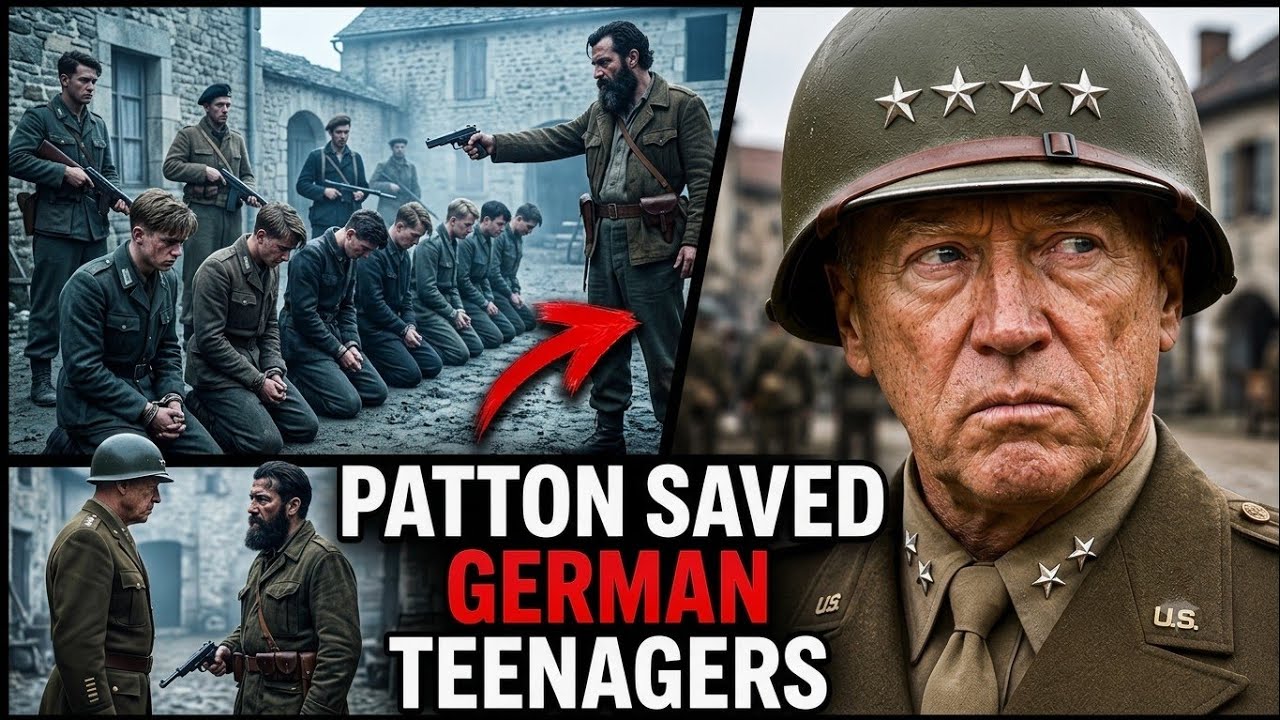
Some of them had fought in Russia, others in Normandy. Some were now surrendering during the retreat through eastern France, dazed and exhausted. A German uniform on a French body, falling into the hands of resistance fighters who had lost relatives to men wearing exactly that uniform.
The resistance did not always ask questions. Between August and October 1944, summary executions took place across liberated France. Collaborators, both real and suspected. German soldiers who fell into the wrong hands before American or British troops could arrest them. The épuration sauvage, the wild purge. Thousands died outside any legal process, in courtyards, fields, and forest clearings. The reckoning for four years of occupation was paid in blood, with no judge in sight.
Patton understood all of this when he entered the courtyard at Vieilleville-sur-Flin. He had Horton with him as a translator. He stood in the middle of the courtyard and looked at the maquis commander for a long time without speaking. The commander looked back. He was not intimidated. For years he had not been intimidated by men with authority.
Patton spoke. Horton translated.
"What are these prisoners accused of?"
The commander answered. Horton translated. He says they are German soldiers.
"That is enough."
Patton's jaw tightened.
"That is not enough. Are they SS soldiers?"
The commander looked at the boys. He said something. He said he did not know. He said they wore German uniforms. He said the uniforms were enough.
Patton walked slowly along the row of kneeling boys and looked at each face. He stopped at the youngest. The boy was fifteen at most. He had the face of someone who had never had to shave regularly. His hands, bound behind his back, were trembling.
Patton turned back to the commander.
"Tell him I want to know where these soldiers were taken prisoner," Horton asked.
The commander answered: "On the road east of the village, sir."
"They surrendered and walked with their hands up."
"Yes, sir."
"To him or to American troops?" Horton asked.
"To him. His men intercepted them before they reached our checkpoint."
Patton was silent for a moment. He looked at the boys again. Then he said something that Horton later recorded in his own notes from that period. He said: "Ask him how old his youngest son is."
Horton was surprised, but translated it. The commander's face twisted. He answered: "He says his son is 16, sir."
Patton pointed to the youngest boy on the ground.
"Ask him if he thinks his son, dressed in a German uniform because the Germans told him he had no choice, deserves to be shot in the head in a churchyard."

Horton translated. The courtyard was completely silent. The commander said nothing for a long time. His grip on the pistol did not loosen, but he did not raise it either. He looked at the boy.
Finally he spoke. He says it is not the same, Horton translated. He says the Germans killed his brother in 1942. He says someone has to pay.
Patton nodded.
"Tell him I understand. Tell him his brother deserved justice."
He paused.
"Tell him this is not justice. Tell him this is murder."
The commander's eyes hardened again. He said something quickly and sharply.
"He says you are American. You have not lived under occupation. You do not understand what it means."
"He is right," Patton said. "I did not. But I understand what is on that ground in front of him."
He looked at the boys.
"Those are not the men who killed his brother. Those are children who were handed rifles and told to fight. Some of them are probably from Alsace. Some may have been conscripted, just as French boys were. He does not know. He has not asked."
Horton translated. The commander looked at the boys on the ground for a long time. Then he looked at Patton. He asked a question. Horton translated. He asked what would happen to them if he handed them over.
They would be treated as prisoners of war. They would be questioned. If any of them had committed crimes, that person would be identified and tried. If they were found guilty of war crimes, they would be punished. If they were conscripts who did what they were ordered to do, they would go to a camp, sit out the rest of the war, and go home.
He asked if you could guarantee that.
"I guarantee it personally."
The commander looked at him. He studied Patton the way men judge other men after years of having to decide very quickly who to trust. He lowered his pistol.
The seven boys were taken into American custody within an hour. Patton stood in the courtyard until the military police had loaded them and moved out. He kept an eye on the maquis commander the whole time, not with hostility, but with the careful attention of a man making sure the situation did not get out of hand.
When the last prisoner had left the courtyard, Patton turned to the commander. He spoke directly, without warmth, but also without contempt. Horton translated. He said he knew what this man had been through. He said he knew what France had been through. He said the men who had done this to France, the real perpetrators, the ones who had planned it, ordered it, built the camps and led the death squads, would be tried and held accountable.
But not in a churchyard, and not without a name being read and a charge being stated.
The commander listened. He said something quietly. Horton translated. He said he hoped Patton was right.
Patton said, "Tell him I hope so too."
He turned and walked back to his jeep.
What happened to the seven boys from that point went through the usual channels. They were processed into a detention center outside the city of Metz. A German-speaking officer from Horton's intelligence service interviewed each of them. The results were what Patton had suspected.
Five of the seven were from Alsace. Their home region had been formally annexed by Germany in 1940. They had been called up for military service in 1943 and 1944. Three of them did not speak German as their native language. Their native language was Alsatian French. They had been given Wehrmacht uniforms, placed in a retreating column, and told to march east. They had not fired a weapon in weeks. When the column fell apart, they walked toward the American lines with their hands up.
The sixth soldier was from Stuttgart, was 16 years old, and belonged to the Volkssturm, the desperate militia Hitler had begun recruiting in the final war years, pulling boys from school and old men out of retirement to fill the gaps the dead had left behind. He had worn a uniform for 11 weeks.
The seventh was the oldest, 18, an ordinary Wehrmacht soldier called up from Bavaria in early 1944. The file showed no SS affiliation and no service record indicating war crimes.
All seven were sent to a prisoner-of-war camp. All seven survived the war. The five Alsatians were repatriated to France in 1945 and 1946. The two from Germany were repatriated in 1947.
Patton never wrote about the incident in his diary. He did not include it in his correspondence either. For him it was just one afternoon in a period full of impossible decisions.
But Horton took notes. He was the type of officer who understood that small moments mattered, that the events around him would not always announce themselves as important. He wrote about the courtyard that evening in a notebook he kept throughout the European campaign. He described what Patton had said, the question about the son, the difference between justice and murder. The commander lowering his pistol.
Then he wrote his own reflection, one line at the bottom of the page: "What I saw today was a general who understood that the war did not end when the shooting stopped, but that it ended when you decided what kind of people you wanted to be when the guns fell silent."
Horton never knew the maquis commander's name, only that he came from a village near Epinal and had been in the resistance since 1941. He fought for another two months with local partisans in the Lorraine region, until the front shifted east and the war moved on with it. Whether he thought about that courtyard afterward, whether the question about his sixteen-year-old son stayed with him, no one recorded.
But Sergeant Purcell, who had set everything in motion by walking into that courtyard with nothing but his rank and his instinct, did leave a trace. He was interviewed decades later for a regimental history. The interviewer asked him about the most important thing he had seen during the war.
He did not talk about combat. He did not talk about the crossing of the Rhine or the advance through Germany. He talked about the courtyard in Vieilleville-sur-Flin. About a fifteen-year-old boy staring at a wall, waiting to die. About the moment the maquis commander's pistol came down.
"I think about what would have happened if I had just driven on," he said. "If I had heard the shouting and thought it was not my problem, it would have been over in five minutes and no one would have known except the people in that courtyard."
He paused.
"What has stayed with me most are the faces of those children when they realized they were not going to die. It was not really relief, more like they could not quite believe it. As if they had already accepted what was coming and did not understand why it had not happened."
He looked at the interviewer.
"Patton came there because I reported it, but I almost did not. I almost thought it was not my job."
He paused again.
"I am glad I made that decision."
The war in Europe ended eight months later. The seven boys from Vieilleville-sur-Flin went home. France was rebuilt, Germany was rebuilt. Alsace-Lorraine became French again, as it had been before 1871 and before 1940. The border that had changed so often that the people living there had learned to speak both languages and trusted neither government.
Patton died in December 1945 in a car accident in Germany. He never saw the Nuremberg trials. He never saw the postwar world take shape. He did not know whether the things he had fought for would hold.
But in a courtyard in Lorraine, on a September afternoon in 1944, he had stood between seven boys and a pistol and argued that justice and revenge are not the same thing. That justice requires a name, a charge, and a hearing. That you cannot look at a boy on his knees and see only his uniform.
Horton's notebook survived the war. His family donated it to the National Archives in 1978. The passage about the courtyard is short. Eleven lines. The last one reads: "He knew those boys might be guilty of something. He did not know it, and the Frenchman with the gun did not know it either. And that not knowing, Patton said, is precisely the point. That is why you need a trial. That is why you need a judge. Because if you shoot them without knowing, you might as well be one of them yourself."