In the autumn of 1936, fire consumed more than just a farmhouse in the Blue Ridge Mountains—it destroyed a family whose final moments remain unexplained nearly a century later. County records say the Caldwell homestead burned to the ground on October 17, 1936, and investigators found three bodies in the stone cellar, seated upright in wooden chairs arranged in a precise equilateral triangle. The blaze was seen from a neighboring ridge shortly after midnight by farmer Elias Whittaker, who reported an unusual blue-white glow from the house before flames took hold. By the time volunteers arrived, the structure was fully engulfed.
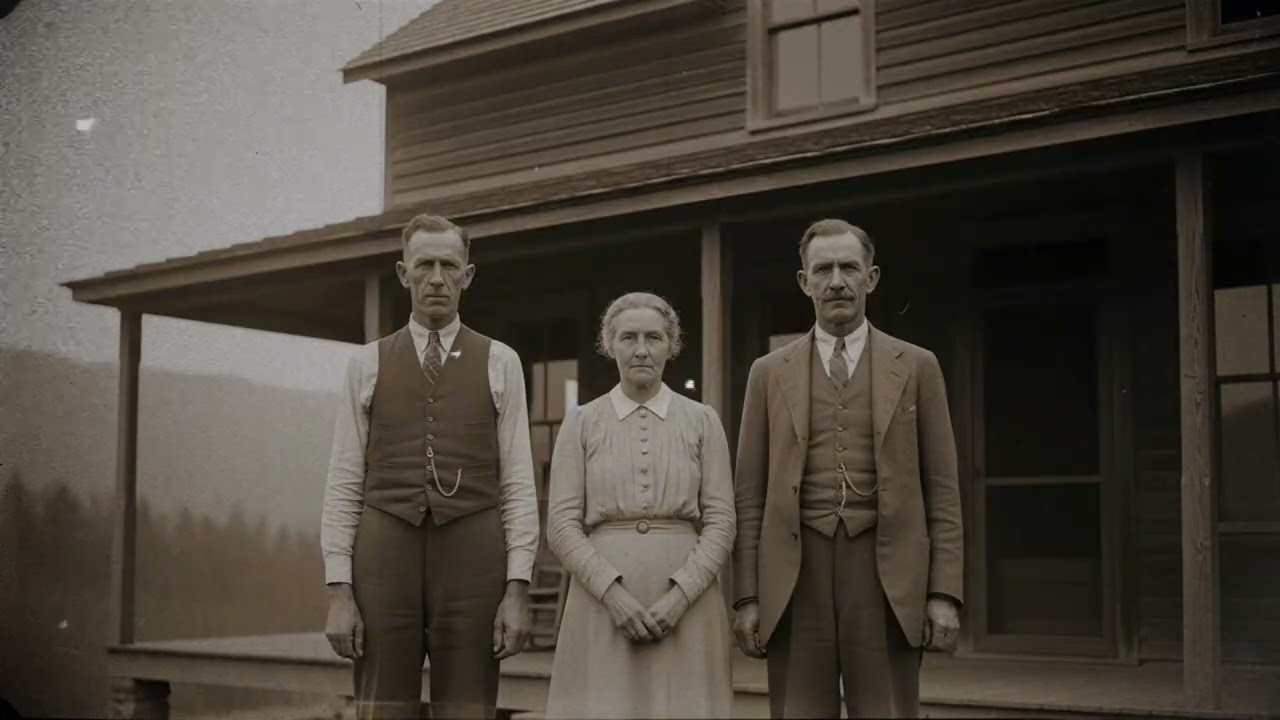
What they found in the cellar defied easy explanation. According to the coroner’s report filed by Dr. Joseph Meritt, the three Caldwells—Thomas, his wife Eleanor, and his brother James—had died before the fire began. There was no soot in their airways, no wounds, no signs of restraint or struggle.
Their chairs were bolted to the floor, positioned exactly seven feet apart, connected by carved symbols in a circle. Each victim clutched an identical stone disc etched with an unrecognized symbol. The discs later disappeared from the county evidence room under circumstances never explained. The property, located 12 miles northeast of Millbrook, Virginia, had a troubled history long before the fire.
Thomas Caldwell’s father, Richard, purchased the abandoned homestead in 1899 for nearly twice its value, a decision that baffled the county assessor at the time. Richard had been a merchant in Baltimore before relocating to the remote hillside following his wife’s death. He rarely came to town, and after his passing in 1921, his son Thomas gave up a banking job in Roanoke to move there with Eleanor. James, Thomas’s older brother, joined them in 1932 after losing his publishing business and going through a bitter divorce in Richmond.
The family kept to themselves, appearing in Millbrook about once a month for supplies. Harold Cooper, who worked at the Millbrook General Store, later described Thomas as courteous but forgettable, Eleanor as always positioned with her back to a wall, and James as unsettling in his gaze. Cooper noted that Eleanor always wore high-neck dresses and kept her left hand gloved, even indoors. On one occasion in the summer of 1934, he glimpsed a circular mark on her wrist, but she pulled her sleeve down and left immediately.
In the months before the fire, Thomas began buying unusual quantities of salt, candles, kerosene, and iron hardware—hinges, locks, and chains—prompting Cooper to joke about the end times. Thomas replied, “Something like that, Mr. Cooper. Something very much like that.
” He also told Cooper that some homes serve a purpose beyond sheltering their occupants, and that his family’s presence on that hillside was necessary. The family had also drawn attention from the local pastor, Reverend Isaiah Thornton, who noted in his diary that Thomas declined his request to pray with the family, saying they observed their own form of devotion. When pressed, Thomas looked toward the North Ridge and said, “Some battles, Reverend, are best fought alone. ” He added, “The older ones.
” The reverend left feeling deeply troubled. Sheriff’s records show that in April 1935, Deputy Samuel Harding investigated unusual sounds near the Caldwell property reported by a hunter named Jeremiah Wells. The official report closed the matter as nothing unusual. But Harding requested a transfer to a neighboring county shortly afterward, and his widow later said he suffered nightmares for weeks, repeatedly muttering “What’s under that house?
” in his sleep. The most significant evidence came from James Caldwell’s journals, 12 volumes spanning his time at the homestead. They were sealed by a county judge in 1937 and only partially reviewed decades later by historian Margaret Thorpe. According to her notes, the early entries were rational, describing James’s gratitude to his brother after his divorce.
But by 1933, his entries began focusing on Eleanor’s strange behavior—her habit of watching room corners, standing too long at north-facing windows, and claiming to hear voices in the walls. James eventually found Eleanor scratching at the cellar wall with a kitchen knife, creating a small opening and saying, “Making a window so they can see we’re still here. ” Thomas sealed the opening with fresh mortar and hung dried herbs over the cellar door. James also discovered references to an 1897 incident involving a neighboring family who left in the night, though he could never locate the newspaper clipping he believed existed.
By early 1936, James began hearing the sounds Eleanor had described—something dragging itself slowly across packed earth beneath the floor. A journal entry in April 1936 records that Thomas finally showed him what lay beyond a concealed door in the cellar: a passage extending some 40 feet into the hillside, ending in a circular chamber cut into the rock. At its center stood a stone pillar carved with symbols. Thomas had constructed three chairs bolted to the floor in a triangle around it.
When James asked their purpose, Thomas replied, “When the time comes, we must be ready. ” Asked what time he meant, Thomas answered, “When the door opens fully. ”
Later entries describe shared dreams among all three family members—dreams of the chairs, the circle, and something watching. James wrote that Eleanor claimed the ritual was the only way to contain something beneath the mountain.
She spoke of a 37-year cycle, referencing 1899, when Richard Caldwell purchased the property, and 1862, when the original family reported visitations. Thomas told James their father hadn’t bought the land by chance. “We are watchers,” he said, “guardians of a door we cannot afford to see opened. ”
The final entry, dated October 16, 1936, the day before the fire, reads in part: “We’ve agreed tomorrow night, the three points of the triangle, the only way to end it.
If anyone finds this, know that what follows is necessary. The thing under the mountain must not be allowed to enter our world. The fire will cleanse. The circle will hold.
” James’s earlier entry also mentioned “our oath upon joining their vigil. ”
Investigators never determined how the family died. The coroner suspected poison but no known toxins were detected in blood samples sent to a Richmond laboratory. The lab report noted unusual cellular degradation not consistent with standard postmortem changes, but no further testing was conducted.
The case was officially closed in 1937 with Sheriff Robert Danvers’s note: “Tragedy born of isolation and madness. No evidence of foul play from outside parties. Case closed by necessity, if not satisfaction. ”
The property sat vacant for years.
When workers cleared the overgrown site in 1952 for a tax auction, they discovered the cellar extended far deeper into the hillside than the house plans indicated. The passage James described was real, ending in a small chamber with a single wooden chair bolted to the floor, fitted with leather restraints on the arms and legs. The center of the floor contained a circular depression sealed with a cap stone. A geologist from the University of Virginia who examined the site noted the excavation appeared to predate European settlement, and the stone at the rear wall was a type of black granite not found anywhere within 50 miles.
In his private field notes, he described temperatures 12 degrees colder than the surrounding passage, a compass that refused to settle, and rhythmic vibrations coming from beneath the sealed stone. He recommended the structure be sealed and stated he would not return under any circumstances. Historian Margaret Thorpe, who researched the family in the late 1950s, found a disturbing pattern of disappearances in the area. Approximately three to four hikers, hunters, or travelers vanished near the property in clusters around specific years, including 1899, 1901, 1934, and 1936—a cycle that aligned with James’s journal references.
A 1968 survey of local folklore recorded an old saying: “Three keeps the door. Three turns the key. ” The property reverted to county ownership and was incorporated into the national forest in 1974. Rangers have consistently noted an unusual absence of wildlife near the site, and reforestation efforts in 1980, 1995, and 2008 all failed, leaving a persistent bare patch.
The case remains officially unresolved. What records show with certainty is that three people died on that remote hillside, seated in a triangle in a stone cellar, while fire consumed the world above them. The rest, as one historian put it, may be a story best left untold—or one that suggests some patterns should not be recognized and some doors, once known, must never be left unwatched.