In the winter of 1958, a retired county surveyor named Hollis Marberry drove back to Stone Penny Hollow, a remote settlement in southern West Virginia he had visited only once before, in 1941. He found the Thrill family home empty, the rooms clean and undisturbed, with dust settled on the kitchen table. Outside, in the snow around the family well, he found six sets of bare footprints leading to the stone structure—and none leading away. When he lifted the wooden cover, the well was dry.
At the bottom, arranged in a circle, were six pairs of eyes looking up at him. The story of the hollow begins in 1798, when a 31-year-old man named Cornelius Thrill walked west out of the Shenandoah Valley with his wife, Drusilla, two oxen, and an iron pot. He carried a land office document promising 160 acres on the far side of a ridge. When he found the hollow that summer, he also found something unexpected: a well already there, ringed by chest-sized stones fitted together without mortar.
The stones were worn smooth in a way that did not match the century or so of white settlement in the region. Cornelius recorded the discovery in his almanac with a simple note: “Good water, cold, deep, no need to dig. ” He did not speculate about who built it. His almanac survives today in a county museum, preserved by descendants who kept records the way other families keep silver.
Cornelius and Drusilla had one son who survived, Absalom, born in 1803 in the cabin they built. They all drank from the well. By the 1820s, the hollow had four families; by the 1830s, eleven. The community grew into a sealed-off settlement of roughly sixty people, nearly all of them Thrills or married into the family.
The well became the first rule of the hollow: water for drinking and cooking came from the stone well, not from cisterns or rain catchments. Drusilla, who died in 1847, once told a neighbor’s son, “The water remembers everybody who drinks it. ” He thought she was joking. She did not laugh, and he never returned to the hollow.
In 1842, a Methodist circuit rider named Reverend Phineas Awl passed through and kept a journal. He noted that the people were polite and fed him well, and that their cabins were clean. But he also wrote that the eyes of the Thrill family disturbed him. Absalom and his son Lorenzo, and even cousins married into the family, had a “sameness about the eye” he could not explain.
The brown of an ordinary eye seemed steeped too long, turned toward a color he had no word for. The reverend stayed three nights, left, and never came back. His journal sat unread in a Bible college archive for 114 years. Over the following decades, four more outsiders left accounts of the hollow.
A peddler in 1861 wrote that the people “none of them look quite at you. They look just past you the way a cat looks at a corner. ” A surveyor in 1888 drew a map and crossed out a paragraph so hard the paper tore; underneath, he had written, “I do not believe these people see what I see when I look at them. ” A Pinkerton agent in 1903, sent to evaluate the area for a railroad spur, noted the family was “uniform in feature and in gaze to a degree I have seen only in inbred populations.
” He did not recommend the spur. In 1922, a county doctor called to treat pneumonia wrote to his wife that the patient’s wife walked him to his buggy and did not blink once during a quarter of an hour. He wrote that he would not be going back. Every account described the same thing in different words: the eyes are wrong.
The last person to marry into the family from any distance was Marcelina Quillin in 1851. Her sister Constance visited in 1856 and wrote a devastating letter home. Marcelina no longer remembered their father or the song he sang while they churned. She sang something, but “the words were not right, and the tune was not right.
” Constance wrote that Marcelina’s eyes had “a kind of muddy bottom to them, as if something is moving under the surface. ” She described being looked at the way a deer feels looked at in a clearing, and she left after three days. She never returned and never spoke of her sister again. By the time of the 1914 photograph taken by a traveling photographer named Lemuel Strake, the transformation was complete.
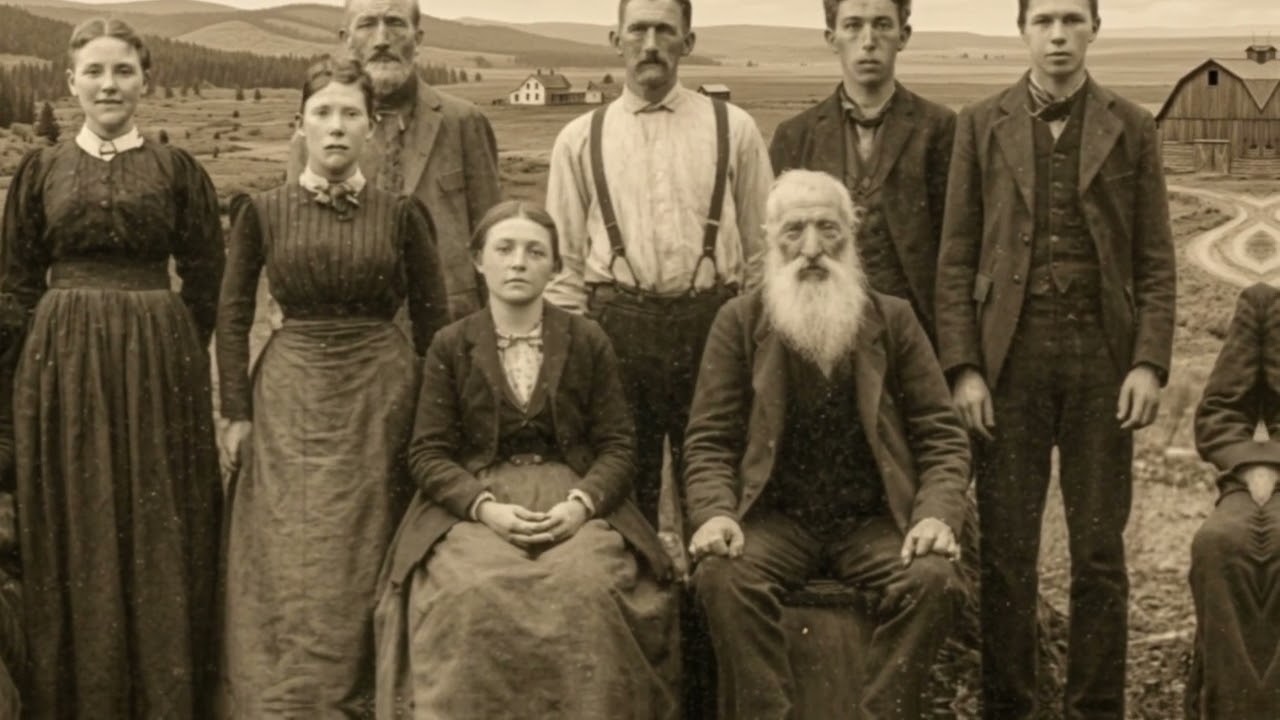
Strake photographed nine members of the family in the dooryard of the homestead. He wrote in his ledger that the plates came out “cleaner than any plates I have ever taken,” and that he was giving them away, leaving for Welch in the morning, and not going back. In the surviving tintype, every person has the same eyes: black as the bottom of a kettle, with no visible iris or pupil. Only the oldest, Lorenzo, still shows some white at the corners.
Marberry first went to the hollow in the summer of 1941, assigned to walk a property line for tax purposes. He walked the last mile and a quarter on a silent track, beneath beech trees with bare ground beneath them, past a stone marker inscribed “CT 1799. ” At the Thrill house, he was met by Wendell Thrill, a tall, thin, polite man in his late forties. Marberry later described the encounter with care.
Wendell’s eyes had no whites at all—not gray, not yellow—just the color of dark water in a deep well. In the house, six people watched him the entire time: Wendell, his wife Tessline, his mother Verina, and three grown sons. They never looked at each other, the map, or anything else. They looked only at him.
Tessline brought him a glass of water from the well. It was colder than it should have been, and it tasted faintly of iron—not rust, but blood. He drank it because refusing would have been an insult to his host. Before leaving, Marberry went out to look at the well.
The water was far down, black with depth. While looking into it, he felt “an attention, a kind of patient noticing far down in the dark. ” When he turned around, all six Thrills were standing in a half-circle behind him, having made no sound leaving the house. He left without finishing his work, fudged the property line in his report, and did not return for fifteen years.
The taste of the water stayed in his mouth for three days. Then he started having a recurring dream: he was at the bottom of the well, looking up at a circle of daylight, and the faces of the Thrills looked down at him. Marberry began researching. Over fifteen years, he assembled a file of outside accounts, wrote letters to historians, folklorists, and a hydrologist named Dr.
Crispen Veil. Veil, who had spent his career mapping underground water, wrote back that the geology of the region does not support a hand-dug well of that depth. “There is no aquifer at that depth in that location. Whatever water is in that well is not coming from anywhere I can put on a map.
” When Marberry pressed for an explanation, Veil did not answer. Months later, his daughter replied that he had died in his sleep, leaving a folder marked “Stone Penny” containing a single sheet of paper with two words: “Do not pursue. ” Marberry kept the paper and kept pursuing. He also found a map drawn in 1873 by a respected surveyor named Alpheus Senate.
Beneath the hollow, Senate had sketched a faint dashed circle about 300 yards across, with a penciled note: “Ground sounds wrong here. Echo as if hollow beneath. Did not survey further. ” Six years later, Senate quit surveying, sold his instruments, moved to Indianapolis, and became a clock maker.
He never explained why. Decades later, his grandson recalled that Senate had once said, “There are places in those mountains that have a floor and a ceiling, and the ceiling is the part you walk on. I made the mistake of measuring through the floor one time. I did not like what I measured.
”
In February 1958, Marberry returned. He went in winter so the hollow would be stripped bare. The track was overgrown; nobody had been in or out in some time. The house was there, smaller than he remembered, with no smoke from the chimney.
The door was unlocked. Inside, every room was clean, the beds made, a glass of water half-full on the nightstand with no dust on its surface. He found no sign of the people. Then he went to the dooryard.
In the snow around the well were six sets of bare footprints, two larger and four smaller, all adult. They led to the well. None led away. The prints were not fresh—by his estimate, between four days and two weeks old.
He stood there a long time before lifting the cover. The well was dry, the walls of stacked stone descending about sixty feet or more. At the bottom, on bare earth, were six pairs of eyes—not people, but eyes, open, the same color of dark water, no whites visible. They were arranged in a circle, evenly spaced, all facing inward toward the center, where something lay that he could not see and did not want to see.
As he leaned over with his notebook, writing down the depth and position of each pair, he heard a sound from the center of the circle. It was not a voice and not water. It was the shape of a call, a rise and fall with no words. It was his name.
He lowered the cover, walked back down the track without looking behind him, drove home, and shook for about an hour. The next morning, he went to the county records office and wrote the word “closed” across the Thrill file in red pencil. He locked the drawer and never went back. When a young surveyor took over his job in 1963, Marberry drove him around the three counties and told him to leave Stone Penny Hollow alone.
The young man never asked about it again. Marberry retired in the spring of 1963. But the dreams returned last winter. He dreams he is at the bottom of the well, looking up at the circle of daylight, and the faces looking down include his own.
In the dream, the version of him at the bottom has eyes the color of dark water with no whites. He no longer tries to wake himself up. He looks at his own eyes in the mirror in the dim morning light and cannot always tell their color.
He only knows he no longer drinks water from any well he cannot see the bottom of.