I went to the cinema the other week, and before the film started, I was, as usual, bombarded with a series of mindless adverts. But one particular advert caught my attention. It was shown not once, not twice, but three times in the space of about twenty minutes. A Royal Navy recruiting ad.
“I used to hate going to work. Now, I love it. ” “Goodbye 224 bus. Hello 224 patrol vessel.
” “I swap four buses a day for four countries a month. Best commute ever. ” “I was born in Liverpool, but I was made in the Royal Navy. ” It showed lots of glossy film of British warships and submarines congregated at sea.
But as I will show you, the chances of that happening today are almost nil. It in fact reveals the terrible recruiting crisis that is crippling the Navy in 2026 and forcing it into what experts are calling a doom loop or death cycle, as I will demonstrate. Remember, my criticisms are not directed against those men and women serving in the Royal Navy, but against those who created this situation. That is, politicians and civil servants.
I can only assume the intention of successive British governments is to actually abolish the Royal Navy. For it can only be a deliberate policy that has created the terrible state of affairs we find today. These are some of the major policy decisions taken by successive Labour and Conservative governments regarding the Royal Navy over the past thirty years. It can be argued that the position the Royal Navy currently is in in 2026 is a result directly of these policies and decisions.
The frigate gap is probably the most serious. Britain has not commissioned into service a single new frigate for almost a quarter of a century, whilst at the same time it has got rid of those which it possesses. The Type 23 class of frigates originally numbered sixteen vessels, which is still more than the two new classes of frigate that is supposed to be replacing the remaining Type 23s, meaning the Navy will still be smaller than it was twenty-five years ago. The catastrophic reduction of the submarine fleet has also seen it shrink from twenty-two vessels in 1997 to a truly pathetic nine today, of which four of those boats are dedicated only to carrying the ballistic missile nuclear deterrent and are not hunter submarines.
The erosion of Britain’s amphibious warfare capability has been very serious and has basically disappeared. If we were faced with another Falklands war type scenario, there is no way on earth the Navy could transport and put ashore that number of troops. Techniques that took eighty years to develop now are thrown away at the signing of a document. And the hilarious thing is our helicopter carrier and also one of our two assault ships have been sold to foreign navies who can manage to find uses for them.
Here is another depressing statistic. There are now more British frigates serving in foreign navies than in the Royal Navy. Eight former Royal Navy frigates serve under foreign flags today, sold off cheaply as successive governments have decimated the Royal Navy. Chile operates the former Type 22 frigate HMS Sheffield and three of the Type 23s, the former HMS Norfolk, Grafton, and Marlborough.
While Romania has two Type 22s, the former HMS Coventry and London. And Brazil, who not only purchased our helicopter carrier HMS Ocean at a knockdown price, but also has two Type 22 frigates in service, the former HMS Broadsword and Battleaxe. As a short-term solution, the government may like to explore the idea of buying back those three Type 23s which are still fully functional. So, following on from my recent videos summarizing the deplorable and shameful state of the once mighty Royal Navy, we now have the very interesting situation regarding one very important class of warships, the frigates, the workhorses of the fleet, of having more frigates awaiting scrapping than actually serving with the fleet.
The Royal Navy officially has seven Type 23 frigates in service, which is an appallingly low number by itself. But it does not really. It has just five. It was announced that HMS Iron Duke had been quietly withdrawn from service due to personnel shortages and mechanical problems.
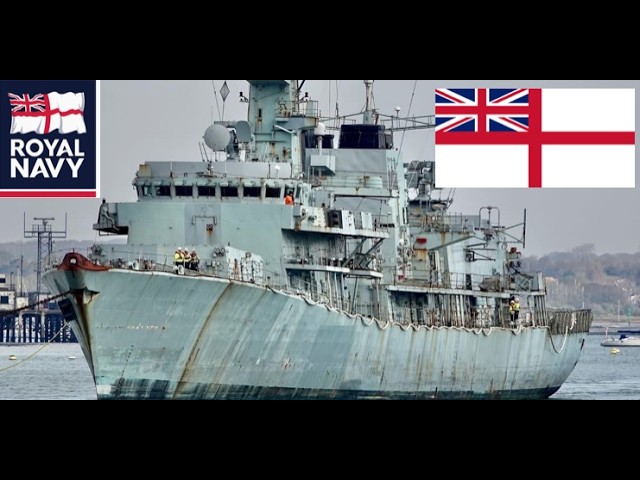
This was despite the taxpayer having funded a full refit of this vessel between 2019 and 2023 at a cost of a staggering one hundred and three million pounds. Iron Duke actually briefly went to sea in 2023, monitoring Russian warships passing through the English Channel, then deployed to the Baltic, managing sixteen months of service post refit before being withdrawn. A huge waste of British taxpayer’s money. She has now been stripped of her weapons and systems and will undoubtedly join her former sister ships, the ex-HMS Westminster, Argyll, Montrose, and Northumberland that are currently sitting in Fareham Creek in Portsmouth awaiting disposal, likely by scrapping.
But I have not finished yet. The Type 23 frigate HMS Richmond will be decommissioned to join her sisters at Fareham Creek shortly, meaning that the Royal Navy will be in the interesting position of having more frigates awaiting scrapping, six, than actually in service, five. And what of the Type 23’s replacements? Britain is currently building thirteen new frigates in two classes.
The first Type 26 class frigate, Glasgow, is currently fitting out at Scotstoun and will begin her sea trials later this year. She is due to enter service in 2027, allegedly. Her sisters, Cardiff, Belfast, and Birmingham are also currently being built. However, of the eight vessels planned in the Type 26 class, rumors abound that the government is probably going to sell one of them, most probably Birmingham, to Norway.
The other class of smaller frigates, the Type 31s, are also progressing with five vessels planned. Though I think it likely we will see a rerun of the Type 45 class destroyer debacle, where twelve vessels were ordered, but the government of the day decided to save money by cutting the order by fifty percent, leaving the Royal Navy with only six Type 45s, our only class of destroyer, completely inadequate, especially when you consider that today only one is actually operational, HMS Dragon, with the rest in refit. The good news, apparently, is HMS Duncan is about to reenter service. So much for the Navy’s much-vaunted rule of three, much discussed online following my previous video.
The rule states that you require three ships per operational role, that is, one deployed, one in training, and one in deep maintenance. This the current Royal Navy struggles to fulfill due to chronically small numbers of vessels and too few crew to man them. All of this begs the question, if the Navy is decommissioning frigates due primarily to insufficient crew, how can they manage to crew thirteen new vessels when they can barely crew five today? I will be very surprised if the government does not in fact sell off fifty percent of the new vessels to foreign nations and will probably also have to permanently dock one of our two aircraft carriers to redirect its manpower to somehow crew the new and existing ships.
That is why joining the Royal Navy today does not seem a particularly attractive option for young people. The figures suggest so. Since 2012, the Navy’s personnel has dropped by sixteen percent. Last year, it had a drop of one point one percent alone.
In the last twelve months, according to figures, the Navy has had two hundred and twenty trained personnel leave, the equivalent of the crew for two new Type 31 frigates. Recruitment for 2023 to 24, the last full figures, was forty percent short of targets. The remaining sailors are seriously overworked and over-deployed, feeding the low morale and poor retention rates bedeviling the service. According to the Ministry of Defense, the Royal Navy is currently about one thousand trained personnel under strength, so the senior service has in fact entered a death spiral.
Not enough sailors remain to properly crew vessels, so the Navy decommissions more and more warships without replacement. While of course it cannot hope to crew new warships, which are much needed to maintain both its fleet and Britain’s defenses, which of course leads to more and more cuts and around and round goes the spiral, ultimately making it an unattractive career prospect for young people, fueling again the death spiral. So people are naturally asking what is the answer to stop the doom loop? Well, the only real answer is to make the Royal Navy an attractive career option again.
It is people that seems to be the major problem, or lack of them. But I am not so sure the doom loop can actually be arrested at this point. I see no evidence that governments really wants to make the deep changes required to overhaul the entire service and make it really functional again. All parts of the armed services are facing a recruitment crisis.
In the case of the British Army, they have been able to offset some of the problem of British people not actually wanting to join the army by simply recruiting more Gurkhas and Fijians. The Brigade of Gurkhas has expanded so much that today eight percent of the entire British Army are Gurkhas, which is a good thing in my opinion as they are some of the best soldiers in the world. Fijians also have a splendid warrior tradition and have made very good infantry soldiers in a variety of units and now number over two percent of the army. Mark my words, very few of those thirteen new frigates will ever see service in the Royal Navy.
Many of them will be cancelled before they are even built or if completed sold to foreign nations to recoup costs. A doom loop is well named, for the Royal Navy looks increasingly doomed to operational impotence and irrelevance on the world stage, something I never thought I would see. Thanks for watching. Please subscribe and share.
Also, visit my audio book channel, War Stories with Mark Felton. You can also help to support both of my channels at PayPal and Patreon. Details in the description box below.