A few months ago, I was in the United States, and while I was in New York City, I took the opportunity to visit the preserved aircraft carrier USS Intrepid. It’s an excellent museum and well worth the visit, but one question kept nagging at me as I wandered around the ship. My question was this: why, if the British Royal Navy was once stronger than the US Navy, is there not a single British aircraft carrier preserved as a museum ship? It seemed like a logical question to me.
The United States is a nation that takes pride in its naval history, and today, not one but five aircraft carriers, symbols of modern naval power, are preserved as museums. Britain, on the other hand, invented the aircraft carrier, and its Royal Navy was no less powerful than the US Navy during most of World War II and for a long time afterward, a respected force to be reckoned with on the international stage. And yet, not a single one of its carriers was preserved to educate people about my country’s technological and maritime achievements. I’ll be visiting the United States again later this year, and among the things I’ll definitely make a point of seeing is a battleship, a class of warship I’ve always wanted to see in person, but that isn’t possible in Britain.
The United States has eight preserved battleships, while Britain has none, despite keeping this distinguished class of warship in service until 1960. Britain actually got off to a good start back in 1922, when her most famous museum ship today, HMS Victory, was preserved for the nation. This first-rate ship of the line, armed with 104 guns, was completed in 1778, and of course she was Admiral Lord Nelson’s flagship at the Battle of Trafalgar in 1805. In fact, Nelson was killed on her deck.
That battle was one of the most important naval engagements in world history. Her final years were quite sad, as she was used as a prison ship and then as a floating headquarters until 1830. But her association with Trafalgar ensured she wouldn’t be broken up, despite the Admiralty’s determined efforts. She was used as a stationary flagship, then as a training ship.
But she ended up in very poor condition and was damaged in a collision in 1903. The Admiralty again wanted to scrap her, but King Edward VII personally intervened to prevent that. In 1905, she took part in the centenary celebrations of the Battle of Trafalgar, but she continued to deteriorate through both World Wars and beyond. It wasn’t until 1921 that shipping magnate Sir James Caird generously donated to the Save the Victory Fund, and the process of dry-docking and restoring her began in 1922.
Since then, she has remained in No. 2 Dry Dock in Portsmouth, where she has been gradually restored, and of course, she has been open as a museum for a hundred years. HMS Victory still serves as the Royal Navy’s flagship, acting as the headquarters of the Second Sea Lord. Imagine if no Royal Navy warship had survived from that glorious period of our history.
But that was almost the case. As for modern warships from World War I and World War II, not a single one survived the scrappers’ torches. As I mentioned, the Americans kept eight battleships, from the last surviving dreadnought, USS Texas, to USS Missouri, the ship on which the Japanese signed their surrender in 1945, ending World War II. In fact, the US Navy kept its last class of battleships, the Iowa class, throughout the Cold War and beyond.
These ships were famously used in 1991 to bombard coastal targets in Iraq during the First Gulf War, using their massive 16-inch guns with devastating effect. That was just one man. Oh my God! Wow!
Oh my God, that’s two at once. That hurts, yes, but oh my God, that’s beautiful. Do it. Fire the salvo.
The last two ships, USS Missouri and Wisconsin, were taken out of service due to budget pressures in the 1990s, but neither was scrapped. Instead, these ships were preserved for future generations as symbols of US naval power. Britain, however, built the world’s first modern battleship, and her name became synonymous with that type of warship, known simply as the “Dreadnought. ” But HMS Dreadnought herself was not preserved for the nation when she was decommissioned in 1920; she was sold for scrap in 1921.
Britain was practically bankrupt by 1941, trying to cover the costs of World War II. Because of the severe economic crisis during and after the war, Britain lost her place to America as the world’s leading military superpower. Britain simply couldn’t afford to be sentimental about her warships after World War II. The country was still under food rationing until the mid-1950s, and was establishing a national health service and welfare state.
It began dismantling vast numbers of warships after the war, willingly giving up its role as the world’s policeman, and of course, it began its withdrawal from empire. Battleships were seen as expensive relics, as aircraft carriers had replaced them as the primary capital ships during the Cold War. No consideration was given to preserving a single battleship as an example of the type and its significance in British history. All the famous remaining battleships from World War II met the same fate.
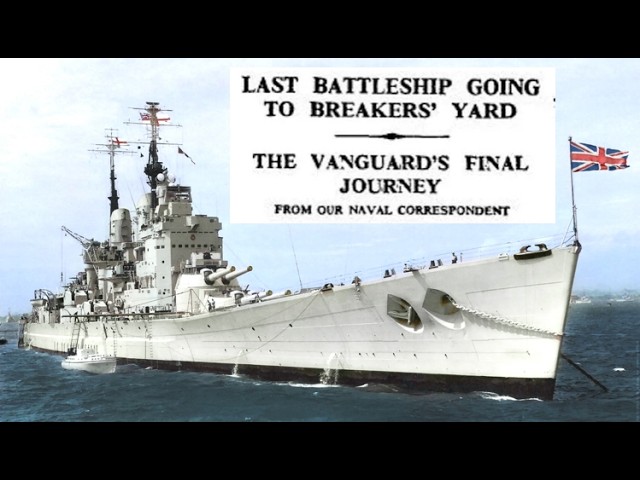
HMS Warspite was scrapped in 1946, then HMS Queen Elizabeth, Valiant, and Malaya were broken up in 1948, along with HMS Revenge and Royal Sovereign. Next, HMS Nelson and Rodney were scrapped in 1949. Then more followed in the 1950s, including HMS King George V, Duke of York, and Anson in 1957, and HMS Howe in 1958. By 1960, the Royal Navy had only one battleship left, the only one built after the war, HMS Vanguard, displacing 44,500 tons and armed with eight 15-inch guns.
By mid-1962, she too had been broken up and turned into scrap, netting the government £560,000. The aircraft carriers, on the other hand, are even harder to justify. I say “harder” because the battleship’s fate might be seen as a necessary evil of post-war austerity, but the carriers were scrapped well into the 1960s and 1970s, when Britain was no longer in such dire economic straits. Consider HMS Ark Royal, the most famous British aircraft carrier of World War II.
She was torpedoed and sunk by a German U-boat in November 1941, after a long and distinguished career, but her loss was a bitter blow. However, there were other famous carriers, like HMS Illustrious, which survived the war and went on to have a long career. After the war, she was placed in reserve, then recommissioned in 1950, and served until 1954. But by 1956, she was sold for scrap.
HMS Victorious, another famous carrier, served in both the Atlantic and the Pacific during the war. She survived the war, was modernized in the 1950s, and served into the late 1960s. She was sold for scrap in 1967. And what about HMS Hermes, which was the flagship of the British task force during the Falklands War in 1982?
She served until 1984, when she was sold to India and commissioned as INS Viraat. She served in the Indian Navy for another 33 years, finally decommissioned in 2017. So, Britain did preserve one of her carriers, but only by selling it to a foreign navy, and even then, it was eventually scrapped in 2021. The real point is that Britain’s attitude toward her warships was completely different from that of the United States.
The Americans had the luxury of money and distance. They were never bombed, never invaded, and their industrial heartland was untouched. They could afford to keep their battleships and carriers in reserve, and later, they could afford to turn them into museums. Britain, on the other hand, was exhausted by war.
Its economy was in ruins, its cities were bombed, and its empire was crumbling. The British people were tired, and they wanted to focus on rebuilding their lives, not on preserving the relics of a past they were trying to move away from. There was also a sense of shame, perhaps, about the warships that had been lost. The Royal Navy had lost over 50,000 men and over 1,500 ships during World War II, including the battleships HMS Royal Oak and HMS Prince of Wales, and the battlecruisers HMS Hood and HMS Repulse.
These were heavy losses, and the public didn’t want to be reminded of them. They wanted to move forward. There is another factor as well. The United States has a different relationship with its military history.
It is a country that was founded on a revolution, and it has always celebrated its military heroes and its victories. The British, on the other hand, are more ambivalent about their military past. They have a long history of losing as well as winning, and they are often more comfortable with the stories of their defeats, like Dunkirk or the fall of Singapore, than they are with their victories. This cultural difference is reflected in the way the two nations treat their historic warships.
The Americans preserve them as symbols of national pride and military might. The British, when they preserve anything, tend to focus on the human stories, like Nelson’s flagship Victory, which is more of a shrine to a man than a celebration of a warship. In the end, it’s a matter of priorities and circumstances. Britain simply couldn’t afford to preserve its battleships and carriers in the decades after World War II, and by the time the country could have afforded it, the public and the government had lost interest.
The scrapyard was the natural end for most of these magnificent ships. But it’s still a great shame. When I walked around the USS Intrepid, I couldn’t help but think that this is what HMS Victorious or HMS Illustrious could have been like. A floating museum, where families could climb around the flight deck, explore the hangar, and learn about the history of naval aviation.
But instead, all we have left in Britain are a few preserved submarines and small ships, like HMS Belfast, which is a light cruiser, and HMS Plymouth, a frigate. The big ships, the capital ships, are all gone. So, when I go back to the United States later this year and visit one of those preserved battleships, I’ll enjoy it, but it will also be a slightly bittersweet experience. I’ll be admiring the American ships, but I’ll also be feeling a pang of regret that my own country didn’t see fit to preserve even one of its own.
It’s a missed opportunity, and I don’t think it’s one that will ever be repeated. The days of the battleship are long gone, and so are the days when Britain could afford to be generous with its history. The best we can do now is learn from the American example and make sure that we don’t make the same mistake again with the ships that are still with us. There are a few still out there, like the historic warships in dry dock in Portsmouth, but they are few and far between.
The rest are just memories, rusting away in some scrapyard in India or Turkey, a sad end for ships that once ruled the waves. And that’s the real tragedy. It’s not just that Britain lost its empire, it’s that it lost the memory of the ships that made that empire possible.
And once that memory is gone, it’s gone forever.