Hermann Göring held more official titles than perhaps any single individual in modern European history. He was commander-in-chief of the Luftwaffe, Reichsmarschall of the Greater German Reich, Prime Minister of Prussia, President of the Reichstag, Plenipotentiary of the Four Year Plan, Reichmaster of the Hunt, and at one point Hitler's officially designated successor.
He commanded a personal fortune plundered from the art collections of Europe. He lived in a palace he had built from the ground up in a Brandenburg forest. He wore costumes so elaborate that even his own subordinates occasionally struggled to keep a straight face.
And yet, by the middle of the war, a persistent whispered question echoed through the corridors of the German High Command, through diplomatic circles, and ultimately through the barracks of the Luftwaffe itself. What exactly was Hermann Göring doing?
Not in the grand strategic sense, not in the historical ledger of his crimes, but literally, practically, on any given Tuesday in 1942. What filled his days? When did he rise? What did he eat? How did he conduct the war from behind the walls of his fairy tale estate while the men of his air force froze to death on the Eastern Front?
The answer is both more fascinating and more damning than almost anything his prosecutors said about him at Nuremberg.
To understand a single day in the life of Hermann Wilhelm Göring, one must first understand the extraordinary arc that brought him to the pinnacle of Nazi power. Nothing about his daily routine in the 1940s made sense without the context of who he had been in the 1910s and 1930s.
Göring was born on January 12, 1893, in Rosenheim, Bavaria, the fourth of five children of Heinrich Ernst Göring, a former colonial governor who had served the Wilhelmina German Empire in Southwest Africa and Haiti. His mother, Franziska, was involved in a long-running affair with a wealthy Nuremberg physician named Hermann Eppenstein, a man of partly Jewish ancestry who became Göring's godfather and, in practical terms, his childhood patron.
Eppenstein provided the Göring family with their primary residence, a medieval castle called Veldenstein, and another property called Mauterndorf in Austria. Young Hermann grew up in these romantic, quasi-feudal surroundings, sleeping in actual castle chambers and absorbing a deep and lasting sense that splendor, power, and the accumulation of beautiful things was simply the natural entitlement of someone like himself.
This childhood explains the adult Göring. It explains Carinhall. It explains the stolen paintings. It explains the theatrical uniforms and the theatrical persona. He had been raised, quite literally, in a castle, and some part of him never entirely left it.
His father died when Hermann was still a child, and Eppenstein eventually ceased his support, forcing the family into more modest circumstances. But the impressions had already been made. Young Göring was a headstrong, rebellious child who was eventually sent to military cadet school, and it was there that he first discovered the thing that would define his early identity: he had a talent for flying.
During the First World War, Göring began his service in the infantry on the Western Front before transferring to the German Air Service, initially as an observer and then as a pilot. He proved to be genuinely skilled, courageous, and aggressive in the air. By the end of the war, he had achieved 22 confirmed aerial victories and been awarded the Pour le Mérite, Germany's highest military decoration, commonly known as the Blue Max.
More significantly, when Germany's most famous fighter pilot, Manfred von Richthofen, the Red Baron himself, was killed in April 1918, the command of his legendary squadron, Jagdgeschwader 1, eventually passed to Hermann Göring. It was one of the most prestigious commands in the entire German military, and Göring held it until the armistice. He was 25 years old, covered in medals, and already developing the habits of theatrical self-presentation that would become his trademark.
The armistice hit Göring harder than it hit most German officers, not because of the defeat itself, but because of what it stripped away. In a matter of days, he went from commanding Germany's most celebrated fighter squadron to being a young veteran with no job, no clear future, and no outlet for the aggressive, acquisitive energy that defined him.
He rattled around Europe for several years, briefly working as a stunt pilot in Sweden, where in 1920 he met and fell passionately in love with Carin von Kantzow, a Swedish noblewoman of considerable beauty who was already married to someone else. She left her husband for him. They married in 1922. He adored her with what appeared to be genuine, consuming passion, a devotion that would outlast even her death.
Göring attended one of Adolf Hitler's speeches in Munich in 1921, and the effect was immediate and electric. Here was someone else who spoke the language of heroism and grievance and national rebirth that Göring himself had been nursing since 1918. He joined the Nazi Party in 1922 and was appointed commander of the SA, the Sturmabteilung, the brownshirt paramilitary force that served as Hitler's street muscle.
On November 8, 1923, Göring marched beside Hitler in the Beer Hall Putsch, the failed coup attempt in Munich that was supposed to spark a national revolution but instead ended with scattered gunfire in the Odeonsplatz. Göring was shot in the groin and thigh and very nearly died. He was smuggled across the border into Austria for emergency treatment.
The wounds were extremely painful and took months to heal, and it was during this period of agonizing recovery that Hermann Göring was first prescribed morphine. He would not be free of it for the rest of his life. This fact, this one wound and this one prescription in 1923, is perhaps more important to understanding what Göring did all day in 1942 and 1943 than any battlefield decision or strategic calculation.
After the failed putsch, Göring and Carin spent years in Swedish exile before the charges against him were eventually dropped under an amnesty. They returned to Germany in 1927. Carin's health had never been robust, and she suffered from tuberculosis and a serious heart condition. When she died in October 1931, he was genuinely heartbroken.
He kept her ashes in a special urn for years before eventually interring them in a mausoleum he built at Carinhall, the vast estate he would construct in the Schorfheide Forest north of Berlin and name in her honor. The grief seemed to intensify his other appetites. He ate more, drank more, dressed more elaborately, wanted more of everything.
By 1932, Göring had been elected to the Reichstag and was serving as its president. By January 1933, when Hitler became chancellor, Göring was one of only three NSDAP members in the cabinet, and he moved immediately and ruthlessly to consolidate power in Prussia, Germany's largest state.
He created a secret state police force and handed it to his subordinates, the force that would become the Gestapo. He had 6,000 political opponents arrested in the weeks following Hitler's appointment. He orchestrated the use of the Reichstag fire of February 27, 1933, whether or not he was directly responsible for setting it, as a pretext for emergency decrees that effectively suspended civil liberties across Germany.
And then, once the power was consolidated, Göring did something that surprised some of his contemporaries. He slowed down. Gradually and then with increasing momentum, he shifted from revolutionary to sybarite, from political operator to collector, from the hard-driving machine of 1933 to the increasingly decorative, increasingly indolent figure that the Wehrmacht and the Luftwaffe would have to deal with throughout the war years.
In 1935, Hitler publicly announced the existence of the German Air Force in direct violation of the Treaty of Versailles and appointed Göring its commander-in-chief. It was the role that would define and ultimately doom his legacy. For Göring, commanding the Luftwaffe was never primarily a military enterprise. It was a performance, an extension of the same theatrical impulse that made him change his uniform six times in a single day.
So what did a typical day look like for the Reichsmarschall at the height of his power? The answer consistently reported by his staff and adjutants was that he generally did not wake up before 10:00 in the morning. On some days, particularly in the later years of the war when the morphine dosages were higher and the military situation was grimmer, it was closer to 11:00. On a few documented occasions, he did not emerge from his private chambers until midday.
For the commander of an air force in the middle of the most destructive air campaign in history, the habit of sleeping until mid-morning was a logistical complication. Generals waiting to brief him on the overnight operations found themselves cooling their heels in his anterooms, clutching reports about losses and sortie rates while the Reichsmarschall was still in his bedroom.
When Göring did finally emerge, the morning ritual was elaborate and time-consuming. He bathed at length and with meticulous attention. His bathroom facilities, both at Carinhall and at his other properties, were among the most lavishly appointed in Germany, fitted with deep Roman-style tubs and extensive collections of bath oils and perfumes.
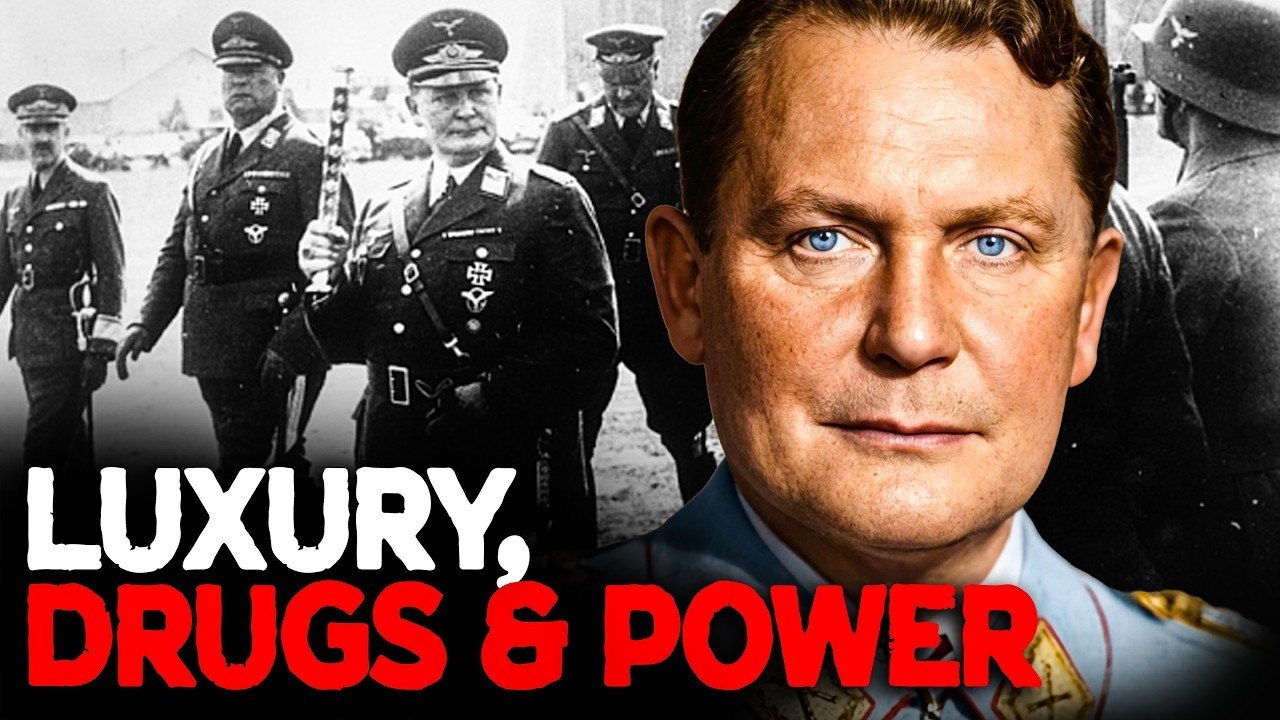
His valet, Robert Kropp, who served him for most of the war years, would lay out the first uniform of the day because there would be several. Göring's relationship with his uniforms is one of the most documented aspects of his daily existence. He did not simply wear uniforms, he designed them, obsessed over them, and changed them with a frequency that bewildered the officers around him.
On a single day at Carinhall, he might appear at breakfast in a creamy white military tunic of his own invention, change after the morning meeting into what one adjutant described as a sort of Renaissance hunter's outfit complete with a large ornamental knife at his belt, appear at lunch in a different version of the Reichsmarschall's uniform with the distinctive baton, and then emerge for the evening dinner in something more reminiscent of ancient Rome than 20th-century Germany.
The breakfast itself was a production. Göring ate enormously throughout his life, and by the late 1930s, and especially during the war years, his appetite had become legendary, and not in a flattering way. He ate multiple courses, meats and pastries and rich German dishes in combinations and quantities that shocked visitors accustomed to wartime rationing.
The irony was not lost on the German public, who were facing increasingly severe shortages of food and basic goods while official propaganda celebrated the sacrifice and solidarity of the German people. Stories circulated, whispered at first and then more openly as the war went badly, about the Reichsmarschall's table and its abundant hospitality while ordinary Germans thinned and shivered.
By 1943, Göring weighed somewhere in the region of 260 to 300 pounds, depending on whose account you trust. A transformation so dramatic from the lean, athletic fighter pilot of 1918 that photographs of the two periods barely seem to depict the same individual. His Luftwaffe subordinates, with the black humor common to military men in difficult circumstances, had a private nickname for him that was absolutely not used within his hearing. They called him "Der Dicker," the fat one.
After breakfast, the morning meeting. This was, in theory, the moment at which the business of running the Luftwaffe actually took place. In practice, the morning briefings at Carinhall were often more social than strategic. Göring would receive his Chief of Staff, his operations officers, and various adjutants, and they would present him with reports on the previous night's operations, current aircraft availability, production numbers, and whatever strategic questions required his attention.
The difficulty was that Göring's attention was variable. His grasp of technical detail was unreliable, and his habit of making large, sweeping pronouncements based on what he felt to be true, rather than what the data actually indicated, was a standing source of despair for the professional officers around him.
He had made one of the most consequential and catastrophic promises of the entire war, the promise to Hitler that the Luftwaffe could supply the surrounded Sixth Army at Stalingrad by air, based on what multiple accounts describe as an almost complete disregard for the logistical realities his own staff were frantically trying to communicate to him.
Albert Kesselring, one of the most capable and clear-eyed Luftwaffe commanders, later said in interviews that trying to brief Göring on complex operational matters was like trying to explain a chess problem to someone who kept insisting on playing draughts. The man understood the outlines of air power. He grasped the basics. He had genuine enthusiasm for aviation. What he lacked was the discipline, the patience, and increasingly the sobriety to translate that enthusiasm into effective command decisions under pressure.
The question of Göring's drug use is central to any honest account of how he spent his days. After his morphine dependency began following the 1923 putsch, he was treated for addiction on several occasions, most notably in 1925 when Carin had him committed to Langbro mental hospital outside Stockholm. He was described in the hospital records as violent when denied his medication, and the treatment was only partially successful.
By the time the war began in 1939, he had largely substituted the raw morphine of his early addiction for paracodeine pills, a milder opioid that he consumed in extraordinary quantities. By 1943, multiple sources, including his personal physician and several of his adjutants, reported that he was taking as many as 40 to 100 paracodeine pills per day.
He carried the pills in a small leather case that went everywhere with him. His staff knew not to comment on it. The effect on his daily functioning was significant and cumulative. He was slower. He was more prone to distraction. He was more given to the kind of grand, disconnected optimism that ignored inconvenient evidence.
The afternoons at Carinhall were the part of Göring's day that most dramatically illustrated the gap between his official responsibilities and his actual preoccupations. After the morning briefing, the afternoon belonged to what he called his collections. This is where the story of Hermann Göring's daily life intersects with one of the great crimes of the Second World War, the systematic looting of European art on a scale that had not been seen since Napoleon.
Göring's art collection, assembled through a combination of forced purchase, outright theft, and the coercive machinery of occupation, was at the time of his arrest in 1945 estimated to contain somewhere between 1,300 and 1,500 individual works. These included paintings by Rembrandt, Vermeer, Van Dyck, Rubens, Titian, and dozens of other masters. They included medieval sculptures, tapestries, ancient Roman bronzes, Renaissance decorative objects, and entire interiors stripped from Jewish-owned homes and galleries across France, the Netherlands, Belgium, Poland, and the Soviet Union.
He had an entire special unit working on his behalf, the Einsatzstab Reichsleiter Rosenberg, or ERR, which was theoretically Rosenberg's operation but which Göring used extensively and with complete priority access to the best pieces. When the ERR finished cataloging the contents of confiscated Jewish homes in Paris, Göring's representatives were usually first in line.
He also personally conducted buying expeditions through occupied territories using a combination of his official position and the simple fact of armed German occupation to negotiate prices that were, in the polite language of the post-war restitution commissions, not entirely voluntary.
The collecting consumed him in a very literal sense. His staff maintained detailed inventories of the works stored at Carinhall, and Göring spent hours reviewing photographs and descriptions of new acquisitions, directing their placement in the estate's galleries, and planning future expeditions. He corresponded directly with dealers, curators, and representatives in occupied countries.
He received regular visits from art experts whom he questioned with the focused, knowledgeable enthusiasm of a genuine connoisseur, because whatever else Göring was, he was not a careless or ignorant collector. He had studied art history with real seriousness. Several of the dealers who worked with him after the war noted, with uncomfortable admiration, that his eye was excellent.
This made the theft more obscene, not less, because it was not the blundering pillage of an ignorant soldier, but the deliberate, informed, methodical accumulation of a man who knew exactly what he was taking and why it mattered.
Carinhall itself was the physical expression of everything Göring wanted his daily life to be. He began building it in 1933 on a forested estate in the Schorfheide, a protected hunting area north of Berlin that had previously been reserved for the Hohenzollern royal family. The name was taken from his first wife, Carin, whose remains were eventually transferred there to a mausoleum in the woods.
The estate grew over the years, extended and elaborated with each new infusion of money and stolen resources, until by the early 1940s it was essentially a private palace complex of extraordinary size and opulence. There was the main house, expanded multiple times to accommodate Göring's growing art collection. There was a separate games room with billiard tables and model train sets that he played with in the evenings with something approaching genuine childlike joy.
There was an elaborate indoor swimming pool. There were guest suites and staff quarters and a fully equipped cinema. There were garages containing dozens of motor vehicles. There were stables. There were kennels. There were aviaries containing exotic birds. The estate included its own airstrip, its own anti-aircraft installations, its own underground bunker complex.
In the forest surrounding the main buildings, Göring had introduced herds of bison, moose, and various deer species, maintaining his own personal wildlife reserve in the Prussian woods. He was, remember, the Reich Master of the Hunt, and he took this designation with total seriousness.
Hunting was not merely a pastime for Göring. It was a fundamental expression of his self-image, the hunter as archetype, the man who moved through the natural world with authority and took what he chose. He hunted with medieval weapons as well as firearms. He kept a spear and various other antiquarian hunting implements as part of his theatrical arsenal.
He invited senior officials, foreign dignitaries, and military commanders to hunting parties at Carinhall that were famous throughout the German political world for their lavishness and for the slightly unsettling experience of spending a day in the Prussian forest with a 250-pound man dressed as a medieval Germanic chieftain carrying a hunting spear.
The dinners at Carinhall were events unto themselves. He loved to entertain, and the guest list across the late 1930s and throughout the war read like a who's who of the Third Reich, the diplomatic corps, the military high command, foreign dignitaries, and a rotating cast of artists, athletes, and celebrities.
Göring was, by universal account, a compelling host. He was funny in the blunt, aggressive way of a man who had spent his formative years in military messes, and he was a gifted raconteur who could hold a table's attention for hours with stories from the First World War, embellished freely and told with the timing of a natural performer.
The food was exceptional. The wine was whatever the best available in occupied Europe happened to be. The conversation was loud and ranging, and occasionally dangerously indiscreet, and Göring, presiding over all of it in his latest theatrical outfit, was in his element in a way that he never quite was when actually doing his job.
The Italian Foreign Minister Galeazzo Ciano, who attended several such evenings and left extensive diaries, described Göring with a mixture of fascination and contempt that captured the essential paradox of the man. Ciano noted his genuine warmth and humor, his obvious intelligence, and his equally obvious unwillingness to let either quality be put to serious use when there was a good dinner and an appreciative audience to be had.
But there was another dimension to the evenings at Carinhall that the formal diplomatic descriptions tended to leave out: the model trains. Hermann Göring's model railway was not a private hobby kept discreetly in an attic. It was an installation that occupied an entire room of the main house, a room large enough to accommodate a scale model recreation of an entire railway network complete with miniature landscapes, tunnels, stations, switching yards, and dozens of locomotives that Göring had collected and in some cases designed himself.
He played with this installation with the focused, unhurried absorption of a child on Christmas morning, operating the controls himself, rerouting trains, setting up elaborate scenarios of switching and scheduling, entirely oblivious to whatever else might be happening in the war. Senior officers waiting to discuss matters of urgency with the Reichsmarschall were occasionally told, with complete seriousness by his adjutants, that he was not to be disturbed because he was in the train room.
It would be easy and in a sense satisfying to dismiss Göring as simply a buffoon, the fat, drug-addled dilettante who lounged about while the war went wrong. But this would be a profound historical mistake, and doing justice to the complexity of his story requires confronting the periods during which he was genuinely formidable, genuinely dangerous, and genuinely effective as a political and military operator.
The late 1930s in particular saw Göring operating at a level of strategic competence and focused ambition that contradicts the later caricature. He was the key figure in Germany's economic rearmament, presiding over the Four Year Plan from 1936 with an energy and ruthlessness that genuinely accelerated Germany's war preparations.
He was a critical architect of the Anschluss with Austria in 1938, personally conducting telephone negotiations with the Austrian government while Hitler hesitated, pushing the process forward with the kind of hard-nosed political bullying he was very good at when sufficiently motivated. He played a central role in the Munich Crisis of September 1938, positioning himself as a moderate voice for negotiated settlement while fully supporting Hitler's objectives.
Neville Chamberlain, the British Prime Minister who returned from Munich waving his famous piece of paper, considered Göring the most approachable and trustworthy of the Nazi leadership, which says something damning either about Göring's skill as a performer or about Chamberlain's judgment, or perhaps about both.
The early phases of the war reinforced this picture. The Luftwaffe performed brilliantly in Poland in September 1939. Its dive bombers and fighters provided the close air support that made Blitzkrieg so devastating, and Göring, though he had little to do with the tactical execution, basked in the reflected glory with characteristic enthusiasm.
The campaign in France and the Low Countries in May and June 1940 was even more spectacular. On June 19, 1940, the day after France requested an armistice, Göring received from Hitler perhaps the greatest honor of his career, promotion to the newly created rank of Reichsmarschall der Großdeutschen Reiches, a rank specifically invented for him and one that placed him formally above every other military officer in Germany.
He was given a specially designed baton to go with it, the Reichsmarschallstab, a gilded weapon of almost comic splendor encrusted with platinum eagles and iron crosses, which he carried with evident satisfaction for the remainder of the war, including at Nuremberg, where the prosecution had the distinct experience of watching a man accused of crimes against humanity fondling a jeweled baton during the proceedings.

At the moment of his promotion, Göring was arguably the second most powerful person in the German Reich and possibly, given the extent of the Luftwaffe's contribution to Germany's string of victories, the most celebrated military figure in the country apart from Hitler himself. Then came Britain. Then came the Battle of Britain, and with it the beginning of the long unraveling.
The RAF's Fighter Command, outnumbered and under immense pressure, held on through the summer and autumn of 1940 while the Luftwaffe attempted to achieve the air superiority that would be necessary for a German invasion of England. What is less commonly discussed is the degree to which Göring's personal command decisions, made from his private train and from Carinhall and from various forward headquarters along the Channel coast that he visited with decreasing frequency as the autumn wore on, directly contributed to the Luftwaffe's failure to win the battle.
His decision in late August 1940 to shift the main focus of German bombing attacks from RAF airfields and radar stations, which were being genuinely degraded, to London itself was perhaps the single most consequential command decision of the entire battle. It came partly from Hitler's desire to retaliate for a British attack on Berlin, partly from Göring's own conviction that bombing London would force the British to commit their remaining fighters to the defense of the capital.
What it actually did was give Fighter Command a desperately needed pause in the attacks on its infrastructure and allow the RAF to begin recovering and rebuilding. The RAF was closer to collapse in late August 1940 than most people at the time realized, and Göring's decision to shift targets may well have saved it. This was not, it goes without saying, Göring's intention.
His decisions during the battle were also shaped by his relationship with his fighter pilots and their commanders. Göring was deeply frustrated by what he perceived as the excessive caution of his fighter commanders. During a famous meeting with his senior pilots on August 19, 1940, he harangued them for not doing more, for not being aggressive enough, for leaving his bombers inadequately protected.
He asked one of his finest fighter aces, Adolf Galland, what he needed to improve the situation. Galland replied with the directness that characterized the best of Germany's fighter pilots that he needed a squadron of Spitfires. Göring was furious. He found the implication that British aircraft were superior to German ones both personally insulting and strategically inconvenient. He was not interested in information that complicated his preferred narrative.
By September 1940, it was clear that the Luftwaffe was not going to achieve the air superiority necessary for Operation Sea Lion, the planned invasion of Britain. By October, the invasion had been indefinitely postponed. By the end of the year, the Battle of Britain was effectively over and the Luftwaffe had lost it.
The Battle of Britain was a turning point in Göring's relationship with Hitler and therefore in his daily life and his sense of himself. Before the battle, he had been Hitler's favorite, his most publicly celebrated lieutenant. After the battle, something shifted. Hitler's confidence in him was shaken, though never quite broken until the very end of the war.
Göring sensed the shift and responded in characteristic fashion by retreating further into the comforts of Carinhall, by intensifying his art collecting, by building new rooms and acquiring new masterpieces, and staging even more elaborate dinner parties as if the accumulation of splendor could compensate for the erosion of trust. The real operational decisions increasingly moved to other hands, to Milch, to Galland, to Kesselring, while Göring retained the ceremonial role and the baton and the increasingly unconvincing pretense of command.
No account of how Göring spent his days can be complete without confronting the specific ways in which the machinery of mass murder intersected with his daily operations, his signature, and his deliberate choices. Göring was not one of the primary architects of the Final Solution in the way that Himmler and Heydrich were, but he was by no means an innocent bystander, and two documents in particular place him in direct involvement.
The first is the authorization he gave Reinhard Heydrich on July 31, 1941, a single page that he signed and that directed Heydrich to undertake, in Göring's capacity as chairman of the Ministerial Council for the Defense of the Reich, all necessary preparations for a total solution of the Jewish question in the European sphere of German influence. This document, produced at Nuremberg as Exhibit USA-509, was one of the most damning pieces of evidence in the entire trial.
Göring's defense was that the word translated as "solution" was ambiguous, that he had not intended murder, that he was referring to emigration and resettlement policies. The prosecution's response was that by July 1941, more than a year into the war and more than two years after the start of systematic persecution, any senior Nazi official who claimed not to understand what "total solution" meant was either lying or had made a deliberate choice not to know.
The second document was the declaration of his status as a Nazi war criminal at Nuremberg. He was charged on all four counts: conspiracy to wage aggressive war, waging aggressive war, war crimes, and crimes against humanity, and found guilty on all four.
But for much of 1941 and 1942, when these decisions were being made and these orders were being signed, Göring's days continued in their established rhythm. The late mornings, the elaborate breakfasts, the brief distracted briefings, the long art-filled afternoons, the theatrical evenings at Carinhall. The war was happening out there, somewhere beyond the manicured gardens and the private forest with its bison and moose.
The year 1942 brought the Eastern Front to a crisis that would prove fatal not only to hundreds of thousands of soldiers, but to whatever remained of Göring's military credibility. Operation Barbarossa, the German invasion of the Soviet Union, launched on June 22, 1941, had initially seemed to vindicate the Luftwaffe's offensive doctrine.
But as autumn turned to winter and the Wehrmacht's advance stalled in front of Moscow, and as the Soviet Air Force, written off in the first weeks as essentially destroyed, continued to produce and fly aircraft in numbers that German intelligence had not anticipated, the picture became more complicated. Göring's response to complexity predictably was to become more confident and more dismissive of inconvenient data, not less.
The catastrophe of Stalingrad took shape through the autumn of 1942 as Field Marshal Paulus' Sixth Army was enveloped by the Soviet counteroffensive Operation Uranus and cut off in the destroyed city on the Volga. Hitler asked whether the Luftwaffe could supply the trapped army by air.
The calculation was brutal and simple. The Sixth Army required a minimum of 300 tons of supplies per day to survive and continue fighting, and the Luftwaffe's available transport capacity, accounting for weather, losses, and operational limitations, could realistically deliver perhaps 100 tons per day, and that optimistically. Göring, presented with these numbers by his own logistics staff, made the promise anyway. He told Hitler the Luftwaffe could do it.
Multiple accounts from Milch, from Zeitzler, from other officers present at the conferences where this decision was made, describe Göring's certainty as something beyond confidence and approaching derangement, an absolute refusal to accept the arithmetic. Some have attributed this to the morphine, others to vanity, the need to not be seen to fail in front of Hitler, others simply to the long-established habit of asserting what he wished to be true and expecting reality to comply.
The Luftwaffe tried. On its best days at the beginning of the airlift, it delivered perhaps 140 tons to the pocket. As Soviet anti-aircraft defenses strengthened and winter weather worsened, the daily deliveries fell to 60, 40, 30 tons. Men of the Sixth Army starved and froze. Paulus surrendered on February 2, 1943. More than 200,000 German soldiers were taken prisoner. Hitler was white with fury, and Göring, who had made the promise that could not be kept, had reached the point of no return in his relationship with the Führer he had served for 20 years.
In the aftermath of Stalingrad, the question of what Hermann Göring actually did all day became, for the first time, genuinely pressing to people outside his immediate circle. Before Stalingrad, his indolence was an open secret, tolerated in the way that powerful men's eccentricities are always tolerated when they are winning. After Stalingrad, it became a political and military liability of the first order.
The bombing of German cities was the dimension of Göring's failure that most directly affected the German civilian population and therefore the dimension that most directly affected his public standing. When Germany's cities first came under serious Allied air attack, Göring had made another of his famous impossible promises. He told the German public, in effect, that no enemy aircraft would ever fly over German territory.
He later refined this to say that if an Allied bomber ever reached Hamburg, his name was Meyer, a Jewish surname chosen presumably for ironic purposes that was now causing him enormous embarrassment. After the RAF's successful thousand-bomber raid on Cologne in May 1942, after the firebombing of Hamburg in Operation Gomorrah in July 1943, ordinary Germans had begun calling him Meyer, loudly and in public.
The Gestapo's regular reports on public morale, the so-called Stimmungsberichte, recorded with increasing frequency that the Reichsmarschall was a subject of popular contempt, that his personal reputation had cratered, that jokes about his obesity and his costumes and his failure to protect German cities were circulating openly in ways that would have been unthinkable in 1940.
How did Göring himself respond to this deterioration? He did not fundamentally change his behavior. He did not throw himself back into his work with renewed focus. Instead, he retreated further. He spent more time at Carinhall and at his other properties, the Berghof at Obersalzberg, the villa at Veldenstein, the various other residences he maintained across the Reich.
He traveled increasingly by his private train, a luxury composition of carriages that included sleeping quarters, a dining car, a conference room, and a bathroom, and which bore the somewhat grandiose name Asia. When Göring traveled by train, the train's schedule, like everything else in his orbit, revolved around his preferences rather than military necessity.
His relationship with Hitler in the years from 1943 onward was a slow, painful dissolution. The two men had known each other since 1922. Hitler had been best man at Göring's second wedding to Emmy Sonnemann, the actress, in 1935, a ceremony of almost incomprehensible Nazi pomp. Emmy was, by most accounts, a genuinely warm and decent woman who loved Göring with a simplicity and devotion that contrasted sharply with the baroque world he inhabited.
His daughter, Edda, born in 1938 through what the official propaganda presented as miraculous medical intervention, was, by all accounts, the only person whose claims on him were entirely uncomplicated by politics, ambition, or fear. He adored her with the uncomplicated tenderness he had once shown Carin. He played with her in the gardens at Carinhall. He brought her extravagant presents. He kept her photograph on his desk.
For Hitler, the relationship with Göring was evolving into something that maintained its formal structure while hollowing out from within. Hitler still received Göring at his headquarters, still consulted him, still retained him in his nominal position. But the easy confidence of the pre-war years was gone. In its place was a kind of wary courtesy, punctuated by occasional eruptions of Hitlerian fury when the Luftwaffe failed yet again.
The other figures in Hitler's inner circle, Goebbels, Bormann, the increasingly powerful Martin Bormann who controlled access to Hitler and used that control with ruthless skill, pressed the advantage whenever they could. Bormann in particular worked systematically to undermine Göring's standing, feeding Hitler with accounts of Göring's laziness, his drug use, his absences, his indifference to the war. Some of these accounts were entirely accurate. Some were exaggerated. Some were invented.
In August 1944, as the Allied armies advanced across France following the D-Day landings of June 6, Göring ordered a massive emergency shipment of his art collection from Paris, where many of the stolen works had been stored, to Carinhall. The operation involved dozens of railway cars and hundreds of staff members, and it proceeded with the kind of precise logistical efficiency that the Luftwaffe, ironically, had rarely managed to demonstrate in its actual military operations.
Göring supervised the packing lists personally, dictating by telephone from Carinhall which works should be given priority, which should be wrapped first, how they should be arranged in the railway cars. The juxtaposition was not lost on those around him. The Wehrmacht was retreating across France. The Luftwaffe was struggling to maintain air cover over German cities. And the Reichsmarschall was on the telephone discussing the packing protocols for his Renoir collection.

By 1944, the daily rhythm at Carinhall had acquired a quality of theatrical unreality that several of Göring's staff would later describe in their memoirs and post-war interviews. The estate was still magnificent, still lavishly staffed, still producing its elaborate meals and its theatrical evenings. But around the edges of this preserved paradise, the war was closing in, perceptible in the sound of distant bombing raids, in the anxious faces of the staff, in the increasingly haggard demeanor of the Luftwaffe officers who came to brief him and left shaking their heads.
There was one area, and perhaps only one, in which Göring's daily engagement remained genuinely technical and genuinely informed throughout much of the war, and that was aircraft development. Whatever his failures as a strategic commander, Göring retained throughout the conflict a genuine enthusiasm for and knowledge of aviation technology.
He was fascinated by the jet age that was clearly coming, intrigued by the Messerschmitt Me 262, the world's first operational jet fighter, and enthusiastic about its potential. His famous and catastrophically consequential intervention in the Me 262 program, when he appears to have supported or at least failed to oppose Hitler's insistence that the aircraft be developed as a bomber rather than a fighter, delaying its introduction in its most effective role by many months, was one of his worst decisions of the war.
He also retained a genuine, if increasingly unfocused, interest in the Luftwaffe's fighter force and its personnel. He liked fighter pilots in the way that only a former fighter pilot truly can, with the fraternal recognition of a shared and dangerous craft. Adolf Galland, who had a complex and often adversarial relationship with Göring, nevertheless described moments of genuine connection, conversations about tactics and aircraft and the nature of air combat that cut through the pomp and ceremony.
When Galland's pilots reported that American P-51 Mustangs were appearing as escort fighters over Germany in the winter of 1943 to 1944, their range far exceeding what German intelligence had believed possible, Göring refused to accept it. American fighters, he informed Galland with absolute certainty, could not have that range. When Galland insisted they could and had, Göring told him that German pilots who reported American long-range escorts over Germany were suffering from hallucinations.
As 1944 gave way to 1945 and the Allied armies closed in from west and east, the daily rhythms at Carinhall began to break down under pressures that even Göring's extraordinary capacity for denial could not entirely manage. The bombing raids on Berlin were increasingly frequent and increasingly devastating. Göring's art collection became a preoccupation of a different kind, not the joyful acquisition of the earlier years, but the desperate logistical problem of how to move hundreds of masterpieces to safety.
He ordered the works crated and prepared for transport. He arranged for the most valuable pieces to be moved to salt mines and other protected storage locations. He spent days personally supervising the packing operation, which his staff conducted with the kind of focused efficiency that had once made Germany's military machine so formidable, now redirected entirely to the preservation of stolen art.
In the early months of 1945, Göring's daily existence had contracted from the baroque magnificence of the Carinhall years to something much more desperate and much less coherent. He was by this point a man whose drug dependency was at its worst, whose physical condition was at its most debilitating, and whose political position was collapsing as rapidly as the military situation on all fronts.
The last great drama of Göring's Nazi career played out in April 1945. As Hitler retreated into the Führerbunker in Berlin and Soviet forces tightened the ring around the capital, Göring departed from Berlin on April 20, Hitler's birthday, for his retreat at Obersalzberg in Bavaria.
From Obersalzberg on April 23, 1945, Göring sent Hitler a telegram. It was based on an interpretation of a 1941 decree in which Hitler had designated Göring as his successor if he became incapacitated or unable to function as Führer. With Berlin surrounded and Hitler apparently resolved to die in the bunker, Göring reasoned that the time had come for him to assume command.
He asked Hitler to confirm that the succession clause was now operative, and he named a specific time, 10:00 in the evening of April 23, by which he would assume authority if he received no contrary instruction. He framed the telegram with elaborate deference, assuring Hitler of his undying loyalty.
The telegram landed in the bunker and was immediately seized upon by Martin Bormann as the evidence he had been waiting for. Bormann presented it to Hitler not as a clumsy attempt at an orderly succession but as a treasonous coup attempt, and Hitler in his bunker state believed him. He flew into a rage. He ordered Göring's arrest. He stripped him of all his offices and ranks.
The SS troops at Obersalzberg placed Göring and his family under house arrest. He sat in his mountain retreat stripped of his titles and his authority and surrounded by armed SS guards while what remained of the Third Reich collapsed around him. Berlin fell on May 2, 1945. Hitler was dead in the bunker having shot himself on April 30.
On May 6, 1945, Göring dismissed his SS guard, made contact with American military units, and surrendered himself to General Carl Spaatz, the commander of the United States Strategic Air Forces in Europe. He went to the Americans rather than the Soviets deliberately, calculating not unreasonably that his chances were better with an enemy that operated according to rule of law.
The first thing American doctors did was begin the process of weaning him off the opioids, a process that would take months and that was, by all accounts, deeply unpleasant for everyone concerned. The process of withdrawing from paracodeine, managed by American military doctors who were methodical and unsentimental about it, took several weeks of considerable physical discomfort and produced at the end of it a Göring who was, by most accounts, clearer in his thinking and more focused than he had been for years.
He lost weight during captivity, not to the lean figure of his youth, but to something more moderate than the wartime maximum. He slept on a regular schedule imposed by prison routine. He ate regular meals of standard prison quality. The external apparatus of his daily performance was stripped away entirely, and what remained was, it turned out, formidable.
American interrogators, including the psychologist Gustave Gilbert, described Göring as the most intellectually formidable of all the defendants. Gilbert measured his IQ at 138. He was perceptive, strategic in his thinking, and disturbingly capable of presenting his own crimes in a light that made them seem like the regrettable necessities of a war he had not chosen.
The International Military Tribunal at Nuremberg began its proceedings on November 20, 1945, with 21 major defendants in the dock. Göring was the most prominent of them, listed first on the indictments, seated at the front of the defendants' box, and treated from the first day as the de facto leader of the group.
His cross-examination by the American Chief Prosecutor, Robert Jackson, became one of the most famous legal confrontations of the 20th century. Jackson had prepared extensively, and his approach was to methodically demonstrate Göring's direct involvement in the crimes charged. Göring, however, refused to be methodically demolished. He answered each question with counter-questions, qualifications, and historical context that turned Jackson's carefully constructed examination into something more resembling a debate between equals.
The British and Soviet prosecutors handled him more effectively, in part because they were less emotionally invested in winning the rhetorical exchange and more focused on building the documentary record. The evidence was overwhelming. The signed orders, the testimony of survivors, the captured files of the ERR documenting every stolen painting, the authorization he had given Heydrich, the testimony about the treatment of Soviet prisoners of war.
The verdict, delivered on October 1, 1946, found Göring guilty on all four counts of the indictment. The sentence was death by hanging. There is a particular cruelty in this for Göring, not because the verdict was unjust, but because the method of execution was one that, as a former military officer, he found deeply humiliating. Military men faced firing squads, criminals were hanged. He immediately petitioned to be shot rather than hanged, a request that was denied.
On the evening of October 15, 1946, the night before his scheduled execution, Hermann Göring bit down on a cyanide capsule in his Nuremberg prison cell and died within minutes. He was 53 years old. The other condemned defendants were hanged the following day. Their bodies, including Göring's, were cremated and the ashes were scattered in the Isar River, a deliberate decision by the Allied authorities to ensure that no grave existed that could become a shrine.
In the decades that followed, the question of how to assess Hermann Göring acquired layers of complexity that still have not entirely resolved themselves. He was not, by the standards of the worst of the Nazi criminals, a figure of clinical sadism or ideological genocide in the way that Himmler or Heydrich were. He was not a bureaucrat of death like Adolf Eichmann. He was not an experimenter, not a direct killer.
And yet, through his political position, his signatures, his authorizations, his willing participation in the institutions of the Nazi state, he was complicit in crimes of staggering magnitude. And the comfort with which he conducted his daily life throughout the years in which those crimes were being committed is one of the most searing indictments of the entire story.
The model trains running while the real trains carried people to Auschwitz. The stolen Rembrandt hanging while the Jewish families from whose walls it had been taken were dying in camps. The elaborate costumes and theatrical dinners while the men of his Luftwaffe froze to death in winter airfields.
The whole story of what Hermann Göring did all day is, at its core, the story of a man who used the resources and pleasures of civilization to insulate himself from the consequences of having helped destroy it.
The Carinhall estate itself was destroyed. In April 1945, as Soviet forces advanced, Göring ordered the buildings demolished rather than allow them to fall intact to the enemy. His staff used explosives and incendiaries to bring down the rooms he had built filled over a decade. The mausoleum containing Carin's remains was also destroyed, though her body was eventually recovered and reinterred in Sweden.
The forests of the Schorfheide grew back over the ruins, and today there is very little visible trace of the palace that once stood there. The bison that Göring introduced to the forest, however, survived, and their descendants still roam the Schorfheide nature reserve, which is now a protected area.
The specific question of what Hermann Göring actually did all day has an answer that is simultaneously mundane and monstrous. He rose late and bathed elaborately. He chose his costume with theatrical care. He ate a breakfast of impressive scale. He received a brief that he half attended to. He spent his afternoon with his art collection or his hunting or his model trains. He presided over his dinner with the warmth and humor of a gifted host. He took his pills and went to bed.
And in the margins of all of this, the routine and the comfort and the performance, he signed the orders, authorized the operations, gave the promises, and maintained the silence that made the crimes of the Third Reich possible.
The daily life of Hermann Göring is not interesting because it was unusual. It is interesting because it was in its physical rhythms and its human appetites so recognizable. And because that recognizability makes the moral distance between his comfortable days and their catastrophic consequences more disturbing than any amount of theatrical villainy ever could.
He was not a monster who lived like a monster. He was a man who lived like a king and governed like a criminal. And the gap between those two things is where the history of the Third Reich has its most disturbing home.