Lee Radziwill was born into the same family, attended the same schools, wore the same caliber of clothes, and moved through the same glittering world as her older sister, Jacqueline Kennedy. She was naturally vivacious, quicker to laugh, and more approachable to strangers. Yet for eight decades, she lived in the shadow of the most famous woman in the world, and the story of how that shadow fell is not simply a story about sisters. Their relationship was shaped in a specific household under specific pressures.
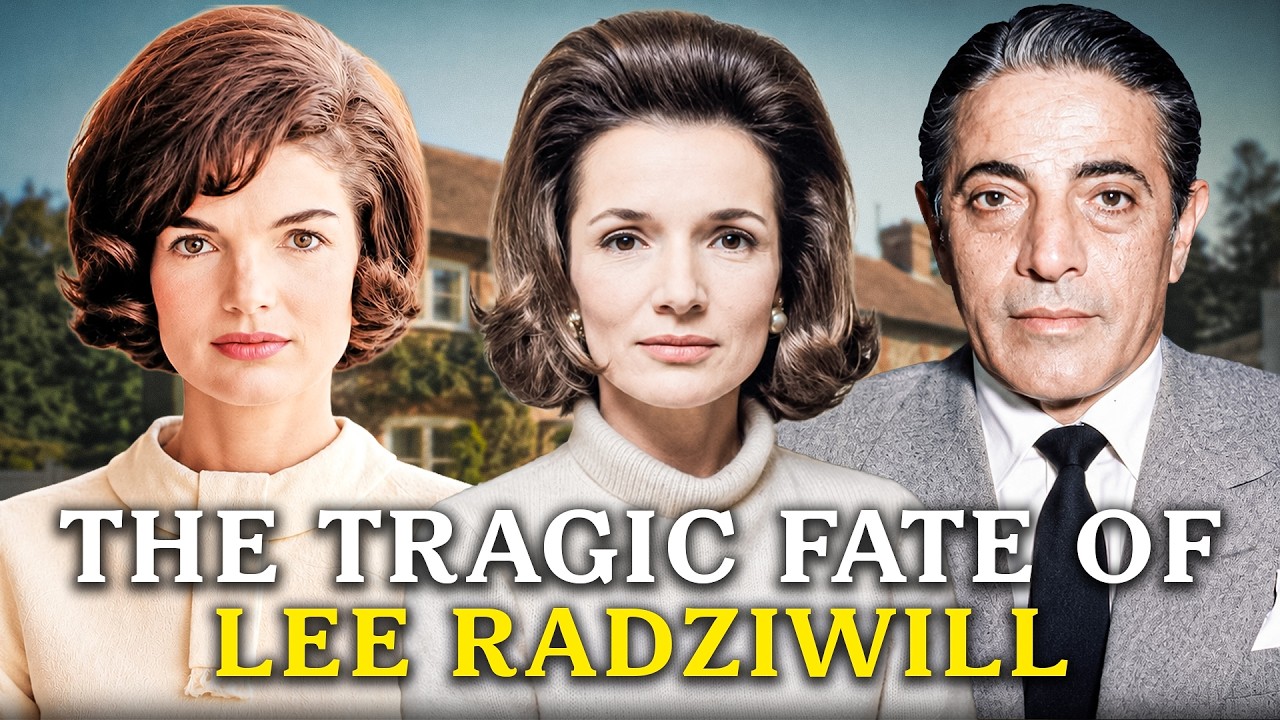
Their father, John Vernou Bouvier III, was handsome, charismatic, and genuinely adored by both daughters. He was also unreliable and financially reckless, and his marriage to their mother, Janet, was organized around barely concealed contempt. The knowledge that each parent had a preferred child left marks that never fully healed, influencing how the sisters related to each other and the world. Jackie and Lee were genuinely close, sharing humor, aesthetic sensibilities, and a real bond.
Their mother had raised them to compete for the highest rungs of American society, and both were beautiful and intelligent. Lee was more fun at a party, but fun was not the primary currency in the competition they were running. Jackie was the one who, at 17, was already operating at the highest level of the world their mother had prepared her for. Lee married first, in April 1953, and became a princess before Jackie became a first lady.
She had real style, real intelligence, and real warmth. Yet her life kept arriving at destinations her sister then occupied more completely. The specific cruelty was that she was not chasing Jackie’s life, but her own life kept intersecting with her sister’s in ways that made the comparison inevitable. The introduction of Aristotle Onassis was the most dramatic instance of a competition that had been running since they were girls.
Onassis was short, stocky, and immensely powerful, charming in the specific mode of very powerful men. He viewed women as a category of acquisition alongside yachts and paintings. Lee was still married to her second husband, Stas Radziwill, when she met him, and Onassis was still involved with Maria Callas. In the summer of 1963, Jackie Kennedy was in the midst of the most devastating period of her life.
Lee arranged for her sister to spend time on Onassis’s yacht, bringing her glamorous, recently bereaved sister into close proximity with the most magnetic man she had ever met. The trip happened because Jackie needed it. The first lady of the United States was seen on the deck of a billionaire’s yacht in the Aegean, visibly alive again after the summer’s grief. Lee was on the same yacht.
What followed between Onassis and Jackie was not immediate or straightforward. Any relationship Jackie pursued carried enormous public and political consequences. For Lee, this was not simply a romantic disappointment. Onassis was the man who had money and power in the combination their mother had identified as the formula for a complete life.
Lee had been first, and then her sister had received the prize. When Jackie Kennedy married Aristotle Onassis on October 20, 1968, it was one of the most shocking events in the cultural history of the decade. Lee reportedly wept when she heard the news. Not because the affair had been ongoing, but because the hope of it had been.
She had been first, and then her sister had received the prize. After Onassis, there was no recovery for the relationship. When Jackie died, her will contained a single sentence addressing the omission of Lee, and that sentence has been quoted and discussed for decades. The language described something that was real but bounded, an obligation that had been discharged in a way Jackie had decided was sufficient.
The effect was devastating. Lee was genuinely bereaved. The relationship, whatever its complications, was the most central relationship of her life. In her final decades, she became a brand ambassador for Giorgio Armani, a role that suited her perfectly and used her genuine aesthetic intelligence.
She wrote a memoir titled “Happy Times,” not all times, not the defining times, but the happy ones. The obituaries all mentioned Jackie. In every country, in every publication, she was described first as Jacqueline Kennedy Onassis’ younger sister. What the story was really about was spending a life measured against someone else.
There is a version of Lee Radziwill’s life that the world never quite got to see, a version in which she was simply herself, remembered not as Jackie Kennedy’s sister, but as Lee.