A blistering radio message sent to Colonel Russell Ayers at 12:10 on the morning of June 24, 1944, declared that an advance of just 50 yards in an hour and a half was “most unsatisfactory. ” The Army general who sent it ordered the regiment to start moving at once. The complaint had already traveled down the chain of command earlier that morning, when Lieutenant General Holland Smith of the Marine Corps, commanding all three American divisions ashore on Saipan, told Army Major General Ralph Smith he was highly displeased with the 27th Infantry Division. The displeasure reached the men on the ground quickly.
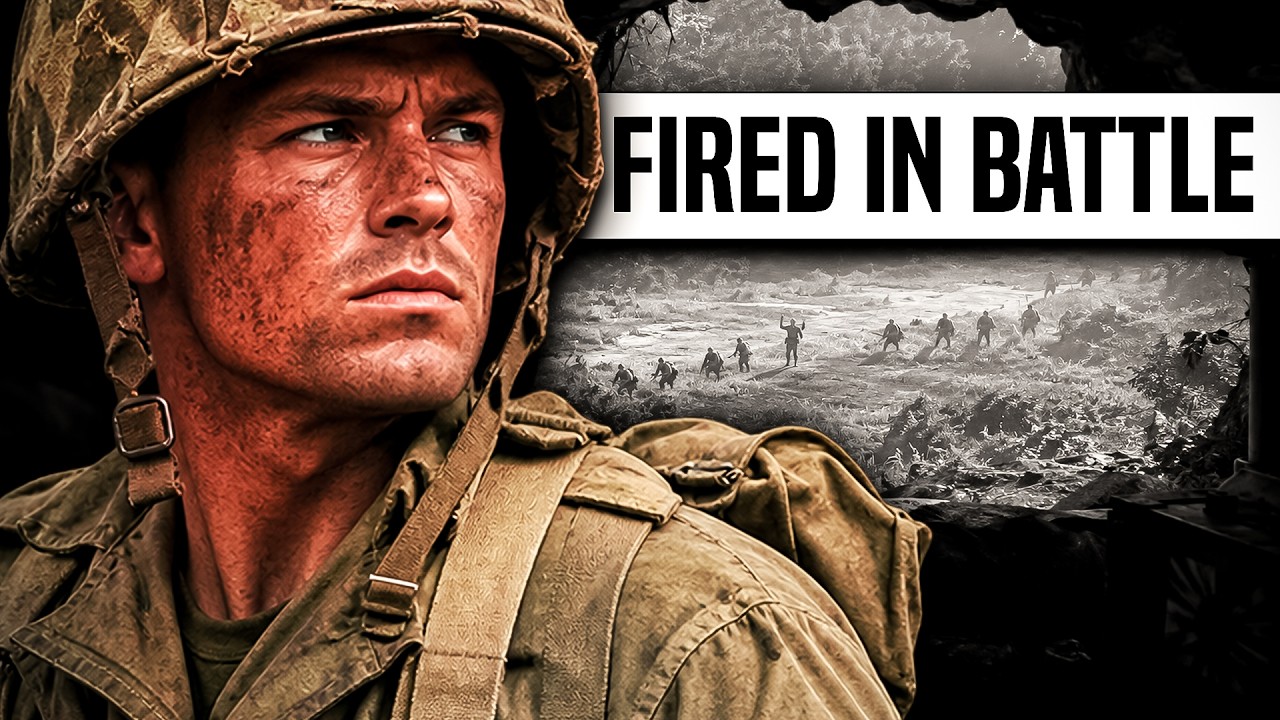
Company K of the 106th Infantry went out in response, with Captain William Hemenway placing two platoons side by side in a long thin line and leaving his third at the mouth of the valley for cover. The line advanced 50 yards without a shot fired. Then the entire cliff seemed to open up at once, and the company broke into a run for a fold in the ground. Hemenway stopped there to straighten his line and was shot in the head as he got up to wave the men forward.
Lieutenant Jefferson Noah Aakes came forward to take command. This was not the first time Holland Smith had timed this division. Seven months earlier, he had watched it from a battleship. In November 1943, the 165th Infantry went ashore on Makin Atoll in the Gilberts, where the Japanese had about 300 fighting men plus a labor force.
Holland Smith waited offshore on the Pennsylvania while his second Marine Division landed at Tarawa that same morning. His 1949 memoir described Makin as an island that ought to have fallen in a single day, taken by soldiers he called “infuriatingly slow. ”
The memoir offered a long list of complaints about the operation. It described a night ashore on a cot outside a command tent with nervous sentries firing at shadows and rounds clipping coconuts off the trees, while his two Marine orderlies spent the night in foxholes.
The heaviest charge concerned Colonel Gardner Conroy, the regiment’s commander killed by a sniper on the first day. Holland Smith wrote that two days later he found the body still lying where it fell, a few yards off the main road, never picked up by the colonel’s own men. The man who held the burial service told it differently. L.
W. Yarwood buried Conroy in the Gate of Heaven Cemetery on Makin the day after he was killed and swore to it in an affidavit in September 1950, a year too late to make it into the book. The radio message ending the fighting went from Ralph Smith to Admiral Kelly Turner on the morning of the fourth day, saying Makin was taken. Tarawa was declared secure that same afternoon.
Back at Pearl Harbor, Holland Smith later claimed he told Admiral Nimitz that if Ralph Smith had been a Marine, he would have relieved him on the spot. On Saipan, the whole division was under his command. The regimental journals for the day before the radio message show how it came into the line. At half past five, as day broke, the 106th and 165th started for the front on routes that crossed.
At about 6:20, the head of one column cut straight into the other and split a battalion in two. Nothing could be sorted out until both reached a clearing where they were meant to part. Officers stood there pointing Jeeps and riflemen in different directions. The 165th took over its piece of the Marine line at 10:00 on schedule, but Company K, caught behind the tangle, did not reach its place until 10:55, and the whole attack waited for it.
The soldiers called the ground in front of them Death Valley. It was a narrow trough on the eastern flank of the island’s big mountain, with the mountain’s cliffs on the left and a chain of wooded hills the men named Purple Heart Ridge on the right. The floor between had very little cover beyond farm buildings and clumps of trees. The division’s chief of staff, Colonel Albert Stebens, described hillsides pocketed with caves and hidden guns that fired only when lines passed, so the fire came into the backs of men who had already walked by.
The caves also ran at right angles to the line of fire of American artillery, so the howitzers could not reach into them at first. The Japanese holding the valley were not a first-class force. One of their regiments had been torpedoed on its way to Saipan and came ashore stripped of nearly all its weapons, and another had been badly used up in the first days of the landing. But both were dug into the caves along the valley walls.
The journals make that first day a string of short efforts that ended where they began. A battalion of the 165th waited at a tree line for Company K, went out onto the open floor, was caught between the cliff and the ridge, and came back under smoke to the same trees. Company K had its first scout hit by a machine gun almost at once and spent the afternoon working men forward a few at a time into a small patch of woods. Company L went up along the base of the cliff into a cove in the mountain wall the soldiers named Hell’s Pocket and stayed flat there for more than an hour while a Japanese ammunition dump blew up around them.
On either side of the valley, the Marines stopped too, waiting for the army regiments to keep pace. As darkness fell, a column of Japanese tanks came down the road that ran the length of the valley. The front tank was already too far in to be fired on without hitting Americans across the road, but both battalions opened on the ones behind it with everything they had, knocking out all of them. The front tank drove on through the lines, turned, and put a shell into a Japanese ammunition dump sitting in the middle of a battalion of the 106th.
The dump went off in every direction, mortar fire came down from the mountain on top of it, and the companies pulled back behind the fire, giving up what little ground they had taken. Holland Smith had made up his mind about that day before the tanks ever came. During the afternoon, he called in Major General Sanderford Jarman, the senior army officer on the island, who was there to command the garrison once the fighting was over. Jarman’s written statement from that day is among the exhibits of the army’s later inquiry.
Holland Smith told him the division had taken hardly any casualties, that he did not think it would fight, and that if it were not an army division with all the political noise that would follow, he would relieve its commander at once. Jarman went to see Ralph Smith and found him in agreement. Ralph Smith had been at the front most of the afternoon. He said he was not satisfied with his regimental commanders, promised to be with the troops himself when they jumped off in the morning, and said that if he did not take the division forward, he should be relieved.
The morning brought the dispatch, the radio message, and Company K’s run for the fold in the ground. By the middle of the afternoon, the battalion that had led into the valley had been pulled out of the line after its worst day on the island, and Colonel Ayers would later say the regiment had been thrown right back to its original line of departure. Holland Smith took his map out to Turner’s flagship, and the two of them went across to the Indianapolis to see Admiral Raymond Spruance, who commanded the Fifth Fleet and the whole operation. Spruance authorized the relief.
Jarman would take over until a new commander could be sent out from Hawaii. That evening, two orders for the next day went out within the same hour. Ralph Smith gave up on hitting the valley head-on, ordering one battalion to hold the mouth while the rest of the 106th swung around the far side of Purple Heart Ridge and came out at the top of the valley behind the Japanese. Holland Smith’s core order told the division to attack up the valley again with the main effort on the left.
The Army’s history of the campaign found no sign that anyone noticed at the time that the two orders pulled in opposite directions, and it judged the eastern side the more promising ground for the main attack all along. Jarman tried Ralph Smith’s plan the next day, and it failed as well. Jarman held the division for a few days. Afterward, he wrote to Lieutenant General Robert Richardson, the senior Army general in the Pacific Ocean areas, about what he had seen, and Holland Smith later printed the letter in his memoir.
It says a battalion would run into one machine gun and be held up for several hours, that a patrol coming near a bivouac at night got telephoned in as a counterattack, and that men who worked all day to take ground would fall back a long way at nightfall to dig in. How late the division had actually been that first morning turns out to be the thing nobody’s paperwork agrees on. Holland Smith’s letter asking for the relief put it somewhere between an hour and a quarter and two hours late. Three days later, in a report to Turner, he brought that down to between just under an hour and two hours.
By the time the memoir came out, the 106th had been unable to start forward until three and a quarter hours after the attack hour. The regimental journal and the army history built on it put Company K in the line just under an hour too late, with the rest of the division on time. The memoir says its figure came from reports made to him and names none of them, and nothing in the surviving files shows where that largest figure came from. The army answered on paper.
One army officer who dealt with the core staff on Saipan would later write that it held the division’s units in little esteem in a position bordering on scorn. On the 4th of July, with the battle still going on, Richardson set up a board of inquiry under Lieutenant General Simon Buckner. Because it was an army board, it could question only army officers and look only at army files. It found that the Marine general had full authority to relieve Ralph Smith, that the orders were properly issued, that he had not been fully informed about conditions in the division zone, and that the relief was not justified by the facts.
The Japanese at the mouth of the valley, the board wrote, held their main defensive position on ground made for defense, and Holland Smith had expected the 27th Division to overrun it rapidly. In Washington, Major General Thomas Handy told General George Marshall that the core commander had some cause to complain, that his fitness for his command was open to question because of a deep prejudice against the army, and that both Smiths ought to be ordered out of the Pacific. Admiral Ernest King called the board’s findings one-sided and would not agree to any further inquiry with Richardson in it. Ralph Smith went to a garrison division in Hawaii and then on to Europe.
Holland Smith was moved up to Fleet Marine Force Pacific, a command with no army divisions under it. In September, Time magazine told its readers that the soldiers at the mouth of Death Valley froze in their foxholes, and the Marine Corps’s own official history describes the letters that then arrived in the division from friends and families back home who believed every word. In November 1948, the memoir ran in three parts in the Saturday Evening Post, and the division’s official historian, Captain Edmund Love, answered in the same magazine under a headline saying the army thought Holland Smith was wrong. In 1955, the army published its official volume on the Gilberts and the Marshalls, and one of the two names on its title page was Edmund Love’s.
The Makin chapter ends with a section on what the island cost, and partway through it turns from the island to the water around it. Before sunrise on the morning after the radio message saying Makin was taken, the small carrier Liscome Bay was steaming off the atoll when one or more torpedoes from a Japanese submarine nobody had detected hit her amidships. Her bombs went off, and she sank in less than half an hour. 644 men went down with her, Rear Admiral Henry Mullinnix among them.
She had been standing by to give air cover to Turner’s ships on their voyage home, and historians wrote that if the island had been taken faster, she would have been out of those waters before that morning. The book says the sinking gave point to an argument often heard in naval circles that fighting ashore which runs past the time it truly needs puts the ships at risk. It quotes Holland Smith on Makin and finds that his criticism seems justified, the more so once a carrier is added to the bill. His memoir, for all its pages on Makin, never names the Liscome Bay.
Edmund Love put his name to a book that cited his old opponent on Makin. In January 1955, Harry Schmidt wrote to the Army’s Chief of Military History. Schmidt had commanded the Fourth Marine Division on the valley’s eastern flank, and after Saipan he took over the core from Holland Smith. About the 27th Division’s week in Death Valley, he wrote, “No one had any tougher job to do.
”
Five years later, the Army’s history of the Marianas campaign gave its verdict on the two days that started it all. It found that Holland Smith’s own orders about which unit controlled the troops on the southern point had never been clear and called that part of his case a weak legal peg. It found the 106th late and hesitant and the Marines on both flanks harder hit and further forward. It concluded that Holland Smith had good reason to be disappointed with the division on those two days, that the wisdom of what he did about it was doubtful, and that the relief did nothing to speed the capture of Death Valley.
The valley fell on the 30th of June, six days after the relief. By then, the ground Company K had crossed on the morning of the radio message lay behind the division, the open floor, the wall of rock, the fold in the ground where a captain had stopped to straighten his line.