A Confederate band perched near the battlefield at Gettysburg in July 1863 played polkas and waltzes while shells hissed and burst around them. The musicians were Moravians from Salem, North Carolina, members of the 26th North Carolina’s band, and they were trying to offer what their religion taught them to share in the midst of chaos: melodic sanity, a soothing presence, music as medicine for the soul. The scene was observed by English military attaché Lieutenant Colonel Arthur J. L.
Fremantle, who noted the strange juxtaposition of dance tunes and the sounds of death. It was a moment that captured something essential about the Civil War soldier’s experience, where music was not a luxury but a necessity. By the spring of 1861, armies on both sides were swelling with citizens who had become soldiers almost overnight. They faced homesickness, illness, the monotony of camp life, and the horror of battle.
In response, they sang constantly, whether alone, in small groups, in glee clubs, or around campfires. Historian Bruce Catton called them the “singingest armies in American history,” and Robert E. Lee himself once remarked, “I don’t believe we can have an army without music. ”
Many soldiers carried instruments with them into the field, including violins, guitars, banjos, and harmonicas.
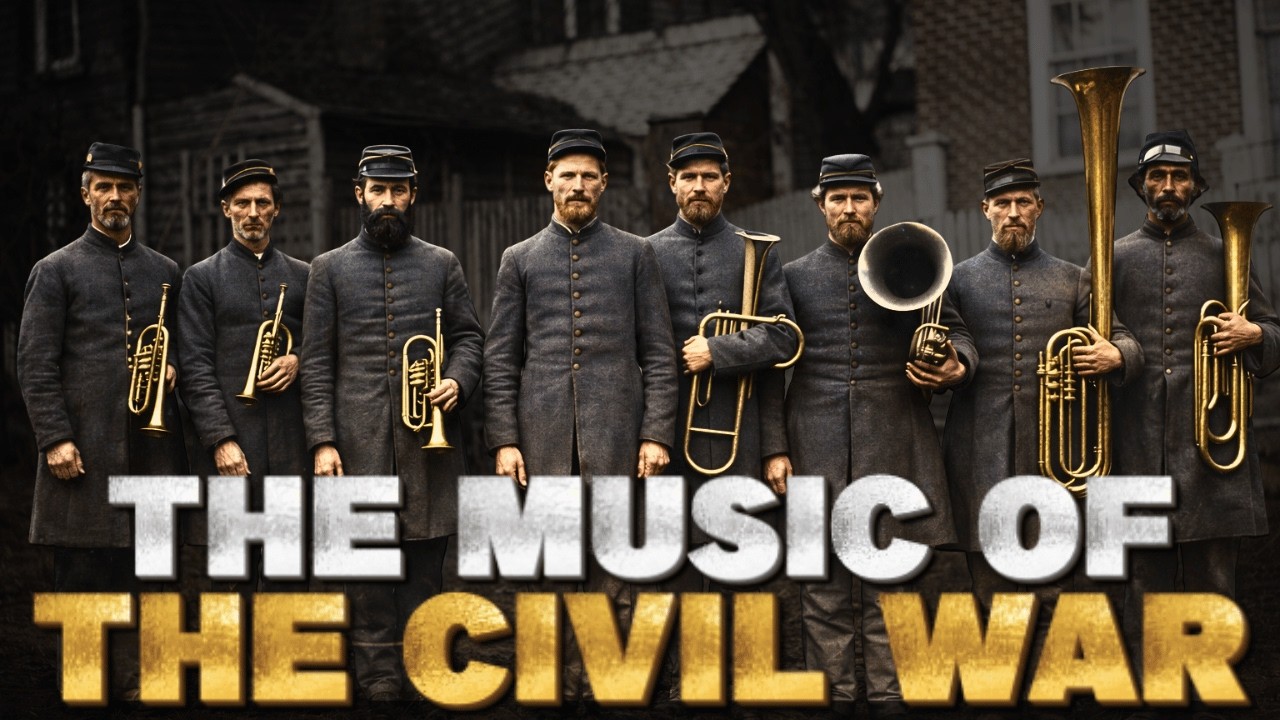
Formal military bands were also established. In May 1861, the War Department authorized bands for federal regiments, though later orders restricted their size and eventually consolidated them at the brigade level. By December 1861, the Union had some 28,000 musicians in 618 bands, a ratio of roughly one musician for every 41 soldiers, and the Confederacy relied on a similar proportion. Bands played at twilight concerts, serenaded commanding officers in the hope of small rewards, and made holidays away from home more bearable.
One soldier from the 24th Massachusetts wrote that he did not know what his regiment would have done without its band, praising the nightly concerts that featured opera selections and original compositions. The instruments of the era were predominantly brass, often built with bells that pointed backward over the shoulder so marching troops could hear the music. Allen Dodworth’s patented rotary-valve brass instruments became popular in both North and South during the war, though both he and his instruments faded into obscurity afterward. Sheet music was published in large Northern cities, and publishing houses produced thousands of songs in pocket songbooks and broadsides.
Among the most popular tunes was “John Brown’s Body,” a song Northern soldiers constantly adapted, changing lyrics to reflect their moods or to mock Confederate leaders. Julia Ward Howe wrote new lyrics to the melody in November 1861, creating “The Battle Hymn of the Republic,” which was first published in The Atlantic Monthly in February 1862. Historian Bell Irvin Wiley later noted that Howe’s dignified version never quite surpassed the popularity of the original lyrics among soldiers. George Frederick Root was another prolific Northern composer, responsible for wartime hits like “The Battle Cry of Freedom.
” In one documented moment during the fighting in the Virginia Wilderness in May 1864, a member of the 45th Pennsylvania began singing the chorus “We’ll rally round the flag, boys,” and his comrades instantly joined in, lifting their spirits after they had been forced back in disorder. Other popular songs included Henry Tucker’s sentimental “Weeping Sad and Lonely, or When This Cruel War Is Over,” which appealed to soldiers on both sides for its longing for peace. Joseph Philbrick Webster’s ballad “Lorena,” written after his own broken engagement, became a favorite among Union and Confederate troops alike, as did “Home, Sweet Home,” which was so meaningful that it was often sung with choked voices. Not all songs were sentimental.
Rousing tunes like “When Johnny Comes Marching Home,” written by Irish band leader Patrick Gilmore under the pseudonym Lewis Lambert in 1863, remained popular long after the war. Henry Clay Work’s “Marching Through Georgia,” written in 1865 to commemorate Sherman’s March to the Sea, became immensely popular with federal veterans after the conflict, though Sherman himself came to despise the song because it was played at nearly every public appearance he attended. Generals also inspired music. Songs praised George B.
McClellan during his rise, such as “For McClellan’s our leader, he is gallant and strong,” and after his removal, one tune asked to “Give us back our old commander. ” Out west, William S. Rosecrans had his admirers singing “Old Rosie is our man,” and even Ulysses S. Grant, who was tone-deaf and once admitted he knew only two songs, had a tune written for him in 1864 called “Ulysses Leads the Van.
”
In the South, soldiers also sang constantly, forming glee clubs and enjoying what they called “musical sprees” or “jubilees. ” Publishers in New Orleans, Richmond, Raleigh, and Mobile issued songbooks with titles like Songs of the South, The Stonewall Song Book, and The Jack Morgan Songster. Ironically, Stonewall Jackson, like Grant, was known to be quite tone-deaf. The most popular Southern patriotic tunes included “Dixie,” written by Ohio-born Dan Emmett for a blackface minstrel show, and “The Bonnie Blue Flag,” written by Irish-born entertainer Harry McCarthy.
While Emmett was disturbed that his song had been turned into a Confederate anthem, Northern versions of Southern songs also appeared, with altered lyrics mocking the Confederacy. Sentimental ballads like “Annie Laurie” and “Home, Sweet Home” were widely sung in Southern camps, as were hymns like “Amazing Grace,” “Rock of Ages,” and “Nearer My God to Thee. ” Instrumental pieces like “The Mockingbird,” a favorite of Abraham Lincoln’s, and “Hail Columbia,” which was used as an unofficial national anthem for much of the 19th century, were also common. One of the most striking examples of music’s power came in the winter after the Battle of Fredericksburg.
The Union Army of the Potomac and Lee’s Army of Northern Virginia were camped on opposite banks of the Rappahannock River, their morale low after the terrible Union defeat in December 1862. One late winter day, a federal band began a moving concert, playing patriotic tunes like “Hail Columbia” and “We Are Coming, Father Abraham. ”
Their music drifted across the icy river, and Confederates gathered on the opposite bank to listen. One Confederate soldier shouted, “All right, play some of ours,” and the Union band responded by playing “Dixie” and “The Bonnie Blue Flag.
” Men from both sides began singing together. As the sun set, the band played one final song: “Home, Sweet Home. ” Soldiers on both sides of the river joined in, many with tears streaming down their faces. When the final notes faded, there was not a dry eye on the Rappahannock.
For one brief moment, the war felt a thousand miles away, and the men were all Americans again, touched by the soothing power of music.