On July 3, 1863, Confederate officer James Francis Crocker marched across the fields of Gettysburg, Pennsylvania, as part of Pickett’s Charge. He described the assault as men dropping around him like pins, closing ranks, and dropping again. By the time he reached the stone wall near the Angle, he had been shot in the right hip and went down. With the men around him dead or retreating, he was left behind enemy lines and captured.
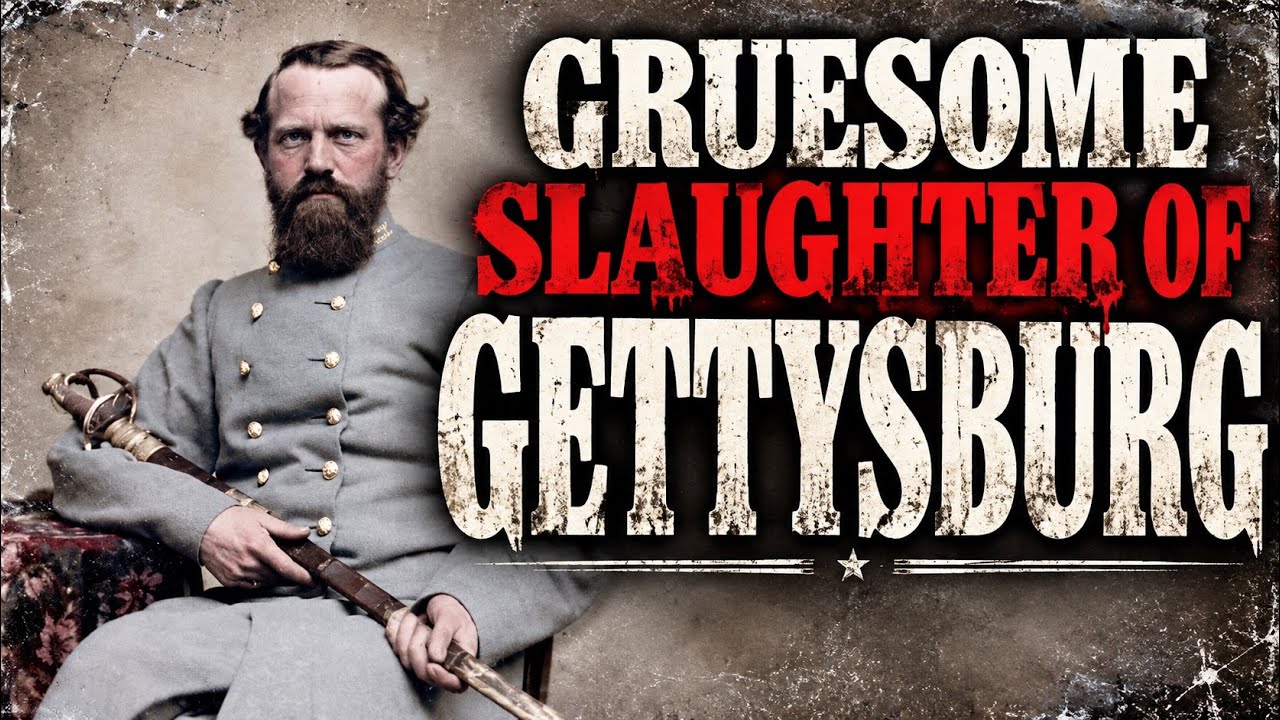
But when Crocker was taken to a field hospital for treatment, a familiar face stood over him. The man recognized him, and the reason behind that recognition became one of the strangest stories of the battle—a story that connects a Confederate officer to the very town he had come to fight against. Crocker was born in Virginia in 1828 into a wealthy plantation family. After his birth father died when he was just six months old, his mother remarried twice, and Crocker grew up with considerable money and property.
That wealth afforded him a college education, which he pursued in the North at Gettysburg College, where he graduated as valedictorian in 1850. He later became a lawyer. When the Civil War broke out after Fort Sumter was fired upon, Crocker enlisted as a private in Company K of the 9th Virginia Infantry. His intelligence quickly set him apart, and he was promoted to officer rank, eventually serving as adjutant.
Almost a year before Gettysburg, at the Battle of Malvern Hill, he was badly wounded by shrapnel to his shoulder, throat, and face. He managed to crawl back to safety and recovered before rejoining his unit at Fredericksburg. By early July 1863, Crocker and the 9th Virginia had marched to Gettysburg. On the night of July 2, they camped in Spangler’s Woods, knowing that many of them would not survive the next day.
Their unit suffered over a 50 percent casualty rate at Gettysburg, with dozens killed, wounded, or captured. At dawn’s light, the men of the 9th Virginia stepped out onto the open field. They had little idea of the enemy’s position, and by then Robert E. Lee had already decided to launch a massive assault on the center of the Union line.
Confederate artillery opened fire, and when the guns fell silent, thousands of soldiers formed up and marched across the fields in parade-ground order. Union soldiers described the advance as both terrifying and magnificent. Crocker’s unit advanced behind Garnett’s brigade, crossing fence lines and under heavy fire. Cannonballs tore holes through the ranks; men were killed and maimed in plain sight of their comrades.
Crocker later recalled watching the lines in front of him fall apart, and as his own men reached the Emmitsburg Road, they began to take heavy hits. Bullets flew from every direction as the Confederates pressed toward the Angle near a copse of trees. Crocker watched Brigadier General Lewis Armistead pierce his hat with his sword and urge his Virginians forward over the wall. Shortly after, Crocker was hit.
The bullet struck his right hip, spinning him to the ground. He lay wounded as the Confederate attack collapsed and the survivors streamed back across the field. Union soldiers moved forward and took him prisoner. Because of Crocker’s deep connections to Gettysburg, he was treated with unusual leniency as a prisoner of war.
He was taken to the Bushman farm, where he received medical treatment. There, he encountered Professor Stove, a faculty member from Gettysburg College—the same college from which Crocker had graduated as valedictorian in 1850. The professor recognized him and stood over him as he lay wounded on the field. Crocker was granted the privilege of walking about town under supervision.
He visited old friends, spoke with colleagues, and even met with college professors. He knew the streets of Gettysburg better than many of the scouts who had surveyed the area. Wounded and captured, he was welcomed back by a town he had grown up among as a student. He was later sent to Johnson’s Island, a Union prison camp where conditions were harsh and prisoners suffered from hunger and deprivation.
While imprisoned, Crocker reportedly told northern newspapers that the South would never be vanquished and would sacrifice its children in the fight before surrendering. His prediction proved wrong. He survived the war, watched the Confederacy fall, and returned to Virginia. After the war, Crocker resumed his career as a lawyer, eventually becoming a judge and serving in the Virginia House of Delegates.
He also served on the board of the College of William and Mary. He died in Virginia and is buried in Portsmouth. Crocker came to Gettysburg twice: first as a young student building a future, and later in a Confederate uniform with the intent to destroy the nation he had once studied within.
Both times, the town received him—once with open arms as a student, and again, even as a wounded enemy prisoner, it did the same.