In 1974, six comedians traveled to Scotland with five weeks of rain ahead of them and a budget that could not cover a single horse. Two of the directors had never made a feature before, and the production cost roughly £229,000. It became the most quoted comedy in the English language, largely because so much of what could go wrong did go wrong. No studio would finance the project.
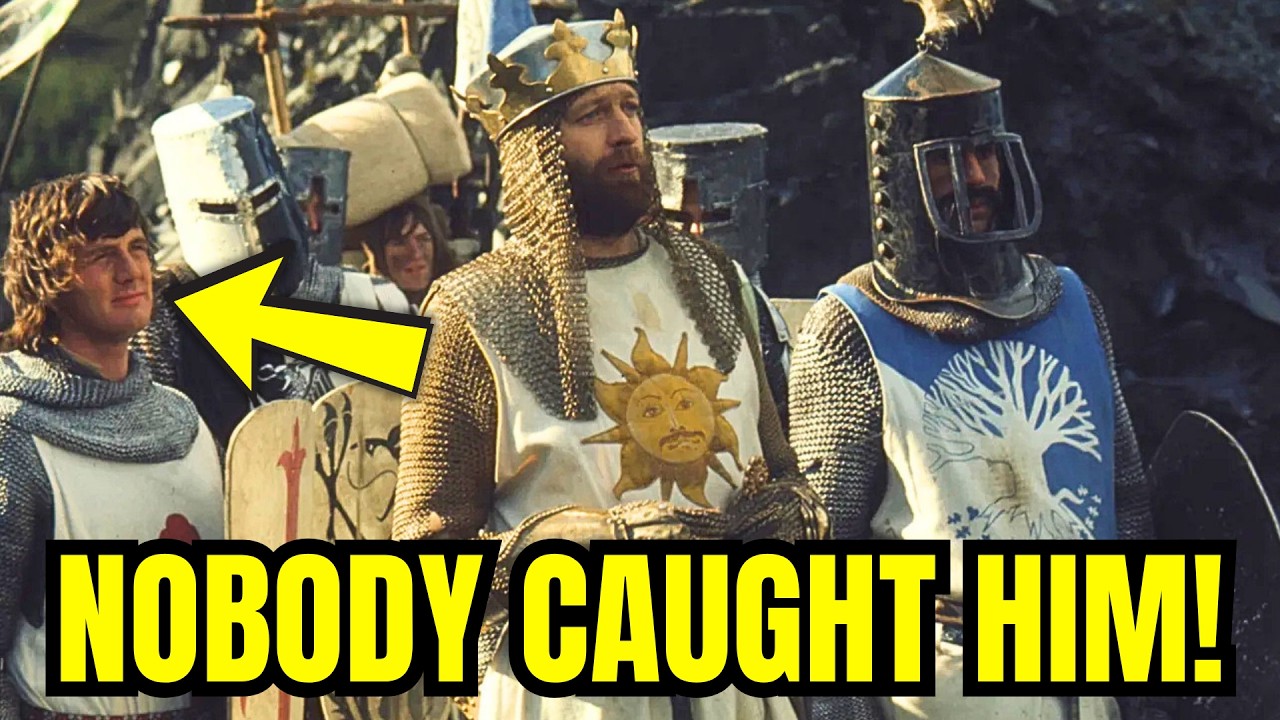
Rock stars did. With the top UK income tax rate at 90 percent, musicians with sudden fortunes needed tax shelters, and a project that lost money was useful. Terry Gilliam compared the arrangement to the musical “The Producers,” where the scheme only works if the show fails. The original budget was a little over £175,000.
Producer Michael White put up the largest share. The rest came from Led Zeppelin, Pink Floyd, Island Records, Chrysalis, Ian Anderson of Jethro Tull, Charisma Records, and Tim Rice’s cricket team, The Heartaches. None of the backers visited the set or asked for changes, which Eric Idle later called ideal. The production could not afford horses, so the knights of Camelot rode on the sound of two coconut halves banged together.
The hollow wooden clop was produced a few feet behind each actor. British radio drama had faked hooves with coconuts for decades, so listeners recognized the sound instantly. The decision became the spine of the film. The first scene is an argument about whether a swallow could carry a coconut to a temperate climate.
Germany released the film as “Die Ritter der Kokosnuss,” and Hungary called it “Galloping on Foot. ”
Scotland effectively banned the production from its castles. Two weeks before filming, the Scottish Department of the Environment withdrew every castle in state care, worried the Pythons would do something inconsistent with the dignity of the buildings. Terry Jones and Terry Gilliam went rescouting in a sports car.
They found Doune Castle, privately owned and beyond the department’s reach. Doune played almost every castle in the film. The great hall became Camelot. The kitchens became Castle Anthrax.
The courtyard hosted Swamp Castle’s wedding. Two exteriors came from Kidwelly in South Wales and Bodiam in East Sussex. Castle Stalker stood in for Castle Aaaaarrrrrrggghhh. Everything else was a hanging miniature, which is why the famous line “It’s only a model” is closer to documentary than intended.
The silliest-looking picture of its decade was also one of the better researched. Terry Jones had been a serious student of the Middle Ages long before making films. He published “Chaucer’s Knight” and later presented the BBC series “Terry Jones’ Medieval Lives,” earning an Emmy nomination in 2004. The grime and damp on screen read as symptoms of a small budget, but they were also a deliberate correction to the scrubbed, heroic Arthurian Britain Hollywood had been selling for decades.
Day One nearly killed the film. The unit set up in May 1974 at the meeting of three waters in Glen Coe to shoot the Gorge of Eternal Peril. Every case, lamp, and length of cable went up the mountainside on somebody’s back. On the very first call of action, the main camera sheared its gears.
The crew was stranded on a mountaintop with one remaining camera that could not record sound. The bridge at the gorge spanned a genuine drop nobody wanted to cross first. Terry Jones walked it himself until the argument stopped. That evening, the production held an emergency meeting.
The watchword that came out of it was “Don’t panic,” which was not being used as a joke. Julian Doyle was fighting a separate war. With no production phone at the hotel, he stood at a village pay phone with a bag of two-pence pieces, feeding them in one at a time while trying to order 200 weapons and 200 costumes from London. On the call sheet, the directing job was split cleanly between the two men in charge.
Neither could overrule the other, and both were learning the trade on a picture that had started going wrong within an hour of the first take. Both later described the experience identically: learning how to make a feature by making an entire feature. Gilliam composed shots like animation frames. Jones protected performances.
Where those priorities collided, there was no tiebreaker. The directors were also cast members who had co-written the script, so every instruction was one peer correcting another. The chain mail was knitted wool. Costume designer Hazel Pethig was working to about one pound per costume.
The knights wore wool and string treated and sprayed to read as metal on camera. It was an old theatrical trick that works under stage lighting indoors but behaves badly in the wet Highlands. Wet wool soaks, doubles in weight, and stays that way. The cast spent five weeks in suits that itched, sagged, and smelled worse daily.
Michael Palin ate mud until he snapped. Seven takes in, the performer crawling through the plague village was still doing exactly what had been asked of him: gravel through the filth and eat a handful with visible relish. Palin had a minor part in that sequence. The handful he swallowed was chocolate-colored to match what he was lying in almost perfectly.
Each time Gilliam called cut for a reason unconnected to Palin’s performance, such as a cartwheel resting a fraction out of position. Palin threw himself down and shouted that the whole thing was a waste of everybody’s time, in front of the entire unit. The set went silent. Then Cleese and Chapman started applauding.
Palin does not appear in the finished sequence at all. Graham Chapman was in the middle of a long struggle with drinking. There was trembling and lapses of memory on lines he knew perfectly well. At the gorge in Glen Coe, he was gripped by a fear of heights.
He stopped drinking for the duration of the shoot to stay, as he put it, on an even keel. That got him through five weeks and through the performance the whole film rests on. Lasting sobriety came later, in December 1977. Palin later suggested that Chapman’s “manic confusion” suited a king whose quest is falling apart around him.
Ten days before the unit left for the Highlands, the producer telephoned the cast to ask whether anybody would mind sharing a hotel room. The six writers and stars took roughly £2,000 each for writing the film and appearing in it. Extras were on about £2 a day. Around 19 university students were hired at that rate to play the women of Castle Anthrax.
The total spend on special effects was about £5,388, covering every explosion, miniature, and drop of stage blood. There were no lavatory facilities at any of the locations. Julian Doyle was out at 5 in the morning searching the roadside for a dead sheep the catapult could launch. When the ending needed a police car, he dressed his own vehicle as one and played the inspector himself.
Six actors played 38 parts. Doubling was standard practice in British comedy of the period, inherited from stage revue. On television, sketches are separated by costume changes the audience never sees, so the doubling stays invisible. Compressing the same technique into one continuous narrative makes the world feel populated by a very small number of people, which suits a kingdom that cannot afford horses.
John Cleese played Lancelot, the Black Knight, the French taunter, and Tim the Enchanter. Palin narrated while playing Galahad, Dennis the political peasant, the Lord of Swamp Castle, and the leader of the Knights Who Say Ni. Gilliam appeared as Patsy, the bridgekeeper, Sir Bors, and the animator who dies. Carol Cleveland played both Zoot and her identical twin Dingo.
Connie Booth, then married to Cleese, was the woman accused of being a witch. The Black Knight sequence was shot in Epping Forest. The production hired a performer who had one leg, fitted him with an artificial one for the sword to remove, and buried his real leg in a hole so he could stand upright and correctly proportioned in the frame. He was in that hole for hours, and by the end, the leg had gone completely numb.
Michael White, who had put more money into the film than anyone else, watched the sequence and decided it was too bloody. He had it lifted out of the cut. Julian Doyle put it back quietly, slipping it into the cut where it stayed all the way through to release. The killer rabbit’s owner was furious.
The production borrowed a small white animal from someone local, intercut it with puppets, then covered it in red stage dye. Nobody asked first. The person who had lent it had been clear about not wanting it dirtied. The dye went deep into the fur and would not come out, and the animal went home permanently pink.
It was unharmed throughout, but unrecognizable to the man who got it back. Gilliam admitted years later that the obvious answer would have been to buy one of their own. There is a battle in the drafts that never reached the film. Michael Palin’s archive at the British Library holds notebooks documenting an alternative climax at Castle Aaaaarrrrrrggghhh.
Five weeks in, the money was gone. What replaced it cost close to zero. Police cars arrive. Arthur is arrested for the murder of a historian.
An officer puts his hand over the lens and the picture stops. Palin has argued ever since that the cheap version is funnier because a film that has spent 90 minutes deflating heroic narrative has no business ending heroically. John Cleese has never come around to it, saying it still annoys him. Most of the music in the finished picture was never written for it.
It came off a shelf from a commercial library. Neil Innes, effectively the seventh member of the group, was commissioned to score the whole film. He delivered the score, and the team replaced almost all of it with canned cues from the DeWolfe library. The score was not bad; it was too good a fit.
Genuinely medieval scoring quietly undercut what the film was doing, which was undercutting the medieval world. Library music written for adventure serials took the knights completely seriously, and that gap is where much of the comedy lives. One sequence had no ending. The Legendary Black Beast of Aaaaarrrrrrggghhh chases the knights down a tunnel toward a conclusion the budget could not pay for.
So the film killed the man drawing it. The animator suffers a fatal heart attack. The pen stops moving, and the creature vanishes because there is nobody left to move it. Gilliam plays the animator himself.
The scene was shot in a workroom belonging to Henry Moore’s daughter, borrowed for the day. Doune Castle is still Camelot. The government body that once refused the production access to the buildings in its care now markets one of them partly on the strength of what got shot there. Doune is run today by Historic Environment Scotland, and its audio guide was narrated by Terry Jones, who mixed genuine castle history with filming anecdotes.
Staff describe people cantering around the courtyard clapping coconut halves together. The shop sells Python merchandise alongside Outlander and Game of Thrones material. The meeting of the three waters in Glen Coe now draws people looking for the Bridge of Death, a spot with no bridge, no signage, and a half-hour climb over rough ground. A shoot that only happened because of a refusal is one of the reasons people booked the trip north in the first place.
Half the film was shot in a garden. Once the unit came back from Scotland with the money spent, the missing pieces got made around North London for almost no money. The fight with the rabbit was staged in Julian Doyle’s own back garden. The Grail appearing in the sky was done in his front room.
The cheapest trick is the one nobody notices: that long, slow zoom into the Dark Forest of Ewing is a still photograph. It shows a gorge at Mount Buffalo National Park in Australia, with candles burning underneath the frame. Even the opening coconut scene was filmed on Hampstead Heath, where an aircraft passed overhead and Chapman looked up and remarked on all those people up there having their gin and tonics. The credits gag bought them time.
The opening titles run on fake Swedish subtitles that begin as ordinary translation and slide into an unmanageable obsession with moose. The subtitlers are sacked, and the people who sacked them are sacked in turn until everything collapses into llamas. Executive producer John Goldstone ends up sharing his credit with Ralph the Wonder Llama. An epic needs an epic front end, and sweeping imagery costs money.
Text costs almost nothing. The Washington Post once cited the sequence as evidence that the Pythons had no idea when to drop a bit. It has aged into one of the most quoted title sequences in comedy. Nobody laughed at the first cut.
The screening room held the people who had put up the money. For the entire length of the picture, the only sound came from the speakers. Executive producer John Goldstone described it going down like a dead balloon. Finishing properly needed another £30,000, and there was a real prospect of the whole thing being shelved.
What saved it was months of re-editing while the soundtrack was stripped out and rebuilt. Screening after screening went by without a laughing audience until the film played in Los Angeles. Jones phoned in from the airport before that screening with instructions to take another 24 seconds out of the picture. The cut went in, and the audience laughed anyway.
After a screening arranged for the British Board of Film Censors, a representative made a list. The board had warned the producers the film was heading straight for an X certificate, which shut out anyone under 18. Producer Mark Forstater made a counter offer in a letter, proposing to give up the first three items and keep the last three. Those last three included the French taunter’s declaration about the general direction of his contempt and the threat involving castanets.
Two of the most quoted lines in British comedy survive because a producer haggled over them on paper. Malaysia has never lifted its ban. The man who bought the American rights saw almost none of the picture. Don Rugoff ran Cinema 5.
He came to the Los Angeles festival screening to look at the film, and narcolepsy put him to sleep somewhere in the middle. He bought the film anyway on the strength of the room. The advertising rested on the boast that the film makes “Ben-Hur” look like an epic. The first thousand ticket buyers in New York were handed free coconuts on the way in, and some had been queuing since 5:30 in the morning.
The first week took around $35,000 in New York alone. By the end of 1978, UK distributor receipts had passed £2. 3 million. Roughly ten funny moments and seventy minutes of silence.
That was one contemporary verdict. Reviews split hard. Vincent Canby and Charles Champlin came down in favor, treating the film as something genuinely new. Variety dismissed the plot as a coat hanger for set pieces.
What built the reputation was repetition. American college campuses adopted it wholesale, and midnight bookings kept it running for years. Empire once reported that Elvis Presley ordered a print for himself and reportedly ran it five times. In 1977, when a network broadcast cut the film for language and content, the Pythons pulled the broadcast rights rather than accept the edit.
Forty-three seconds was how long it took to sell out the O2 Arena in 2014. The reason those shows existed was a court judgment. Eric Idle had turned the film into “Spamalot” in 2005, a musical that took the Tony for Best Musical and earned considerably more than the film it came from. Mark Forstater sued over his share of the proceeds.
He won in 2013, leaving the surviving Pythons facing roughly £800,000 in back royalties and legal costs. They paid it the only way six comedians in their seventies realistically could. Monty Python Live mostly ran at the O2 that summer, the first time the group had performed together on a stage in 34 years. The run was extended to ten nights.
Those original 1974 backers still take a share of “Spamalot. ”
Monty Python and the Holy Grail cost roughly £230,000 and five weeks of rain. It is still generating checks for people who never once bothered to visit the set. Almost everything people quote from this picture is the direct product of something the production could not afford.
The coconuts exist because there were no horses. The Black Beast vanishes because there was no ending to draw. The film stops mid-scene because the budget stopped first. Gilliam came out of it a director and never really went back.
Jones went on to direct both Python features that followed, and the structure they landed on became a template comedy is still borrowing from.