Bourbon Street in New Orleans, shortly after dark on January 9, 1965. Five men walking along the narrow sidewalk stopped when James Brown’s music blasted from an open doorway. One of them said, “Let’s take a look. ” The largest of them stood 6-foot-9 and weighed 315 pounds, the biggest man in professional football.
A bouncer pulled a gun from his belt, chambered a round, and pressed it against the man’s nose, telling him that if he stepped through the door, he would be killed. No one pulled the trigger. No blood was shed. The incident ended in less than a minute.
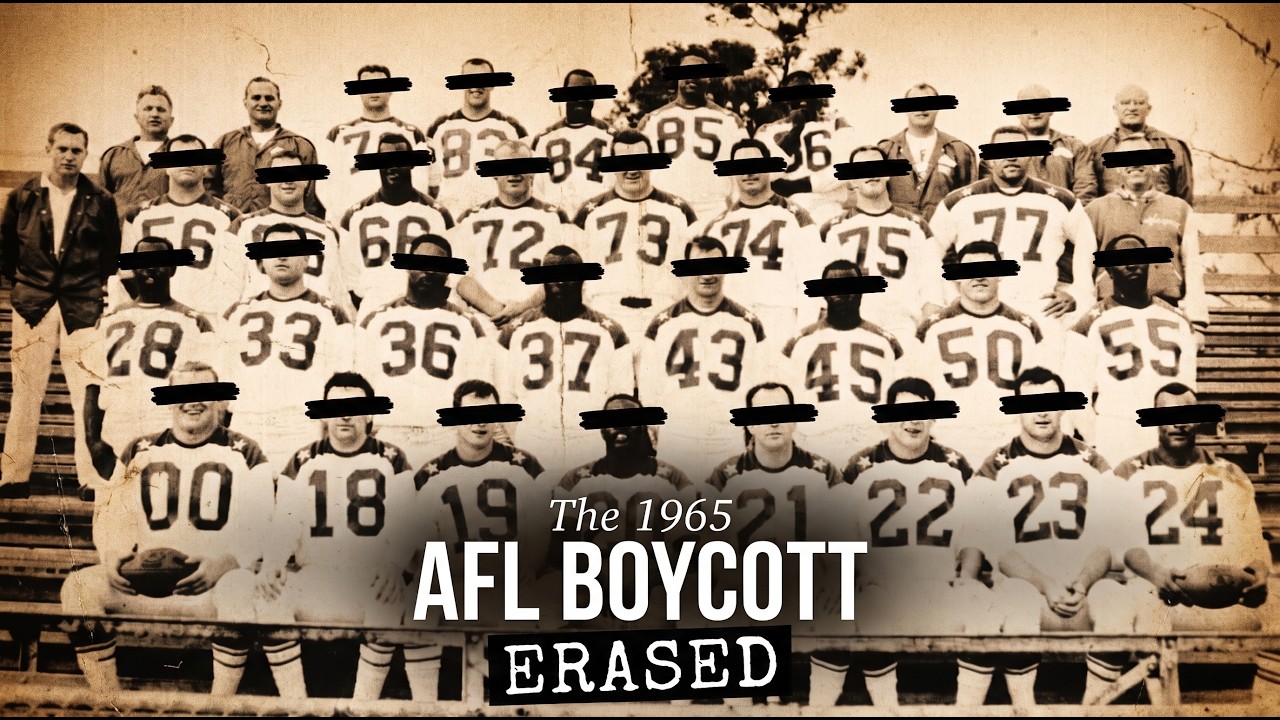
But within 24 hours, that gun cost the city of New Orleans a professional football team. What most people under 70 have never heard is this: in January 1965, more than 20 professional athletes did something that had never been done before in any sport in the history of the country. They boycotted an entire American city. It worked in less than two days.
The man who ultimately spoke for them didn’t want the job, took it only because there was no alternative, and wrote the final statement alone in an empty hotel room. To understand why this mattered, you need to understand what everyone thought would happen instead. The Civil Rights Act had been signed six months earlier. On paper, segregation in public places was over.
On the ground in Louisiana, 250 years of custom doesn’t stop because a president signed something in Washington. New Orleans was being tested. The city desperately wanted a professional football franchise, and promoter Dave Dixon had spent five years building a campaign to convince the National Football League that the city could support one. Hosting the American Football League All-Star Game was the test.
Tulane Stadium, January 16. A crowd of 60,000 was expected, the largest the AFL had ever drawn for this game. Early signs looked positive. Just a week earlier, the city had hosted the Sugar Bowl without incident, with a Syracuse team featuring eight black players in front of the first fully integrated crowd in that game’s history.
Organizers made promises. Clem Daniels of the Oakland Raiders remembered exactly what they were told: “They told us to bring our wives and children. There will also be a golf tournament. It seemed like a big treat.
” Then the planes landed. Trouble began at the curb of New Orleans International Airport, immediately. Bobby Bell, a future Hall of Famer for the Kansas City Chiefs, saw what happened in that moment. White players walked out, got into taxis, and headed for their hotels.
When black players tried to hail a cab, the white driver would say, “I can’t. ” They stood at the curb for what Bell estimated to be about two hours. Sid Blanks was 21, a rookie running back for the Houston Oilers who had played at all-white Texas A&I University. He watched cab after cab pass him by until an airport worker took pity and explained the rules.
“You have to get the right cab, son, because you’re colored. You can’t ride just any cab. ”
Cookie Gilchrist, a fullback for the Buffalo Bills known as the strongest man in the league, tried to laugh it off. When told he needed a cab for colored people, he said, “I don’t care what color the cab is, I just want to get to my hotel.
” He finally got a ride, but only because the driver spotted a white man standing beside him—Jack Kemp, the Bills’ quarterback. The driver said Gilchrist could ride as long as Kemp was the one who hired the car. That was the actual policy: a driver could carry black or white passengers, but the person hailing the cab had to be of the driver’s race. Remember Jack Kemp.
He’ll appear again. Then came the hotels. The West team stayed at the Roosevelt Hotel, integrated only weeks earlier, reluctantly, because the new federal law left no choice. The East team was several miles away at the Fontainebleau Hotel.
The players did what anyone does on a road trip. They unpacked, showered, and dressed for a night out in one of America’s great cities. Dick Westmoreland, a defensive back for San Diego, didn’t make it past the elevator. “I thought I looked pretty sharp.
I had on a nice brown suit and some cologne, Aqua Velva or whatever was popular in those days,” he recalled. “There was this elderly white woman in the elevator. As the players got off, she said aloud, ‘What’s that smell? ‘”
Then the restaurants.
Ernie Warlick was a tight end for the Buffalo Bills. He and some teammates went looking for the French Quarter food everyone had told them about. Warlick went to hang his coat on a rack, the way anyone hangs a coat. A white couple at the next table said, “Don’t put your coat next to ours.
Put it over there somewhere. ” He moved it. Then someone from another table crossed the room and threw the coats on the floor. They picked them up and hung them again.
Someone else came and threw them down again. Warlick said, decades later, “I said oh my god, what have we gotten ourselves into? ”
When Warlick was barred from a club later that night, the two white Bills teammates with him—Jack Kemp and defensive lineman Mike Stratton—walked out with him in protest. So Jack Kemp saw this himself, not just heard about it.
Warlick and the Buffalo group weren’t the only ones in the Quarter that night. A few blocks away, a second group was walking on Bourbon Street. This is where the story stops being about coats and cab rides. Dick Westmoreland was out with San Diego defensive linemen Ernie Ladd and Earl Faison, plus Dave Grayson of the Chiefs, and one white player, Walt Sweeney of the Chargers.
They had no trouble getting a taxi, likely because Sweeney was with them. It was impossible not to notice Ladd. Years later, he would become one of the most famous professional wrestlers in America. But in January 1965, he was simply the biggest man in the league.
They were jeered as they walked down the street. Faison remembered one heckle word for word: “You niggers, get off the street. John F. Kennedy doesn’t play here tonight.
” Kennedy had been dead for just over a year. Then came the music. James Brown, loud, blasting from an open doorway. They thought for a moment they’d found a Black club.
The bouncer said, “You can’t come in here. ” Ernie Ladd laughed at him. “I’ll tear these doors off,” he said. “What do you mean I can’t come in?
” Westmoreland acknowledges he was talking too. “If we can’t come in, why are you playing Black music? Turn that music off. ” Then the bouncer reached toward his belt.
Dave Grayson: “The bouncer had a gun in his belt. He pointed it at Ernie and told him if he walked through the door he’d kill him. ” Earl Faison remembered more. “The guy chambered a round, used a racial epithet, and said they weren’t coming in.
” The players jumped back. Ladd surged forward. The gun came within inches of Ernie Ladd’s nose. “I’ll pull the trigger.
”
No one moved. None of them noticed what was happening behind them. A crowd had gathered, about 20 people at first. By the end, there were nearly 200.
They couldn’t find a cab, so they walked back to the hotel. Somewhere along that walk, Ernie Ladd said it out loud for the first time. “I told Earl I wasn’t going to play in New Orleans under those conditions. ” Faison agreed.
He sent a message to Sherman Plunkett of the New York Jets, and Plunkett contacted the rest of the East team. Room 990, Roosevelt Hotel, tomorrow morning. The next morning, white players boarded the buses for practice with no idea anything was wrong. Ron Mix of San Diego remembered the moment.
“The bus was a third empty, and the coach asked, ‘Where is everybody? ‘ Someone said, ‘None of the Black players are here. They’re all in a meeting. ‘”
Here’s the part that stays with you.
When Mix walked into Room 990, the men inside weren’t shouting. They weren’t organizing. They were sitting around watching television—the Pro Bowl, the rival league’s All-Star game, live on CBS. Mix got permission from his coach to present his case for playing.
He asked Faison and Clem Daniels at the door if he could speak. They said fine. Mix said later that before he opened his mouth, he knew their decision was already made. Nothing was going to change their minds.
He tried anyway. He talked about a better tomorrow coming. Art Powell of the Raiders cut him off. “Listen, we know we’re not going to change these people, but they’re not going to change us either.
We have to act according to our conscience. ” Mix made the honest, difficult argument that withdrawing would set a bad example for every Black American who couldn’t simply pack up and leave town. Powell’s answer is the line this entire story turns on: “I think it will be better to stay here to show that we don’t accept this kind of treatment for ourselves and our people. Do you want us to look the other way?
” Abner Haynes of Kansas City told Mix what was about to happen. “He said the important men of the city would be through that door any minute to ask us to let them fix it. But we have to do what we believe is right. ” He was right about the timing.
The knock came. The man they sent was Ernest Morial, secretary of the New Orleans NAACP branch. The game’s officials had called him in a panic and given him the job of persuading his own people to change their minds. Morial did what was asked.
He asked them to wait 24 hours, then said this: “In the final analysis, the decision is theirs. ” Remember that name. Thirteen years later, Ernest Morial became the first Black mayor of New Orleans. Then came Dave Dixon.
Five years of work, an entire franchise depending on this weekend. Warlick remembered the dialogue exactly. Dixon said, “Please don’t go. We have this game to play.
” They replied, “You should have thought of that before. ”
They took a vote. The exact count was never recorded, but the result was never in doubt. They were leaving.
Then the meeting saw the moment nobody tells you about. Cookie Gilchrist was the man who actually ran that room. The loudest voice, the biggest name, the person most responsible for what had just been decided. And six weeks earlier, Gilchrist had walked off the field mid-game because he wasn’t getting the ball enough.
He knew exactly what the papers would do with him. Troublemaker. Malcontent. He’d spent his career fighting that label, and he wasn’t going to hand it to them now.
Not when it could taint everything the room had just decided. So the man who had led the charge stepped back. “We need an older man,” he said. “Ernie, you be the spokesman.
” Then everyone grabbed their bags and left. Ernie Warlick, the tight end whose coat had been thrown on a restaurant floor the night before, sat alone in Room 990 while reporters waited outside the door. He described it later in the simplest words anyone has ever used to describe a historical moment. “I sat there and wrote something.
” What he wrote was 110 words. It said the players could not play under adverse conditions where entertainment and transportation facilities were unavailable to Black players, and where service was denied to them. 110 words written by one man alone in a hotel room, because the man who was supposed to write them was too worried about what they’d call him. Then came the part nobody expected.
With the Black players gone, the white players gathered. According to Butch Byrd, a young Bills player who was in the room, everyone wanted to play. Some had never been picked for an All-Star team before. Then Ron Mix stood up.
“Guys, I want to play this game,” he said. “However, I respect what the Black players are going through, so I will not play. ” Jack Kemp, the quarterback who had called the cab for Cookie Gilchrist and walked out of the club with Ernie Warlick, said the same. Byrd’s summary: the white players’ decision was changed by Mix and Jack’s leadership.
Mix wrote his own account for Sports Illustrated two weeks later, and was honest about how hard it was. “I felt it would be wrong not to play, but it was important that at least one white player join them to say, ‘We are with you. ‘”
On January 11, AFL Commissioner Joe Foss announced the game would not be played in New Orleans. They played it in Houston on the 16th, the date it had always been scheduled for.
The crowd that was supposed to be 60,000 in Tulane Stadium was 15,446 at Jeppesen Stadium. The West beat the East 38-14. Nobody remembers the score. Dave Dixon was furious.
He told the New York Times the boycotters had unfairly damaged his city’s reputation, and that their strident action would hinder the work of well-meaning people of both races. He was wrong. Over the next two years, New Orleans changed. Black bus drivers were hired.
Black passengers were no longer forced to sit in the back. Canal Street department stores opened their doors to everyone. Restaurants and grocery stores quietly stopped forcing Black customers to order at the side window. In 1967, New Orleans finally got its football team.
The Saints. Dave Dixon, the man who had begged them not to leave, became a co-owner. In that first Saints team photo, there are 48 men. Ten of them are Black.
The boycott didn’t cost New Orleans a franchise. It was part of the reason the city was ready to host one. But there’s something else. The part that tells you what it cost the men who did it.
At the airport, waiting to fly home, Cookie Gilchrist didn’t feel triumphant. He knew that no matter what the statement said, no matter who signed it, everyone would blame him. He wrote later: “Even though Ernie Warlick was the front man for the boycott, I was blamed by everyone. ” White passengers were milling around the terminal, and on overhead televisions, the faces of the boycotted players began to appear.
He wrote about that moment: “Suddenly I felt like everyone in the airport was looking at me, and for the first time in my life, I was afraid for my safety. ” The strongest man in professional football, standing in an airport, afraid. His young teammate Butch Byrd said the same thing in fewer words. “What I remember clearly is the end of it, and felt fear.
” That’s what it looked like. Not a movement, not a march, not a speech anyone quotes. A group of tired men who had been promised a golf tournament and a banquet, but were met with a gun in the face, and decided the only thing left to do was go home. Ernie Ladd, the man that gun was pointed at, said it plainly.
“Somebody had to take a stand and stop players from being treated as second-class citizens. We didn’t do it for publicity. We did it because of what’s right and what’s wrong. ”
Jack Kemp spent 18 years in Congress and ran for vice president of the United States in 1996.
Ernie Ladd became one of America’s most famous wrestlers. Ernest Morial became mayor. Almost none of the millions who knew those names ever learned they were in New Orleans in January 1965.