On February 26, 1960, Buckingham Palace announced that Princess Margaret would marry Anthony Armstrong-Jones. The public announcement came just seven days after the birth of Prince Andrew, held back at the Queen's request.
At the time of that announcement, a woman named Camila Fry was approximately six and a half months pregnant. The child she was carrying was Armstrong-Jones's.
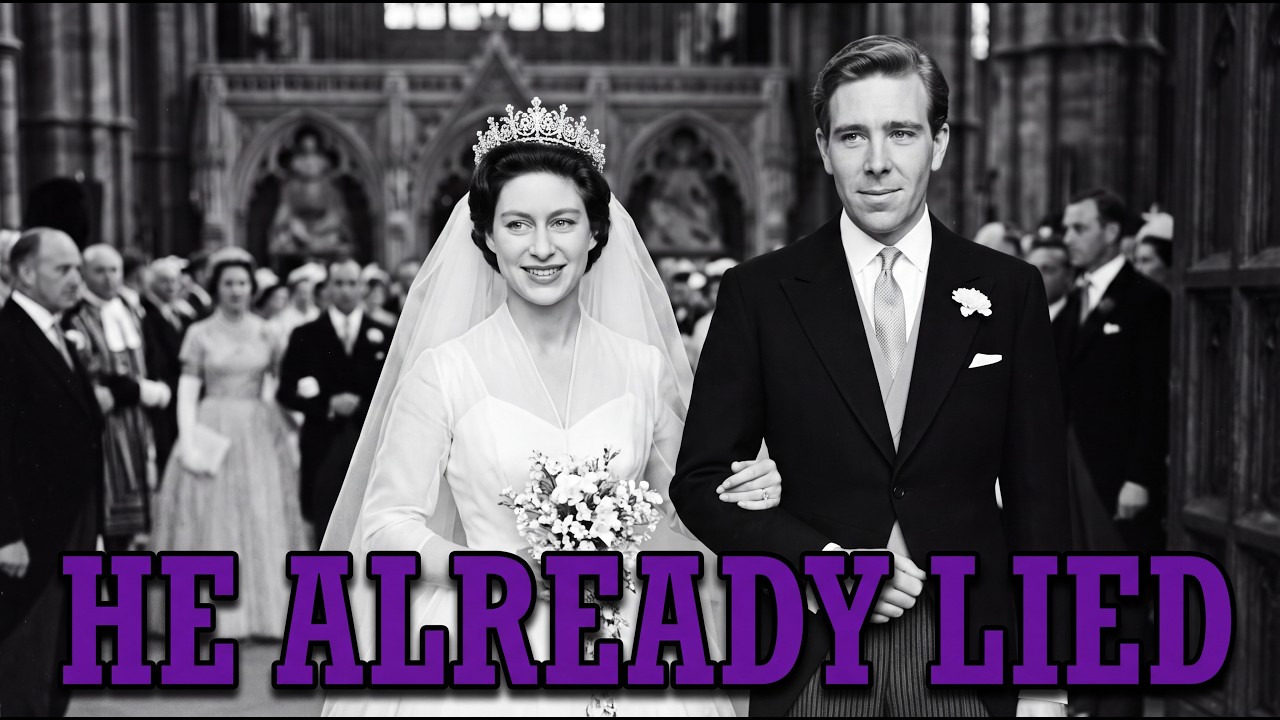
The wedding took place on May 6, 1960, at Westminster Abbey. It was the first royal wedding ever broadcast on live television, with an estimated audience of 300 million viewers worldwide.
Armstrong-Jones was a photographer, untitled, and rode a motorbike. He was presented as proof that the monarchy could modernize.
What almost no one knew that morning was that Camila Fry, the wife of the man announced as best man just seven weeks earlier, was about eight months pregnant with Armstrong-Jones's child.
Armstrong-Jones was born on March 7, 1930, in Belgravia. His parents divorced when he was four. At 16, he contracted polio and spent six months recovering in the Liverpool Royal Infirmary, left with a permanent slight limp.
He studied at Eaton and Jesus College, Cambridge, where he failed his second-year architecture exams and turned to photography. By his mid-20s, he had transformed British theater photography with grainy, handheld images of actors in motion.
His social world stretched from the theatrical to the aristocratic. Biographer Anne de Courcy identified the twin motivating forces in his life as "work and sex, both backed by immense charismatic charm and a drive unfettered by many of the social constraints of his class and day."
Margaret initially assumed he was homosexual. She later told Christopher Warwick, "I enjoyed his company very much, but I didn't take a lot of notice of him because I thought he was queer."
Margaret came to the relationship carrying significant weight. In October 1955, she had ended her relationship with Group Captain Peter Townsend, citing the church's teaching that Christian marriage is indissoluble and her duty to the Commonwealth.
The government had threatened to strip her of her royal rights and income if she proceeded. She chose duty over love.
Four years later, in the autumn of 1959, she and Armstrong-Jones began discussing marriage. The private engagement took shape while they were staying at Widcombe Manor in Bath, the home of Armstrong-Jones's close friend Jeremy Fry and his wife Camila.
Camila Fry, née Grinling, was born in 1933. She married Jeremy Fry in 1955. Jeremy was an heir to the Fry's chocolate family, an inventor, entrepreneur, and arts patron.
Camila had known Armstrong-Jones before her marriage. De Courcy's biography identifies her as a former girlfriend whose relationship with him had not entirely extinguished after she married his closest friend.
Working back from a birth date in late May 1960, the gestational timeline places conception in July or August 1959. The conception preceded the private engagement.
By the time the engagement was publicly announced, Camila was visibly pregnant with Armstrong-Jones's child. The entire public engagement period unfolded while that pregnancy advanced toward term.
On March 18, 1960, Buckingham Palace announced that Jeremy Fry would serve as best man. Three weeks later, in early April, Fry withdrew. The stated reason was a recurrence of jaundice.
The real reason wasn't jaundice. The Sunday paper The People had surfaced a 1952 arrest record. Jeremy Fry had been detained in Hyde Park that year and paid a fine of two pounds for what contemporaneous reports called a minor offense.
Later accounts consistently identify the charge as importuning for immoral purposes, the standard legal language at the time for homosexual solicitation. The Times obituary of Jeremy Fry later stated plainly that it wasn't a suitable role for a man with a conviction for a homosexuality offense.
The replacement was Dr. Roger William Gilliatt, a London neurologist, 37 years old, and the son of Sir William Gilliatt, former surgeon gynecologist to the Queen.
At no point did contemporaneous coverage connect Fry's departure to Camila's pregnancy.
On the morning of May 6, Westminster Abbey filled with prime ministers. Harold Macmillan was there. Winston Churchill was there. The Archbishop of Canterbury, Geoffrey Fisher, the same man who had counseled Margaret against marrying Townsend five years earlier, conducted the service.
After the ceremony, the balcony appearance, and the wedding breakfast for 120 guests, the couple boarded the royal yacht Britannia for a six-week Caribbean honeymoon.
They were at sea when Polly Fry was born. The date is given as May 28 in the Telegraph's account and de Courcy's biography, though some accounts give May 26. Either date places the birth three weeks into the marriage.

Polly was registered as the daughter of Jeremy and Camila Fry. She grew up believing Jeremy was her father.
For four decades, what had happened at Widcombe Manor stayed where it had been left. Armstrong-Jones became Earl of Snowdon. His son David was born in November 1961. His daughter Sarah followed in 1964.
Polly Fry grew up in Bath. Whispers reached her as a teenager and persisted through her 20s and 30s. Not until 2004, when she was approximately 44 years old, did she decide she wanted a definitive answer.
She arranged a meeting with Armstrong-Jones and asked whether they could settle the question with a DNA test. He agreed. Both provided swab samples.
The result excluded Jeremy Fry as Polly's biological father. It confirmed Armstrong-Jones.
When stories first emerged publicly, Armstrong-Jones denied that any test had taken place. Jeremy Fry called the claim utter nonsense. Jeremy Fry died on July 18, 2005, in Matai, India.
Approximately three years later, when de Courcy's biography was published and the Telegraph ran the article headlined "Lord Snowdon fathered a secret love child just months before marrying Princess Margaret," Armstrong-Jones eventually acknowledged it.
Polly wrote about the experience in The Mirror in 2008: "Finding out at the age of 45 that the man I had idolized and put on a pedestal higher than Nelson's column since I was a small child wasn't in fact my father was a hard burden to bear."
She wasn't included in Armstrong-Jones's will. When he died in 2017, that will was valued at approximately £3.2 million.
The marriage itself had run its full course in the years between the honeymoon and the DNA test. De Courcy's biography describes Armstrong-Jones's pattern with some precision. The Guardian's review of the book notes that he liked to keep several women on the go and may have confined himself to no more than one simultaneous affair, or at most two, while married to Margaret.
He told de Courcy directly, "I believe in serial and simultaneous."
His affairs during the marriage included Anne Hills, a journalist with whom he conducted a relationship lasting approximately 20 years. Hills died by suicide in 1996.

A later affair with Melanie Cable-Alexander, an editor at Country Life, produced a son, Jasper, born April 30, 1998, which ended his second marriage.
There were also the written notes. Multiple biographers record that Armstrong-Jones left messages around their Kensington Palace apartments, including notes reading "24 reasons why I hate you" and notes tucked into her books with the words "I hate you."
Margaret wasn't passive in return. She had a brief affair with Anthony Barton, a Bordeaux wine producer and the godfather of their daughter Sarah.
In 1966, she had a one-month liaison with pianist Robin Douglas-Home, nephew of former prime minister Alec Douglas-Home. Douglas-Home died by suicide roughly 18 months after the affair ended.
Then in September 1973 at the Café Royal in Edinburgh, she met Roddy Llewellyn. He was 25. She was 43. The eight-year relationship that followed was the most sustained and most public of her romantic life since the Townsend affair.
In early 1976, long-lens photographs of Margaret and Llewellyn on the beach at Mustique appeared in the News of the World. The formal separation announcement followed.
Snowdon issued a television statement after the separation. "I am naturally desperately sad in every way that this has had to come," he said. "I would just like to say three things. Firstly, to pray for the understanding of our two children. Secondly, to wish Princess Margaret every happiness for her future. Thirdly, to express with the utmost humility my love, admiration and respect I will always have for her sister, her mother, and her entire family."
Margaret, watching the clip, said, "I have never seen such good acting."
The decree nisi was granted in May 1978. The divorce was finalized July 11, 1978. It was the first divorce of a senior member of the House of Windsor in the modern era.
Armstrong-Jones remarried Lucy Lindsay-Hogg in December 1978. Margaret never remarried. She died February 9, 2002, aged 71.
Anthony Armstrong-Jones died at his home in Kensington on January 13, 2017. He was 86.
The structural outline of his story is identical to one that runs through the royal family decades later. A man connected to the royal family maintaining a relationship with another woman while presenting a public image of committed partnership in a ceremony broadcast nationally.
Armstrong-Jones did it first. He did it at what was meant to be the monarchy's proof of concept. The first royal wedding ever put on television, staged precisely to demonstrate that the institution could deliver a perfect show for a new mass audience.
The pregnancy was already there when Margaret walked down the aisle. The child was born while they were still on the honeymoon. Almost no one knew for 44 years.
The pattern is identical. The accountability wasn't. And the pattern started earlier than anyone discusses. Not in the 1980s, not with the heir to the throne, but in 1960 at the first royal wedding anyone ever watched on television, with a child already three weeks from being born into a world that would take four more decades to acknowledge her.