In the autumn of 1887, a 34-year-old surveyor named Wendell Crumbrin was sent to map an unclaimed stretch of ridgeline along the border between eastern Kentucky and West Virginia, hired by a coal speculation company out of Philadelphia. He was from a flat, ordered town in Ohio and had spent 11 years working in Michigan, the Carolinas, and west of the Missouri. But the mountains unsettled him from his first day there. Crumbrin took a room in the loft of a general store run by a widow named Permelia Ashlock, in a small settlement at the foot of the ridge known as Otterkin Bend.
He rode out before sunrise each day with his instruments, his notebooks, and a gray mule named Gristle to survey the steep, old-growth timber and the coal seams beneath the ridges. On the 11th day of his work, Crumbrin felt the woods go quiet around him—not the silence of a predator moving, but something older that seemed to have no direction. The small sounds of the forest returned after a minute, but on his way down the ridge at dusk, he kept looking over his shoulder and finding nothing there. After the widow Ashlock learned he intended to keep going up the ridge, she told him there was a man he ought to talk to before he did.
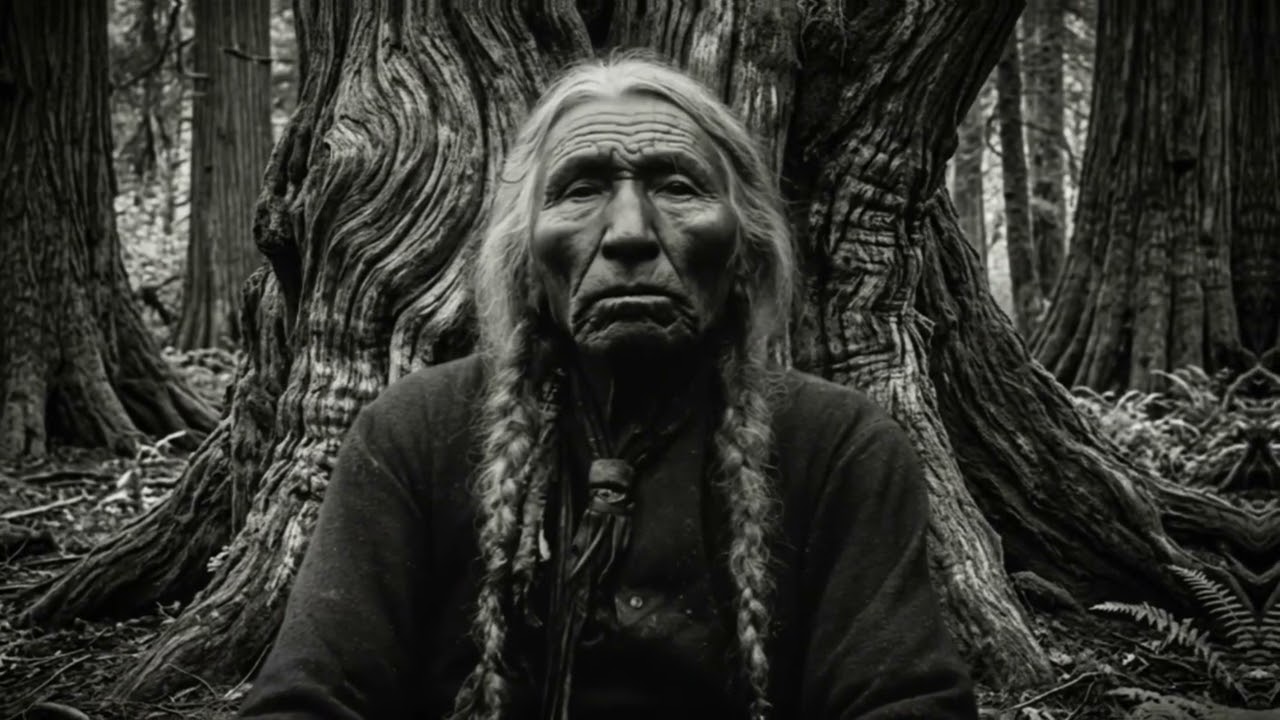
His name was Aldis Two Winters, a man of part Cherokee descent, older than anyone knew, who lived about four miles south near the sharpest bend of the creek. She told Crumbrin the man knew the ridge, and she warned him not to interrupt or argue with him. Crumbrin rode out to the cabin before sunrise. The old man greeted him without offering food or drink, and told him that his mother’s people called the ridge the place where the dirt remembers.
He said something was buried in it that should not be there, that it had been there for longer than his mother’s mother’s mother, and that what was buried was not asleep—it was only waiting. Aldis Two Winters then told Crumbrin that when he was four years old, in 1843, his mother took him up the ridge to gather roots. He remembered the day because it was the day he first saw what lived there. He described a tall, thin figure with arms that hung past its knees, skin like wet bark, deep-set eyes the color of old amber, and a smile unlike an animal’s smile—the smile of a man about to ask a question he already knew the answer to.
His mother took his hand and led him away slowly, singing a wordless song under her breath, and did not stop until they were inside with the door barred. She told him the thing had seen him, that it now knew his face, and that he must never go up the ridge alone. The old man told Crumbrin that the thing on the ridge was older than the people who first came into the mountains, and that the woods had grown up around it like a scar over a wound. He said the people who had come before the Cherokee had not worshiped it or fought it—they had bargained with it.
They had buried something with it in the deep dirt of the high meadow, and as long as what was buried stayed buried, the thing would keep to itself. But the agreement was not eternal. Aldis described neighbors and friends he had lost over 81 years. A hunter named Oed Stillwagon went up in the autumn of 1859 and never came back.
His rifle was found leaning against a tree at the foot of the ridge and his coat folded neatly beside it, the buttons still buttoned. A man in flight, the old man noted, does not stop to fold his coat. A circuit preacher named Jeremiah Callaway went up in 1871 to pray over the place, believing his faith would protect him. His horse was found standing in the creek three days later, and his Bible found open on a rock to Psalm 23, the page about the valley of the shadow folded back so hard the paper had torn.
He was never found either. A stonemason named Cyprien Whitlo went up in 1883 with a friend looking for a place to quarry. Only the friend came back. The friend told Aldis he had heard Cyprien call his name from the high meadow, in Cyprien’s voice, but the voice grew better at saying the name each time, as if it had only just learned the word.
He told the old man not to let anyone up on that meadow, for any reason, and he left the country within a week. Aldis told Crumbrin the thing did not eat the way an animal eats—it took the part of a man that makes him a man, and what it left behind was no longer the man who walked up the ridge. He said that after disappearances, people sometimes saw a figure at the edge of the high meadow at dusk that looked almost like the lost man, lifting a hand as if to wave, and that anyone who waved back did not come home. His own father had waved back.
The old man gave Crumbrin a small pouch of dark seeds from a plant his mother’s people called the listening seed, which he said no longer grew anywhere. He told him the seeds would give him a moment of warning: if they grew warm, he must turn around immediately and walk down, without looking behind him and without running—running, he said, tells the thing you are afraid, and it follows fear. The seeds were the last the old man had. Crumbrin rode back to the widow’s house and told himself the old man was a storyteller, and that he would not let an old man’s stories interfere with his work.
He kept the seeds in his pocket and continued up the ridge, though he slept poorly and dreamed of a smile he could not see clearly. On the third day after his visit to Aldis, Crumbrin heard a voice in the woods behind him speak his given name, clearly and softly, from only a few paces away. He did not turn around. He packed up his instruments and came down the ridge two hours early.
That night he realized the old man had never been told his given name—he had only been introduced as Mr. Crumbrin. On the fifth day, while sighting a marker through his instrument, Crumbrin saw in the lens a tall, thin figure standing in the trees behind the marker. He stood up so fast he knocked the instrument off its tripod, and the figure was gone.
He put his hand in his pocket, and the seeds were warm—warmer than his body—even though the air was cold enough that his breath was visible. That evening Crumbrin rode straight to Aldis’ cabin and held out the seeds. When the old man asked how warm they were, Crumbrin said warmer than his body. When asked if he had turned around and come down when he felt them, Crumbrin admitted he had not—he had told himself it was nothing.
The old man told him he must not go back up, not the next day, not ever. He asked if Crumbrin had heard the thing speak. Crumbrin said yes. When asked what it had said, he said it had spoken his given name.
The old man told him the thing was further along with him than he had hoped. Aldis told Crumbrin that once it has spoken your given name, you are no longer just any man on the ridge—you are someone it has named for itself, and you are on its list. He told him to carry the seeds always, to leave that night in the dark, to pack only what he needed, to walk to the railhead on foot because the seeds worked better when he was moving, and to take the first train and not get off until he was at least three states away. He warned him that the equinox was in two days, and that he did not want to be in that country on the equinox.
He told him that if he ever saw in a window, polished glass, or still water a tall figure standing behind him, he must not turn around—he must pretend he had not seen it and walk away. Crumbrin rode back to the widow’s house. She was not surprised, and she had already begun packing him food. She asked only one question—whether the seeds had grown warm.
When he said yes, she told him the old man was right and that he should go. He left the mule with her, paid what he owed, and walked out into the dark. He walked all night and through the next day. The seeds grew gradually cooler as he went, and by the time he reached the railhead they were cold.
He bought tickets through Lexington and Indianapolis, finally stepping off the train in a small town in southern Indiana he had never heard of, where he rented a room above a hardware store and stayed for three weeks before telling anyone where he was. He did not return to Lexington for two months. He married Vera, the woman who had mended his shirts, the following spring. He delivered an incomplete map to the company in Philadelphia, citing illness, and refunded part of his fee—the kind of thing that ended careers.
He took a position teaching mathematics at a small college in southern Indiana and never worked as a surveyor again. Crumbrin kept the seeds in a small wooden box on the mantle of his study and checked them once a year around the equinox. They never grew warm again, except once in 1903, when he caught a glimpse of a tall figure in a darkened shop window on his walk home. He did not turn his head.
He walked a long way home through the lighted streets, and when he reached his house, the seeds were faintly warm. He sat in his study that night with the lamp turned up high and did not sleep. In the morning, the seeds were cold again. He died in 1909 of pneumonia at the age of 56.
After his death, Vera found among his papers a letter he had written but never sent, addressed to Aldis Two Winters in care of the general store in Otterkin Bend. In it, Crumbrin wrote that he had thought of the old man every day for 21 years, that he had not been back, that he had not told a soul, but that he had not had a peaceful night’s sleep since he came down off the mountain. He dreamed of standing on a railway platform and seeing a thing in the window glass that he would not describe even there. He asked the old man whether the seeds had kept it from finding him, or whether it was only being patient.
The letter was never sent. Vera kept it in the box with the seeds. When she died in 1931, the box passed through family hands and eventually came to a small historical society in Indiana. When the box was last opened, the seeds were still intact.
A woman who worked at the society said the box had been opened only twice in 50 years, and both times, the person who opened it remarked that the seeds, against all expectation, were warm. Aldis Two Winters lived another nine years after Crumbrin left his cabin. He died in 1896 in his sleep. Before he died, he told a young man from the settlement named Vuly Garner much of what he had told Crumbrin, and instructed him to write it down, put it in a tin box, bury it under the third stone of his hearth, and dig it up only if a stranger came asking questions.
The tin box was dug up in 1962 by a folklorist from a university in Ohio. He published a short article in a regional academic journal that was not widely read, and the contents of the box were donated to a university library, where they still sit in a folder marked “Otterkin Bend Papers. ”
The settlement of Otterkin Bend lasted another generation. After the First World War, when the young men did not come back from France and the coal company never built the railroad, the cabins emptied out.
By 1930, no one was living in the bend. The cabins fell in, the road grew over, and the ridge stood as it had always stood. The county sheriff’s office recorded 11 disappearances on or near that ridge between 1940 and 1960, in a county whose entire population never exceeded 4,000. Most were quietly attributed to drowning, bear attack, or a man wandering off drunk.
In nine of the 11 cases, no body was ever found. In one of the two cases where remains were located, the official cause of death was written as exposure. In the margin of that report, in handwriting that does not match the coroner’s, someone had written three words: “It took him. ”
The narrator of this account says he drove up to the ridge the previous autumn, walked to the place where the old cabin had been, and found nothing left but the stones of the chimney and the iron hinges of the door lying in the leaves.
He did not stay long. He walked back down, drove home, and wrote down everything he had learned. He says he believes the thing on the ridge is still there, that it has been there longer than any of us, and that it will be there longer than any of us.
He claims he has collected accounts that were erased from official American records between 1843 and 1891—reports filed by sheriffs, surveyors, army officers, and country doctors—in a collection he calls the Appalachian Dossier.