A senior forester in Russia’s Ural foothills spent 19 years documenting encounters with an unexplained sound in a birch forest—an account preserved in 17 volumes of notebooks that survive to this day under private ownership in St. Petersburg. Gavril Osipovich Vitchenko was born in 1868 in a village called Sorokino along the Kama River, a settlement that no longer appears on modern maps. He trained as a surveyor, worked for a timber concessionaire, and by 1902 was appointed senior forester over a large tract of birch and spruce forest in the western foothills of the Urals.
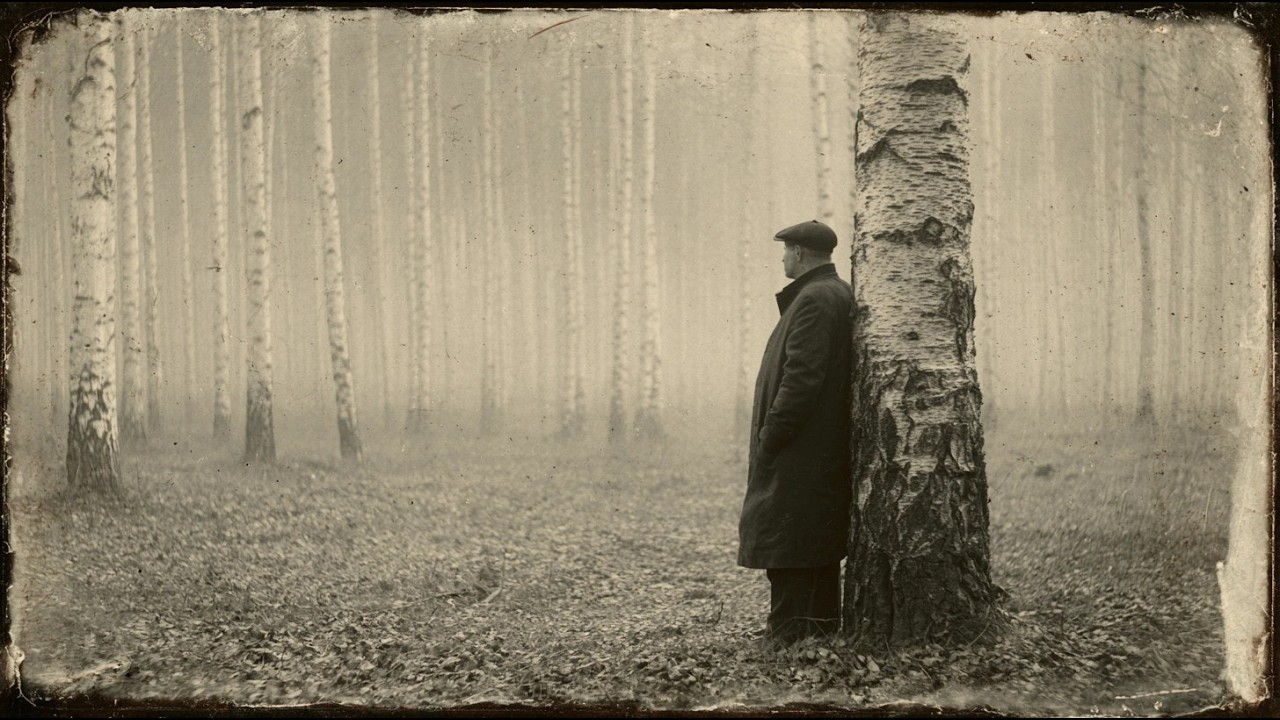
His superiors considered him reliable and methodical, and for nine years his work proceeded without incident. That changed in late August 1912, during a dry summer, when Vitchenko heard what he described as a voice coming from a swale of mature birch near the northern boundary of his section. He was careful to note it was not words, not a human call, but a low, sustained sound that rose at the end like a question. He stood still for several minutes and heard it again.
He did not mention it to anyone. Eleven days later he heard it again from the same area while eating his midday meal at the base of a birch tree. He wrote that what alarmed him was not the sound itself but the quality of attention it produced in him—”as though something was not calling out blindly, but calling out to a specific point in space, and that point was where I was sitting. ” He walked to the stand of tall birch near a spring and said out loud, “I hear you.
I don’t know what you are. ”
Vitchenko heard the sound six more times that September, always from the same northern swale, always around dusk. He began documenting it with the precision of a surveyor: date, time, duration, wind direction, cloud cover, temperature. He made a map triangulating the direction of the sound, and every line pointed back to the same stand of birch near the spring—a tree he had named “Stary” in his notes, meaning “the old one.
”
His October report to the district office asked whether other foresters had reported unusual wildlife activity. His supervisor recommended setting a trap in case an injured animal was involved. Vitchenko did not set a trap. Instead, on a clear afternoon in mid-October, he sat in the swale with his back against Stary and waited until dark.
He heard nothing, and wrote, “It appears it will not call when I am already here. ”
During the winter of 1912–13 he heard the sound once, on a Sunday morning in February, while skiing near the creek south of the swale. He noted that the forest carried sound differently in the frozen air, but the quality was the same. In spring 1913 he changed his routine to spend as much time in the swale as possible, adjusting his daily route so the northern boundary was his midpoint.
For three weeks he heard nothing and began considering that the previous year’s sound had been an atmospheric phenomenon carrying noise from a distant valley. Then, in early May, the sound rose from about 20 meters away, between two birch trunks where he was certain nothing stood. This time he could hear variation inside it—”the same phrase, more or less, with a slight alteration the third time it repeated, the way a person might say the same word with different emphasis. ”
Over the summer of 1913, Vitchenko identified at least four distinct sound patterns, which he labeled A, B, C, and D in his notebooks.
Pattern A was the original long, sustained rising sound. Pattern B was shorter, two or three clipped pulses. Pattern C was lower in pitch with internal variation. Pattern D, heard only twice, was higher and almost melodic.
He wrote that he was uncomfortable with both possibilities—that D was a different state of the same source, or a different source entirely—but most uncomfortable with the second. In September 1913, his sister Nadezhda visited. On her second night, while walking the northern boundary with him, she stopped mid-sentence and said, “What is that? ” Vitchenko had heard nothing at that moment, but she was turned toward the swale, alert.
She told him, “You knew exactly what I was asking about. You turned to look the moment I stopped speaking. ”
Three days later she brought it up again at dinner, saying she had heard the same sound that afternoon while walking near the creek, coming from the north. When Vitchenko asked what it sounded like to her, she said it was like someone calling out from a long way away, but not quite that—”More like someone calling out in a language where I didn’t know the words.
You knew the words maybe, but I didn’t. ”
After she returned to Perm, she wrote to him: “I keep thinking about that sound. I can’t stop hearing it. I mean that literally.
In the evenings before I sleep, I hear it again. It feels like remembering something. ”
The war began in August 1914. Vitchenko was 46, outside immediate conscription, and his position carried administrative protections.
The district offices grew chaotic, his supervisor was replaced twice in 18 months, and supplies became unreliable. He continued his work, and the encounters continued—if anything, they became more frequent. In 1915 Nadezhda mentioned the sound again, briefly: “I still hear it sometimes in the evenings. Is that strange?
It’s been two years. I hear it the way you hear a song you learned a long time ago. ”
In July 1916, Vitchenko returned to the swale at dusk. In two hours, all four sounds occurred in sequence—A, then B, then C from very close, then a long silence, then D.
He wrote, “It was not possible sitting there to believe this was accidental or random… I felt that I was being addressed, not spoken to in the sense of language. Addressed in the sense of recognized, known, specifically attended to. ” He wrote one more line before walking home: “I have spent 14 years learning this forest.
I think tonight it was informing me that it has spent 14 years learning me. ”
In late March 1917, Vitchenko noticed marks on the bark of the older birch trees around the spring—deep grooves, spaced and repeated in a way that did not look random. He spent a morning measuring and sketching them. Each tree had a different pattern, but there was a consistency of spacing, depth, and repetition “that suggested intention.
” He did not say they were writing or symbols, but he noted the marks were old—lichens had grown into them—and predicted they predated his arrival by decades. He also cross-referenced them against his sound map: the marked trees aligned almost perfectly with the points from which the sound most often originated. Nadezhda wrote back that she wanted to come and see the marks. She arrived in the summer of 1918.
Walking among the marked trees, tracing the grooves with her fingers, she said she had dreamed this exact scene—the light coming through the trees, standing in that spot. Vitchenko wrote, “I believed her completely, which was itself surprising to me, as I am not a person who generally believes in the significance of dreams. ”
That evening, outside his house, they heard the sound together for the first time. When Vitchenko asked how long she had been hearing it, she said six years—since her 1913 visit.
She had continued hearing it in Perm, in the city, mostly at night. “I thought it was memory,” she said. “I thought I was remembering the sound from my visits, but it was too regular for memory. Memory fades.
This didn’t fade. ”
During her three-week stay, Nadezhda identified a fifth sound pattern, which Vitchenko had classified as a subtype of C. She insisted it was distinct, noting a longer pause before the third element. Vitchenko listened and conceded she was right.
He updated his notes: “E identified by Nadezhda. I had been hearing it for two years without recognizing it as distinct. This suggests my attention, however extended, has limits. ”
On her last night, they sat in the swale after dark and heard all five patterns over the course of more than an hour.
Vitchenko wrote that sitting there with his sister, both hearing the same thing, he felt “very simply that I was in the presence of something I would never fully understand. And that this was not a problem to be solved. It was a condition to be inhabited. ”
After the revolution, a new supervisor from Kazan reviewed Vitchenko’s accumulated reports and asked about the recurring notation “unidentified wildlife phenomena.
” Vitchenko described the sound as plainly as possible. The supervisor said it was almost certainly an owl. Vitchenko said he had considered that possibility. The supervisor said the notation should probably be removed from official reports, as it was not in keeping with the scientific materialist principles of the new forestry directorate.
Vitchenko said he understood—and continued to note the sound in his personal notebooks. In August 1920, Vitchenko found fresh marks on a young birch tree at the edge of the swale, one he had walked past hundreds of times. The wood beneath the bark was still pale, not yet weathered. He wrote, “Whatever made the first ones, the old ones on the ancient trees, it is still here, still present, still, for lack of a better word, communicating.
” He later added that he had left a small mark of his own on Stary’s trunk below the old marks. “I’m not sure what I intended by it. It felt correct. ”
In 1921, Vitchenko was reassigned to a different district as part of the post-revolutionary restructuring of the forestry administration.
He had roughly two months’ notice. During that autumn the sound became more frequent than it had been since his early years there. He wrote that he understood how this sounded—that he was not someone who believed forests had feelings—but that he had spent 19 years paying very close attention to one forest, and the frequency and character of what he heard had changed in the week since he received his notice. On his last full day, he rose before dawn and went to the swale.
He sat against Stary’s trunk in the dark and cold October air and waited for the light. While it was still dark, the sound came—all five patterns, in the same sequence he had heard three years earlier with his sister. He sat until the sun was well up. In his notebook, he left three blank pages.
After them, he wrote, “I have said goodbye to places before. I know how it feels. This was different. I’m not sure goodbye is the right word for what I said.
I’m not sure what word would be right. ” On the next line he wrote that he had told it his full name out loud in the forest—Gavril Osipovich Vitchenko. “It seemed like the correct thing to do after 19 years. And then I walked away.
”
The notebooks passed to Nadezhda sometime in the 1920s; she kept them until her death in 1953. They eventually went to a nephew, then through slow migrations, and are now held by a private collector in St. Petersburg interested in early Soviet natural history documentation. Translated excerpts circulated quietly in archives in the 1990s.
Vitchenko did not die in the forest. He was reassigned, not replaced by death. What he heard he never explained, and he did not try to explain it away.
What survives of him are the records he kept across 19 years—and the note that one thing he heard, he said, sounded like a language in which he did not know the words.