In 1859, Florida Senator Stephen R. Mallory, who would later serve as Confederate Secretary of the Navy, boasted that the United States had no more reason to pause its progress than a soaring eagle. His confidence reflected a decade of remarkable growth and prosperity, yet beneath that optimism lay a nation increasingly divided into two distinct worlds. When Abraham Lincoln won the presidency in November 1860 with less than 40 percent of the popular vote, the outcome triggered a crisis that would tear the country apart.
South Carolina seceded before the year ended, and ten more slaveholding states followed, forming the Confederate States of America. The war that followed was rooted in decades of deepening differences between the industrializing North and the agrarian, slave-dependent South. By 1860, the United States had grown from 33 states and five territories, with 18 free states and 15 slave states. Kansas entered the Union as a free state in January 1861, and five months later eleven slave states had seceded.
Delaware, Maryland, Kentucky, and Missouri remained in the Union despite permitting slavery. The nation’s population expanded at an extraordinary pace during the 1850s. The eighth federal census, directed by Joseph C. G.
Kennedy, recorded a total population of 31,443,321, an increase of 35 percent in a single decade. Kennedy noted that general good health and peace had prevailed, an observation that would prove tragically ironic given the conflict to come. Immigration played a major role in this growth. Between 1850 and 1860, approximately 2.
8 million immigrants arrived in the United States, and 86 percent settled in free states. Nearly half of New York City’s population was foreign-born. The influx of Irish and German Catholics during the 1840s and 1850s triggered nativist backlash and ethnic riots in several northeastern cities, most notably Philadelphia in 1844, where sixteen people were killed. The free states held a commanding demographic advantage.
Of the roughly 19 million people living in the 18 free states, 98. 5 percent were white. Immigration and higher birth rates meant the North’s population grew faster than the South’s, and far more people moved from slave states to free states than the reverse. Urbanization accelerated dramatically in the North.
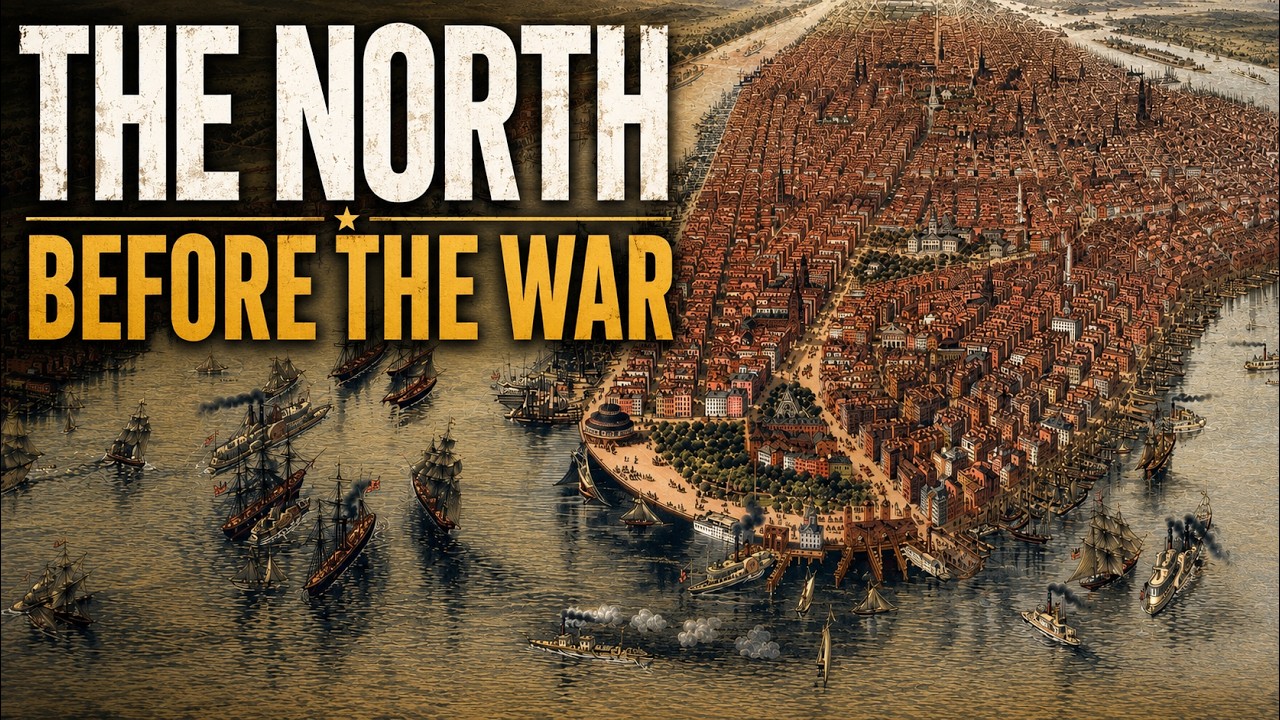
By 1860, one quarter of northerners lived in urban areas, compared to only one in ten in the South. The nation’s largest cities were overwhelmingly concentrated in the North, with New York, Philadelphia, Brooklyn, Baltimore, and Boston leading the list. New Orleans was the only southern city with more than 100,000 residents. The northern economy had been transformed by the first industrial revolution.
Mechanization and the American system of manufacturing, which relied on special-purpose machines and interchangeable parts, revolutionized production. By 1860, manufactured goods surpassed the value of farm products for the first time in the nation’s history. The industrial gap between the sections was staggering. The North had six times more manufacturing plants than the South and nearly twelve times as many factory workers.
Massachusetts alone produced 60 percent more manufactured goods than the entire future Confederacy. New York, Pennsylvania, and Massachusetts each surpassed the total industrial output of all the states that would secede. Northern agriculture also far outpaced the South. The horse-drawn reaper, invented by Maine’s Obed Hussey and Virginia native Cyrus McCormick, dramatically increased grain production.
By 1860, the North controlled roughly 82 percent of the nation’s wheat, 66 percent of its corn, and vast majorities of nearly every other agricultural product, from wool to hay to potatoes. The transportation revolution reinforced these advantages. Turnpikes, canals, and railroads transformed the northern economy, with most routes running east-west rather than north-south. By 1860, the United States had more railroad mileage than the rest of the world combined, and the North possessed over 22,000 miles of track compared to the South’s 8,541.
Shipping figures told a similar story. Of just over 11,000 vessels clearing U. S. ports in the year ending June 1861, only 819 came from southern seaports.
New York City alone handled about 64 percent of all U. S. exports and 70 percent of imports. The North also led in innovation and education.
Ninety-three percent of the 143 important American inventions between 1790 and 1860 came from free states, nearly half from New England alone. Literacy in the free states stood at about 94 percent, and New England led the world in educational facilities at mid-century. Religious and reform movements, shaped by the Second Great Awakening, fueled moral campaigns for temperance and abolition. The anti-slavery movement became increasingly political during the 1850s and polarized the nation, splitting the Baptist, Methodist, and Presbyterian churches into northern and southern factions.
Still, the North was far from unified on racial equality. During the 1850s, only four northern states permitted free blacks to vote, and several northern states passed laws prohibiting free blacks from entering their territory. Black abolitionist John Rock observed that many Americans believed black people were oppressed only in the South, when in fact racism and discrimination existed throughout the North. The Republican Party, essentially a sectional organization, gathered in Chicago in May 1860 to nominate a presidential candidate.
Front-runner William Henry Seward of New York was seen as too radical to win the lower northern tier of states. Other contenders, including Salmon Chase, Simon Cameron, and Edward Bates, carried political baggage that alienated key factions. Abraham Lincoln, a former Whig with a moderate reputation and an appealing self-made image, emerged as the compromise candidate. His managers packed the convention gallery with supporters using counterfeit tickets.
After a dramatic three-ballot contest, Lincoln secured the nomination, with delegates in the Wigwam erupting in celebration. The Republican platform condemned John Brown’s Harpers Ferry raid but focused on economic issues such as a homestead act, internal improvements, a transcontinental railroad, and a higher tariff. Most significantly, it opposed the extension of slavery into new territories. On November 6, 1860, Lincoln won the presidency with 180 electoral votes, though he received only 39.
8 percent of the national popular vote. His name did not even appear on the ballot in ten southern states. In the upper South, most of his limited support came from German immigrants in St. Louis.
Even as northern voters elected Lincoln, they rejected racial equality in their own states. Nearly one third of the Republicans who voted for Lincoln in New York also voted against a state constitutional amendment that would have enfranchised black men. The Republican Party downplayed the moral issue of slavery to win the crucial lower northern states. The South viewed Lincoln’s election as an existential threat.
An Atlanta newspaper declared that the South would never submit to such humiliation and degradation as the inauguration of Abraham Lincoln, even if the Potomac ran crimson with blood. South Carolina seceded before the year was out, and the Confederacy was born. By 1860, the United States had become two clashing civilizations, one grounded in free labor, industry, and reform, the other in slavery, agriculture, and a rigid social order. The overwhelming imbalance in population, industry, agriculture, and transportation favored the North, but the political rupture made war almost inevitable.
The first shots would follow within months, and a four-year conflict that few imagined possible was about to unfold.