On May 27, 1942, a car slowed at a bend in the road in Prague. It was 10:32 in the morning. Inside sat one of the most powerful men in Nazi Germany. There was no escort, no armored vehicle, and no visible protection. He always slowed down at this exact spot.
Two men stepped off the pavement. One raised a submachine gun. It jammed. The second threw a modified grenade. The explosion tore into the car. The man inside forced the door open, drew his pistol, and tried to chase his attackers. He was wounded and bleeding, but he kept advancing.
His name was Reinhard Heydrich. Even inside the Nazi system, men like him were feared. Not because of what he felt, but because of what he didn’t.
In 1931, Heydrich was a naval officer. He was disciplined and structured. A military court of honor ended his career overnight over a broken engagement. The Navy called it conduct unbecoming. At 27, he was finished.
Most men would have collapsed. Heydrich filed it away. Within weeks, he applied to the SS. During his interview with Heinrich Himmler, he claimed experience in intelligence work. There was no evidence he had any. Himmler hired him anyway.
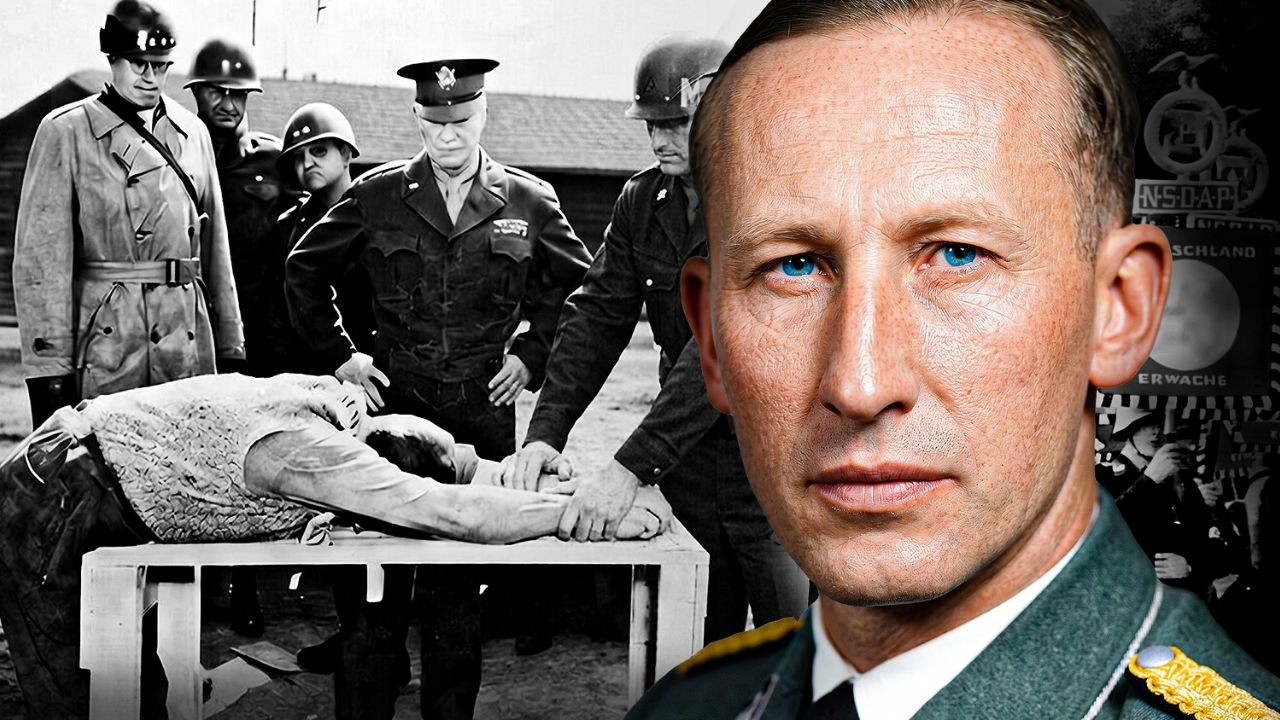
Heydrich did not rise through charisma. He did not inspire crowds. He built systems, records, dossiers, and surveillance. Senior Nazi officials began to find files on their personal lives appearing on Heydrich’s desk. Secrets they had told no one.
People did not fear Heydrich because he shouted. They feared him because he already knew. Careers collapsed without explanation. Decisions changed without warning. No one could point to a single order, but everyone felt it. Something was always watching.
By 1939, he merged every police and intelligence force into the RSHA. The entire machinery of terror—Gestapo, death squads, spies—was under one roof, under one man. Even Himmler later confided that Heydrich made him uneasy. The man who created the system was uncertain of the man he hired.
In September 1939, Poland was invaded. Behind the advancing army followed the Einsatzgruppen. Their mission was systematic mass shootings of civilians. Jews, Soviet functionaries, Roma, men, women, and children were killed in ravines, forests, and at the edges of nameless villages.
Reports flowed back to Berlin. They were detailed and precise, with numbers, locations, and dates. In those columns of figures, no one wrote the word murder. Heydrich read them the way a manager reads a quarterly report. He requested adjustments. More efficiency. Less chaos.

On January 20, 1942, a meeting took place at a villa in Wannsee, outside Berlin. Fifteen men sat around a table. Heydrich chaired the meeting. He presented documents listing 11 million names by country. The routes, the camps, and the projected timelines were discussed.
The protocol survives. It shows that nobody asked questions. Nobody objected. The discussion moved to logistics almost immediately. Heydrich had said it out loud, clearly and calmly, in the language of administration. Once something is said that way, it begins to function like a project. Not an atrocity to be committed, but a process to be managed.
That was his contribution. Not the hatred. Others had that. He provided the architecture.
In spring 1942, Heydrich was appointed Reich Protector of Bohemia and Moravia. Resistance was crushed. Arrests and fear followed. But factories ran faster. Production rose. Stability returned. At 37, he began to believe his own myth.
He attended the opera without bodyguards. He rode in an open car. He wanted to be seen. He stopped using an armored car. He found it unnecessary.

Back to that bend in the road. The car slowed. The grenade detonated. He chased his attackers until his strength failed. The men who did it, Josef Gabčík and Jan Kubiš, had parachuted in from Britain. They had waited months for this one chance.
Heydrich was taken to hospital. Surgery followed. For a moment, it looked like he would survive. Then infection set in. On June 4, 1942, Reinhard Heydrich was dead. He was 38 years old.
The SS gave him a state funeral. Hitler spoke. Himmler wept at his grave. In the days that followed, the Nazis liquidated the village of Lidice. Every man was shot. Women and children were deported. The village was erased from the map in reprisal for two men with a grenade.
That is the measure of what they lost. What made Heydrich irreplaceable was not loyalty or ideology. It was the absence of something. Many others in the Reich could still be slowed by fear, ego, or the instinct to calculate risk. A flicker of something human occasionally made them hesitate.
Those who observed Heydrich closely described no such moments. He looked at 11 million names on a list and saw a scheduling problem. He looked at mass execution reports and saw inefficiency.
A sadist can be stopped. You can appeal to his ego, his fear, or his survival instinct. A man who processes other people’s suffering as administrative data has no lever. There is nothing to push. That is what made him the most dangerous man in Nazi Germany. Not what he felt, but what he didn’t.
Heydrich died because two men felt enough to act and because he had stopped believing anyone would. The system he built did not die with him. Auschwitz continued. The deportations continued. The killing continued.
But he had believed something that turned out to be wrong. He believed the system he built had already made him untouchable. He was wrong. And it turns out that mattered.