In the weeks after Pearl Harbor, the U.S. Army faced a crisis in the Pacific. The Philippines were falling, and Washington needed someone who understood the theater and the commander on the ground. That is why Dwight Eisenhower was summoned to the War Department on December 14, 1941.
He joined the War Plans Division, a small office of 54 officers responsible for the strategic thinking of the entire U.S. Army. Eisenhower was given a specific portfolio: the Far East, the Pacific, Australia, China, Hawaii, and the Philippines.
His record at that moment was entirely staff work. West Point, class of 1915. First in his class at the Command and General Staff School in 1926. Army War College in 1928. Service in the office of the Assistant Secretary of War, then under Chief of Staff Douglas MacArthur, then four years in the Philippines as his senior military assistant.
He had never commanded a division, a regiment, or a battalion in combat. He had never led American soldiers under fire. He was a staff officer with an excellent file, placed in the one room where the war was actually being run.
George Marshall had been building toward this moment for years. In 1937, he wrote that nothing but abstract efficiency should be allowed to interfere with the selection of a colonel. In 1941, he told the Truman Committee that seniority alone would defeat you before you started. He had seen the First World War’s officer selection failures firsthand and was determined not to repeat them.
But the record shows that Marshall was not looking for the best fighting general in 1942. He was looking for something else, and he was explicit about what it was. Combat leadership was not on the list.
Eisenhower took over the War Plans Division on February 15, 1942, as a one-star brigadier general. Nine weeks after arriving in Washington, he was running the office. Then came the reorganization of March 9, 1942.
The War Department was dismantled and rebuilt. The old general staff sections were radically reduced. Personnel was authorized 13 officers. Intelligence, 16. Operations and training, 14. Supply, 12. Eisenhower’s division was authorized 107 officers.
On March 23, the division was renamed the Operations Division. Eisenhower was now running an organization six times larger than the second-largest staff section in the War Department. Marshall gave him the authority to issue orders in the name of the Chief of Staff on matters executing approved plans.
Marshall refused to call the new organization a command headquarters. He named it Operations. But when describing what Eisenhower actually did, Marshall called him the chief of operations of the U.S. Army. The gap between the title and the description is the closest thing to a written evaluation that exists.
On February 28, Eisenhower submitted a study on strategic concepts for the Southwest Pacific. The real argument was about Europe. He recommended developing a specific plan for operations against northwestern Europe, with forces massed in the British Isles to engage German air forces starting in mid-May.
The idea was not entirely his. On March 6, the Joint Strategic Committee reached the same conclusion independently. Eisenhower’s role was to implement it. On March 25, he pressed Marshall to decide which theater would host the first major Allied offensive. The answer was Germany, attacked through Western Europe.
The numbers behind the plan were brutal. To force German forces off the Russian front, planners estimated 600,000 ground troops and 6,500 aircraft would be needed. What would actually be available by January 1943? 252,000 ground troops. The gap was enormous.
On April 1, Eisenhower and Colonel Thomas Handy presented the plan to Marshall. Marshall approved it, suggesting changes in language, not concept. He read the paper and edited the text. The document went to London as the Marshall Memorandum.
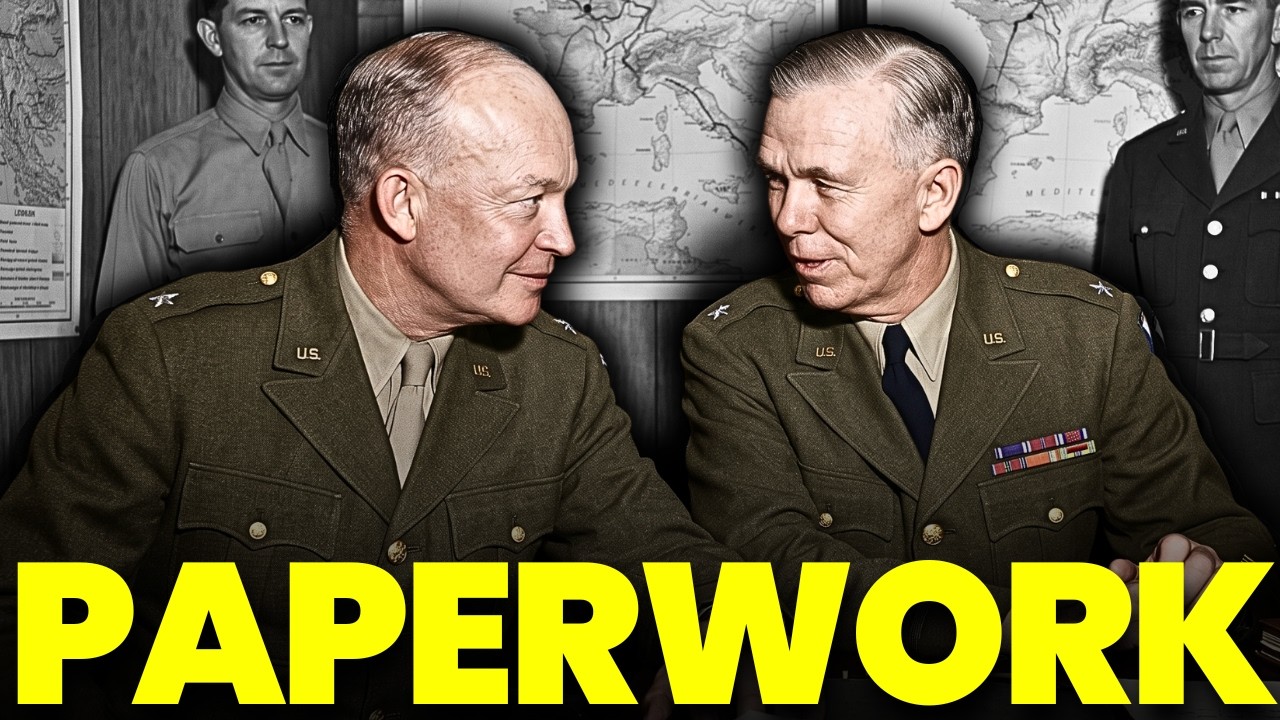
It called for a cross-channel attack with 48 divisions and 5,800 combat aircraft, estimated for April 1943. The American share was about one million men, 30 divisions, and 3,250 aircraft. The British share was 18 divisions and 2,550 aircraft. An emergency version was attached, a landing in September or October 1942 with only five divisions.
Marshall took it to London and secured agreement on April 14. He returned and warned his staff that the agreement was fragile. Many British participants had reservations. It would take firmness to prevent further dispersion. Then the dispersion began.
April was a defense on four fronts: the Middle East, China, Lend-Lease to the Soviets, and the Pacific. Eisenhower’s team fought all four simultaneously. In the Pacific, Admiral King wanted bomber priority. The Army refused, insisting that the buildup in Britain came first. The President approved sending two American divisions to the Southwest Pacific so Australian and New Zealand divisions could stay in the Middle East.
Every one of those decisions drew from the plan the Operations Division had just written. Eisenhower won some and lost others. He had no authority to settle any of them. He could only make the case again, better, and put it before Marshall.
This was the test. Six months of losing arguments to admirals, allies, and the President, then returning the next morning to make the same case in different words. Most strong personalities cannot do that. Many excellent combat leaders in the U.S. Army in 1942 could not have done it for six days.
In May, Roosevelt sided with the planners. On May 6, he told his senior military advisers he was disturbed by objections to operations in the European theater before 1943. He considered active operations in 1942 necessary. His reason was one line: the Russian armies are killing more Germans and destroying more Axis equipment than all 25 United Nations combined.
On May 23, Eisenhower flew to the United Kingdom. He went with Arnold, Somervell, and Clark, four senior officers sent to inspect the machine that was supposed to execute the invasion in ten months. Eisenhower examined planning arrangements, tactical planning, staff formation, intelligence coordination, landing craft, and division organization.
He returned on June 3 and issued his judgment: it was necessary to give the mission driving force, or the Allies would not be ready to attack by spring 1943. Work had to begin immediately.
Within a week, Marshall had selected the chief of the Operations Division to provide that driving force. Eisenhower departed for London on June 23 and took command of the European Theater of Operations on June 25, 1942.
That is the decision. A man returned from 11 days in England, wrote that the effort there lacked drive, and within seven days the Chief of Staff made him the drive. The scale of the appointment is diminished in retelling.
Eisenhower went from one star in February to three stars by July. The forces he commanded were far smaller than the plan required. By late September, American forces in the UK prepared for the cross-channel attack numbered about 188,000 men. Then Operation Torch siphoned off more than 150,000 troops and three of the four divisions. By the end of February 1943, the American force there had fallen to 107,801.
Torch itself involved 125,000 soldiers, sailors, and airmen landing in North Africa between November 8 and 11. Three task forces, three commanders: Patton in the west, Fredendall in the center, British officer Kenneth Anderson in the east. Roosevelt selected Eisenhower as Allied commander in chief. He ran the three landings from a command post in Gibraltar.
Eleven months earlier, he had been a deputy in a 54-man office.
The honest version of the story is uncomfortable for everyone. It is uncomfortable for those who revere Eisenhower because it says his rise in 1942 was not earned on a battlefield. There was no battlefield available. It is uncomfortable for those who champion fighting generals because it says the man who beat them to the top did not cheat. He was the best available candidate for the job as it was actually defined.

The problem was never the candidate. The problem was the job description.
The job required a man the British would accept. Eisenhower had spent the interwar years gaining that acceptance. It required a man who could write, not decorate, but actually write. A document that a president, a prime minister, navies, and two general staffs could read and discuss without misunderstanding. The Marshall Memorandum went to London and framed the next two years of the war.
It required a man who could be trusted alone with political matters. Marshall urged the President to give Eisenhower discretion to deal with Admiral Darlan and General Giraud as military circumstances required. The entire operation was based on the belief that French citizens in North Africa would welcome an American campaign but not a British one. That is a diplomatic requirement in uniform.
Four requirements: acceptability within the alliance, document drafting, political judgment, and discretion. Every one is documented. None of them were tested in combat. None of them could be measured in a battle.
Marshall’s method of evaluating a staff officer was to read his drafts and edit them. His handwriting appears on nearly every important document produced by the Operations Division. He told his men how to work with him: send him a rough draft early, and it would likely pass unchanged. He cared more about the answer being right than about receiving a finished product.
Every paper written under that system was read line by line by the Chief of Staff. He changed the words. He told the officer when his thinking was incoherent. He did this several times a week for six months. No efficiency report on earth tells you more about an officer than that.
The pace created enemies. The division’s insistence on speed and willingness to accept responsibility produced hostile reactions from other Army officers. One officer sent a letter to the Operations Division for a reply to be signed by the Chief of Staff. The officer left. When he returned about an hour later, the draft reply was already on its way. One hour for a document that would go out under Marshall’s name.
Four officers from the division were killed on field visits to theaters. They flew toward war zones to inspect matters for Marshall, and four did not return.
Eisenhower ran that world for a little over four months. That is what Marshall was watching when he formed his judgment. Not a battlefield. A workshop running at full capacity, with the Chief of Staff’s pen in every file.
The pivotal week is the seven days between June 3 and June 10, 1942. Eisenhower returns from England. He reports the effort there lacks drive. Marshall’s response is not to find a driver. It is to send the man who wrote the report.
Marshall did not think he had found the greatest combat commander in the U.S. Army. He had no evidence to think that. What Marshall thought he had found was something rarer and, in that year, more valuable: a senior officer who could hold an alliance together, write a clear plan, push it against institutional inertia, and be trusted alone in a room with allies and politicians.
By those specifications, Eisenhower in June 1942 was not just the best candidate. He may have been the only fully qualified one in the U.S. Army.
This is a defense of the decision. It is also an indictment of the system. The specifications did not include a combat requirement. Nothing. And once specifications without a combat requirement become the path to the top, they do not stay in Washington. They travel.
Men promoted under those specifications promote in their own image. Watch it happen within six months. In September 1942, Eisenhower selected Walter Bedell Smith as chief of staff of his theater. Smith’s war until then had been in the office of the Secretary of the General Staff. A staff officer chose a staff officer. It was the right choice. Smith was excellent at that work. The pattern is the point.
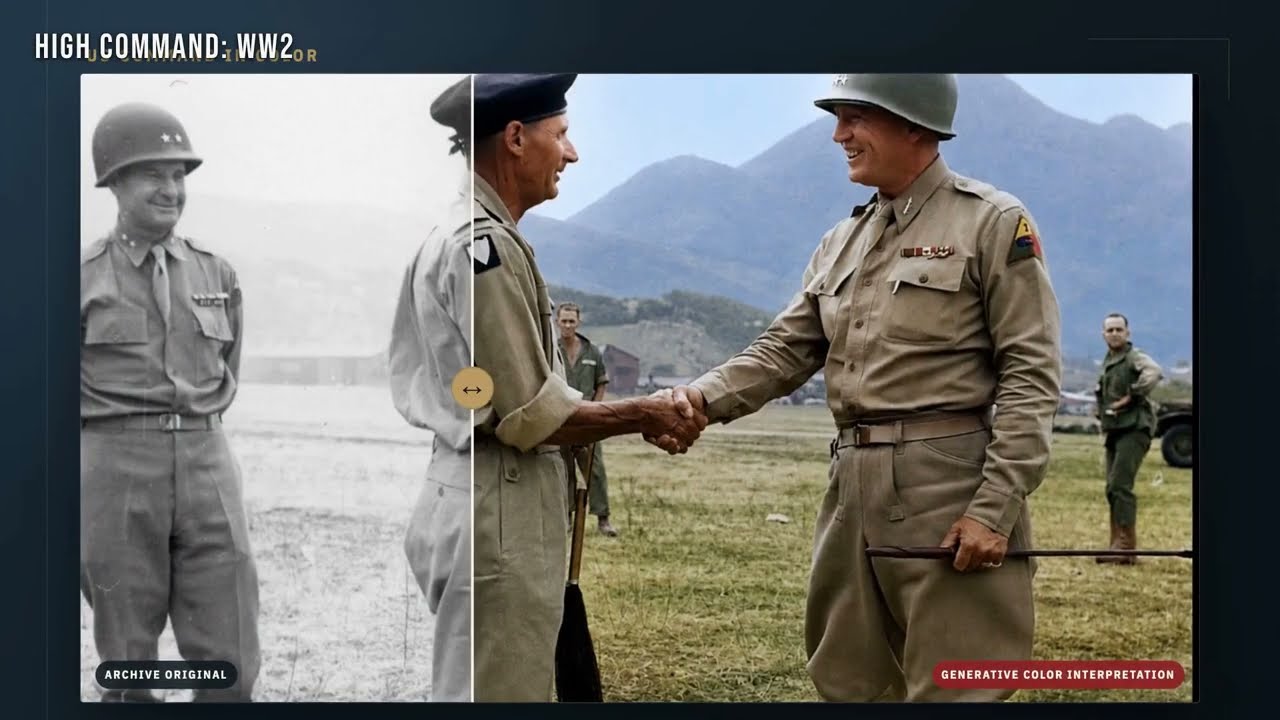
Watch the other side. The same selection system that produced Eisenhower produced Lloyd Fredendall, who commanded the Central Task Force at Oran in November and the II Corps in Tunisia after that. Alexander’s assessment of Fredendall’s performance in February was unfavorable. The division commanders had lost confidence in a commander they held responsible for assigning them tasks, then imposing methods and procedures unsuited to accomplishing them. On March 6, 1943, Patton took command of the corps.
The system that selects for staff qualities will promote men with excellent staff qualities. Sometimes, as with Eisenhower, the man turns out to have the other talent too. Sometimes, as with Fredendall, he does not, and infantrymen in a Tunisian pass pay the price.
The reverse is the more important part. If the ladder to success is built from alliance skills, clear language, and political prudence, then the officer who has none of those, who is sharp and abrasive but brilliant at the one task the army exists for, will find the ladder missing rungs he needs.
In July, the entire plan collapsed. The British decided against the emergency cross-channel landing for 1942 on July 8. On July 16, Roosevelt sent Marshall, King, and Hopkins to London to settle it. Two days earlier, the President had told Marshall he opposed a full American effort in the Pacific against Japan, closing off Marshall’s alternative.
Eisenhower, now commanding operations in London, met the American mission on July 18. He had prepared a revised version of the emergency operation targeting the Cotentin Peninsula. Between July 20 and 22, the Americans pushed it to the British Chiefs of Staff and failed. On July 22, before Churchill and the British command, they conceded.
Roosevelt then presented his representatives with five alternatives in order of preference. French North Africa was at the top. Marshall and King chose North Africa. The President committed to the decision on July 25 and repeated it on July 30 as commander in chief.
The operation Eisenhower had spent five months building was canceled. The replacement was the Mediterranean diversion he and Marshall had argued against all spring. It drained the buildup, exactly as predicted. Eisenhower accepted the mission. He began planning an operation he believed was strategically wrong before anyone confirmed he would lead it. He did so without leaking, without complaining, without a public word against the decision.
The command question tells you something about Marshall too. The British suggested Marshall himself as supreme commander. Roosevelt refused. The President’s approval of Eisenhower was indicated on July 31. Marshall was not consulted about the British proposal at all. The directive to Eisenhower was not approved until August 13, nearly three weeks after the decision to launch the invasion.
Eisenhower was given the invasion of French North Africa on a timeline Roosevelt wanted for October, without a written directive for three weeks, in a theater where the entire political premise was that the French would welcome an American campaign and not a British one. He landed on November 8.
There was no other American officer in 1942 who could have taken that specific mission without making things worse. Not Patton, who could win the battle and lose the French. Not MacArthur, for reasons that need no explanation.
The specifications Marshall wrote were, for that year and that operation, exactly right. The problem is what happened afterward. The specifications written for a 1942 coalition emergency became the permanent standard. The qualities that got a man through Marshall’s door in December 1941, clear papers, sober temperament, the ability to sit across from an ally without exploding, stayed at the top of the list for three more years. Long after the shooting started. Long after the army had actual combat records to judge men by.
The army got the evidence and never rewrote the standard. The systematic charge is simply this: the U.S. Army in World War II built a promotion system that was excellent at identifying men who could manage an alliance and poor at protecting men who could only win battles.
Marshall was not corrupt. He was not stupid. Neither was Eisenhower. They built a mechanism that worked, and then the mechanism kept working on its own after the conditions that justified it changed.
Marshall did not think Eisenhower was a great combat commander in 1942. There is no document in which he says that, and he had nothing to base it on. What Marshall thought, based on the evidence actually on his desk, was that this was the best staff officer he had ever employed. A man who could write a plan, defend it before two governments, execute it when it was rejected, and be left alone with allies, admirals, and French politicians without a minder.
Every one of those judgments was correct. That is what makes the story difficult. The account is not that Marshall was wrong. It is that he was right for reasons unrelated to combat, in an institution that treated his reasons as a permanent rule.
107 authorized officer positions in one division of the War Department versus 13 in personnel and 12 in supply. That number is not a footnote. That is the shape of an army deciding where its future leadership will grow. It grew in the office.
The plan that demanded 48 divisions and a million American soldiers in England by spring 1943 was written in a 107-officer office, by a man who had never led a company in combat, and approved by a chief of staff who edited the language and left the concept alone. That is how the commander of Normandy was selected. Not a flash of insight. A file. A paper record. Eleven days in England. One week in June.