On April 2nd, 1855, at approximately 1:00 a. m. , Nelson Lee settled down to rest after completing his patrol, unaware that his life was about to be violently upended. In the dim glow of the campfire, he glimpsed shadowy painted figures moving swiftly through the chaos.
It was a Comanche raid. Lee, a former sailor and Texas Ranger in his late 40s, had set out weeks earlier with a companion named William Aken to drive a herd of mules westward from Corpus Christi, Texas, toward Matamoros, a trading hub near the Mexican border. Their route cut directly through the heart of Comanche territory, a region notorious for its danger. The group assembled hired men and gathered horses for the trek along the Rio Grande.
Lee acquired a pocket watch that could chime like an alarm, a rare and costly device for the time, and used it to signal the start of their daily trek at 3:30 a. m. The journey began in early March, with fertile grasslands along the river providing vital nourishment for the mules. By April, the group reached a point southwest of El Paso and chose to rest for several weeks.
Though they posted sentinels each night, their precautions were no match for the highly skilled raiders they would soon face. The Comanche, masters of stealth and ambush, struck without warning. During the raid, only four men survived: Lee, Aken, and two hired hands named Thomas Martin and John Stewart. The rest met a brutal end.
The survivors were stripped of their clothing and dressed in traditional Comanche attire, including buckskin leggings and hunting shirts. When the raiders discovered Lee’s pocket watch, they demanded he demonstrate its function. When it chimed, their astonishment was evident. Lee, quick-witted, seized the opportunity and deliberately fostered an air of mystery and reverence.
He later wrote that he believed the Comanche viewed the watch as a supernatural object, possibly linked to the great spirit. Daylight revealed the full horror of the raid’s aftermath. Lee’s account is chilling: bodies were mutilated in gruesome ways, disemboweled, scalped, and left as a stark reminder of the Comanche’s mastery of psychological warfare. Scalps, still fresh, hung from the warriors’ belts.
During the journey into captivity, the Comanche employed methods of psychological control designed to strip the captives of their humanity. To instill fear, the captors would fake scalping, brandishing bloody tomahawks and grabbing at the captives’ hair before stopping at the last moment. The captives’ faces were covered with deer skins with small holes cut near the mouth for minimal breathing. Bound hand and foot, they were tied to mules, and if a captive fell, they would dangle helplessly.
Lee recounted how his tumbles off the mule became a source of laughter and mockery. Even meals were acts of intimidation, with boiling chunks of horse flesh thrown at the captives, burning their skin. At night, the captives were stretched out on their backs, hands and feet tied to stakes, with buffalo hide securing their throats, leaving them immobile and sleepless. After days of exhausting travel, the captives reached what Lee described as a large Comanche village, which he estimated housed 500 people and hundreds of tents, though this figure may have been exaggerated by his fear.
The captives were paraded through the camp and brought before the Comanche chief known as Big Wolf. Big Wolf had heard of Lee’s unusual pocket watch and demanded to see it in action. Lee’s response reveals both his quick thinking and desperation. Declaring that making the watch chime at that moment would wreck the world, he leveraged the Comanche’s reverence for the unknown to avoid immediate harm.
While Big Wolf seemed skeptical, he did not press the issue. The relief was fleeting. Lee was taken outside the village, where a terrifying ritual awaited. Aken, Martin, and Stewart were already there, bound and stripped.
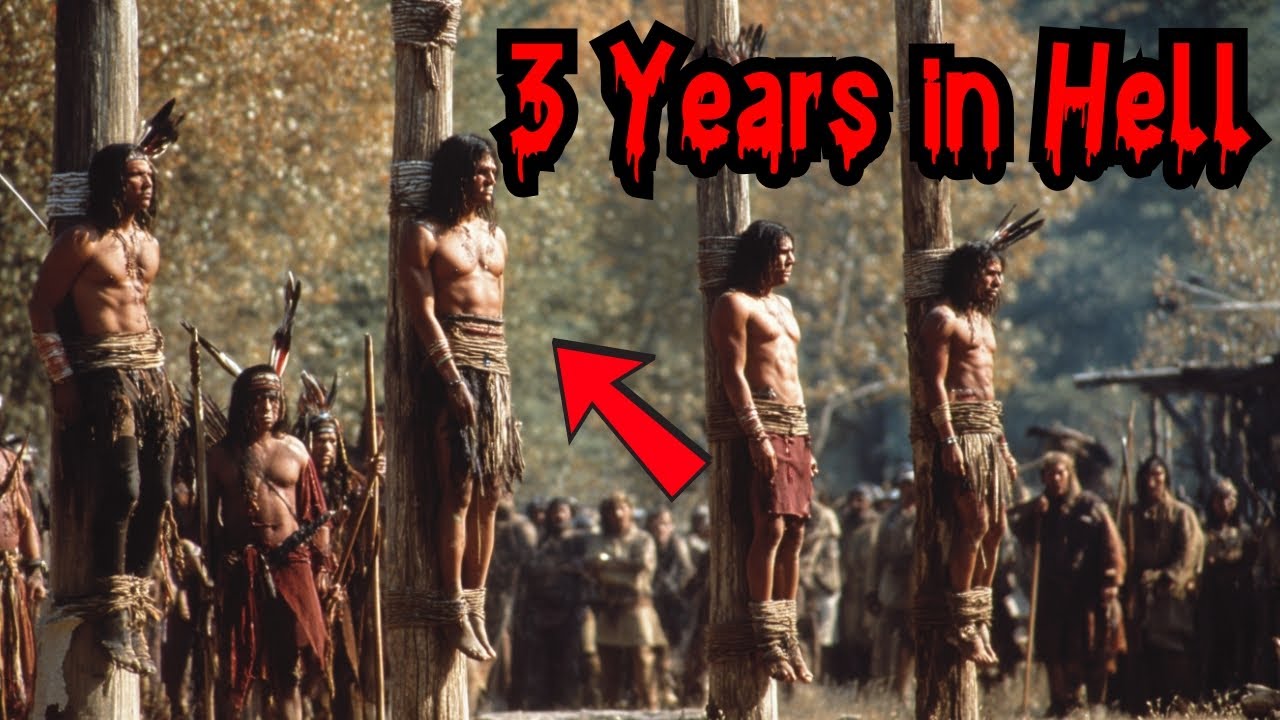
The captives were tied to tall posts, their hands raised high by ropes. Aken was positioned opposite Lee. In a choreographed procession, warriors armed with tomahawks, knives, and flint spearheads circled the captives. Two warriors stepped forward to scalp Martin and Stewart, removing small patches of skin the size of a silver dollar.
Though alive, the two men bled heavily, their cries echoing through the clearing. The warriors continued their procession, letting out war whoops as they passed, raking flint spearheads across Martin and Stewart’s bodies. The torment was methodical and relentless. Lee and Aken were left untouched during the ordeal.
Lee later wrote: “How many times they circled, halting with war cries and repeating the same demonic ritual, I cannot say. ”
Lee described the scene with vivid clarity, noting how the warriors engaged in the task until “every inch of the bodies of the unfortunate man was hacked and covered with clotted blood. ” The ordeal was so unbearable that Lee longed for the ability to choose his own death rather than endure the relentless cruelty. As historian S.
C. Gwynne notes in “Empire of the Summer Moon,” the Comanche did not shy away from inflicting suffering. Gwynne writes: “Not only did they inflict horrific suffering, but by all accounts, they took pleasure in it. Making people scream in pain was part of their culture, accepted without question.
”
Between acts of violence, the Comanche paused to smoke tobacco and taunt their captives, mocking Martin for praying and pointing out the gruesome injuries inflicted on him and Stewart. The pause was brief, and the ceremony resumed with a chilling war dance. Two warriors circled the captives before drawing their hatchets and delivering fatal blows to Martin and Stewart, crushing their skulls in an instant. The bodies were discarded without ceremony, leaving Lee and Aken bound and bracing for their own deaths.
Yet to their astonishment, the ritual ended, and they were spared for reasons Lee could not comprehend. His pocket watch, revered by the Comanche as a mystical object, became a tool of leverage. Aken told Lee that the Comanche believed the watch to be a living spirit in a silver body. This insight became Lee’s lifeline.
Aken, however, would not share Lee’s fate. Sent to another camp, he offered a brief farewell and left Lee with his parting wisdom. From that moment, Lee never saw or heard of Aken again, and he was presumed dead. Over the next three years, Lee lived among various Comanche tribes.
His pocket watch continued to command respect, traveling with him and maintaining its status as a sacred object. Following Aken’s advice, Lee adapted to his circumstances, serving Big Wolf and other tribal leaders. He performed tasks as needed, gradually earning their trust. Eventually, he was allowed to move freely within the camp and even carry a knife, a significant shift in his status.
Big Wolf’s tribe gave Lee the nickname Jamakaco, meaning “the good white man. ” While Lee’s relationship with the tribe varied, he still faced cruelty, particularly from a master named Spotted Leopard, who severely injured him after a failed escape attempt. Yet moments of compassion emerged, with women in the tribe, such as a Comanche named Sleek Otter, offering him kindness and protection from the warriors’ wrath. Lee’s chance for freedom came during a journey with a chief named Rolling Thunder.
Ironically, the trip was intended to address the growing threat of white settlers encroaching on Comanche lands. Seizing his moment, Lee grabbed a hatchet and struck Rolling Thunder, burying the blunt edge into the chief’s skull. In his own words: “Seizing the hatchet in that moment, I leapt toward the chief and drove the blunt edge deep into his brain. ”
With the chief incapacitated, Lee armed himself with a rifle and knife, mounted a horse, and fled into the wilderness.
He wrote: “In an instant, I pulled the rifle from beneath him and took the long knife from his belt. Then, mounting his horse, I rode wildly away over an unknown path toward freedom. ”
His flight marked the beginning of a perilous journey through an unforgiving wilderness as he sought refuge in the Mexican state of Chihuahua. Navigating the vast and rugged terrain was a daunting challenge.
Lee faced natural obstacles at every turn, with cliffs, mountains, and dense brush forcing him to backtrack repeatedly. By day, he used the sun to guide him southward. By night, the North Star served as his compass. Weeks into his escape, Lee’s physical and emotional strength began to falter.
He described his condition in stark terms: “I was weary in body and spirit. My limbs were swollen and the wounds and bruises covering me were inflamed and painful. Day by day I grew weaker as I pressed on. Often I prayed that when I fell asleep, I might never wake again.
”
After nearly a month on the run, even Lee’s horse succumbed to exhaustion. Forced to abandon the animal, he continued on foot. He wrote: “Now, for the first time, my heart sank within me. For all I could see, civilization was as distant as when I began.
I began to doubt myself, to fear that I’d lost my sanity. ”
The wilderness itself seemed to conspire against Lee. Rattlesnakes and predators lurked in the shadows, drawn by the scent of his kills. Even building a fire became a risk, as the flames could attract attention.
To reduce this danger, Lee used natural features like cliffs and thick brush to hide the light. On the 56th day of his grueling escape, Nelson Lee’s fate took a miraculous turn. Resting in an open prairie, he was startled by the sharp crack of a rifle shot. Gripping his own rifle, he prepared for another encounter with potential captors.
But to his immense relief, the figures approaching were not Comanche warriors. They were a group of Mexican hunters, recognizable by their wide-brimmed sombreros. The group, heading home to San Fernando, likely near modern-day Chihuahua, quickly recognized Lee’s dire condition. Emaciated, unshaven, and barely recognizable after three years of captivity, Lee was a shadow of the man who had once roamed the American frontier.
The hunters took him in without hesitation, providing him with water, food, and a horse to ride. The journey to San Fernando took a week, during which the Mexicans shared their limited resources with Lee without question. Once in San Fernando, Lee was placed under the care of a local doctor. For six weeks, he remained there, gradually regaining his strength and recovering from the physical and emotional toll of his ordeal.
When Lee finally boarded a boat bound for New York, it marked the end of three long, harrowing years. His time among the Comanche, defined by captivity, survival, and eventual escape, had come to a close. In 1858, Nelson Lee stood once again on the familiar ground of the East Coast. Reflecting on his journey, Lee wrote: “I was home at last, and my time with the Indians was over forever, though I would never forget the horrific scenes of suffering and torture I witnessed among them.
”
Determined to preserve his experiences, Lee began writing his memoir, “Three Years Among the Comanches. ” The book served not only as a record of his personal survival, but also as a vivid chronicle of life on the frontier, offering readers insight into the cultural collisions between settlers and native tribes.