In 2001, High-C quietly discontinued one of its most beloved products without a recall, press release, or warning to consumers. The formula did not change, and the can remained on shelves, but the name vanished along with the green, slime-covered ghost that had appeared on its label since 1987. For years afterward, cashiers still rang up the product under its old code, and parents kept asking for it by a name that no longer appeared anywhere on the packaging. That contradiction, a product erased and yet still sold, reflects a larger pattern for the brand.
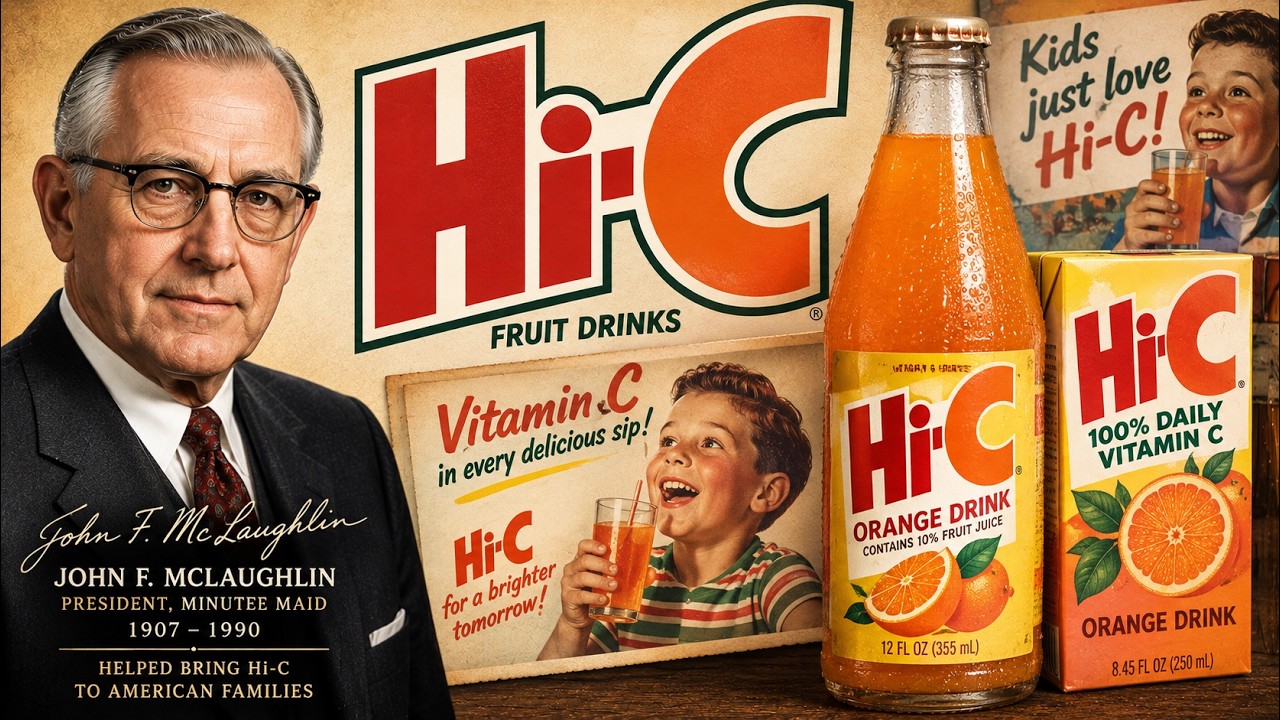
The full story of High-C is not just about a discontinued flavor but about how a vitamin supplement created for anxious post-war mothers became one of the most recognizable tastes of American childhood, only to slowly lose its place in the country that made it famous. The story begins in Houston, Texas, in 1946. Niles Foster ran a bakery and bottling plant, a small commercial operation that supplied local markets through truck routes. Foster was not a trained chemist but a tradesman who understood shelves, spoilage, and how far a product could travel before going bad.
After World War II, households were rebuilding, and a new type of health-conscious mother was reading about vitamins and worrying about what her children were getting in their diets. The fruit drinks available in 1946 were thin, unstable, and often required refrigeration that many post-war kitchens did not have. Foster saw an opportunity in creating a nutritional drink that families could keep on a shelf. He spent more than a year perfecting a formula that included orange juice concentrate, peel oil, orange essence, sugar, water, citric acid, and a deliberate dose of ascorbic acid, vitamin C.
He named the drink High-C for its high vitamin C content, a straightforward name that made its purpose clear. The packaging solved the other major problem. The drink shipped in 56-ounce cans that were hot packed, enamel lined, and sealed tightly enough to require no refrigeration before opening. A can of High-C could sit in a Houston pantry through a summer without spoiling.
This shelf stability was the innovation that made everything else possible. Foster tested the drink in 1947 and launched it nationally in 1948, backing the rollout with thousands of dollars a week in promotional spending in every market he entered. He partnered with Clinton Foods, Inc. , which produced and distributed the product while Foster managed the business.
The drink first expanded across the southern United States, then reached Los Angeles and San Francisco by 1949. Instead of building one central factory, High-C grew through a network of regional contract packers. Each packer was placed near the markets it served. A co-packer in Geneva, Ohio, already processing grapes, gave High-C its second flavor.
A plant in Paw Paw, Michigan, working with apples and cherries, added two more. This multi-plant system meant fast regional shipping and fewer outdated products sitting in warehouses, an advantage no single-factory competitor could easily match. By 1958, High-C was in supermarkets across the entire country, less than a decade after its national launch. Niles Foster did not stay to see it fully succeed.
In 1954, Clinton Foods sold its Florida holdings, including High-C, to the Minutemaid Corporation. Foster left the company shortly after the sale closed. George Roberts, who had worked as Foster’s assistant sales manager since the first launch, stayed behind. He would spend the coming decades as national sales manager and later director of contract packer operations, quietly running the machine Foster had built.
The product itself had to convince skeptical post-war mothers to trust a drink from a Houston bottling plant. It succeeded on four fronts. The first was the formula, which tasted like a tangier, sweeter, more assertive cousin of orange juice. The peel oil and orange essence gave it a sharper citrus punch than the thin fruit drinks on shelves.
The ascorbic acid was printed proudly on the label, and a mother reading the can was buying a health decision, not just a drink. The second front was the can. High-C’s version was hot packed and enamel lined, sealed tightly enough to stay safe on a shelf without refrigeration. In 1948, when ice boxes were still common in many American kitchens, that solved a real problem.
You could buy High-C on a Tuesday and serve it on a Sunday without worrying it had turned. The third front was price, though the historical record does not confirm exactly how much a can cost at launch. What is recorded is the scale of the bet: Foster and Clinton Foods spent thousands of dollars a week in promotional spending in every market. That spending only made sense if the can was cheap enough to convert trial into repeat sales quickly.
The fourth front was distribution. By building a network of regional packers, High-C kept product moving fast and fresh into every market without the delay and spoilage risk of shipping from one distant plant. By the time rivals noticed, High-C was not just a drink with a clever vitamin pitch but a drink with a distribution machine running underneath it. By 1958, High-C had become a supermarket fixture.
Grape, apple, cherry, orange, pineapple, and peach flavors all moved through the same contract packer network. For the next decade, marketing stayed focused on mothers, with magazine ads and displays leaning on the vitamin C nutrition pitch. It worked because it never had to compete for attention; it simply had to be believed. That approach would not survive the culture it helped build.
Through the 1960s, American children were spending more hours watching television than any generation before them, and advertisers noticed. The marketing pitch for High-C shifted away from the anxious mother toward the child watching Saturday morning cartoons. The vitamin C promise did not disappear, but it stopped being the headline. The headline became flavor, fun, and whatever character was popular that season.
The payoff came in 1986. High-C took an existing bright green orange-tangerine blend called Citrus Cooler, which had quietly been in the product line since the 1960s, and gave it a new name and face. The flavor became Ecto-Cooler, and the face became Slimer, the green ghost from The Real Ghostbusters, the animated spin-off of the 1984 film. The can turned neon, and the label showed Slimer grinning next to the name.
It was designed as a short-term promotional tie-in, the kind of licensing deal that usually dies with the cartoon. It did not die with the cartoon. The Real Ghostbusters went off the air in 1991, but Ecto-Cooler kept selling in lunchrooms and vending machines nationwide. The neon green can with a grinning ghost became a small badge of identity.
The flavor, an orange-tangerine blend nobody had marketed as special a decade earlier, became the most emotionally durable product High-C ever made, outlasting its launch show by a full decade. None of that popularity changed what was inside the can. The fine print told a quieter story: roughly one part in ten of the liquid was real fruit juice. The rest was water, sugar, and citric acid.
For now, in the late 1980s, nobody outside a laboratory or a regulator’s office was reading that closely. By the early 1990s, High-C was not just a beverage brand but a fixture of cafeterias. It sat on lunch trays in public schools from Houston to Cleveland to Sacramento, stocked in vending machines next to the gym, and handed out at birthday parties in the foil-topped juice box format that had replaced the old can as the way most kids encountered it. Ecto-Cooler, fruit punch, and orange rotated as flavors, but the shape of the experience did not change: a straw, a foil seal, a drink that tasted nothing like fruit and exactly like childhood.
The reach went beyond the school cafeteria. High-C found its way onto fast food counters, most durably at McDonald’s, where Hi-C Orange Lavaburst became a fixture on the beverage menu for decades. To an entire generation of American kids, ordering an orange drink at a drive-thru and getting a Hi-C was not a choice; it was how the transaction worked. Running underneath all of it, unchanged since 1946, was the number nobody put on a poster: roughly one part in ten of what filled the can, box, or fountain cup was actual fruit juice.
For a long time, that gap between promise and product cost the brand nothing. Parents trusted the name because their own parents had trusted it. Kids did not read labels; they read flavors, colors, and cartoon characters. But the regulatory climate was about to change.
The same decade that made Ecto-Cooler a cultural fixture was producing the advocacy groups, FTC hearings, and parental unease that would spend the next thirty years chipping away at the assumption that a drink named for a vitamin and sold through a cartoon ghost was good for children. Beginning in the early 1970s, an advocacy group called Action for Children’s Television, a handful of mothers in Newton, Massachusetts, began pressuring the FCC and the FTC to examine what was being sold to children too young to distinguish a commercial from a fact. Their early campaigns targeted toy advertising. By the middle of the decade, the target widened to food, specifically high-sugar cereals, candy, and imitation fruit drinks.
In 1977, the group joined with the Center for Science in the Public Interest and formally petitioned the FTC to restrict such advertising. High-C was never named in a headline-grabbing enforcement action, but it did not need to be singled out to be affected. It was exactly the kind of product this regulatory movement was built to scrutinize: a drink whose name promised vitamins, whose can was covered in a cartoon ghost, and whose contents were roughly nine parts water and sugar for every one part real juice. The climate around it shifted slowly from unquestioning trust to quiet suspicion.
That suspicion took decades to translate into lost shelf space, but it never fully went away. The second blow came from a serious competitor. In 1981, a German company called Rudolph Wild launched Capri Sun in the United States, a foil pouch with a tiny straw taped to the side, a packaging gimmick that seemed too fragile to survive a school backpack. Kids loved the pouch because it differed from the can and box High-C had trained them to expect.
Within a decade, the pouch had become the format American children associated with a kids’ drink. By the 1990s, Capri Sun was not just competing with High-C for shelf space; it was setting the category standard. High-C had lost a format fight, and that kind of loss shows up slowly, one lunchbox at a time, over twenty years. The institutional exit came slowly, then all at once.
In 2010, Congress passed the Healthy, Hunger-Free Kids Act, tightening federal nutrition standards for every school lunch, breakfast, and vending machine in the country. The new rules took effect at the start of the 2012–2013 school year and were built around a simple idea: less sugar, more whole grains, and fewer sweetened drinks. High-C had spent sixty years building its identity inside that setting, and a drink built mostly of water, sugar, and roughly 10% real juice no longer fit comfortably within the new rules. There was no single memo announcing the end of an era, no press conference, no formal farewell.
Cafeteria by cafeteria, district by district, the can that had once been a lunch tray fixture stopped being ordered as often. The exit was administrative, not dramatic, a line item quietly removed from a procurement contract rather than a scandal on the evening news. In 2017, the second blow landed somewhere more visible. McDonald’s quietly dropped Hi-C Orange Lavaburst from its beverage menu.
The drink had sat behind that counter for sixty-two years. It was replaced by Fanta and a new Sprite Tropic Berry variant, part of a broader promotional realignment with Coca-Cola’s brands. There was no farewell tour and no announcement to customers who had been ordering it since childhood. One day it was on the menu board; the next it was not.
The response was immediate. Customers complained, online petitions circulated, and longtime regulars asked loudly where their orange drink had gone. By 2021, McDonald’s brought it back. Sixty-two years erased in a memo, but four years reversed by demand.
No formula changed and no ceremony accompanied either shift. The drink had never actually died; it had simply stopped being assumed. Every few years, someone with a marketing budget and a nostalgia deadline decides that absence is worth reversing. In 2016, with a new Ghostbusters film headed to theaters, Coca-Cola brought Ecto-Cooler back to store shelves for the first time in fifteen years.
Fans had spent that decade and a half keeping the memory alive through online petitions, retro food blogs, and message boards trading rumors about a comeback. This time it happened, with juice boxes and cans that turned slime green when cold. Five years later, when Ghostbusters: Afterlife arrived in theaters, Ecto-Cooler came back once more, but smaller and stranger. There was no retail release at all.
The only way to get a bottle was to respond to the company’s social media posts and hope to be chosen. A product that once sat in every supermarket in the country had become a prize you had to win. The loyalty never stopped. Sealed, unopened cartons of the original 1990s Ecto-Cooler have sold online for real money.
One carton reportedly fetched close to $200 years before the 2016 revival, bought by someone who had no intention of drinking it. For collectors, the appeal was never really about taste; it was about holding something that proved a specific version of childhood had actually existed. When Coca-Cola brought Ecto-Cooler back in 2016, a company spokesperson confirmed the formula had been quietly simplified. The sweeteners were reduced to plain high-fructose corn syrup, and other ingredients were trimmed to hit, in the company’s own words, the correct amount of tartness.
The nostalgia people were chasing was not the original can from 1987 but an approximation of an approximation, built to taste close enough to a memory that few could have described precisely. High-C began in 1946 as a promise printed on a can: high vitamin C nutrition a mother could trust, sold by a Houston tradesman. It became, through five decades of cartoons, lunch trays, and drive-thru counters, something closer to a shared national memory. Then one of the institutions that had built that memory quietly decided the product no longer belonged.
The brand did not die; it just stopped being the default. It became something you had to go looking for. The Coca-Cola Foods division that now oversees Hi-C production is headquartered in the same city where Niles Foster once ran a small bakery and bottling plant, testing an orange drink recipe he had spent over a year perfecting. He never saw what it became.
He was not there for the cartoons, the lunchroom trays, or the McDonald’s counters that dropped the drink and then brought it back. The company he built simply outgrew him in the same city where he started it.