Gettysburg’s True Reckoning: How a Doomed Strategy, Not a Single General, Doomed the Confederacy
GETTYSBURG, Pa. – For over 150 years, the most enduring verdict of the Civil War’s defining battle has been a simple one: James Longstreet lost Gettysburg. The accusation, sharpened by decades of Lost Cause mythology, paints the general as the slow, sullen architect of defeat, a man whose tardiness on July 2nd, 1863, squandered a moment of Confederate destiny.
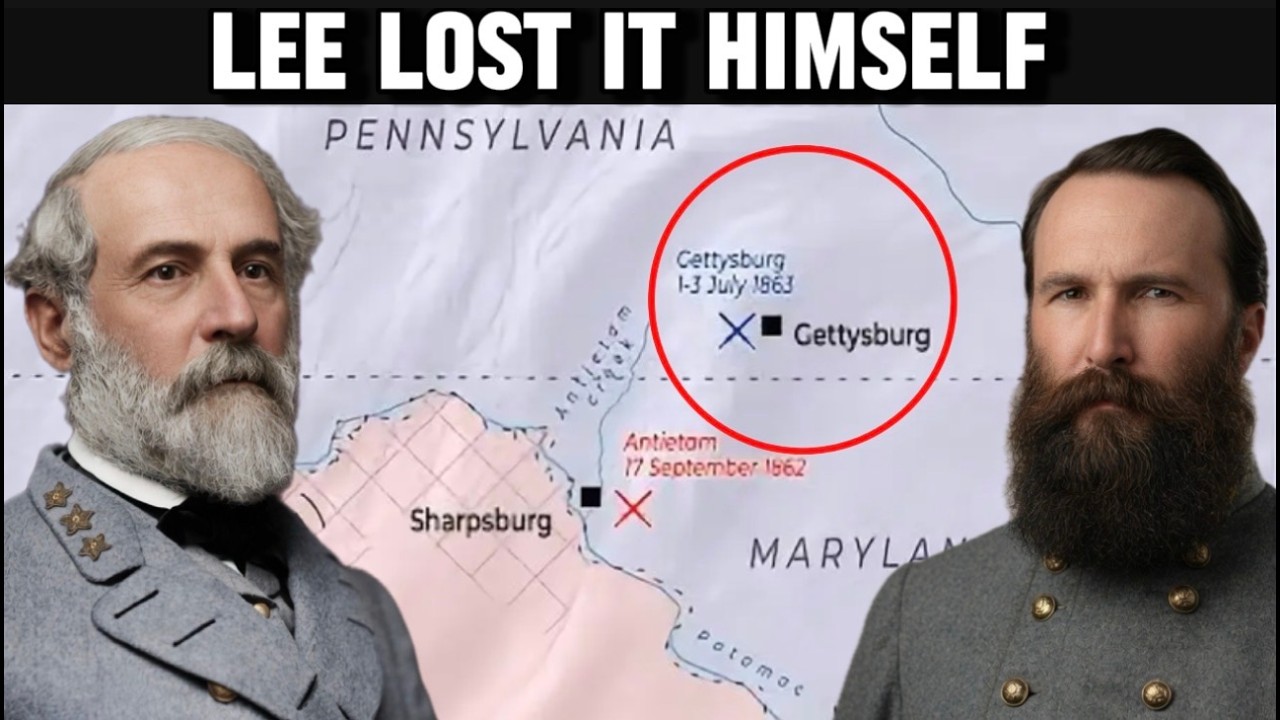 But this narrative, so comforting in its simplicity, is a historical fabrication. The Confederacy did not lose Gettysburg because one man moved too slowly. It lost because Robert E.
Lee, stripped of his intelligence and his most trusted lieutenant, marched an overstretched army into a strategic dead end and then fought a battle it was structurally and tactically incapable of winning.
The roots of the disaster lie not in the fields of Pennsylvania, but in the spring of 1863. Lee’s stunning victory at Chancellorsville had been a masterpiece of audacity, but it was a victory built on a dangerous illusion. It had been made possible by Stonewall Jackson’s legendary flank march and the catastrophic collapse of Union General Joseph Hooker’s nerve.
The Army of Northern Virginia, emboldened by success, marched north in June believing it could repeat the miracle. But the army that crossed the Potomac was a shadow of its former self in command. Lee had reorganized his force from two corps to three, promoting Richard Ewell and A.
P. Hill to corps command. He had lost Jackson, the one man who understood his orders implicitly and executed them with relentless aggression.
And he had lost J. E. B.
Stuart, whose cavalry—his eyes and ears—had embarked on a self-appointed raid around the Union army, leaving Lee blind and groping through hostile territory.
The result was a catastrophic intelligence failure. When A. P.
 Hill’s men stumbled into Union cavalry west of Gettysburg on July 1st, it was not part of a plan. Lee had not chosen the ground. He had not scouted the terrain.
The greatest army in Confederate history had blundered into its most consequential battle while foraging for shoes.
The first day’s fight was a tactical success, but a strategic failure. Confederate forces drove two Union corps back through the town, but the retreating Federals consolidated on the formidable heights of Cemetery Hill and Culp’s Hill. Lee, sensing a decisive victory, issued a discretionary order to Ewell to take the high ground “if practicable.”
Ewell, newly promoted and uncertain, hesitated. The moment passed. By the morning of July 2nd, the Union position was nearly impregnable.
Lee’s plan for the second day was to strike the Union flanks in a coordinated assault. But the plan was built on a fantasy. He had no intelligence on Union troop dispositions.
His new corps commanders lacked the initiative and the shared understanding that had made Jackson so effective. Longstreet, who had argued for a defensive strategy, was ordered to attack the Union left. He moved with deliberate slowness, his objections rooted not in cowardice but in a clear-eyed assessment of the ground.
When he finally attacked in the late afternoon, the assault was piecemeal and uncoordinated. On the other end of the field, Ewell’s demonstration on Culp’s Hill stalled. The Confederates had hammered the Union lines, but they had not broken them.
 They had lost thousands of irreplaceable men for nothing.
The third day was the culmination of this systemic failure. Lee, convinced that the center of the Union line could be broken, ordered a massive frontal assault on Cemetery Ridge. Longstreet, who would command the attack, was so certain of its futility that he could not bring himself to give the order, merely nodding to his artillery chief to begin the bombardment.
The cannonade was spectacular but ineffective, overshooting the Union positions. Then, 13,000 Confederates under George Pickett and others stepped into the open field. They advanced with parade-ground precision into a storm of canister and rifle fire.
They briefly breached the stone wall at the “Bloody Angle,” but the Union line held. The charge was broken, leaving half its number dead, wounded, or captured.
The blame for this catastrophe was laid at Longstreet’s feet almost immediately. The chief architect of this narrative was Jubal Early, a bitter and unforgiving man who used the Southern Historical Society to wage a decades-long campaign against Longstreet. Early’s motivation was political as much as historical.
Longstreet had committed the unforgivable sin of becoming a Republican and accepting a federal appointment from Ulysses Grant. He had made peace with the United States, and for that, he could never be forgiven.
But the evidence does not support the accusation. Lee’s own post-war account was remarkably restrained, acknowledging the army had not executed his intentions. He never blamed Longstreet by name.
 The real failure was Lee’s own. He had attacked when he should have maneuvered. He had trusted in a coordination his army could not deliver.
He had sent men across an open field against a position his most trusted subordinate had told him could not be taken.
Gettysburg was not lost on July 3rd. It was lost in the strategic romanticism of a campaign that offered no sustainable path to victory. It was lost in the structural gaps of a reorganized army asked to perform beyond its capacity.
It was lost in the absence of Stuart’s cavalry and the presence of untested corps commanders. It was lost because Lee, a tactical genius, had come to trust his own instrument too completely, believing that audacity could substitute for resources and intelligence.
The search for a single villain has always been about the demands of grief and mythology, not the demands of history. History is less merciful. It offers no single moment of redemption, no one man whose removal would have changed the outcome.
Gettysburg was a defeat born of a thousand accumulated failures, a doomed army meeting a capable defender on ground of the defender’s choosing. Longstreet knew it before the charge began, and he knew it as he watched it fail. He spent the rest of his long life in a country that did not want to hear the truth.
The Confederacy lost Gettysburg because it had finally met an enemy it could not outmaneuver, and a strategy it could not outrun.