On October 1, 1913, it took a crew at Ford’s Highland Park plant 12 hours and 8 minutes to build the chassis of a Model T. By the spring of the following year, that same chassis was being assembled in 93 minutes total. In about a year, inside one building, the way a car was built changed completely—and so did the experience of the men building it. Before 1913, a car was built in a fixed spot.
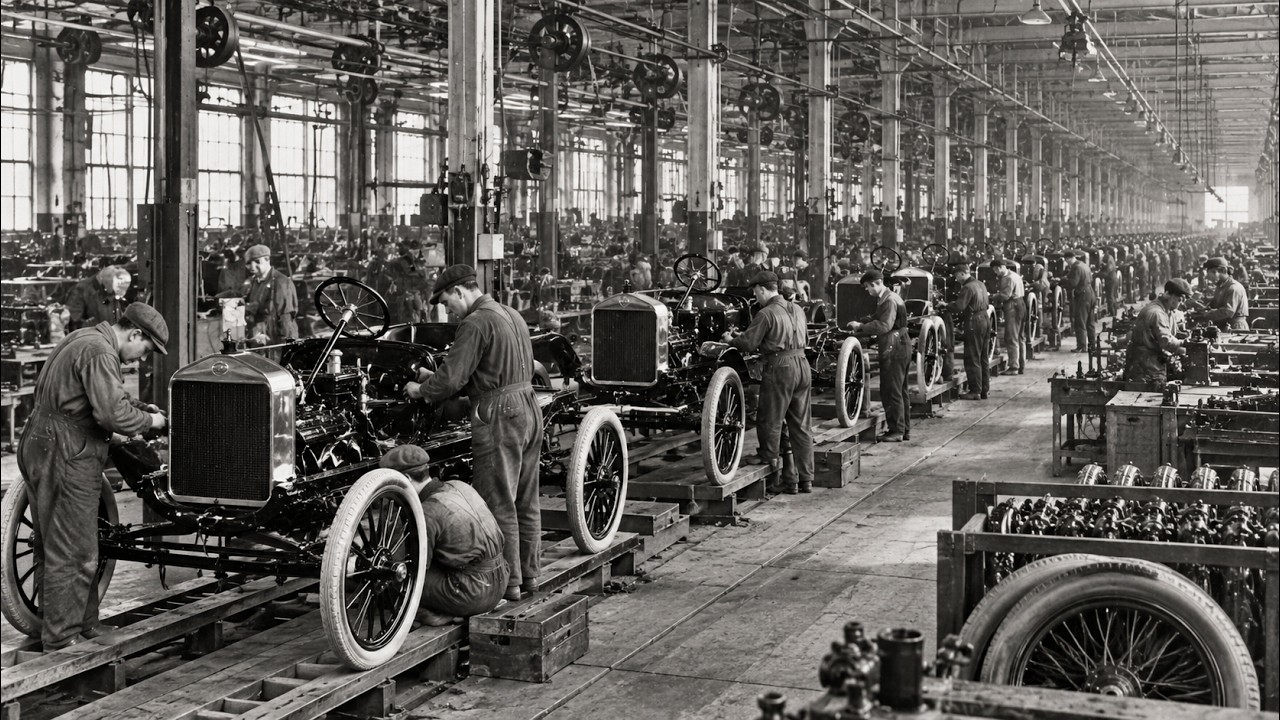
Workers gathered around a single chassis and assembled the entire vehicle where it sat, walking back and forth to bins of parts scattered around the shop. The method produced a fine automobile, but it was slow and expensive. When the Model T went on sale in 1908, it cost $850, and Ford built just 11 cars in its first month. Most of the working day disappeared into walking, waiting, and searching for parts rather than actual assembly.
Henry Ford wanted to build a car for what he called the “great multitude”—a vehicle cheap enough for an ordinary working family. The Model T was rugged, simple, and made of interchangeable parts, but the stationary building method stood in the way of mass production. In 1910, Ford moved production to a new plant in Highland Park, just north of Detroit, designed by architect Albert Kahn. The building was filled with so much glass that people called it the Crystal Palace.
For the first couple of years inside that gleaming hall, workers still built cars the old way, one at a time, standing still. The idea that solved the problem did not come from another car factory. It came from a slaughterhouse. In the meatpacking plants of Chicago and Cincinnati, carcasses were hung on overhead trolleys and moved past a line of men, each of whom made one cut as the animal traveled the length of the rail.
Ford engineer William Klan visited the Chicago packers and came back with a thought: if a disassembly line could take an animal apart by moving it past men doing one task each, why couldn’t an assembly line put a car together the same way, in reverse? Ford himself later credited the idea generally to the overhead trolley used by the Chicago packers in dressing beef. Before committing the whole factory to the concept, Ford’s men tested it on one small part. In the spring of 1913, they took the flywheel magneto, a component of the ignition system.
Building one had taken a single skilled worker about 20 minutes. The job was broken into 29 steps given to 29 men standing in a row, with the magneto sliding down a waist-high moving line. The first run cut assembly time from 20 minutes to 13. After adjustments, a magneto that once took 20 minutes came off the line in about five, tripling output without adding a single new machine.
With the magneto proven, Ford’s engineers turned the idea loose on the car itself. Through 1913, they put line after line into motion. On October 1, they came for the largest job: the chassis, the rolling frame that everything else bolts onto. Initially, the frame was laid on the floor and dragged past workers by a rope and winch.
Even that first crude attempt cut the build time roughly in half, down to about six hours. By early 1914, the line was mechanically driven and moved at a steady six feet per minute. The assembly of the car had been broken into 84 distinct steps, each assigned to a man who stood in one place and did only one task. The chassis that once took the better part of two working days was finished in 93 minutes as it moved.
At full stride, a finished Model T came off the end of the line about every 24 seconds. The line depended on sameness. Every car had to be identical, and every part interchangeable, because a man doing one motion in seconds had no time to file a piece to fit. Ford’s famous remark that customers could have a Model T in any color, so long as it was black, reflected that logic: variety was friction, and friction stopped the belt.
The impact on the automobile itself was historic. The Model T, which started at $850, fell in price to about $260 by 1924. On June 4, 1924, the 10 millionth Model T rolled off the line. By the time the model was discontinued in 1927, more than 15 million had been built.
By 1914, a man working on the line could buy the car he built with about four months of his pay. But the speed came at a real cost. To bring build time down, Ford’s engineers broke jobs into pieces so small that almost anyone could do them with almost no training. The mechanic who once understood the whole car was replaced by a man whose working life narrowed to a single motion, repeated all day at a pace the line set and he could not change.
There were no decisions, no variety, no rest. The work no longer belonged to him; he belonged to the work. Workers voted with their feet. In 1913, the Ford Motor Company hired 50,448 workers, but at any given moment the plant only had about 13,623 people working in it—a turnover rate of roughly 370%.
Men quit almost as fast as they could be hired. Some walked out within days, some within hours. On January 5, 1914, Ford announced the solution: the $5 day. The basic wage went from $2.
34 for a nine-hour day to $5 for an eight-hour day. Newspapers put the announcement on the front page. More than 10,000 men crowded the gates of Highland Park in the January cold. On one bitter morning, the company turned fire hoses on the crowd, leaving men soaked and freezing rather than opening the gates.
The $5 day worked as intended. Turnover collapsed, and Ford had shown that a laborer could be paid enough to become a customer. The move is seen as one reason the American middle class swelled in the decades that followed. The higher pay, however, came with conditions.
The second half of the pay was called a share of the profits, and workers had to qualify for it. Ford created a “sociological department” whose inspectors visited workers’ homes to check whether houses were clean, whether men drank, whether families saved money, and whether they took in boarders. Nearly 90 percent of workers qualified, but the company had reached beyond the factory floor and into workers’ private lives. The home inspection system was largely dissolved by around 1921.
The thinking behind these changes had roots in the work of Frederick Winslow Taylor, whose 1911 book “The Principles of Scientific Management” argued that human work could be studied like a machine. Ford’s men built their line by trial and error rather than by following Taylor directly, but Taylor’s ideas were part of the industrial climate. Together, Taylor’s job breakdown and Ford’s moving line produced what became known as Fordism: the belief that the most efficient factory worker is a reliable, interchangeable part of a larger machine. The system created enormous wealth and made cars affordable to ordinary families, but it also scattered knowledge that one mechanic once held across 84 sets of hands, none of whom needed to understand the rest.
The line could not be slowed by any single person and did not need any single person, because every motion had been made simple enough to teach to the next man at the gate. As accounts from the men who stood on the line put it, the line never stopped. There was no finishing; there was only the next car, at the pace of the machine, until the whistle blew. The method Ford perfected in about a year at Highland Park spread to factories across the industrial world and defined how most of the industrial workforce labored for the rest of the century.
The hour and a half that put a Model T within reach of the man who built it was the same hour and a half that took the whole car out of his hands and left him with one motion. The deal struck in that glass building in 1913 is one, the accounts suggest, that workers are still living inside today.