In 1931, Mahatma Gandhi walked through the grim industrial towns of Lancashire, England, to face the British mill workers whose livelihoods his boycott movement had destroyed. The British government feared he would be lynched by the angry unemployed crowds. Instead, the workers came out in thousands and cheered him. Gandhi told them he was not against them but against a system that exploited both them and India.
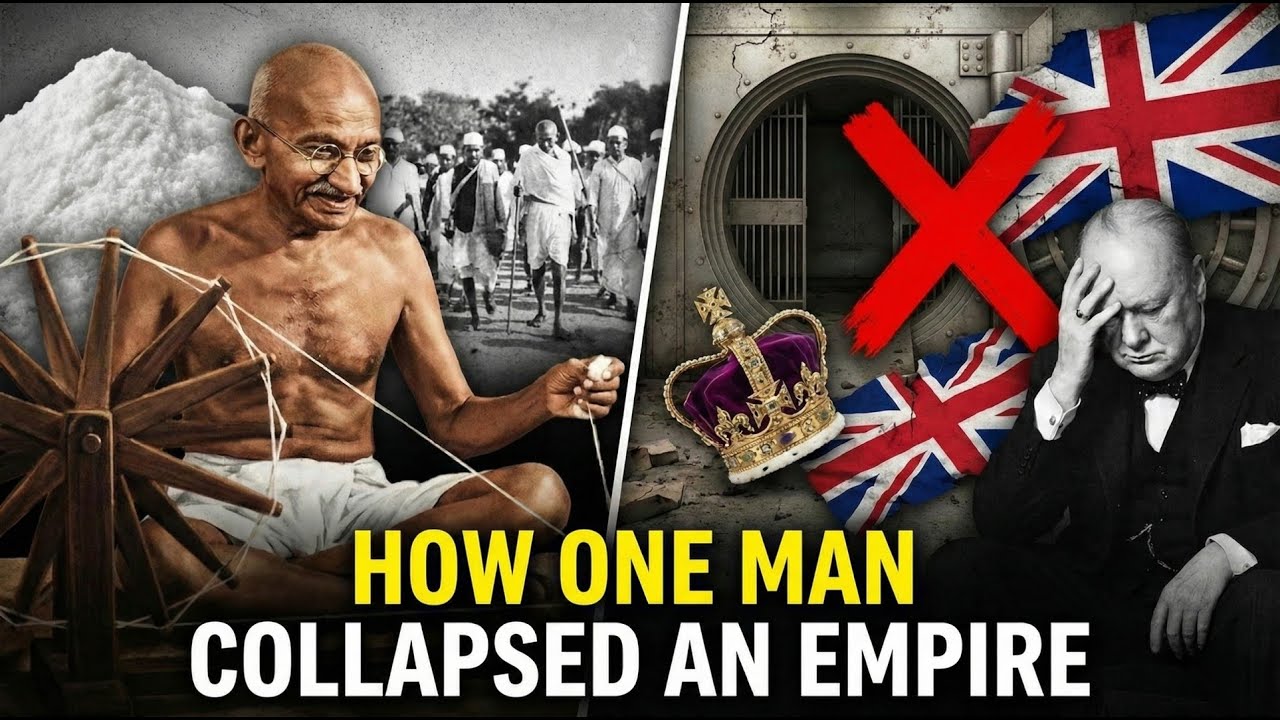
One union leader reportedly told him, “Mr. Gandhi, I understand we are suffering, but you are suffering more. ” The visit became a moment of solidarity that humanized the Indian independence struggle for the British public. The confrontation was the visible peak of a deeper economic war that Gandhi had waged for years.
His strategy was built on a simple insight: the British ruled India for profit, and if that profit disappeared, the empire would leave. In the early 18th century, India was the world’s industrial powerhouse, controlling roughly 25% of the global economy. Its textile industry was legendary. The weavers of Bengal produced muslin so fine that a full dress could pass through a wedding ring, and European courts prized Indian cloth above all others.
The British initially came to India as buyers and traders. But as the East India Company transformed into a military conqueror, it decided to replace the Indian weavers rather than compete with them. British mills produced coarse cloth that could not match Indian quality in a free market, so the British rigged the market instead. They imposed massive tariffs on Indian cloth entering England while forcing India to open its borders to British goods duty-free.
Accounts from the era describe coercion against weavers, including forced contracts at a loss and reports of beatings and imprisonment. Some dark historical accounts tell of British agents cutting off the thumbs of master weavers so they could not pass on their skills. General William Bentinck, the British governor, wrote in 1834 that “the bones of the cotton-weavers are bleaching the plains of India. ” The weaving centers of Dhaka and Murshidabad were reduced to ghost towns, and the artisans who once clothed the world became landless peasants.
By the mid-19th century, India had been reduced from a manufacturer to a supplier of raw materials. Indian farmers were forced to grow cotton, sold it cheaply to British agents, and then were forced to buy back finished British cloth at a profit to the empire. This “drain of wealth” funded Victorian mansions, railways, and imperial expansion across Africa and Asia. When Gandhi returned to India in 1915 after years in South Africa, he saw the poverty and despair.
Unlike many nationalists focused on political oppression, he saw an economic equation. The British were in India because it paid them to be there, and their single largest industry was the textile trade. Gandhi realized that if the Indian people refused to buy British cloth, the factories in Manchester would stop, the money would stop, and the empire would become a burden instead of an asset. He began preaching a philosophy centered on khadi, handspun and handwoven cloth, and made the spinning wheel the symbol of the revolution.
He abandoned his western suits for a simple loincloth made of khadi and spun for hours every day, even while speaking with diplomats. He organized massive bonfires in Bombay and Kolkata where Indian elites burned their finest British-made clothes in ritual purification. Winston Churchill famously dismissed Gandhi as “a half-naked fakir. ” British officials laughed at the idea of fighting the industrial revolution with a spinning wheel.
But Gandhi was not trying to out-produce Manchester. He was trying to destroy Manchester’s market share through moral refusal. It became shameful to wear foreign cloth in India. The social pressure spread like wildfire, and orders from India began to dry up.
The warehouses in Manchester filled with unsold stock. The Indian National Congress formally adopted the boycott of foreign goods as its primary strategy. Women played a huge role, picketing shops and lying down in doorways to block the sale of British cloth. Import figures collapsed, with British cloth imports falling by more than 50% in some years.
In the industrial towns of Northern England, mills that had run around the clock cut shifts, then closed entirely. Tens of thousands of British workers lost their jobs. The poverty in Lancashire in the 1930s was severe. Families lived on scraps, and men stood on street corners begging for work.
The British press blamed Gandhi, calling him the villain starving the British worker. But Gandhi calculated that inflicting pain on the British working class would create a political crisis in London, where politicians could not ignore mass unemployment in Manchester. When Gandhi asked to visit Lancashire during the 1931 Round Table Conference, he wanted to look the unemployed workers in the eye. The workers’ warm response shattered the British propaganda campaign against him.
Gandhi then opened a second front in his economic war. He turned his attention to salt. The British Raj held a monopoly on the production and sale of salt in India, and the tax on it was over 2,400% of its production cost. It fell heaviest on the poorest, who needed salt to survive in the hot climate.
When Gandhi announced his plan to march to the sea and make illegal salt, Congress leaders were skeptical. They thought salt was a trivial issue. But Gandhi understood that every Indian understood salt, and that breaking one small law on a mass scale would make the British administration impossible. On March 12, 1930, at age 61, Gandhi led 78 volunteers from his ashram.
They walked for 24 days covering 240 miles. As the march grew, villagers poured out to see the holy man who was going to fight the British with a pinch of salt. The international press arrived and walked alongside him. The British government was paralyzed.
If they arrested him too early, they would make him a martyr. If they let him reach the sea, they would look weak. They did nothing. On April 6, 1930, Gandhi reached the coast at Dandi.
He walked into the waves, bent down, and picked up a lump of salty mud, breaking the law. It was a signal. Across the entire coastline of India, millions of people rushed to the water to make illegal salt. Police beat protesters with steel-tipped batons and arrested 60,000 people, but the jails filled and the salt kept coming.
The salt monopoly collapsed and, more importantly, the fear of the British was broken. By the late 1930s, the cost of governing India was rising while revenue was falling. Textile duties were down, the salt tax was unenforceable, and the liquor tax was being undermined by temperance movements led by Gandhi’s followers. The British were spending more to govern India than they were extracting from it.
The Second World War was the final blow. Britain fought for survival against Nazi Germany and could not afford to garrison a hostile subcontinent in open revolt. Gandhi launched the Quit India movement in 1942, telling the British to leave immediately. Britain arrested the entire Congress leadership and crushed the protests, but the cost was astronomical.
Britain ended the war bankrupt, owing billions of dollars to America and billions of pounds to India itself in the form of the Sterling Balances debt. The transfer of power in 1947 was a political event, but it was driven by economic reality. The British left because the business model had failed. The legacy of the cloth war shaped India’s future.
The spinning wheel, the chakra, became the symbol of the nation and sits in the center of the Indian flag today. But the obsession with handspun cloth and suspicion of industrialization meant India was slow to modernize its own textile industry, and it lost the global textile race to countries like China and Bangladesh in the late 20th century. In Manchester, the decline that began with the boycott turned into a terminal collapse. The mills never really came back, closing one by one as British industry faced new competition and lost its captive markets.
There was bitterness for a long time, but over time a new understanding emerged. People began to see that the prosperity of Manchester had been built on an unfair foundation, and that the suffering of the mill worker and the Indian weaver were connected. In 2019, a bronze statue of Gandhi was unveiled outside Manchester Cathedral, just a few miles from the sites of the factories he helped to close. The statue represents reconciliation.
It acknowledges that the old world of imperial exploitation had to end, and that the dignity of a people is worth more than the balance sheet of a corporation.