On the morning of June 17, 1945, American aircraft flew over the southern tip of Okinawa and dropped paper. The bundles scattered in the slipstream and drifted down across the last corner of the island still held by Japanese forces, where the remnants of an army were living underground. The leaflets had been falling for nearly three months. Since March 25, a week before the invasion, aircraft had dropped about eight million leaflets over the island, and the 10th Army had printed more on Okinawa itself, firing them from artillery pieces inside shell casings.
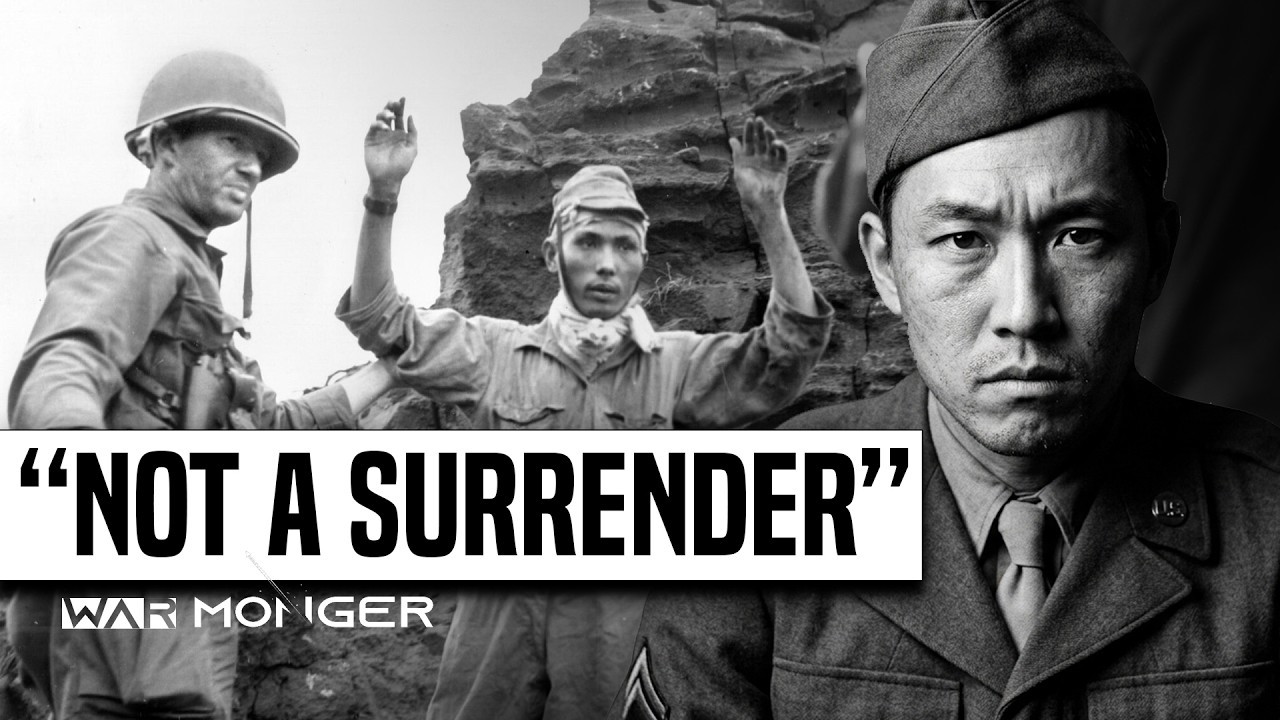
Some were addressed to farmers, some to soldiers. By that June morning, the effort had narrowed to a single purpose: getting men out of the ground alive. The narrow end of that effort weighed about what two men could carry. A portable loudspeaker in the Pacific in 1945 meant an amplifier in a case, a battery or small generator, a length of cable, a horn on a tripod, and a hand microphone.
The horn had to sit close enough to a cave mouth to be heard over gunfire and far enough back to keep the operator alive, a distance no one could work out in advance. Carrying it forward was a job for two. Stringing cable was a job for two more. The man who ended up at the microphone spoke in Japanese from a spot every hostile weapon in the area could reach, and he kept speaking after the first answer came back.
For 70 days, that work produced almost nothing. Through the first stretch of the battle, the 10th Army took fewer than four prisoners a day out of an enemy force of about 100,000. The men underground had been told by their own officers, and in writing, that capture meant torture and death, that a captured man was dead to his household and his country, and that the proper end for a soldier in a hopeless position was to arrange his own. Nothing in their training covered any other outcome.
There was no procedure, no instruction on how to behave if taken, no page in any manual describing what a Japanese soldier should do with his hands. An army can be driven into a corner and still have no vocabulary for what happens next. That was the problem the Americans were trying to solve with a horn on a tripod. By mid-June, the attempt had reached the highest level on the island.
Seven days earlier, on June 10, an aircraft had dropped a single message addressed to one man. It was a letter from Lieutenant General Simon Bolivar Buckner, commanding the 10th Army, to Lieutenant General Mitsuru Ushijima, commanding the Japanese 32nd Army. Buckner wrote that Ushijima’s forces had fought with great bravery, that their infantry tactics had earned the respect of their opponents, and that, as one infantry general to another, he believed Ushijima understood as plainly as he did that the destruction of all Japanese resistance on the island was a matter of days. Then he invited him to open negotiations.
The letter was pitched at a professional soldier’s sense of his own standing. Nobody on the American side expected it to work, and it did not. What often gets left out is how long it took to arrive. The Japanese command network in the south of Okinawa had come apart so completely that a message dropped from an aircraft on the 10th only reached the army commander on the 17th, the same morning the leaflets were going down.
Ushijima and his chief of staff found it funny. Both men said that entertaining such a proposal was beneath their honor as samurai. That account comes from prisoners taken afterward, because no surviving Japanese document records either general’s reaction, and both were dead within five days. The second part of this story was written five months earlier, on another island, by a sergeant about paper.
In January 1945 on Leyte in the Philippines, a Japanese-American soldier named Harold Nishimura sat down to assess how leaflets had performed during that campaign. Nishimura belonged to the language team attached to the 7th Infantry Division, one of the small detachments of Japanese-speaking Americans parceled out to combat divisions across the Pacific. His report ran long. He noted that in the late stages of the fighting, almost every prisoner had either come in holding a leaflet or said a leaflet had influenced him, which was the finding his superiors wanted.
Then he added the finding they had not asked for. Of the 127 prisoners the division had taken, nearly all of them took exception to a single word printed on the paper. The word was “surrender. ”
That finding did not rest on one man’s impression.
Interrogation reports from the theater’s translator organization said the same thing in the same period, and they went further. Men took exception to the word even when it appeared in English, a language most of them could not otherwise read, because they knew what those letters meant on that page. One soldier was seen to look at a leaflet, drop it, grind it into the dirt with his heel, and say the term aloud in his own language. The term carries the sense of descending from a high place to a low one, and it is not a word said much in Japanese even in peacetime.
The people running American propaganda in the Pacific turned that finding into policy. In December 1944, the Office of War Information issued a classified handbook for its own writers, setting the rule down without qualification: propaganda must never employ the words for “surrender” or “prisoner of war. ” Everything possible had to help the man keep his face. Photographs of captured men could appear on a leaflet if the printers blanked out the eyes, and the leaflet then had to explain why the eyes were covered, because prisoners had told their interrogators that what frightened them most was their households at home finding out.
Japanese prisoners who had volunteered to write leaflets for their captors helped work out the replacement phrase. In English, it ran to three words, and it went across the front of every card in that series: “I ceased resistance. ” The distinction sounds like nothing from the outside. Inside a Japanese infantryman’s head in 1945, it was everything.
Since childhood, he had learned that he must never surrender. Nobody had ever raised ceasing resistance with him at all, which meant there was no rule against it and no shame attached to it. The phrase handed him a description of what he was doing that his own upbringing had left unguarded. By the summer of 1945, the Americans had tested this word on the people it was aimed at.
That was the sentence going down over southern Okinawa on June 17, printed on a card five by eight inches, red, white, and blue. A postwar study of the leaflet series puts the number of that particular card used on the island at about 600,000 and states that its distribution was held back on purpose until the last ten days of organized resistance, so that it would arrive when the men reading it had nowhere else to go. The Japanese text carried instructions, and those instructions are the reason this story ends as it does. Come toward the American lines at a walk with hands raised high.
Come by daylight, never at night. Come singly rather than in a group. Wear a loincloth and nothing else, and clothing will be provided. Anyone may use this card, Japanese or Korean, soldier or civilian.
Anyone without a card may come in the same way and will meet the same treatment. Every one of those lines is doing a job, and the last two are doing the job the story turns on. The men who spoke those words out loud came from a school in Minnesota. The army had opened a Japanese language school at the Presidio in San Francisco a month before Pearl Harbor with a budget of $2,000 and 60 students, and moved it to Camp Savage in Minnesota in 1942.
Several thousand graduates went through it before the war ended. Most of them were second-generation Japanese Americans. A great many had relatives behind wire in the relocation camps while they were being trained. A great many had relatives in Japan.
The course ran eight hours a day with two more in the evening. Men who fell behind were dropped, and students who wanted extra hours went into the latrines after lights out, because the lights in the latrine stayed on. Graduates went out to combat units in teams of about ten. The 96th Infantry Division’s team, which landed on Okinawa in the second wave on April 1, was headed by Warren Higa of Honolulu and included his younger brother Takajiro, along with Rudy Kawahara, Haruo Kawana, Thomas Matsui, Akira Ohori, Isamu Yamamoto, Herbert Yanamura, and two men from California, Fred Fukushima and Fred Nonaka.
Their language officer for the campaign was a young Navy man named Donald Keene, who would spend the next 60 years as the most important American scholar of Japanese literature. Takajiro Higa was 21. He had been born in Hawaii, sent to Okinawa as a small boy, lived there for 14 years, and left six years before he came back with a rifle company in front of him. He had learned in a tent on Leyte that his next objective was the part of the island where he grew up, from a blown-up photograph of Naha on the wall.
He had told the intelligence officers that some of the structures they had marked as coastal fortifications were tombs. Every one of these men walked with an escort. A Japanese-American soldier in a Pacific rifle company was in danger from the enemy in the ordinary way, and in danger from his own side in a way nobody had solved. The arrangement was that a non-Japanese American soldier stayed beside him wherever the front lines were fluid, so that a nervous rifleman at 40 yards in bad light would see two Americans instead of one.
Several of the men on Okinawa asked for time off to go looking for their own relatives among the civilians coming out of the hills. On June 17, the 7th Infantry Division tried the direct approach. Every unit in the division ceased fire for one hour, which for a division on that ground was an extraordinary thing to authorize. While the guns were quiet, the interpreters put the appeal out over portable loudspeakers along the front.
Several Japanese soldiers came out and walked toward the American lines. They stopped, stood, and watched for a few moments. Then they went back into the ground. One American soldier was hit during the hour.
Somebody in the caves put three holes through one of the loudspeakers. The army’s official history of the campaign gives the result of that hour in four words: the appeal was wholly ineffective. The second thing that happened on June 17 had been running alongside the first rather than following from it. Aimed at different people, the guns went on firing while it happened.
Southeast of the village of Nakaza, the southern coast of Okinawa falls into the sea as a rock cliff, and the cliff face is full of natural caves. People were sheltering in them in numbers nobody could count from above. Interpreters from the same 7th Division set up a loudspeaker at the top of that cliff and started talking down into it. Between 500 and 600 civilians came out.
What they said into those caves was addressed to families, which is why it worked on soldiers. It told them where to walk, when to walk, and what would happen when they arrived, in the same flat operational language as the card. Where the man on the microphone had the Okinawan tongue, he used that instead of standard Japanese. Okinawan is its own language rather than a dialect of Japanese, and to a household in a sea cave, the difference was the difference between a stranger and somebody from home.
Takejiro Higa did that work on the 96th Division’s front for three months. He and his brother are credited with talking more than 30,000 Okinawans out of caves and out of the tombs cut into the hillsides, a figure that comes from the veterans’ own accounts rather than from a unit report. Then the interpreters at Nakaza went through the crowd they had brought out and found more than 70 Japanese soldiers standing in it. These were men who had left their army before that morning and were hoping to walk out of the war as civilians.
The interpreters picked them out of a column of 500 or 600 people by talking to them one at a time in a language whose speakers knew what a person from a particular village should sound like. The same thing was happening on other divisional fronts. Takejiro Higa pulled a Japanese colonel out of a group of refugees by asking him about the village he claimed to come from. The colonel, who had worked out that a civilian camp offered better prospects than a military stockade, gave himself away in a sentence.
Higa said afterwards that if the man had named a village he did not know, the colonel might well have walked straight through. The card and the loudspeaker gave a Japanese soldier a way out of the ground that his own training had left unguarded. The clause covering civilians gave him a second way out on top of the first. And the men with the island’s own language stood at the end of both routes and could tell a farmer from an infantryman.
All of it existed because a sergeant on Leyte had written down what his prisoners complained about. There is one more part of the design, and it is the part that gets left out of every telling. The card was five by eight inches, which is large for an air-dropped leaflet, and the front carried bright red, white, and blue stripes with an English sentence across the top. All of that was for the American rifleman the Japanese soldier was walking toward.
The designers picked the size and the colors so that a man in a foxhole would recognize the paper in a pair of raised hands from a distance. The English text told him what to do about it: “The bearer has ceased resistance. Treat him in accordance with international law. Take him to the nearest commanding officer.
”
A day or two before the mass drop began on Okinawa, 10,000 copies of the card went out to units in the line, 15 to a company, so that every soldier there had held one and knew it on sight. Under the English line, the same card carried its translation, so that the man walking in with his hands up knew exactly what the American facing him had been instructed to do about him. A Navy document prepared with that leaflet says as much, that the color design existed for troops who might not otherwise realize a Japanese soldier was giving up. That precaution came at a price.
In May 1944, General MacArthur’s headquarters sent a signal to a subordinate command demanding an investigation into reports that Japanese carrying passes and attempting to come in near Hollandia had been killed by American troops. The signal gave the reason in one line: the situation had to be corrected if propaganda for surrender was to work at all. A psychological warfare officer at another corps complained that riflemen at the front were canceling out his whole effort by shooting men who were trying to give up. Divisional commands ran talks about it.
One division offered a case of beer for a prisoner brought in alive. Internal memoranda from the Southwest Pacific show another raising the offer to three days of leave and ice cream. The harder half of the problem therefore stood on the American side of the line, and the paper had to be aimed at both halves at once. The Japanese half was a matter of finding a phrase a man could say to himself.
The American half was a matter of making a piece of paper visible at 200 yards to somebody who had spent three months being shot at out of cave mouths and had every reason to fire first. Two words on a card were changed, and the change appears nowhere in the battle narratives. After June 17, the numbers moved in a way nothing in the Pacific war had prepared anyone for. Prisoner intake across the 10th Army had already climbed from fewer than four a day to more than 50 a day in the week from June 12 to June 18.
On June 19, as two divisions ran forward along the coasts, 343 Japanese soldiers came in of their own accord. On June 20, the day the American 32nd Infantry took the east end of Hill 89 and stood on the roof of Ushijima’s headquarters, 977 prisoners were taken. In four years of Pacific fighting, there had been no day like it. By then, the talking had multiplied past the language teams.
Men who had come in were volunteering to go back into the caves and fetch their friends. The Americans gave them cigarettes to carry as physical evidence that the promises held. Two of these men, called Muramoto and Goto in the American paperwork, brought back several hundred prisoners between them. The units they worked with came to trust them enough to let them carry weapons and sleep inside the company perimeter at night.
A small landing craft idled a hundred yards off the southern cliffs with a loudspeaker on its deck. The voice coming off it belonged to a Japanese army sergeant who had come over and grown convinced the treatment was real. He gave the men in the rocks below him orders in his own rank, telling them to leave their positions, strip to their loincloths, and walk north up the coast to the American lines. Being a sergeant, he was often obeyed.
Ushijima and his chief of staff killed themselves in the small hours of June 22 on the seaward face of Hill 89, having eaten a large meal and finished the last of the Scotch whisky carried down from Shuri. Organized resistance ended that morning. Much of what is known about that night reached the American files through a prisoner who had heard the details from other prisoners. Even the death of the enemy commander came in through the interpreters.
How many men came out is a question with four answers. The 10th Army’s own accounting for the battle proper gives 7,401 Japanese soldiers surrendered, of whom more than 200 held commissions and close to half were unarmed laborers. That count stops on June 22 because that is where the campaign narrative stops. Everything that walked out afterwards got booked somewhere else.
The clerks distinguished soldiers from laborers, from Okinawan conscripts, from civilians, and those categories were exactly what the men coming out of the caves had been trying to move between. A farmer taken into a labor unit in April could be entered three different ways depending on which desk saw him and on what he chose to say about himself. The interpreters were the one link in that chain able to tell them apart, and they were sorting a column at a time in the open with the fighting still going on a few ridges away. A good deal of what they decided in those moments came down to a judgment about an accent and about the names of villages.
The mopping up that ran from June 23 to June 30 brought in 2,900 more military prisoners along with a labor contingent about a third that size. A postwar accounting of the leaflet effort on the island puts the Okinawa figure above 11,000. Life magazine, printing the story while the sweep was still going on, gave it as 9,498. All the numbers were arrived at honestly, and none of them agrees with the others.
Nowhere in any of it is there a line saying which man came out because of which sentence. What can be set beside those totals is the earlier arithmetic. Tarawa yielded 150 prisoners. Guam gave up between three and four times that number.
Saipan, much larger and fought over for three weeks, produced a shade over 2,000. Iwo Jima, taken without any comparable effort of this kind, ended with about one man in 20 of its garrison in American hands. Okinawa’s figure for soldiers alone comes to close to twice those four put together, out of an army that had been ordered to die where it stood and had spent 70 days doing exactly that. The civilian ledger is larger and was counted on a different basis.
About 80,000 Okinawans came out of the caves at the southern tip of the island during the last two weeks of June. Most of them were women, children, and the very old, walking north in columns with bundles on their heads. Between a third and a half of them were hurt. Frontline units stopped their own fighting to collect them and walked them back through the lines, something that happened every day in the last fortnight and appears in no operational summary as an event.
During the final days, there were always groups sitting just behind the front waiting for help, for instructions, or, as a good many of them expected, for execution. The bodies of many thousands more lay in the ditches in the cane fields, and some number nobody has ever fixed stayed sealed underground. The talking did not stop when the 10th Army declared the battle over. Captain Howard Moss, the language officer of the 7th Division, kept working the caves through the summer with his team, bringing in some hundreds more men and taking their information as he went.
On August 29, two weeks after the war had ended everywhere else, Colonel Kikuji Hongo, who had commanded a Japanese infantry regiment in the fighting for Kunishi Ridge, walked out of the ground there and handed over more than 400 men to Moss. Hongo explained that the fighting for the bridge in the middle of June had broken his people up, that they had been sitting in the caves underneath it ever since, and that they had come out because somebody had talked them out. Every one of those men walked out of an army that had been given no procedure for any of it. Most of the men who did the talking were American soldiers whose parents had been born in Japan, and a fair number of them were writing letters that month to relatives inside American relocation camps.
The work stayed classified for decades, so the histories written in between are quiet about them. What they were doing on June 17, 1945, came down to a horn on a tripod at the edge of a cliff, a cable running back over the rock, and a man lying on his stomach with a microphone. He was telling several hundred people the safest hour of the day to come out, one at a time, in daylight, with their hands up. Enough of them believed him that the counting afterwards had to be done four times.
An army was talked out of the ground by men it had been taught to think of as traitors, using a phrase its own prisoners had helped write on paper colored for the benefit of the riflemen waiting on the other side.