In January 1945, the U. S. Third Fleet slipped through Balintang Channel into the South China Sea—the heart of Japan’s maritime lifeline, where every barrel of oil from Borneo and Sumatra had to pass on its way to Japan’s refineries. The fleet was vast: about 90 ships, nearly 900 aircraft, and three fast carrier groups.
For ten days, it operated inside an enemy-controlled sea, surrounded by airfields in Formosa, Luzon, Hainan, the Chinese coast, and Indochina. Allied intelligence estimated roughly 300 enemy aircraft in Formosa alone and about 500 more in southern China and northern Indochina. The question that lingers over the operation is a simple one. How did a force of that size stay hidden for ten days in a closed sea dominated by the enemy?
Part of the answer lies in what the fleet was hunting. U. S. Naval Intelligence believed the surviving hybrid battleships Ise and Hyuga were anchored in Cam Ranh Bay, Indochina, with escorts.
Admiral William Halsey, commanding the Third Fleet, had requested the operation in November and been refused. He asked again at Christmas while the fleet was at anchor in Ulithi, and Admiral Chester Nimitz granted permission on December 28, on the condition that major Japanese fleet units were confirmed in the area. The rest of the answer had been at sea since Christmas Eve, a component rarely discussed. On December 24, the carrier Enterprise sailed from Hawaii with a classification no ship in the U.
S. Navy had carried before. Its hull number changed from CV to CVN, the N signifying night operations. It carried Air Group 90.
In the Philippines, it was joined by the light carrier Independence, which had been flying night fighter and night search missions for the fast carriers since the previous summer. Together with six destroyers, they formed Task Group 38. 5. Their aircraft carried radar in pods slung under their wings.
In practical terms, this meant the Third Fleet could launch search crews at three or four in the morning and have results on the flag bridge before sunrise. A daytime search mission achieved the same purpose, but it revealed the searcher. Any aircraft flying 200 miles in daylight could be spotted from the ground, its heading tracked, and its path followed back to the carrier deck it launched from. The night crews were invisible to anyone without radar, and Japanese units in that theater had almost none.
The second thing the two carriers did was quieter and more direct. On the night the fleet crossed Balintang Channel, fighters from the Independence shot down three Japanese transport aircraft flying from Luzon to Formosa. They were passenger and cargo planes, not reconnaissance aircraft. They were also three crews crossing the same waters as the fleet, who could have landed in Formosa and reported a strange night of heavy radar chatter.
No one on the American side recorded it as an intelligence operation. It was logged in summaries as three aircraft shot down during a routine patrol. The weather did the rest. January in the South China Sea is typhoon season, and the fleet used the edge of a typhoon to hide inside the poor conditions left by a storm over Mindoro while crossing the sea’s center.
The price was that refueling became nearly impossible for days. On the tenth, destroyers could not refuel at all. On the seventeenth and eighteenth, the entire fleet failed to complete fueling and had to wait for the weather to ease. The fleet could wait because it carried its fuel with it.
Task Group 30. 8, composed of six fast oilers, two escort carriers, and their escorts, entered the sea through a different channel to the north. The carriers never had to leave the sea for supplies. After two days inside, no report had been sent.
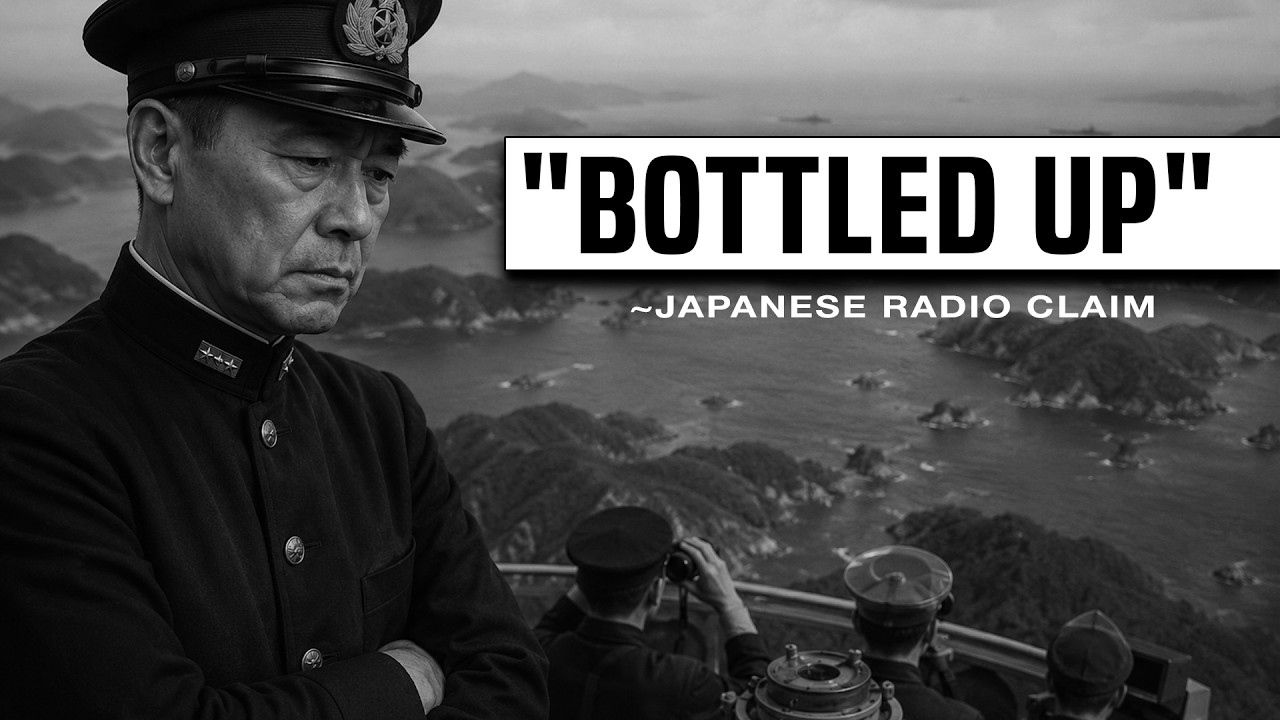
Tokyo knew something was happening because the previous week had been noisy. Between January 3 and 9, the same carriers had struck Formosa, Okinawa, and Luzon, destroying over 150 Japanese aircraft while losing 86 of their own, 46 of them in accidents rather than enemy fire. Then the entire force turned west after dark on January 9 and vanished from view. Japanese broadcasts announced that the American force was trapped inside the South China Sea and would be destroyed when it tried to leave.
Secrecy applied in all directions, including inward. The Fourteenth Air Force, under U. S. Army Air Forces command and operating from bases in China, received orders to attack Japanese ships and airfields in Hong Kong to support the landings on Luzon.
It was never told that the Third Fleet was heading into the South China Sea. No attempt was made to coordinate the two forces. On January 16, a reconnaissance squadron from China attacked ships in Hong Kong on the same day carrier squadrons did. Neither knew the other was coming.
The scale of the night capability deserves plain explanation because it changes the nature of the operation entirely. The three fast carrier groups carried about 900 aircraft. The entire night strike force within that fleet consisted of just two ships. Independence carried nine radar-equipped Hellcat fighters and thirteen radar-equipped Avenger torpedo bombers.
Enterprise carried a slightly larger group of the same two types, roughly 50 aircraft out of 900. Most of the operational advantage the fleet enjoyed during those ten days came from aboard those two ships. January 12 was the day the arrangement paid off. Before dawn, night crews launched to search the Cam Ranh Bay area, radioing the positions of enemy ships anchored there.
By six in the morning, the strike group—three carriers and a light carrier with two battleships and escorts behind them—was 50 miles from the harbor, and the first aircraft left the decks at 7:31 a. m. , about half an hour before sunrise. There was no warning.
But the two battleships were not there. Search aircraft combed the harbor and coastline for hours and found nothing resembling a large warship. The conclusion aboard ship was that the enemy had hidden them using camouflage. It took the U.
S. Navy several months to confirm that Ise and Hyuga had never been in Indochina. They were near Singapore and stayed there for weeks. What was there was shipping traffic.
The strikes caught a convoy of ten ships guarded by seven warships off central Indochina and sank four loaded oilers, three cargo ships, the light cruiser Kashii, and three escorts. A second convoy lost an oiler, two escorts, and a patrol boat. A third lost two cargo ships, three oilers, three escorts, and a landing craft. In Saigon, two cargo ships and an oiler went down in the harbor, and a fourth oiler was targeted at sea.
One ship sunk in Saigon that day was not Japanese. The French cruiser Lamotte-Picquet, disarmed and anchored there under the French flag, was attacked and sunk by American aircraft. The colonial government in Indochina, for its part, refused to hand over captured American pilots to the Japanese and instead escorted them toward the Chinese border. Nearly every man shot down over Indochina that day made it home.
Four days later, the fleet turned toward Hong Kong, where the reception was different. The garrison fired antiaircraft fire that one U. S. Navy report described as so intense as to be almost unbelievable.
Low-flying torpedo bombers bore the brunt, and their weapons were set to depths too great to be effective when they arrived. Twenty-two aircraft were shot down over the colony that day, and 27 more were lost to accidents. Portugal was also on the receiving end. Neutral Macau was hit on the sixteenth because Allied agents knew an aviation fuel stockpile there was about to be sold to the Japanese.
The Portuguese government protested. Washington offered an apology on January 20. A court of inquiry was held, and in 1950, the United States paid Portugal $20. 3 million in compensation for damages.
There was something else in Hong Kong on the sixteenth that had not been there when the fleet entered the sea. The oiler convoy HI-87 had been diverted from its southern voyage in an attempt to keep it away from the carriers. No one could tell it where the carriers were. The convoy headed for Hong Kong, and five large oilers and a Navy oiler were destroyed there.
That is the entire operation in one sentence: ships were moved to avoid a fleet no one could locate, and moved into the heart of the strike. There is a gap in the records here that should be named rather than covered up. American accounts state the fleet was not detected on the tenth and eleventh of January, and the fleet’s war diary asserts that as fact. What the Japanese search organization was doing on those two days, which sectors it flew, and whether anyone suggested searching far out at sea, does not appear in the English-language literature at all.
The downside is well documented; the reason has been reconstructed from the American side. The exit itself was a point of contention. Halsey wanted to leave through Surigao Strait in the central Philippines because the weather in the north was bad. Nimitz asked him to use Luzon Strait instead, arguing that passage through the central islands would be reported by Japanese garrisons stationed there, possibly drawing enemy raids on the supply line to Luzon.
Halsey took the northern route. On the twentieth, the fleet exited through Balintang Channel with a division of destroyers ahead of the carriers. Radar picked up large numbers of Japanese aircraft during the passage. Fifteen were shot down, most of them transporting army personnel being evacuated from Luzon.
No attack was launched against the fleet. It had sailed 3,800 miles inside the South China Sea and lost no ships to enemy action while there. The night groups paid the price out of their own accounts. Air Group 41 aboard Independence ended its tour that January having shot down 46 enemy aircraft.
It lost 10 of its 35 night fighter pilots in combat and three more in accidents. That is a loss rate no squadron could survive twice, borne by men flying single-engine fighters off a small deck in darkness. Enterprise’s captain, Grover Hall, submitted a report on the entire experience to the Commander in Chief of the U. S.
Fleet on May 30, 1945. His verdict on the South China Sea operation was blunt. The weather was so bad it became a test of the pilots’ ability to fly on instruments rather than a beginning of real night operations. What he recommended was that the Navy begin work on radar-directed carrier landings, because pilots still had to wait until they could see the ship’s lights.
That was still the final stage in January 1945. An Avenger crew returning over a darkened fleet would hold course and wait. One of their number, Joe Hanek of the torpedo squadron on Enterprise, later said they never knew where they were until the pilot cut the engine and the deck lights came on beneath them.
He described the rest of it as pure terror.