In January 1927, a young court official sat before the British prime minister and quietly confessed that he sometimes wished the next king would break his neck while out riding to hounds. The prime minister, Stanley Baldwin, looked at him for a long moment. Then he said, “God forgive me. I have often thought the same thing.”
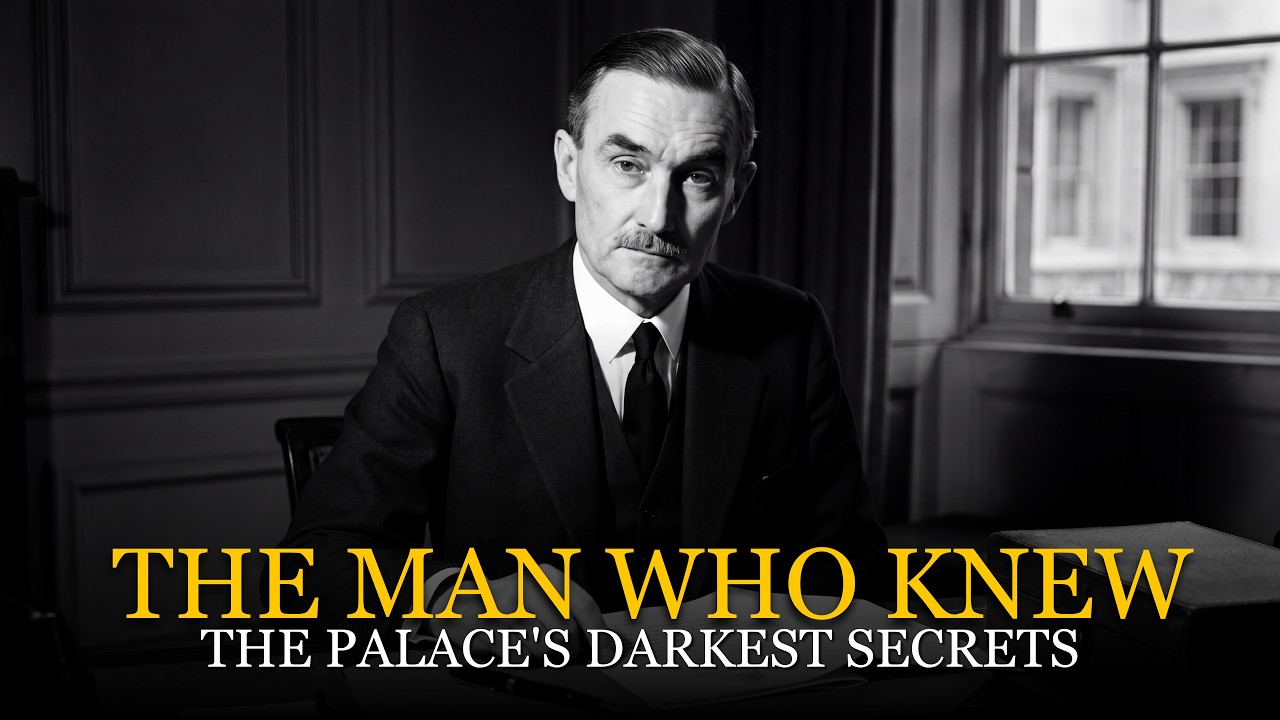
That official was Tommy Lascelles. Almost no one outside Buckingham Palace knew his name. Over the next fifty years, he served four monarchs, kept a secret diary the size of a small library, and quietly decided which aspects of royal life the British public would be allowed to see.
In 1920, a thin young man in a borrowed morning coat walked through the front gate of York House at St James’s Palace, looking for the office of the Prince of Wales. He was thirty-two years old. He had a military medal in a drawer at home and a degree from Oxford in modern history that no one had ever asked him to use. His name was Alan Frederick Lascelles, though no one who knew him called him Alan. From childhood, he was known as Tommy.
He was born on 2 April 1887 in an unremarkable house in Kensington. His father was the Reverend Frederick Lascelles, the younger son of the 4th Earl of Harewood. Younger sons of younger sons inherit very little. They inherit the name. They inherit the style. And if they are clever, they inherit the expectation that they will find something useful to do with their lives, because no one will leave them a fortune.
Tommy was clever. Marlborough College, then Trinity College, Oxford. He took his degree in 1910 and, having no particular plan, went to Bavaria to learn German. The world was about to change. In August 1914, he joined the Bedfordshire Yeomanry as a junior officer. He served on the Western Front. He won the Military Cross. He never spoke about it afterwards.
He returned home like so many men of his generation, with a quiet, unshakeable conviction that he owed the country something his survival had not yet repaid. He married a clever, kind woman named Joan Thesiger in 1920. She was the daughter of the 1st Viscount Chelmsford, the Viceroy of India. Tommy spent eight months as his aide in Delhi. There, in the heat of the Viceroy’s residence, he first learned how great institutions work.
When the post of assistant private secretary to the Prince of Wales came up in 1920, he wrote to Lord Cromer, the Lord Chamberlain, asking to be considered. He was thirty-three. The Prince was twenty-six. He thought he would be working for the most popular young man in the world.
Edward, Prince of Wales, was on the front page of every newspaper from Toronto to Sydney. He had toured Canada and crowds had swarmed around him. He had toured Australia and they had swarmed again. He had a slightly lopsided smile and a habit of looking at women in a way that made them remember the look for years afterwards. He flew his own aeroplane. He drank cocktails. He wore the kind of suits English tailors would copy for the next decade. British royalty after the First World War had a brand-new product, and he was the Prince of Wales.
Tommy walked into the office at York House on a grey morning. He was given a desk, a pile of correspondence, and a quiet warning from the first private secretary, Godfrey Thomas, that the work was not always easy. Within two weeks, he realised the work was not even what he had been told it was. The Prince did not read his red boxes. The Prince was rarely in the office. The Prince was clearly in love with a married woman named Freda Dudley Ward, and the entire household was organising itself to protect that fact.
For context: the British monarchy in 1920 employed nine hundred staff at Buckingham Palace alone. The Sandringham estate in Norfolk covered twenty thousand acres. The Balmoral estate in Aberdeenshire covered fifty thousand. The Civil List paid £410,000 a year to maintain the King and the family. The Prince of Wales had his own income from the Duchy of Cornwall of £70,000 a year, plus Civil List allowances. He also had a personal staff of sixteen, two cars, a private railway carriage, a country house called Fort Belvedere, and a valet who knew where every shirt in the world was.
Into that machine walked Tommy Lascelles. He was paid £700 a year, had a flat in St James’s, a wife in the country, and a quiet voice. He was, on paper, the third most junior member of the Prince of Wales’s staff. By the end of his first year, no one on that staff knew more than he did about what the Prince actually did. He began in 1920 the diary that would not be published until 2006.
Within a year of taking the post, Lascelles had decided that the Prince of Wales was the most charming young man in Europe and the most disastrous human being he had ever met. The early private entries were not the entries of a hostile employee. They were the entries of a man trying to understand the gap between what he had been told and what he saw with his own eyes.
The Prince was charming. The Prince was funny. The Prince, when he chose, could focus all his attention like a candle flame on a stranger across a tea table and make that stranger remember the moment for the rest of their life. He had a genuine gift with people. And he had no gift, and after a while Tommy concluded no interest, in anything that happened inside a red leather box.
The boxes mattered. The boxes were the daily work of the sovereign: cabinet papers, Foreign Office telegrams, parliamentary news, senior appointments, the documents a heir to the throne was expected to read so that he would not be a beginner when his turn came. The Prince’s boxes piled up at the office in York House and at Fort Belvedere. Tommy read them so that anyone in the household could answer if asked what was in them. He briefed the Prince over lunch on the train or over a drink, or he did not brief him at all.
There was the drinking, the constant smoking, the endless need for amusement, and the purposelessness that disguised itself as spontaneity, which meant a tour of South Wales might be cancelled because the Prince had a cold, and his staff would have to invent an excuse for ten thousand people standing in the rain. As for the women, the pattern, as Tommy saw it through the early twenties, was always the same. The Prince would find a married woman in her late twenties or early thirties, usually beautiful, often with a husband elsewhere. He would descend on her with all the weight of his unmet emotional need. He would write to her three times a day. He would telephone her at all hours. He would give her jewellery. He would give her a small, clinging authority over his household, because the staff, including Tommy, would refer questions to her when the Prince was unavailable. Then one day he would simply stop.
He would meet a new woman, and the entire apparatus of attention would switch off in a single afternoon. The abandoned woman would discover that her telephone calls to the Prince’s apartments at York House were no longer put through. Quiet instructions had been given to the palace switchboard to say that His Royal Highness was not at home. No message ever came explaining why. The Prince did not have the courage to end a relationship face to face. He simply withdrew.
The most painful case was Freda Dudley Ward. She was a small, charming woman with two daughters and a husband who sat in Parliament. The Prince loved her for sixteen years. He eventually wrote her hundreds of letters, many still in private hands, quoted in Philip Ziegler’s official biography of Edward published in 1990. He spoke to her on the telephone every night. The courtiers, including Tommy, regarded her as in fact a stabilising influence on a young man who had no stability. When she was discarded in the autumn of 1934, it was done through the telephone exchange. She called again and again and no one answered. Eventually she wrote a letter asking what she had done. The Prince did not reply. The new woman was Mrs Wallis Simpson.
Tommy watched all of this. His diary entries from the late twenties are in parts the entries of a man learning to feel contempt. He began his post with the usual loyalty of a junior courtier. He ended it with a settled conviction that the man he served was not fit to be king.
In January 1927, the prime minister was Stanley Baldwin. Baldwin was a small, pipe-smoking man who looked like a country squire and thought like an Oxford philosopher. He asked to see Tommy privately about a tour the Prince had just made of East Africa. Tommy by then was the official who travelled with the Prince and saw what really happened. The two men sat in the prime minister’s room in the House of Commons. Tommy told him what he had seen: the drinking, the neglect of duty, the growing public risks. Then, in the voice of a man who had decided to say what he was thinking, he said he sometimes wondered whether the best thing for the country would be for the Prince of Wales to break his neck in a horse race.
Baldwin was silent for a long time. Then he said, “God forgive me. I have thought the same thing many times.” That was in the diary that night. The assistant private secretary and the prime minister of Great Britain, alone in a panelled room, had secretly agreed that the heir to the throne should die. No one outside the room knew for seventy-nine years. Tommy went home that night and wrote it down. He was forty years old. He had already begun to understand the second half of his life.
In 1929, Lascelles did the unthinkable. He resigned from royal service and walked out of the office of the future King of England. He did it during a tour. He and the Prince were in East Africa again. An incident occurred in Tanganyika that Tommy considered a line crossed. The Prince had been drinking heavily for several nights in a row. There was an unsuitable woman at a hotel in Dar es Salaam. The courtiers spent the morning inventing a cover story. Tommy went to the Prince’s tent. He said he was not prepared to spend any more of his life pretending to be something he was not, and that he intended to leave the household at the end of the tour.
The Prince was offended. The Prince was also charming in his own way. He asked Tommy to reconsider. Tommy did not reconsider. He returned to London. He submitted his resignation in writing to the senior private secretary. He left. In the social customs of the British court, this was extraordinary. Courtiers did not resign. They were transferred. They were given honours and quietly moved sideways. They were left in post until they died. They did not leave of their own accord.
The Prince, after Tommy resigned from his service, took the unusual step of pretending nothing had happened. No public announcement was made. Tommy’s name simply disappeared from the staff list in the Court Circular. Letters were written. Friends heard one story from Tommy and another from St James’s Palace. The stories did not match.
What followed was six years of near-exile. Tommy had no private fortune. He had a wife and three small children, Lavinia, John and Caroline. He had to find work. For a time he served as aide-de-camp to the Earl of Bessborough, Governor General of Canada. He spent two years in Ottawa. He found Canada, in his diary, a kind and quiet country. He returned home in 1931 and looked for work. He was, by London standards, in disgrace. He had crossed the heir to the throne. Many drawing rooms were no longer open to him. He did not complain. He read. He took long walks. He played a great deal of chess. He wrote letters. He waited.
The political world around him was waiting too. The twenties had ended in financial collapse. Ramsay MacDonald’s Labour government had fallen. The National Government had been formed. King George V, aged sixty-six, was suffering from chronic bronchitis and a weak heart. The question of the succession occupied every senior official. Stanley Baldwin, now prime minister again, had not forgotten that conversation in his room in the House of Commons.
In 1935, the King’s senior private secretary, Lord Wigram, wrote to Tommy Lascelles asking whether he would consider returning to royal service. The post was not on the Prince of Wales’s staff. It was on the King’s own staff. Tommy thought for forty-eight hours and then accepted the role offered. The royal household at that time employed just under 1,400 staff spread across Buckingham Palace, Windsor, Sandringham and Balmoral. The main office, the Private Secretary’s Office, consisted of only three men: the private secretary, the assistant private secretary, and the deputy assistant. They managed the King’s correspondence, his audiences, his red boxes, his speeches, his diary, and his briefing on every appointment in the United Kingdom. They knew everything. And they controlled who else knew.
Tommy Lascelles returned to Buckingham Palace at the age of forty-eight as assistant private secretary to the King. He had a private flat in Holywell Mews. He was paid £1,500 a year. He had access to every door in the building. More importantly, he had the personal trust of King George V, who began asking for him by name within weeks of his arrival.
The old King, on his deathbed, asked Tommy about his son. Tommy told him the truth. The old King looked at the ceiling and said, “After I am dead, this boy will ruin himself within twelve months.” Tommy did not record his reply. He did not need to. The dying King had said it for him. King George V died at Sandringham at five minutes to midnight on 20 January 1936. The Prince of Wales became King Edward VIII. Tommy Lascelles stood in the next room.
When King George V died at Sandringham in January 1936, Tommy Lascelles knew he was witnessing the beginning of a constitutional crisis. The deathbed at Sandringham. The great house. The low fire in the King’s bedroom. The Queen at the bedside. The Archbishop of Canterbury, Cosmo Lang, in the next room. The Prince of Wales standing at the door. Lord Dawson of Penn, the King’s physician, injected the King with a lethal dose of morphine and cocaine so that his death would be announced in the morning papers rather than the evening ones. This was not known at the time. It was acknowledged in Dawson’s diary forty years later. Tommy did not know. He only knew that the old King was dead and a new King had taken the throne.
The new King was forty-one years old. He had been Prince of Wales for almost all of his adult life. He had been waiting for the moment in which he now stood. He was in some ways very well prepared. He had toured the Empire. He had inspected every regiment. He knew the soldiers’ songs, the colonial governors, the names of local newspapers in every important city in the Empire. In one respect, he was entirely unprepared. He had no intention of changing his private life.
Mrs Simpson was on the train coming up from London. She arrived at Sandringham at the Prince’s explicit invitation the day after the funeral. She was housed in a guest cottage. The senior courtiers pretended she was merely a visiting friend. Cosmo Lang, the Archbishop, took Tommy aside and said this would not do. Tommy agreed. He went back to his office and wrote it down.
The first months of the new reign were a slow accumulation of incidents that the senior courtiers had to manage. The red boxes were not being read. Cabinet papers were left lying around. State documents were taken to Fort Belvedere where Mrs Simpson and her circle of American friends were staying, and sometimes returned with the corners of pages turned down where unauthorised hands had read them. Foreign telegrams from Berlin and Rome went unanswered for weeks. Lord Wigram, the senior private secretary, decided he was too old for what was coming. He retired in June. Sir Alec Hardinge succeeded him. Tommy Lascelles was promoted to assistant private secretary. He was now the second man in the Private Secretary’s Office.
In August, the King chartered the yacht Nahlin and took Mrs Simpson on a six-week cruise in the Adriatic. The European press covered the cruise in detail. The American press covered it in even more detail. There were photographs. There were reports from foreign diplomats. There was the famous incident of a photograph in an Italian newspaper of the King carrying Mrs Simpson into the water on a beach in Yugoslavia, both in swimming costumes, both laughing. The British press published none of it. British editors had agreed, at the personal request of Lord Beaverbrook and Geoffrey Dawson of The Times, to maintain complete silence about the King’s private life until the time came to tell the British public.
Inside Buckingham Palace, Tommy was the man collecting the files. He kept the foreign press cuttings. He kept the embassy reports. He kept the courtiers’ notes. In late September he drafted a memorandum for Sir Alec Hardinge setting out the constitutional position. A King of England could not marry a divorced woman whose two former husbands were still alive. The Church of England, of which the King was Supreme Governor, would not permit it. The Dominions, whose loyalty was personal to the King, would not permit it. The British government would not permit it. That memorandum formed the basis of every conversation the senior palace officials had with the prime minister, the Archbishop, and the Dominions Office over the next ten weeks.
The constitutional facts at stake. In 1936, the British Empire covered 25 per cent of the world’s land surface and a quarter of its population. The Crown enjoyed the loyalty of 500 million subjects in five self-governing dominions, three colonies, fourteen protectorates, and a hundred smaller territories. The Royal Marriages Act 1772 and the Act of Settlement 1701 were the statutes governing the King’s marriage and the succession to the throne. The Church of England, under canon law, did not at that date permit the remarriage of divorced persons within the Church while a former spouse was still alive. Mrs Simpson’s first husband, Earl Winfield Spencer, was alive in California. Her second husband, Ernest Simpson, was alive in London. The King was forty-one and unmarried. The senior officials concluded in mid-October that the King had made up his mind to marry Mrs Simpson. He had told Mrs Simpson. He had told his friends. By this stage he had told Stanley Baldwin personally. Baldwin had told him, in the gentlest possible tone, that the government could not advise this course.
On 13 November 1936, Sir Alec Hardinge sat at his desk in Buckingham Palace and drafted, with Tommy’s help, the letter that would force the King to choose. The letter, of about eight hundred words, was addressed to His Majesty from his loyal private secretary, and is now in the Royal Archives at Windsor. Its essence was a warning that the silence of the British press could not continue much longer. Public opinion, once it knew, would be against the proposed marriage. The government, if faced with the question, would not give its consent. If it withheld consent and the King insisted, the government would resign. No alternative administration could be formed to give different advice. A constitutional crisis without parallel in the modern history of the Crown would follow within weeks. The letter ended with a recommendation that Mrs Simpson go abroad without delay.
The King read it at Fort Belvedere. He was furious. He believed, in a way that is hard now to imagine, that senior court officials had no right to address him in that tone. He thought the prime minister had put Hardinge up to it. He thought at first that Tommy Lascelles had drafted every word and Hardinge had merely signed it. He was right in substance about both Hardinge and Tommy. And although the two men had in fact shared the drafting, he never trusted Hardinge again. He had never trusted Tommy at any time. He suspected the court of acting against him. He was right to suspect them. He did not reply to the letter for three days.
The letter was shown to Mrs Simpson at Fort Belvedere. She cried. She offered that week to go abroad. The King would not let her go. He had decided that after so long a silence, he would not now retreat. He would push the matter to confrontation.
The next month was one of the most extraordinary in the recorded history of the British Crown. The King held a series of meetings with Stanley Baldwin in the King’s sitting room at Buckingham Palace. Tommy was in the next room throughout. The conversations were recorded in the diary because Baldwin, on leaving the sitting room, would walk straight across the corridor to the Private Secretary’s Office and dictate what the King had said. The King would summon Hardinge or Tommy after Baldwin had left and give his own account. The two accounts usually agreed in substance. Both men were honest.
A third option was briefly on the table: a morganatic marriage. The King would marry Mrs Simpson, but she would not become Queen, and no children of theirs would inherit the throne. The proposal would require special legislation in each of the Dominions and the United Kingdom. The government rejected it. Mackenzie King rejected it in Canada. Joseph Lyons rejected it in Australia. The Executive Council of the Irish Free State rejected it. The South African cabinet rejected it. By the first week of December, the morganatic proposal was dead.
The British press, silent for months, broke its silence on 3 December. The Bishop of Bradford gave a speech in his diocese gently criticising the King’s neglect of his religious duties. The provincial press picked it up. The London press, waiting for any excuse, used the Bishop’s speech to release a flood of coverage. By 4 December, the British public knew, and crowds were gathering outside Buckingham Palace.
Tommy spent those days moving between the Private Secretary’s Office, the King’s sitting room, the prime minister’s room at Number 10, the Archbishop’s office at Lambeth Palace, and his own flat in Holywell Mews. He slept four hours a night. He ate at his desk. He made the small daily decisions that kept the palace running while the constitutional question burned. He kept his diary. He recorded everything. The diary entries for the first week of December 1936 are the closest thing Britain has to an internal record of a constitutional emergency. They show a man whose moral position was fixed. The King was not fit to be King. The marriage proposal was not the cause of the crisis. It was the occasion for it. The cause was the man himself.
By 2 December, Tommy believed the only solution was abdication. He believed it before the King did. By 7 December, the King was beginning to speak privately of abdication. By 9 December, he had instructed his private solicitor, Sir Walter Monckton, to prepare the documents. On 10 December at Fort Belvedere, he signed the instrument of abdication in the presence of his three brothers, the Duke of York, the Duke of Gloucester and the Duke of Kent. The document was signed by them as witnesses. It was carried to Westminster and laid before both Houses of Parliament on the 11th. The His Majesty’s Declaration of Abdication Act 1936 was passed in both Houses the same day. Royal assent was given by a commission. The King ceased to be King at 1:52 pm on 11 December. The Duke of York became King George VI.
That night, the man who had been Edward VIII gave the most famous broadcast in the history of the British monarchy. He spoke from Windsor Castle, from Augusta Tower. He told the country that he could not carry the heavy burden of responsibility and discharge his duties as King without the help and support of the woman he loved. He said goodbye. He sailed for France on a destroyer the following morning. He was given the title Duke of Windsor by his brother. Tommy listened to the broadcast in the Private Secretary’s Office at Buckingham Palace. The diary entry that night was one of the shortest in the volume. He wrote that what they had feared for so long had happened, and that he was more tired than he had expected. He went home and slept.
At ten o’clock on the night of 11 December 1936, a man stood in a corridor at Windsor Castle and listened to a king say goodbye to his country. Augusta Tower sits at Windsor Castle on the south side of the Upper Ward. The tower contains a small panelled office. A BBC engineer named Wood had installed a microphone on the desk that morning. The room was warm. The lights were low. The former King wore evening dress. He had a glass of water in front of him. It was handed to him by Sir John Reith, the Director-General of the BBC. The clock struck ten. The voice that millions knew began reading the words that Sir Walter Monckton and Winston Churchill had helped him draft, at a slightly slower pace than usual.
Tommy was not in the room. He was in the corridor outside. The senior palace officials were at Windsor that night because of the change of reign. Tommy stood with Sir Alec Hardinge and listened to the broadcast through the door. The diary records that they did not look at each other. When the broadcast ended, the former King left the tower, was driven to Portsmouth, and at midnight boarded HMS Fury for France. He did not set foot in Britain as a private citizen for the next nineteen years.
What he left behind was a royal household that had not slept for a week, a country told that its King was giving it up, and a new King who had not sought the post. King George VI, who had been Duke of York that morning, was forty-one years old. He was tall, thin, fair-haired, with a long, bony face. He had been a young naval officer in the First World War. He had served at the Battle of Jutland in the gun turret of HMS Collingwood. He was a good shot, a mediocre horseman, and a clever man who had lived his whole life in the shadow of his elder brother. He had a stammer that made public speaking a daily ordeal. He had a wife, Elizabeth Bowes Lyon, whom he loved without reservation, and two daughters, Elizabeth, aged ten, and Margaret, aged six. He had wept on his mother’s shoulder at Marlborough House on the night of 8 December when his brother told him abdication was inevitable. He told his cousin, Lord Louis Mountbatten, that he had no idea how to be King. Mountbatten told him that his own father had said the same in 1910 and had become a perfectly good King. The new King wiped his eyes and said he would try.
Tommy met him for his first audience as sovereign on 12 December 1936 in the King’s sitting room at Buckingham Palace. The new King looked at him for a long moment and said, “You must help me.” Tommy bowed. He said, “Of course, sir.” The conversation was brief. The diary entry that night says only that the new King was a decent man and that they must do what they could for him.
What followed between December 1936 and the outbreak of war in September 1939 was the most personally satisfying period of Tommy Lascelles’s working life. He was senior assistant to a private secretary for a King who needed him. King George VI was frightened at heart. He was deeply shy in public. He hated speaking. He hated cameras. He hated ceremonial. He had to do all of it. Tommy organised his schedule. Tommy drafted his speeches. Tommy briefed him before every audience. Tommy walked with him in the Buckingham Palace gardens before every State Opening of Parliament, so that the King could rehearse the speech once more in private, in the open air, away from the staff who might hear him stammer.
The Queen helped. Lionel Logue, the Australian speech therapist, helped. The palace staff helped. The new King got through it. He was not a great public speaker. But he was deeply moving because the country could hear that every word cost him effort. The first eighteen months were also devoted to repairing the damage of the abdication. The palace staff had to brief the Dominions. The palace staff had to deal with the press. The palace staff had to negotiate, painfully and at length, the settlement with the Duke of Windsor, who was constantly demanding from his exile in France money, or a public role, or a post at an embassy, or permission to come home with his new wife, whom he had married at the Château de Candé in June 1937.
Tommy was a central figure in that settlement. The Duke had taken with him from his private fortune before the abdication about £1 million. He demanded an additional Civil List allowance of £25,000 a year. The new King thought this excessive. The negotiations lasted a year. The final figure was £21,000 a year, paid from the King’s personal income from the Duchies, not from the Civil List, as a private family arrangement. The Duke complained that it was not enough. He kept complaining for thirty years.
The Duchess of Windsor, born Bessie Wallis Warfield, was refused the title of Her Royal Highness. In fact, she was denied it by letters patent issued by King George VI on the explicit recommendation of Tommy Lascelles. The Duke was allowed to be His Royal Highness. The Duchess was not. She would be referred to as Her Grace. That decision was one of the cruellest acts of the new reign. It poisoned the relationship between the brothers for the rest of their lives. Tommy did not regret it. His diary records his view that the woman should not hold the title of HRH because she could not be trusted to behave like one.
By the summer of 1939, the European political situation had made the palace’s anxiety about the Duke of Windsor a secondary matter. Adolf Hitler had annexed Austria. He had annexed the Czech lands. He was threatening Poland. The new King’s reign, which had begun in scandal, was about to become a wartime reign. Tommy Lascelles, who had survived the trenches twenty years earlier, would spend the next six years in the back office of the Crown at war. On 3 September 1939, at eleven in the morning, the British ultimatum to Germany expired. The country was at war. The King broadcast that night from Buckingham Palace. Lionel Logue stood beside him. Tommy stood at the door. The King did not stumble. He was, in the small ways that mattered, ready.
For seven years, Lascelles served a King who hated being King and a country that needed him to appear as if he loved it. The war years. Buckingham Palace was bombed nine times. The King and Queen stayed in London. They visited the East End the day after the worst raids. The Queen, walking through the ruins of Stepney, made her famous remark that she was glad they had been bombed, because now she could look the East Enders in the face. Tommy was usually in the following car. He had a flat in the palace basement. He had a steel helmet hanging on a hook by the door. He worked fifteen-hour days in the early war years.
In 1943, the senior private secretary, Sir Alec Hardinge, collapsed. He had carried the burden through the abdication and the first three years of war. He had not slept well since 1936. His marriage was under severe strain. His health was failing. He went to the King and asked to be relieved. The King turned to Tommy Lascelles and asked him to take the post. Tommy was fifty-six. He held the post from July 1943 until November 1953.
Tommy Lascelles was private secretary to the King. And for most of that decade, he was the most powerful unelected man in the United Kingdom. His daily routine. Eight in the morning, breakfast at home with Joan. Nine, the office. Ten, the King’s audience. Eleven, correspondence. Lunch at the desk. Afternoon, the prime minister, the Lord Chancellor, the Foreign Secretary, ambassadors. Five, tea with the King. Evening boxes. Home at eight. Diary at nine. Bed at eleven. Six days a week. Sundays, sometimes, off.
The relationship with Winston Churchill defined the war years. Churchill lunched with the King every Tuesday. The two men, who had been on opposite sides during the abdication when Churchill argued for Edward to stay, became close friends during the war. The King looked forward to those meetings. He took notes. He often asked Tommy to summarise the meeting afterwards in the diary so that he could refer back to it. The diary record of those lunches is one of the principal historical sources for the wartime relationship between the Crown and the prime minister.
The Duke of Windsor was the biggest personal problem of that reign. He was in France when war broke out. He had no steady job. He wanted to come home and serve in any military capacity within the United Kingdom. But the new King did not want him there. Churchill, who admired him, offered him the post of Governor of the Bahamas. He accepted. He was sent across the Atlantic in 1940. What he did in the Bahamas and what he did on the way there has been the subject of historical investigation for fifty years. He met people in Spain and Portugal in the summer of 1940 known to be in touch with German intelligence. He made statements recorded by the German Foreign Office, regarded in Berlin as expressing a desire for a stable European peace, and possibly for his own return as a constitutional monarch in the event of a British defeat. He gave an interview to the American magazine Liberty in 1941 in which he made statements the British Foreign Office regarded as defeatist. He took a personal interest in Nassau in the conduct of commercial affairs that a governor’s office should not have touched. He spent four years there. He was of no use.
Tommy in London was the man in charge of that file. The wartime telegrams about the Duke’s conduct are in the Royal Archives at Windsor. Some remain closed. Tommy was the man who briefed Churchill and the King on every new embarrassment. He was the man who decided what would be reported and what would not. He was the man who advised after the war, when the Duke wanted to come home, that he should be politely told there was no post for him in the United Kingdom.
The largest piece of intelligence about the Duke’s conduct was the so-called Marburg File. In May 1945, advancing American troops found in a castle in Germany a cache of captured German Foreign Office documents, including telegrams between the German ambassador in Madrid and Joachim von Ribbentrop about meetings with the Duke of Windsor in 1940. The papers suggested that the Duke had been prepared in his conversations to consider a return to the throne under a peace settlement. The papers were not in themselves evidence of treason. They were evidence of conversations that should never have taken place. They were a time bomb for the monarchy’s reputation.
Tommy was at the centre of the British effort to keep the Marburg File quiet. The papers were eventually published in heavily redacted form in the official series of German Foreign Office documents. In 1957, the Duke gave an interview in which he denied everything that mattered. The British public at the time paid little attention. The damage was contained. For the rest of his life, Tommy never wrote down the worst of what he knew about the Duke’s wartime conduct. The most explicit passages were excised before the diaries were prepared for publication. Andrew Lownie’s 1997 book, republished as The Traitor King in 2021, argued that the central figure in the postwar cover-up of the Duke’s record was Tommy Lascelles. The argument is plausible. The evidence is not conclusive.
The King’s health declined in the late forties. He was a heavy smoker. He had spent six years of war under enormous nervous strain. He developed arteriosclerosis in his legs in 1948. In 1951, he was diagnosed with lung cancer. He had part of his left lung removed in September. Tommy was present at every stage. He was at Sandringham on the night of 5 February 1952, when the King went to bed for the last time. He was there in the morning when the news came that the King had died in his sleep. Princess Elizabeth, aged twenty-five, was in Kenya at Treetops Hotel. She returned home a Queen. Tommy met her at the airport. He was sixty-five. He had served four monarchs. One last great crisis was waiting for him.
In the summer of 1953, a journalist at a Buckingham Palace garden party noticed a young princess brushing a piece of lint off the uniform of a divorced man, and Lascelles’s next great crisis began. The garden party was held on 2 June 1953, the day of the new Queen’s coronation. The Westminster Abbey ceremony had been in the morning. The Buckingham Palace garden party was in the afternoon. The new Queen and her family were in the White and Gold Drawing Room. Outside on the grass, the guests milled about.
Princess Margaret Rose, aged twenty-two, was the most photographed young woman in the country. She had her sister’s beauty but on a slightly smaller scale. She was known for her sharp intelligence and quick wit. Since her father’s death, she had become increasingly close to one of the courtiers. Group Captain Peter Townsend was thirty-eight. He was a Battle of Britain pilot. He had won the Distinguished Flying Cross in 1940 for shooting down enemy aircraft over the south coast. He also held the Distinguished Service Order. He had been equerry to King George VI since 1944. In the last years of the King’s life, he had become almost a member of the family. The King had been very fond of him. The Queen Mother had kept him on after the King’s death as comptroller of her household at Clarence House.
He had a wife. He had two sons. He had begun divorce proceedings from his wife the previous year. The divorce was granted in November 1952 on the grounds of her adultery. He was technically the innocent party. Socially, he was a divorced man.
The lint moment. Margaret bent down on the grass at the garden party and brushed a piece of lint off Townsend’s jacket. The gesture was small. But it was also intimate. It was a wife’s gesture, not a princess’s. A reporter from the New York Daily News, standing ten feet away, saw it. He filed the story. By the third week of June, the New York Daily News and the London papers were running it. The princess was in love with a divorced equerry. The world’s press woke up. So did the royal court.
Sir Alan Lascelles, the Queen’s private secretary, summoned the Princess to his office. He had known her since she was a child. He had been present at her christening. He had given her her first briefing on Garter Day the previous year. He loved her in his quiet, formal way. The conversation that followed is recorded in two memoirs. Townsend, in his 1978 memoir Time and Chance, said Tommy was kind and firm. Margaret, in a private conversation relayed by Anne de Courcy, said Tommy was cold and impossible.
Tommy set out the constitutional position under the Royal Marriages Act 1772. The Princess, being under twenty-five, could not marry without the Sovereign’s consent. The Sovereign, on the advice of her government, would not give that consent to the marriage of the Queen’s only sister to a divorced man whose former wife was still alive. If the Princess waited until she was twenty-five, the Royal Marriages Act would not require the Sovereign’s consent. However, it would require notification to the Privy Council and Parliament. Parliament, on the advice of the Cabinet, would not approve the marriage either. The Princess would then have a choice. She could give up her place in the line of succession, her Civil List income, and her royal status. She could leave the country. Or she could give him up.
That was the framework as presented. It was accurate in some respects. It was in part a tightening of the law to fit the outcome the court preferred. Constitutional historians have recently argued, notably Vernon Bogdanor and Anne de Courcy, that the position Tommy described in 1953 was more restrictive than the law actually required. By 1955, when Margaret was twenty-five, she could have married Townsend by notification to the Privy Council. The loss of her succession rights was the only certain consequence. The Civil List question was more complicated. Nevertheless, the court presented it to the Princess as an insuperable obstacle.
The Queen, aged twenty-seven and only four months on the throne, was advised by Tommy that she could not give her consent. She loved her sister. She did not want to give that advice. But she gave it. The Princess cried. The Queen Mother cried. Tommy did not. He returned to his office and drafted the official response. The diary entry for that period is the most damaging passage in the Lascelles archive. He recorded his opinion that anyone who behaved in such circumstances as Peter Townsend did must be either a fool or a rogue. The word “rogue” is a harsh word. It meant that Townsend was either stupid or dishonest. Tommy did not specify in his diary which he thought he was. That line, when published in 2006, became the defining line of the villain in the modern public imagination.
He believed, when he wrote it, that he was protecting the Crown. He believed that a second marriage of a senior member of the royal family to a divorced person, seventeen years after Edward VIII’s marriage, would undermine everything the court had done in 1936. He believed it because he was the only person in Buckingham Palace who had been in the building during both crises. He had a long memory.
The Cabinet was consulted privately. Winston Churchill, who had defended Edward VIII in 1936, told the Queen in 1953 that he could not advise her to consent to her sister’s marriage to a divorced commoner. Lord Salisbury, the Leader of the House, an Anglo-Catholic who would have resigned over the issue, made clear he would not remain in office if the marriage went ahead. Geoffrey Fisher, Cosmo Lang’s successor as Archbishop of Canterbury, indicated he would oppose any church marriage. The political ground was fully prepared.
The court’s solution was the same one used in 1936 in a different form: separation. Townsend was offered the post of air attaché in Brussels. He accepted. He left England in July 1953. The Princess was told she could see him again when she was twenty-five. She had twenty-two months to wait. Tommy retired on 21 November 1953. He was sixty-six. He had been in royal service, on and off, for thirty-three years. He left Buckingham Palace, in his own phrase, on tiptoe. He did not say goodbye to the Princess. He did not try to see her on his last day. He packed his diaries, put them in metal boxes, and had them driven to his new flat in Kensington Palace. His role in the matter was not over.
Townsend was sent to Brussels on the court’s orders, and Margaret was told she would have to wait until she was twenty-five to see him again. The next two years are the long, slow tragedy of the Townsend affair. The Princess was twenty-two when the posting began. She would be twenty-four when she next saw Townsend in person. The court did not entirely prevent communication. There were letters. There were occasional telephone calls. There were two brief meetings, one in Brussels and one in London. They were chaperoned. They were short. They were not enough.
Meanwhile, the Princess began appearing in photographs at every London social occasion. She went to nightclubs. She went to the theatre. She drank. She smoked more than the court thought proper. She was photographed dancing with a long series of young men who were not Peter Townsend. The press began writing that she had recovered. The court quietly hoped she had. She had not.
Tommy had retired. He had handed the Private Secretary’s Office to his deputy, Sir Michael Adeane. Adeane was a more conventional man. He had served under Tommy for ten years. He had absorbed the court’s view of the Townsend affair entirely. He continued to give the new Queen the same advice. The Princess remained on the course set for her in 1953.
In August 1955, the Princess turned twenty-five. The Royal Marriages Act no longer required the Queen’s consent. The constitutional analysis had moved to its second stage. By that time, the Princess and Townsend had not seen each other for almost two years. They corresponded in October. Townsend travelled to London on 12 October. He met the Princess at Clarence House. The press gathered outside on the pavement and never left. For two weeks, the country watched.
The Daily Mirror ran a front-page poll asking the British public whether the Princess should be allowed to marry the man she loved. 94 per cent said yes. The Times ran a leader on 24 October arguing that since the royal family was the symbol of family life in the United Kingdom, a princess’s marriage to a divorced man would weaken that symbol and should not take place. The leader was written by the editor, Sir William Haley. It had been informally cleared in advance with Lambeth Palace and, through Adeane, with Buckingham Palace.
The court did not give way. The court’s position, relayed privately to the Princess, was that if she insisted, she would have to renounce her place in the line of succession, lose her Civil List income, leave the United Kingdom, and live abroad as a private citizen. That advice, as constitutional historians have recently argued, was not entirely accurate. The loss of the right to the throne was certain. The Civil List was arguable. The exile was a preference of the court, not a legal requirement. Nevertheless, the options were presented to the Princess in that form.
She went on 24 October to Royal Lodge in Windsor Great Park. Townsend joined her. They spent the weekend together. She had made her decision. He had made his. They had made it together. They would not marry. The Princess returned to Clarence House. She signed a personal statement that Adeane helped draft, drawing on the words Tommy had used twenty years earlier for the abdication broadcast. The statement was issued on 31 October 1955. It said, in the Princess’s voice, that she had decided not to marry Group Captain Peter Townsend, mindful of the Church’s teaching that Christian marriage is indissoluble, conscious of her duty to the Commonwealth, and resolved to put these considerations before any others. The statement was read on the radio that evening. The country, half of which had hoped for the marriage, fell silent.
Tommy read the statement in the evening papers from his flat in Kensington Palace. What he wrote in his diary that night has not been published. The volumes edited by Hart-Davis skip over the period in a few brief notes. The full record sits within the restricted material at the Churchill Archives Centre. What can be said is that he got the result he had wanted from the start. The Princess did not marry the man she loved. The monarchy was not plunged into a second abdication crisis. The institution he had served all his life was preserved. The price of that preservation was paid by a young woman who lived two doors down from his flat.
Princess Margaret married Antony Armstrong-Jones, the celebrity photographer, in 1960. The marriage was catastrophic from almost its first year. There were affairs on both sides. There was drug use. There was separation. In 1978 came the first divorce of a senior member of the royal family since King Henry VIII. She lived her last years in a flat at Kensington Palace next to the one Tommy had occupied. She died in 2002 of complications following a stroke.
Townsend married a Belgian heiress named Marie-Luce Jamagne in 1959. She looked remarkably like Princess Margaret. They had three daughters. He lived in France for the rest of his life. He died of stomach cancer in 1995. By all accounts, he loved Margaret for the rest of his days. Tommy continued to live in flat number 5 at Kensington Palace for another twenty-six years. He read, he gardened, he played chess, he kept his diary, he waited. He never met the Princess again as a private citizen, though he saw her once by chance on the stairs of the building they shared, and he bowed to her.
In 1953, the new Queen gave him the Grand Cross of the Royal Victorian Order and gave him a flat in Kensington Palace, and Tommy Lascelles began the second half of his career. The flat in Kensington Palace was a set of long, low, narrow rooms in the old north wing of the building. It had a sitting room overlooking the gardens. It had a small library. It had a kitchen, a bedroom, and two narrow rooms for visiting grandchildren. In a cupboard off the corridor stood fifty metal boxes containing the diaries, letters, photographs and memoranda of a busy working life.
He spent twenty-eight years there. He had a clear plan. He would catalogue the papers. He would arrange them by year. He would write a connected narrative of the hardest periods, the abdication and the Townsend affair, so that future readers would have context for the events. And he would arrange, through a codicil to his will, that they be released in stages over the decades. The personal material, family letters and the India diaries, could appear first. The political material, the abdication, the war, and the Townsend affair, would wait until everyone affected was gone.
This was not modesty. This was historical engineering. Tommy knew better than anyone alive that the historian who controls the timing of publication controls the historical record. He had spent his working life managing what reached the public and when. He proposed to manage it from beyond the grave.
The first release came quickly. He gave occasional interviews to official biographers. He helped Wheeler-Bennett with the biography of King George VI, published in 1958. He helped Donaldson with the biography of King Edward VIII, published in 1974. He helped Ziegler in his last years with the new biography of the Duke of Windsor, published in 1990 after Tommy’s death. The interviews were not formally recorded. The biographies, when they appeared, used his sources without naming him. Anyone who read between the lines could tell whose memory was speaking. Those lines were Tommy’s lines.
The second release was the 1989 volume of royal service, edited by his son-in-law Duff Hart-Davis. It covered the years 1920 to 1936. The reviews were positive. The Times Literary Supplement called it the most candid record of life at the royal court since Lord Hervey’s memoirs two hundred years earlier. The book was read by the people who read such books. The wider public largely ignored it. Tommy was dead. His widow was dead. His control seemed secure.
Then in 2006, twenty-five years after his death, the second volume appeared. King’s Counsellor covered the years 1936 to 1952. It contained the record of the abdication. It contained the record of the war. And at the back, within the 1953 entries, it contained the Townsend material. The archive is substantial: fifty volumes of handwritten diaries, about four thousand letters in chronological files, and nearly one hundred and twenty memoranda from his time as private secretary, including the original drafts of fourteen royal speeches. The file copies include nineteen records of audiences with King George VI and the surviving copies of wartime telegrams relating to the Duke of Windsor. The full archive runs to about thirty linear feet of paper. It sits at the Churchill Archives Centre, Churchill College, Cambridge, where the Lascelles family deposited it in 2001. Nearly 15 per cent of the material is closed. The restrictions are imposed by the Royal Archives at Windsor, not by the college.
The man who wrote it all is buried in the churchyard of Sutton Waldron in Dorset. He died in his sleep at Kensington Palace on 10 August 1981. He was ninety-four. His will left £200,000 and a great deal of furniture, books and correspondence. He outlived his wife by ten years. He outlived King George VI by twenty-nine years. He outlived the Duke of Windsor by nine years. He outlived Princess Margaret by two decades on paper. But he did not outlive her long in terms of the story’s context. He achieved what no other courtier of the twentieth century achieved. He decided how he would be remembered, and he built the archive that would do the remembering. He did not entirely succeed. The archive turned against him in places. But the strategy itself was brilliant. He had spent his life managing the image of others. In retirement, in a quiet flat at Kensington Palace, he managed his own.
In 2006, twenty-five years after his death, his political diaries were published, and Tommy Lascelles’s modern reputation collapsed. King’s Counsellor appeared in May. It was edited again by Duff Hart-Davis. It contained an introduction by the historian Andrew Roberts. The book ran to 470 pages of diary extracts with editorial notes. It received extensive and serious reviews. The reviews acknowledged that the book was the most important addition to the documentary history of the British monarchy since the publication of Queen Victoria’s letters more than a century earlier. The reviews also recognised that the book was a problem.
The material on Edward VIII was harsh but not surprising. Edward had been dead for thirty-four years. The Townsend material was not surprising in its broad outline but shocking in its detail. Princess Margaret had died only four years earlier. Her divorce, her struggles, her grief were still fresh in every reader’s memory. The line describing Townsend as either a fool or a rogue found its way into every review. The newspapers picked it up. The Daily Mail ran extracts over five days. The Daily Telegraph ran a special report on the legal advice. The Guardian ran a long review of the Edward VIII politics. The Spectator ran a piece by Hugo Vickers arguing that Tommy had been right in the end, even if his phrasing could have been gentler.
The bigger impact came later, with the arrival of Peter Morgan’s drama The Crown in 2016. The first season of the Netflix series, watched on release by around twenty million households worldwide, dramatised the Townsend affair across two episodes. Tommy was played by the British actor Pip Torrens. He was given the dialogue. He was given the manner. He was given the character’s overall frame. He was the courtier who broke the Princess’s heart with his cold view of constitutional propriety. The performance was, from an academic point of view, fair. The dialogue was mostly based on the published diaries. The advice Tommy is shown giving the young Queen is the advice his published diaries record. The drama added humanisation. It did not invent the substance.
What the drama did was new. It put Tommy in front of a vast global audience. Within a year of broadcast, the phrase “Lascelles principle” began appearing in newspaper articles and political commentary as shorthand for the idea that a sovereign may in extreme circumstances be advised to refuse a prime minister’s request for a dissolution of Parliament. The principle, of course, had nothing to do with Princess Margaret. It came from an anonymous letter Tommy wrote to The Times in 1950 under the pseudonym “Senex”, setting out the theoretical circumstances in which a sovereign might refuse a request for dissolution. The letter became a reference point in academic constitutional debate. After The Crown, it became a phrase the general public knew.
But the Tommy Lascelles of the public imagination after The Crown was no longer the constitutional theorist. He was the man who broke Margaret. The public conversation about him was angry. Was that fair? The case for the defence had several elements. Tommy did not invent the Royal Marriages Act. He was not the prime minister. He was not the Archbishop of Canterbury. He was the sovereign’s private secretary, a member of the royal household, giving advice on constitutional consequences. The decision was not his. It was the Queen’s, on the advice of her ministers. Tommy gave the advice he believed to be correct.
The case for the prosecution was simpler. Tommy’s advice was more restrictive than the law required. He presented the legal position as more absolute than it was. He allowed his moral disapproval of divorce to seep into the constitutional analysis. He spoke to the young Queen, four months on the throne and dependent on his judgement, in a tone that closed off the option of consent. By the time the formal legal questions arose in 1955, he had retired and was no longer at court. But the position the court took in 1955 was the position he had set in 1953. The advice he gave was the advice that was followed.
Both views are arguable. The public, since publication and the drama, has tended towards the prosecution. What is hard to argue with is the broader question. Did Tommy do what he did out of malice towards the Princess? The published record gives no hint of that. He had known her since she was a baby. He had played with her on the grass at Royal Lodge. He had grieved with the family on the night her father died. The cruelty in the published diaries is not personal cruelty. It is institutional cruelty. It is the language of a man who, when forced to choose between an individual and the institution he had served all his life, chose the institution. He did it in 1936. He did it again in 1953. He was honest enough to record what it cost him and what it cost her.
The bomb in the Cambridge archive was not, in the end, the diaries. The bomb was the system. The diaries simply made the system visible.
The deepest question Tommy Lascelles’s life leaves us with is whether the institution he served was worth the price the people inside it paid. The institutional case. The British monarchy survived the twentieth century. It survived the loss of Empire in India. It survived the loss of the African colonies. It survived two world wars. It survived an abdication. It survived the death of a King at fifty-six. It survived the long reign of an inexperienced young woman who became, by the time of her death seven decades later, one of the most respected sovereigns in the country’s history.
The institution that survived was not the institution that had existed in 1898. It was a smaller, more cautious, more strictly ceremonial institution. It had become the modern monarchy. That modernisation was not the work of one person. It was certainly not the work of one private secretary. But the senior courtiers, that small elite of unelected advisers who served four monarchs across the five most dangerous decades in the modern history of the British Crown, can claim a large share of the credit. Tommy Lascelles was for forty years near the centre of that court. He did not, in his own view, do anything else with his life. He had no second career. He had no second loyalty. The Crown and its continuity were the job.
The individual case. The cost was real. It was paid primarily by three people. First, Edward, Duke of Windsor. He lived in Paris for thirty-five years as a private citizen with a title. He never recovered from the abdication. He never accepted that his marriage was the cause of the crisis rather than merely the occasion for it. He blamed his brother. He blamed his brother’s wife, the Queen Mother, whom he could never bring himself to speak to alone again. He blamed Tommy Lascelles. He spent the rest of his life writing memoirs defending his decision. He died of throat cancer in 1972. His funeral at St George’s Chapel, Windsor, was attended by his niece, the Queen. He was buried at Frogmore. The Duchess survived him by fourteen years and was buried beside him in 1986. The Duke had once been the most popular man in the Empire. He died a man his nation no longer remembered.
Then Princess Margaret. She lived to seventy-one. She never recovered, by the testimony of all her biographers, from the loss of Peter Townsend. Her marriage to Lord Snowdon, as he became, was not a substitute. Her relationship with Roddy Llewellyn, sixteen years her junior, in the seventies, was not a substitute. She drank, she smoked, she lived in a flat at Kensington Palace, and in her last years she received almost no one. Her health declined in the late nineties. She had a series of strokes. She died on 9 February 2002 at King Edward VII’s Hospital in London. She was buried at Windsor. The senior royals attended her funeral. Her close friend Patricia Mountbatten said privately that the Princess had been broken in 1955 and had spent forty-seven years pretending she was fine.
Then Peter Townsend. He lived sixty-eight years after the meeting at the Buckingham Palace garden party. He flew, he wrote, he married, he raised three daughters, and he lived in a quiet village in France. He spoke about Princess Margaret only when asked, and even then he spoke briefly. He never blamed her. He never blamed the royal family. He died of stomach cancer at his home in Saint-Léger-en-Yvelines on 19 June 1995.
Those are the three. There are smaller costs too. Freda Dudley Ward, cut off by the palace switchboard in 1934, never spoke to the Duke of Windsor again. She died in 1983 at the age of ninety. Wallis Simpson, Duchess of Windsor, lived a long widowhood in Paris, increasingly isolated from her former friends, by the testimony of her doctors and the journalists who tried to visit her. She died blind and confused in April 1986. King George VI himself, whose health was broken by a job he never wanted, died at fifty-six.
The question Tommy Lascelles’s life leaves us with is whether the institutional achievement was worth the human cost. It is a question on which honest people can disagree. The defenders of the institution argue that he had no real choice. The British monarchy in 1936 could not have accommodated a king married to a twice-divorced American woman who, by the testimony of the British ambassador in Berlin, was on friendly terms with the German leadership. The British monarchy in 1953 could not have sustained a second royal marriage to a divorced commoner without undermining the very abdication settlement Tommy had helped engineer. He did the work the institution required of him. The institution survived. The lesson is that institutions sometimes require their servants to do difficult things.
The personal critics argue that Tommy’s role was not as inevitable as his defenders claim. They argue that the Royal Marriages Act could have been interpreted more flexibly. They argue that the palace’s preference for separation was a preference, not a constitutional necessity. They see a princess who could have married, lost her place in the succession, and lived a quiet, private life with the man she loved. They argue that the institution would have survived either way. They see the palace, led by Tommy, choosing the harder path because it preserved a particular vision of monarchy that no constitutional text required.
The truth, as so often, is that both sides are partly right. Tommy did what he believed to be right. He paid for that belief in his last years with the slow erosion of his reputation. The people he advised paid with their lives.
He died on 10 August 1981 in his flat at Kensington Palace. He had been ill for a few weeks. He was visited in his last days by his children and by his close friend at court, Sir Edward Ford. On the morning of his death, he asked to be propped up in bed so that he could see the garden. He looked at the garden for some time. He closed his eyes. He did not speak again. By the afternoon, he was gone.
His memorial service was held at the Queen’s Chapel of the Savoy in November. The new Queen he had served attended. So did the Queen Mother. So did Princess Margaret. She sat at the back. Reports say she did not look at the coffin during the service. She left immediately afterwards, alone, in her own car. She made no comment to the press.
He served four monarchs. He wrote fifty volumes. He kept the Marburg files secret. He drafted the Hardinge letter. He advised on the abdication of a king and the marriage of a princess. He was for forty years the most powerful unelected man in British public life. He was, in his own settled view, a servant of an institution larger than any of the people who passed through it. Whether the institution was worth the price people paid, he did not in the end claim to know. He recorded what he saw. He wrote what he thought. He left the archive to the historians.