Lady Sarah Chatto has spent her life doing something her mother never could: quietly walking away from the chaos and building a life of her own. Born into one of the most glamorous and painful branches of the royal family, she grew up in the shadow of Princess Margaret, a woman the world watched fall apart in slow motion.
To understand Sarah, you have to start with Margaret. Born in 1930, Margaret was the younger daughter of a man never meant to be king. For the first six years of her life, she was simply part of a close family, known for making people laugh, for her singing, and for her gift at impersonations. She was adored, and she knew it.
Then came 1936. Her uncle, Edward VIII, abdicated the throne for Wallis Simpson. Her father became George VI, and her sister Elizabeth became heir to the throne. That single event drew a line between the sisters that could never be erased. Elizabeth had a destiny, a role, a path. Margaret was the spare: clever, funny, beautiful, but with no purpose and no clear place.
The abdication that put her family on the throne also quietly trapped Margaret in a role with no meaning. She was royal enough to be watched, but not royal enough to matter. She had everything except a reason to exist. A person without a role goes looking for one, and Margaret went looking in love, pleasure, and the company of artists and bohemians who lived by different rules.
Then came the love that broke her. His name was Peter Townsend. He was a decorated RAF captain, a hero of the Battle of Britain, and a divorced father of two, sixteen years older than Margaret. She had adored him since her teens. By the early 1950s, that admiration had become love, and the love became a national crisis.
The Royal Marriages Act meant Margaret needed the Queen’s consent to marry before age 25. The Church of England would not bless a marriage between a royal princess and a divorced man whose first wife was still alive. The government made its disapproval clear, and the press turned the painful matter into months of public spectacle.
Margaret waited, hoped, and believed it might somehow be allowed. She turned 25 in August 1955, the age at which she could theoretically marry through a different, far more painful path: renouncing her royal rights and income. Then, on October 31, 1955, she gave him up.
Her public statement is one of the saddest documents in modern royal history. She said she was mindful of the Church’s teaching that Christian marriage is indissoluble, conscious of her duty to the Commonwealth, and had decided to put these considerations before any others. She was 25 years old. She had just chosen the crown over the only man she truly wanted, and the crown gave her almost nothing in return. No husband, no role, no reward. Only the cold satisfaction of having done what was expected.
No one watching her in the following years could doubt that something inside her never healed. The recklessness, the late nights, the defiance, the pursuit of pleasure: all of it defined the rest of her life. A young woman had learned, in the most public way possible, that her heart did not matter.
When Margaret married photographer Antony Armstrong-Jones in Westminster Abbey, the country breathed a sigh of relief, convinced the sad princess had finally been saved. He was clever, modern, ambitious, and completely at home in the changing London of the time. He moved easily between the aristocracy and the world of artists and bohemians. He was not a grand aristocrat by birth, which, after the stiff men who had blocked her marriage to Townsend, was a large part of his appeal.
Their love story was conducted in secret, which suited them both. After the public destruction of her hopes with Townsend, Margaret had learned to hide what mattered to her. The engagement was announced in early 1960, and they married in Westminster Abbey on May 6, 1960. It was the first royal wedding broadcast live on television, watched by an estimated 300 million people around the world.
Antony was made Earl of Snowdon, and Margaret became Countess of Snowdon, though to the world she would always simply be Princess Margaret. Together they were, for a brief and dazzling moment, the most glamorous couple in Britain: a princess and an artist.
One gift would echo through the entire story. In 1959, a friend named Colin Tennant gave Margaret ten acres of land on a small, almost empty Caribbean island called Mustique. On those ten acres, Margaret eventually built the only property she ever owned, a villa she named Les Jolies Eaux, meaning beautiful waters. The main house, completed in 1972, had five bedrooms, a reception room, guest and staff cottages, and green space stretching down to the sea. It was a private paradise, a place where the princess could host aristocrats and Hollywood stars, far from the eyes of England.
In 1960, all that was still in the future. What the public saw was a marriage that looked like the happy ending Margaret had been denied. The press wrote of a new dawn for the royal family, of a princess who had broken the mold and emerged triumphant. It was a beautiful surface, and like most beautiful surfaces in this family, it was already hiding something underneath.
David arrived first, in 1961. Then, on the morning of May 1, 1964, at Kensington Palace, Princess Margaret gave birth to a daughter. They named her Sarah Frances Elizabeth Armstrong-Jones. At the moment of her first breath, she was seventh in line to the British throne.
Seventh in line is close enough to the throne to be fully royal, born in a palace, baptized under the nation’s gaze. But seventh is also far enough away to make reaching the throne virtually impossible. She was born into the full prestige of the crown without ever being destined to carry its burdens. Over her lifetime, that number only grew. By 2026, with new royal births constantly arriving, Sarah had fallen to around 29th in line. Her entire life, in a sense, has been a slow, quiet drift away from the center of the family toward something very much like freedom.
Sarah and her brother grew up inside Kensington Palace. From the outside, it was a childhood of maximum privilege: grand rooms, royal engagements, staff, luxury, security, and the most famous aunt in the world, the Queen of England, living a short distance away. To the public, the Armstrong-Jones children were golden, the adorable offspring of the country’s most attractive couple.
In those early years, there was real warmth. And there was one gift in particular that Margaret gave her daughter that would change the course of Sarah’s life. Whatever else can be said about Princess Margaret, she did one thing for Sarah that was vitally important: she encouraged her interest in art. While another royal mother might have prepared her daughter only for public display, Margaret, the passionate lover of music, theater, and painting, pushed her daughter toward creativity and individuality.
Margaret’s approach to raising her children was considered unconventional for a royal figure. She wanted them to feel normal. She let Sarah be drawn to the things that couldn’t be photographed for a magazine: the inner life, the quiet work of hands and eyes. That talent became the most important thing Margaret ever gave her daughter. The creative life she encouraged in the good years became the thing that would carry Sarah safely through the bad ones. A child who can draw, who can lose herself for an hour in the shape of something and the light on it, has her own room that no argument can invade.
The daily reality of that early childhood was a strange mix of the ordinary and the impossible. There were things any small child knows: nursery routines, favorite toys, a brother to follow and fight with. Then there were things almost no child on earth knows: the feeling that the woman tucking you in at night is, to millions of strangers, just a face in a magazine, a picture on a postage stamp, a name on the radio. Sarah grew up at the point where private family life meets public spectacle, and she learned very early how thin the wall between them really is.
The photos the public saw showed a charming, modern family: the artist father, the radiant princess mother, and two clever children. It was a beautiful picture. It was increasingly just a picture, because the good years were running out. The marriage that had seemed perfect in Westminster Abbey was rotting from the inside, and the two small witnesses to all of it, the boy and the girl, were about to learn the truth about their dazzling parents behind doors the public never saw.
Somewhere inside the apartment, folded between the pages of a book she was sure to open, Margaret would find another list of things her husband hated about her. Lord Snowdon, the brilliant, charming photographer the whole nation had fallen in love with, had developed a habit of exceptional cruelty. He would write notes, actually lists, cold and precise lists of the things he hated about his wife, and hide them in places he knew she would find them, tucked between the pages of books he knew she would pick up and read alone.
Biographer Sarah Bradford recorded one such note. It read: “You look like a Jewish hairdresser and I hate you.” Consider that for a moment. The cruelty lies as much in the method as in the words. This wasn’t something shouted in the heat of an argument and regretted an hour later. This was colder, far more deliberate. He sat down. He thought about it. He chose the words that would do the most damage. He folded the paper. He chose the right book, the one he was confident she would reach for. Then he waited for the wound to land at a time of his choosing, when she was alone, defenseless, expecting nothing.
This was the emotional climate of the home. Not an occasional storm, but a permanent, low, toxic fog. Cruelty was woven into the daily life of the apartment, planted like small bombs hidden in the most ordinary, innocent moments of the day. A woman couldn’t even sit down to read in her own home without risking a surprise attack from her husband’s hatred.
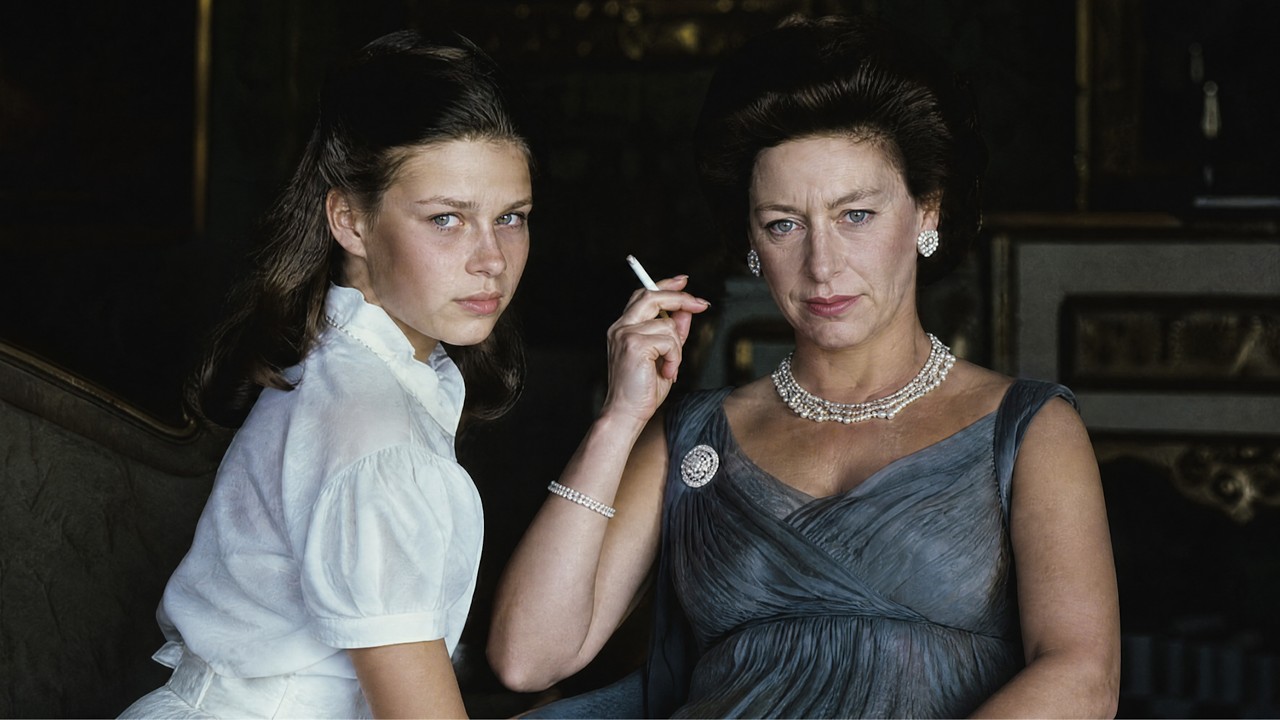
We tend to comfort ourselves with the idea that children of such marriages are somehow protected from the worst of it, that adults manage to contain their war behind closed doors. But family structures don’t work that way. Children breathe the air of the home long before they can name what’s wrong with it. They feel the temperature of the room the moment they walk in. They learn the difference between their parents’ faces in public and their faces in private. They become experts in the small signs: the clench of a jaw, the silence that isn’t peaceful, the cheerfulness that’s slightly too bright. They become observers.
By all accounts, that is exactly what little Sarah became. The quiet, watchful child who learned early that the brilliant, glittering adults around her could turn on each other without warning, and that the best thing a small person could do was watch and listen, and keep her inner world carefully hidden where it couldn’t be hurt.
The terrible thing about Margaret and Antony was how clever they both were. That was the tragedy. Their cruelty wasn’t the stupid, reckless cruelty of people without minds. It was inventive. It was precise. It was the cruelty of two of the sharpest minds in Britain, locked together in a marriage that no longer worked, each using everything they knew about the other to wound as deeply as a human being can be wounded. Snowdon, the artist of image, knew exactly how to make Margaret feel ugly. Margaret, with her quick, sharp tongue, knew exactly how to make her husband feel small.
Consider the scale of unhappiness that filled those years. A marriage that began before 300 million television viewers in 1960. Two children born into that atmosphere in 1961 and 1964. Notes of pure hatred passed between the pages of books. A lavish five-bedroom Caribbean villa ready as a private retreat. And underneath it all, a princess who, less than a decade earlier, had given up the love of her life in the name of the sanctity of marriage, now trapped inside a marriage that was sacred in name only.
For the children, the lesson was brutal and simple: the people who are supposed to make you feel safe in this world are the very ones who hurt each other most. David, the older son, would carry that knowledge in his own way. Sarah, the younger daughter, would carry it in hers. She spent her childhood quietly learning, in a house full of beautiful, dangerous adults, exactly what she did not want for her life.
But the notes in the books were only half the war being waged in that house. There was another secret living in those rooms. In fact, there were two, one on each side, and both of those secrets had names.
By 1966, the marriage had a secret on each side, and neither parent was willing to be the one to stop. The infidelity went in both directions, which matters enormously because the story the press would later tell the public made Margaret the villain, alone and unforgiven. The truth was far more balanced. It was a marriage in which both partners cheated, repeatedly, over many years, and the children grew up surrounded by the consequences of an unfaithful father and an unfaithful mother, not a wronged saint and a guilty sinner.
According to biographer Sarah Bradford, Margaret began her first affairs in 1966. The man was Antony Barton, a wine producer from Bordeaux, France. And here the details become particularly painful for this family and this story, because Antony Barton was Sarah’s own godfather. The man chosen to be a spiritual and moral guardian to the little girl became, for a time, her mother’s lover.
Think about the impact that has on the structure of a child’s world. The roles in this family didn’t stay where they were supposed to be. The clear lines that are supposed to protect children, the boundaries between the people in their lives, were quietly blurring. Nothing was in its proper place.
A year later, in 1967, Margaret had a brief affair with Robin Douglas-Home, a nephew of former Prime Minister Alec Douglas-Home and a society pianist. It lasted about a month and ended unhappily. It wasn’t a love story so much as a symptom, the act of a woman seeking whatever warmth she could find outside a marriage that had turned cold and cruel.
Meanwhile, Lord Snowdon was not a faithful husband waiting at home with his wounds. He conducted a long series of affairs of his own. There was an ongoing relationship with a woman named Ann Hills. There was an affair with Lady Jacqueline Rufus-Isaacs, daughter of the 3rd Marquess of Reading. And there was his work, which became a kind of affair in itself, an escape from the marriage as effective as any lover. He threw himself into his role as art director of the Sunday Times, spending long, punishing hours away from the apartment and his wife, building a separate life with separate people in which Margaret had no part.
So the home Sarah and David grew up in was not a home with a difficult father and a faithful, suffering mother. It was a home where both adults had stepped outside the marriage, where both kept secrets, and where the cruelty of notes hidden in books was met with the betrayal of affairs. It was a home run on deception, and the children lived at its heart.
Then there were the drinks and the cigarettes, the slow poisons that filled the gaps. Margaret had drunk heavily for most of her adult life. She was also a famously heavy smoker, estimated at her peak to consume about 60 cigarettes a day. Imagine that number for a moment. 60 cigarettes in a single day. A cigarette lit almost every 15 minutes of every waking hour. The home was run on alcohol, tobacco, bitterness, and performance. In public, a charming, witty, enviable couple. In private, two people circling each other with knives, numbing the pain with whatever came to hand.
For a watching child, that constant sense of wrongness is the most confusing thing of all. It isn’t a single dramatic event you can understand and get past. It’s the daily feeling that the smiles in the photographs aren’t the truth, that the people you love most are lying to the whole world and to each other all the time, and that you are somehow required to pretend along with them. It is no wonder at all that Sarah became a woman who values honesty, privacy, and stability above almost anything else one could value. She saw up close, for years, what the alternative does to people. She watched two of the most gifted humans in the country slowly destroy trust between them. And she was close enough to feel every tremor of it in the walls of the house.
By the early 1970s, the marriage was nominal only, a legal arrangement neither party respected. Both Margaret and Antony were, in every important sense, looking for another life. Then, in the autumn of 1973, in a restaurant in Edinburgh, Margaret met someone who would not remain a quiet secret. Someone who would bring this private catastrophe into the open under the eyes of the entire world.
In the autumn of 1973, in a restaurant in Edinburgh, a 43-year-old princess met a 25-year-old man. His name was Roderick Llewellyn, known to everyone as Roddy. He was a garden designer, a charming, handsome, slightly aimless young man from a well-connected family. He was 17 or 18 years younger than the princess who fell in love with him.
For Margaret, the relationship with Roddy was qualitatively different from the short, unhappy affairs that had come before. It wasn’t just a reckless month with a velvet-jacket pianist. It lasted, on and off, for almost eight years. In many ways it became the great late love story of her life. The relationship in which she finally allowed herself to be the woman she had been forbidden to be at 25, when the Church, the government, and the crown had taken Peter Townsend from her and told her to be grateful for the sacrifice.
There is something unbearably painful in that symmetry, and it’s worth pausing on because it explains so much. At 25, Margaret gave up the older, divorced man she loved because duty demanded the sacrifice, and she made it. Now, in her 40s, she was openly involved with a much younger man because she had decided, deep down, that she was done sacrificing her happiness for anyone or anything. The renunciation of 1955 and the affair of the 1970s are not two separate scandals. They are two halves of the same wound. The girl denied love grew into a woman chasing it on her own terms, whatever the cost, whatever the world said.
But Margaret was still legally married to Lord Snowdon, still a senior member of the royal family, and the only sister of the reigning Queen, a woman whose every move attracted overwhelming attention from a press that grew hungrier, bolder, and crueler with each passing year. For a few years, the relationship stayed mostly out of the public eye. Margaret and Roddy spent time together at Les Jolies Eaux, the villa on Mustique, far across the Atlantic, on a private island where a princess could allow herself to believe for a while that she had finally found a place beyond the reach of cameras, headlines, and the judgments of England.
She was wrong about that, wrong in a way that would humiliate her before the entire country. She was wrong in a way that would expose the slow, private collapse of her marriage in public, at the very moment her children were old enough to read every cruel word the papers printed and understand its precise meaning. The world was changing fast, and the old protections were fading. The deference that once shielded the royal family from real scrutiny, the tacit agreement that some things simply weren’t photographed or published, was crumbling. A newer, harsher kind of journalism was being born. A kind that didn’t believe a princess had any right to a private life at all. A kind that saw the Queen’s sister not as a person to be protected, but as a prize to be hunted.
In 1976, David Armstrong-Jones was 14 years old. His sister Sarah was 11. They were at the worst possible age for what was about to happen. Old enough to read the papers. Old enough to understand every word. Old enough to hear what other children whispered, and to feel the looks adults now gave them. They were about to watch their mother transform overnight into the biggest scandal in Britain.
In February 1976, telephoto lenses captured them on Mustique, and within days the whole nation was watching. The photos showed Princess Margaret and Roddy Llewellyn together on the island in swimwear, relaxed and intimate, two people enjoying the warmth of the Caribbean sun. They were taken secretly by paparazzi who had tracked the princess across the world to her private retreat. When they were published in the British tabloids in February 1976, they exploded like a bomb in the royal family.
It’s hard for us now to grasp how enormous this was at the time. Margaret was the Queen’s sister, the second most famous woman in the country. She was still, in the eyes of the law and the Church, a married woman. And here she was on the front pages of every paper, vacationing with a much younger man, the age gap of 17 or 18 years becoming the entire focus of the story. The tabloids did the arithmetic for their readers over and over, inviting the nation to feel outraged.
The coverage was ferocious in a way rarely directed at a senior royal before. Margaret was described as snatching younger men. She was attacked as a selfish woman squandering public money on parties in the sun while ordinary Britons struggled to pay their bills in a decade of strikes, shortages, and hard times. The attacks weren’t confined to the tabloids. They reached Parliament itself. In the House of Commons, a Member of Parliament stood up and denounced Margaret as a royal parasite, a woman wasting taxpayers’ money on a life of pleasure. Roddy Llewellyn was reduced, headline after headline, to her “toy boy,” a disposable young lover, a living symbol of a princess who had shed every constraint of her position.

Now place two children at the heart of that storm. David was 14. Sarah was 11. This wasn’t distant history they would read about quietly in a book years later. This was happening to their mother in real time, that very week, on every newsstand, in every passing conversation, in the looks of every adult who saw them. Imagine being 11 years old and seeing your mother described by a politician in the national parliament as parasitic. Imagine walking into school. Imagine conversations stopping when you enter a room. Imagine other children who had heard their parents talking at breakfast repeating what they’d heard. Imagine knowing that your family’s most private failures had become the country’s most public entertainment, and that there was absolutely nothing you could do to stop it.
That is the real core of what Lady Sarah Chatto endured. Not a quiet, dignified, sad divorce conducted discreetly behind palace walls, but a national spectacle. Humiliation conducted in loud headlines, with her mother cast as the villain and her family displayed as a cautionary tale for the whole nation to whisper about. The chaos of the home, which had at least been private, was turned inside out and displayed for everyone.
And there was a deeper cruelty buried within the public reaction, a cruelty the children would have felt even if they couldn’t yet put it into words. The very press and public who had wept for Margaret in 1955, who had pitied the brave young princess giving up her great love for the sake of Church and country, now turned on her without mercy. The woman they had once admired for her sacrifice was now despised for finally, two decades too late, seeking a little happiness. There was no winning. Obedience had brought her heartbreak and praise. Disobedience had brought her freedom and contempt.
A daughter watching could be forgiven for drawing a harsh conclusion from all of this: that the approval of the crowd is worthless and fickle, given and withdrawn on a whim, and that a life built to please that crowd is a life built on sand. Sarah was 11. She couldn’t have analyzed it in those terms. But children absorb the essence of a lesson before they can articulate it, and the essence of this lesson was unmistakable. The spotlight wasn’t a reward. It was a danger. And she was beginning to understand that the safest place to stand, for someone in her position, was as far from that spotlight as possible.
The scandal did its work quickly. The grainy photos were the death blow to a marriage that had been quietly dying for a decade. Within weeks of the photos appearing, the pretense could no longer be maintained. On March 19, 1976, just over a month after the photos were published, Princess Margaret and Lord Snowdon issued a public statement. They announced that their marriage had irretrievably broken down and that they had agreed to live apart. The fairy tale that began before 300 million television viewers in Westminster Abbey in 1960 was over. It didn’t end quietly and with dignity behind closed doors. It ended in the most public way imaginable, with the whole nation watching and judging, and with two children standing in the middle of the wreckage.
For 11-year-old Sarah, the lesson of her early childhood was now confirmed in the harshest possible terms. Her parents’ glittering, gilded world was not safe. It was not solid. It could collapse at any moment, and when it collapsed, it would collapse in front of everyone she would ever meet.
Years later, on a July day in 1978, Margaret became the first senior royal to divorce since the reign of her great-great-grandfather. The separation announced in 1976 had, over time, become a full and final divorce. On May 24, 1978, the court granted the decree nisi. On July 11, 1978, the divorce became final. Princess Margaret and Antony Armstrong-Jones, Earl of Snowdon, were no longer husband and wife.
To understand the real weight of that moment, you have to understand how almost unbelievably rare it was. This was the first divorce of a senior member of the British royal family since 1901, when Princess Victoria Melita of Edinburgh divorced Ernst Louis, Grand Duke of Hesse. Three-quarters of a century had passed between the two events. The royal family doesn’t divorce. That was the unwritten rule, the iron wall on which the entire moral authority of the monarchy seemed to rest. The abdication crisis of 1936 had been precisely about this principle. And Margaret had been asked to sacrifice her heart in 1955 in the name of this principle.
Here is the cruel, perfect symmetry that runs through the entire life of Princess Margaret. The irony a novelist might hesitate to invent. In 1955, she gave up Peter Townsend precisely because he was a divorced man. She was told, over and over, that the Church taught that marriage is indissoluble, that a royal princess so close to the throne could not possibly marry a man whose marriage had been dissolved. She sacrificed the love of her life on the altar of that single principle, and she did it publicly, and she was praised for her sense of duty. Now, 23 years later, she herself was a divorced royal. The very thing that had been used to break her heart at 25 had become her own reality at 47. The woman who was told divorce was impossible for someone in her position lived to become exactly that: a divorced princess.
Whatever quiet relief she may have felt at finally being free of a cruel marriage, the bitterness of that irony must have been hard to bear. She obeyed the rule and lost her love. She broke the rule and lost her marriage. The crown took from her either way.
It’s tempting to look at Margaret through these years and see only the architect of her own destruction, the spoiled princess who wasted her talents. But that’s too easy and misses the deeper truth. Margaret was a woman placed in an impossible position from the age of six: a life of total visibility and total purposelessness, then punished for every way she tried to fill the void. When she chose duty, duty gave her nothing. When she chose pleasure, the world called her a parasite. There was no path in her life that ended in peace, because the role she was born into didn’t include one.
Her daughter, who had been watching her, would understand this more than anyone alive. And perhaps that understanding is precisely why Sarah never became bitter. You can’t hate someone once you truly see the trap they were caught in. For David and Sarah, the divorce was at once an ending. And in a strange, complicated way, it was a relief. The long cold war that had filled their home for as long as either could remember was now officially over. The notes hidden in books, the affairs, the fragile daily performance of a marriage that had died years ago: all of it was finished. Their parents would no longer have to pretend, and neither would the children.
But a legal ending doesn’t erase a childhood. It can’t go back and change what one has already lived. David and Sarah were now, in the eyes of the whole country, the children of the great royal scandal of their era. They had grown up inside a marriage that had become a public catastrophe, and they would carry that knowledge, that private, heavy inheritance, into the rest of their adult lives.
The most remarkable thing, looking back, is how the chaos of those days settled into Sarah completely differently than might have been expected. Many children of such homes take one of two paths. Some repeat the pattern, seeking the same intensity and the same disasters they grew up in, because at least it’s familiar. Others break in silence. Sarah did neither. She didn’t become reckless. She didn’t chase attention or drama to fill the void left by her childhood. Instead, she watched what unbridled whims and public spectacles had done to her mother. And she began, very slowly and very quietly, to build her own life around everything Margaret’s life had so painfully lacked. Privacy instead of fame. Stability instead of storms. A marriage that lasts instead of a marriage that burns. Work that means something instead of a role that means nothing. A self that doesn’t need an audience to feel real.
But that quiet construction was still ahead of her. First, the young woman had to live through the hardest chapter of the story, because the divorce didn’t free Princess Margaret toward the happiness she had sought. It freed her toward a long, slow, cruel decline, and her daughter was beside her every step of that downward path.
Over the next two decades, Sarah watched the most magnetic woman she had ever known slowly fade away. The years after the divorce were not kind to Princess Margaret. Her great late-life love story with Roddy Llewellyn eventually ended. Roddy went on to marry someone else and build his own life. Margaret, the woman who had once dazzled an entire country, settled into a life that quietly shrank and hardened with each passing year.
The habits of a lifetime began to call in their debts, slowly at first, then all at once. The smoking, that astonishing 60 cigarettes a day at its peak, had done lasting damage to her lungs, her heart, and her circulation. She eventually managed to give up cigarettes, but for many who knew her, the change came too late. The heavy drinking also took its steady toll on both body and spirit. After a severe bout of hepatitis in 1984, she began to be more careful, and later in life she cut back further. But decades of hard living couldn’t be erased by wishing. The body keeps its records.
Then came the strokes. On February 23, 1998, at her beloved villa Les Jolies Eaux on Mustique, the island that had been the setting for her greatest glamour and her greatest scandal, Margaret suffered a mild stroke. It was the first real crack in the wall of her physical world, the first sign that the body that had carried her through everything was beginning to fail. After that, the island that had given her so much pleasure seemed to turn against her. In early the following year, as a result of an accident in her bathroom at Mustique, her feet were severely burned by hot water, permanently and seriously affecting her mobility.
Consider the cruelty of that image. The woman who had once roamed those ten green acres and beautiful waters as a radiant princess, who had swum in that warm sea and danced in that villa, could now barely walk. After that 1999 accident, she almost stopped drinking, but by then her body was failing faster than anyone could repair. The strokes kept coming, one after another, each one taking something more.
Look at the bare timeline of her final years; the speed of this collapse is a tragedy in itself. A mild stroke in February 1998. The burn accident in 1999 that left her immobile. Hospital admission on January 10, 2001, after she lost her appetite and her ability to swallow normally following another stroke. By March 2001, the strokes had left her with impaired vision and complete paralysis on the left side of her body. The brilliant, sharp-tongued, quick-witted princess, once the most exciting woman in Britain, was now partially blind, partially paralyzed, and dependent on others for the most basic and most private daily tasks.
Now imagine Sarah through all of this slow disintegration. By the late 1990s, she was a mature woman, a wife, and soon a mother of two young children. At the same time, she was a daughter watching her mother fade away piece by piece, year after year, before her eyes. There is a particular, terrible grief in this kind of loss, one known fully by anyone who has cared for a dying parent. It isn’t the shock of sudden, clean death that comes and is over. It is the long, drawn-out disappearance of a person while they are still alive with you in the same room. It is watching the light of someone you love go out gradually, slowly. It is watching the body fall apart while the memory of who that person was remains painfully alive and vivid in your mind.
And here, in the hardest of these years, the truth of Sarah’s heart shows itself most clearly. Whatever anger she might have been entitled to from her troubled childhood, whatever grudge another person might have nursed, this period tells you where her real love lay. She didn’t turn her back. She didn’t keep a safe, bitter distance. The relationship between mother and daughter remained close, loyal, and affectionate to the very end. Sarah stayed near. By every account, she was a devoted, loving daughter to a difficult, fragile, frightened woman who desperately needed her.
Margaret’s last public appearances came in 2001, and they were heartbreaking for those who remembered her at her peak. In August, she appeared frail in a wheelchair at her mother’s 101st birthday celebrations. In December, she appeared again, even weaker, at the 100th birthday of her aunt, Princess Alice, Duchess of Gloucester. The most magnetic woman in Britain had become a ghost, wheeled into family gatherings on her chair, reminding everyone present how quickly and how deeply a once-brilliant life can fall.
Then, in February 2002, she suffered a final stroke, and in the early hours of February 9, 2002, at 6:00 a.m. at King Edward VII’s Hospital in London, Princess Margaret died quietly in her sleep. She was 71 years old. Sarah was 37, just weeks away from her 38th birthday. She had lost the mother she had spent her entire life trying both to survive and to love. The woman whose chaos had shaped her, whose creativity had saved her. Now, finally, with the great storm of Margaret’s life over, the world began to see clearly what that frightened, watchful child had quietly become.

While the press chased her mother around the world, Sarah had been busy doing something almost invisible: building a life that actually worked. This is the part of the story the headlines never showed and never will, because it consists entirely of the things headlines don’t care about. No scandals, no drama, no spectacle, no tears on the front pages. Just the slow, patient, deliberate construction of a good, lasting life by a woman who had seen up close the cost one ultimately pays for choosing a different path.
It began with art. The creativity her mother had encouraged in the early, good years became the solid foundation on which Sarah built everything else. She didn’t treat it as a hobby, or as a passing amusement for a bored royal. She trained seriously, as a real, professional artist. She attended Bedales, known for its progressive, creative spirit. She studied at Camberwell College of Arts. She studied at Middlesex Polytechnic, and completed her training at the Royal Academy Schools, which offer some of the most demanding and prestigious art education programs in the entire country.
And here’s the crucial thing: she was genuinely talented. This wasn’t polite indulgence of a princess by flatterers. In 1988, she won the Windsor and Newton Award for emerging artists in painting and drawing. In 1990, she won the Creswick Prize for landscape. These were real awards, won in fair competition against other serious young artists who had no royal blood to recommend them. Beginning in 1995, she began exhibiting her work at the Redfern Gallery, and she made one choice in particular that tells you almost everything about the person she had decided to be. She exhibited under her maiden name, Sarah Armstrong-Jones, not under any royal title.
Think carefully about what that single choice reveals. A daughter of one of the most famous, most photographed women in the entire world chose to exhibit her paintings under a name that quietly downplayed her true identity. She wanted her work to be judged on its merits, on the painting itself, not on the pedigree behind it. After a childhood spent as a supporting character in her mother’s endless public drama, she built an identity around the one thing in her life that was entirely her own.
Then came love, and here again, at every turn, she chose the exact opposite of her mother’s doomed path. She met an actor named Daniel Chatto while they were both working on the film Heat and Dust in India. He later gave up acting to become a painter like her, sharing her quiet world. On July 14, 1994, Sarah married him.
The wedding itself was a kind of quiet rebellion against everything her parents’ marriage had represented. There was no vast cathedral. There was no global television broadcast watched by hundreds of millions. There was none of the mythic spectacle with which her mother’s doomed 1960 wedding had been launched. Instead, Sarah chose to marry in a small, beautiful church in the City of London called St Stephen Walbrook. The service was conducted by the Reverend Chad Varah, founder of the Samaritans, a charity built entirely on quietly listening to people in their darkest moments of despair.
There is something almost perfect in that detail, something that feels intentional rather than accidental. The daughter of very private pain was married by the very man who had devoted his entire life to listening to and relieving the private pain of others. She wore a dress designed by Jasper Conran, and she wore the Snowdon floral tiara. And she wore something else, something that meant far more than any tiara ever could. She wore her mother’s pearl earrings, those set with several small diamonds and two large pearls, even on the day she began her new life, the day she stepped away from her childhood forever. She chose to carry a piece of Margaret with her.
And her marriage to Daniel Chatto did the one thing Margaret’s marriage had so spectacularly failed to do. It lasted. It worked. It held. They had two sons together. Samuel David Benedict Chatto was born on July 28, 1996. Arthur Robert Nathaniel Chatto was born on February 5, 1999. Sarah raised them, as much as any royal could, away from cameras and out of headlines, in a family life as normal and loving as her position would allow.
Look at the two weddings side by side, because the contrast is the essence of Sarah’s philosophy in a single image. Her mother married before 300 million television viewers in the most sacred, most public building in the land, amid a blaze of glamour the press treated as a national salvation. That marriage ended in cruelty, betrayal, and front-page divorce. Her daughter married in a small city church most Londoners had never heard of, with no global broadcast and no fairy-tale framing, blessed by a clergyman famous for listening to the despairing. That marriage held, solidly, for the rest of her life. The grander the beginning, it seemed, the harder the fall. Sarah watched the lesson play out in her own family, and she chose the smaller door on purpose.
She carried the same instinct into the way she raised her boys. Samuel and Arthur did not grow up, as their mother had, in the heart of heated national drama. They grew up as far from it as a royal childhood allows, with an artist mother and a painter father, in a home where creativity and privacy were the family currency instead of scandalous headlines. Everything Sarah had been denied as a child, the sense of safety, the sense that the walls of the home would hold, she sought deliberately to give her children. That was the deepest kind of personal repair, the kind that says: the thing that hurt me will end with me. She broke the pattern. The daughter of chaos built calm with her own two hands. The daughter of the great royal scandal of her era made a lasting marriage, a real home, and a respectable career out of all the things her mother’s glittering, tragic life had lacked. And she did it all so quietly, with so little fuss, that most of the country barely noticed she existed.
When Margaret died in February 2002, her daughter did not turn her back on her memory. She chose to carry it. It would have been so easy, after such a childhood, to become bitter, to remember only the affairs, the cruelty that filled the house, the public humiliation of the grainy photos, and the long, undignified years of decline, and to quietly close the door on all of it forever. Many children of difficult, hurtful parents do exactly that. And no honest person could have blamed Sarah for choosing to do the same. She had earned the right to walk away and never look back.
But that’s not what she did. The proof lies in the smallest, most personal detail of all. After Margaret’s death, Sarah inherited her mother’s pearl earrings, the very ones she had chosen to wear on her wedding day. And in the years that followed, she wore them again and again at royal occasions and family gatherings, deliberately and visibly, as a quiet, unmistakable tribute to her mother.
That single detail reframes the entire story, and it deserves a pause to feel its full weight, because it tells us that Sarah’s escape was never, at any point, an escape from Margaret as a person. It was an escape from the chaos, from the pattern, from the specific way of life that had destroyed so much around her. She didn’t reject her mother. She rejected the destruction, and she held on to the love with strength and gentleness.
That distinction is the deepest thing this entire story has to teach us. It is possible to refuse, completely and for your whole life, to repeat the mistakes of the people who raised you, without ever once hating them for making those mistakes. It is possible to step away from a parent’s chaos while still keeping them close in your heart. Sarah seems to have understood this truth instinctively, in a way many people spend their entire lives struggling and failing to learn. She separated the sin from the sinner. She held on to the woman and let go of the wreckage.
Consider everything she witnessed. She watched her mother be punished, again and again, simply for wanting to be loved. She watched the crown and the Church tear Peter Townsend from a heartbroken young woman in 1955. She watched the press destroy her late love story with Roddy and turn her mother into a national villain in 1976. She watched the long, slow, ungraceful physical collapse of her final years. And yet, through all of it, she appears to have held on to one simple, saving truth. Her mother wasn’t just a scandal. Her mother was also the woman who encouraged her to paint, who gave her the creative life that would eventually become her salvation. There was love underneath all the wreckage. And Sarah refused to let the chaos erase it from the record.
When she wore those pearl earrings to a wedding or a jubilee or a funeral, she was making a quiet statement no headline could capture and no journalist would think to print. She was saying that her mother mattered, that the brilliant, broken, fascinating, impossible Princess Margaret was a woman worth remembering with tenderness and not just with scandal. And that a life can be a harsh lesson and still be a life deeply loved by the child who lived in its shadow. It is the most generous act in this entire story. The one person who had every reason in the world to be angry chose instead to be loyal. And that loyalty, that quiet steadfastness, that refusal to let her own pain turn into bitterness, would soon be recognized and valued by the one person in the entire family whose recognition meant the most. Because someone had been watching Sarah all along, with the same patience with which Sarah had been watching everyone, and that someone was the Queen.
In the years following her sister’s death, the Queen drew one person closer to her than almost anyone else, and that was the quiet one. Queen Elizabeth II had shared a strong, exceptional, lifelong bond with her younger sister. For all of Margaret’s chaos, all the scandals, anxiety, and embarrassment Margaret had brought the family over the decades, the two women had been close throughout their lives: the heir and the spare. The two little girls who had watched their uncle abdicate and their shy father take the throne. They were bound by a shared childhood no one else on earth could fully understand.
When Margaret died in February 2002, the Queen lost not just a sister. She lost the only living person who had known her longest, who remembered her from her very beginnings. And in the years following that loss, the Queen gently, naturally turned toward Margaret’s daughter. The bond between aunt and niece, already warm and real, deepened into something truly exceptional within the family. Those close to the royal family described the Queen as adoring Sarah, seeking her company whenever she could. One court insider put it simply: Sarah was the Queen’s absolute favorite among the younger members of the family.
The signs of that special closeness were clear to anyone who knew where to look. The Queen was said to allow only Sarah to accompany her to one of her most private and cherished retreats: Craigowan Lodge, the modest house on the Balmoral estate in Aberdeenshire, where the Queen went to truly, completely get away from the world and its demands. People who saw the two women together described the ease between them, the deep loyalty, the shared sense of duty, and above all, the laughter. They said there was so much laughter whenever the Queen and Sarah were in the same room, the sound of two people simply enjoying each other’s company.
Think about what that really means. Out of the entire sprawling royal family, all the children, grandchildren, cousins, and in-laws, the one person the Queen wanted beside her in her rarest, most private moments was the quiet daughter of her rebellious, controversial sister. The watchful child who had grown up observing everyone, who had built her entire adult life on calm, steadiness, and loyalty, had become, in the end, the most trusted and welcome companion of the most powerful, most scrutinized woman in the family.
That is the great prize at the heart of the story, and the profound irony is that it is such a quiet prize. Margaret spent her entire life chasing power, attention, freedom, and love, reaching for all of it with both hands. She was punished for that reaching at almost every turn. Sarah asked for none of those things. She didn’t demand the spotlight. She simply built a stable, honest, private, loving life. And she carried her difficult mother’s memory through all of it with extraordinary grace. In the end, it was Sarah, not Margaret, who ended up holding the one thing Margaret had wanted more than anything else in the world: the deep, simple, unconditional affection of the head of the family. The thing the “spare” could never quite obtain was given freely to the quiet daughter, because of the person she had chosen to be.
When Queen Elizabeth II died in September 2022, Sarah was visibly among the most grief-stricken people in the entire family, her sorrow plain for the world to see. She had lost not just her aunt, but her closest friend, the older woman who had recognized in her all those quiet qualities the headlines never thought worth printing. And the gentle inheritance of duty continued quietly, in the only way anything in Sarah’s life ever happened. Going back to 2004, she became Vice-President of the Royal Ballet, the very institution her mother had once led as President. In 2024, Sarah herself was appointed President of the Royal Ballet, taking on, with quiet grace, the role Margaret had held before her, completing a smooth, continuous transfer of duty across generations, and doing it without a trace of scandal attached to her name.
So what does the story of Lady Sarah Chatto ultimately reveal about the crown, and about the real, hidden cost of being born near it? It reveals, first, that the monarchy can give a person every gift imaginable and still leave them with nothing that truly matters, exactly as it did for Margaret the “spare,” who had all the world’s glitter and no real purpose. And it reveals, second, something far more hopeful and human. That the most powerful act available to a person born into that gilded trap may not be seizing power, or chasing pleasure, or loudly demanding to be seen and adored. It may be something quieter than all of that. It may be simply the daily, stubborn, unglamorous refusal to fall apart.
Sarah was born seventh in line to a throne she would never reach, inside a family already crumbling at its roots. And she chose, deliberately, patiently, year after year, to build a life of calm in the middle of all that noise. She didn’t inherit her mother’s chaos. She inherited her mother’s earrings, and she wore them with love. And in the end, the quietest person in the room turned out to be the strongest one of all.