On July 3, 1863, two cousins from Chesterfield County, Virginia, stepped off across the open fields of Gettysburg together as part of Pickett’s Charge. Cornelius and Everett LaPrade had marched side by side since enlisting in 1861 with Company I of the 14th Virginia Infantry, fought through the Seven Days battles, and even missed Antietam together when both fell ill at the same time. Somewhere between Seminary Ridge and the stone wall at the Angle, one of them disappeared forever. The cousins were a carpenter and a farmer from just outside Petersburg and Richmond.
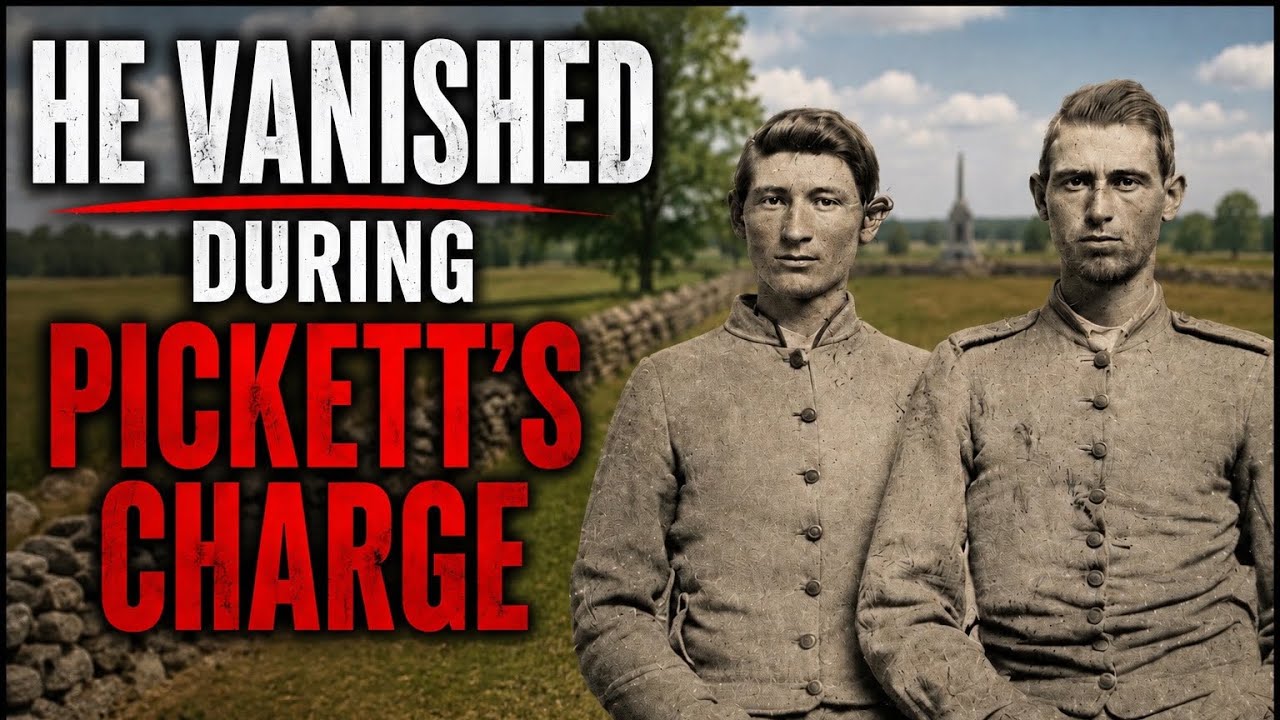
Because they were assigned to the same unit, their military careers mirrored each other almost exactly. They survived Malvern Hill and Seven Pines, and by the summer of 1863 they were healthy in time to join General Lewis Armistead’s brigade in Pickett’s division for the march north into Pennsylvania. The 14th Virginia began its advance across the field near the Codori house and barn, one of the landmarks that still stands along the Emmitsburg Road today. The Confederate soldiers crossed that road under heavy fire as Union artillery raked their lines.
Of the roughly 422 men who went into the charge with the 14th Virginia, about a quarter became casualties in the open fields. The attack was supposed to be coordinated, with Armistead’s men providing support for the shattered brigades already stalled at the stone wall. The 14th Virginia pushed forward at the double quick after crossing the road, and for a brief moment they drove Pennsylvania troops back behind the wall at the Angle. Armistead went over the wall with his hat on his sword and the Confederate flag unfurled beside him.
From his position across the ridge, Robert E. Lee saw that flag go over and believed the charge was succeeding. He was wrong. The Confederate line was not holding.
Union soldiers along the wall pushed back, and the attack collapsed. Amid the chaos at the wall, the LaPrade cousins became separated. With so many men jammed into that small pocket of ground, formations broke apart. Soldiers were fighting hand to hand, running in all directions, and it became impossible to account for everyone until after the fighting stopped.
Cornelius LaPrade was never seen again. Initial reports suggested he may have been wounded and captured, but no hospital record in Gettysburg or the surrounding area confirms that. There is no marked grave for him in the town or its cemeteries. He is simply one of the many unidentified Confederate soldiers whose fate was never determined.
There is a grim possibility that explains the absence of any trace. Cannon fire did not produce the neat wounds shown in films. Explosive shells could tear a body apart, scattering remains across the field. There is no way to know if that is what happened to Cornelius, but it remains a plausible explanation for why nothing of him was ever identified.
After the battle, Union soldiers who died on the field were buried hastily but with markers. Confederate dead were treated differently. Civilians were left to gather the bodies, often interring them in mass pits without individual identification. Some were never buried at all.
In the decades that followed, remains were exhumed and moved to the national cemetery, where unknown soldiers from both sides now rest. The story of the LaPrade cousins is the story of the common soldier, the type of man whose experience is often overshadowed by the famous commanders. While thousands of visitors have worn down the grass in front of Armistead’s monument, there is no monument dedicated to Cornelius LaPrade or his cousin. The only tribute to them is the Virginia monument far across the field, shared with every other Virginian who fought there that day.
More than 160 years later, no one will ever know exactly what happened to Cornelius LaPrade. But he likely died somewhere on that field, and tourists now walk over the ground where he fell without ever knowing his name.