In the Gilded Age, extraordinary beauty functioned as both an asset and a trap. Young women blessed with exceptional looks found doors opened everywhere, their faces printed in every publication. They were celebrated in society columns, painted by leading artists, and courted by men whose motives ranged from sincere affection to calculated pursuit of wealth. Yet beauty ages while well-managed fortunes do not, and many of these celebrated women discovered that the society which elevated them for their appearance had no use for them once it faded.
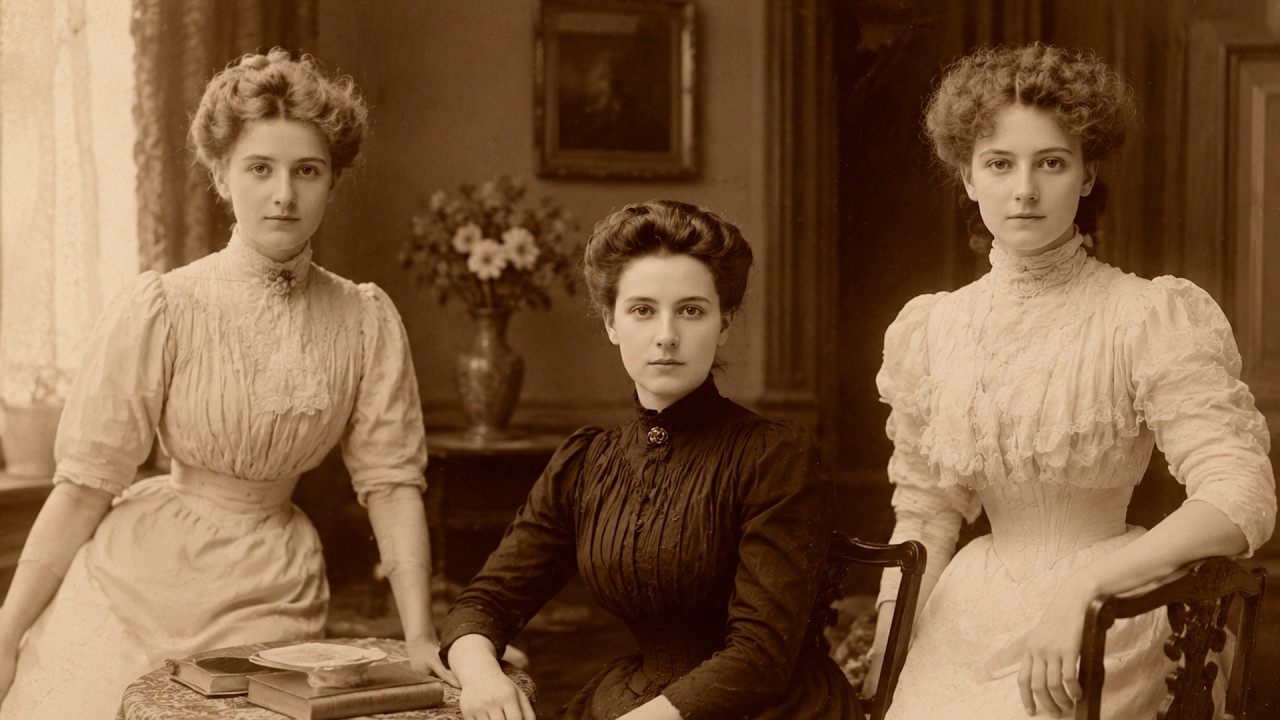
Among the most remarkable of these figures was Huguette Clark, heir to one of America’s most controversial copper fortunes. Born in Paris in 1906, she was the daughter of William Andrew Clark, a Montana copper king whose ruthlessness shocked even an era accustomed to corruption, and who was described by Mark Twain as “as rotten a human being as can be found anywhere under the flag. ” His fortune, estimated at $150 million in 1907, built a 121-room mansion on Fifth Avenue with 30 bathrooms. Huguette’s childhood was shadowed by tragedy.
In 1919, when she was 13, her beloved older sister Andrée died of meningitis at 16, leaving a wound that never fully healed. When her father died in 1925, 19-year-old Huguette became one of the richest women in America. She then withdrew from the lavish family mansion into a modest apartment, beginning a gradual retreat from a world that had taken her sister and left her with a fortune she never asked for. Her brief marriage to William McDonough Gower, a law student who had worked for her father, lasted only two years from 1928 to 1930, with persistent rumors that it was never consummated.
Divorce papers cited excessive cruelty, and she chose to be known as Mrs. Huguette Clark for the rest of her life. Rather than pursuing charitable works or social climbing, Clark turned inward to a world of miniatures. A 1929 exhibition at the Corcoran Gallery showcased seven of her paintings, and critics praised her natural talent.
Instead of embracing this recognition, she retreated deeper into her Fifth Avenue apartment where she developed an obsessive artistic passion. Over time, she amassed a collection of 1,157 antique dolls, meticulously indexed and cared for. She especially favored French dolls from the Gilded Age, including the sad-featured Jumeau dolls. One Jumeau doll later sold at auction for $113,500 against an estimate of $25,000 to $35,000.
In the late 1950s, she began commissioning Christian Dior to create haute couture outfits for her 19th-century dolls. She attended Dior fashion shows in Paris, selecting designs not for herself but for her silent companions. Her passion extended to Japanese culture, commissioning skilled artisans to create historically accurate miniature temples, castles, and tea houses. One ambitious project, a miniature temple requiring special government permission to use cedar wood reserved for imperial buildings, took three years and cost $80,000 in the 1940s.
Her fascination with Japanese culture attracted unwanted attention in 1941. Following Pearl Harbor, FBI agents investigated her extensive Japanese art purchases and those miniature buildings requiring imperial permits for possible espionage. Though investigators found nothing more than a wealthy woman’s genuine interest in 17th-century Japanese culture, the experience was a turning point for the shy heiress. In the 1950s, Clark stopped visiting Bellosguardo, her mother’s 9-hectare estate in Santa Barbara, telling relatives she would feel sad to go there without her mother.
When her mother Anna died in 1963, the last link to the outside world was severed, leaving Huguette alone with her dolls and memories. For nearly three decades, she rarely left her Fifth Avenue apartments. In 1991, at age 84, what began as routine treatment for basal cell cancer lesions became something extraordinary. Despite making a full recovery, Clark chose to remain permanently in her small room at Beth Israel Medical Center.
She arranged for many of her beloved dolls to be moved into her hospital room. For the next 20 years, she paid about $400,000 annually for the privilege of living in a simply decorated room, watching cartoons including “The Smurfs,” “The Flintstones,” and “Scooby-Doo,” surrounded by dolls. Her daily routine involved 12 hours with her private nurse, Hadassah Peri. Hospital staff quickly realized their patient’s extraordinary wealth.
Fundraising officials wrote internal memos noting her fortune of $700 million and that she had no close family. What followed was described by investigators as a 20-year campaign to drain portions of her copper inheritance. Her nurse Hadassah Peri received more than $31 million in gifts over those decades, including five homes, jewelry, a $200,000 Bentley, and a $200,000 Stradivarius violin. Doctors collectively received $3 million, while other nurses received hundreds of thousands.
Meanwhile, three magnificent properties remained frozen in time. Her 42-room Fifth Avenue apartment was meticulously preserved but unoccupied, filled with hundreds of dolls exactly as she left them in 1991. Le Château, a 21-hectare farm in Connecticut she bought in 1952, was never inhabited. Most astonishing was Bellosguardo, the Santa Barbara estate, where cars remained in the garage with 1949 license plates, furniture covered with protective sheets, and formal dining room tables set for guests whose last visit occurred when Eisenhower was president.
In 2005, at age 98, Clark signed two radically different wills just six weeks apart. The March will left her fortune to 21 distant relatives she had never met, descendants of her father’s first marriage. The April will disinherited those relatives entirely, establishing an art foundation at Bellosguardo and leaving $30 million to her nurse Hadassah Peri, plus significant gifts to her lawyer, accountant, and hospital staff. When Huguette died on May 24, 2011, just two weeks before her 105th birthday, relatives discovered that her lawyer Wallace Bock had barred them from attending the funeral.
The contradictory wills ignited a fierce legal battle over an estate valued between $300 and $400 million. Relatives challenged the newer will, arguing that a woman living in a hospital room watching cartoons while her mansions sat empty demonstrably lacked the mental capacity for such decisions. The defense countered that she was of sound mind but suffered from an extreme fear of the outside world and no concept of money’s value. A settlement reached in September 2013 divided the difference.
Relatives received $34. 5 million after taxes, while Bellosguardo became an art foundation as Huguette had wished. Hadassah Peri agreed to return $5 million and received nothing from the will, though she retained most of the $31 million she had received as gifts during Huguette’s lifetime. The settlement carefully avoided any determination of Huguette’s mental capacity.
In January 2020, auction house Sotheby’s sold her legendary doll collection at the Ritz-Carlton in Santa Barbara. Collectors from around the world competed for pieces from her miniature world. A small selection of historically significant pieces remained at Bellosguardo, where limited public tours now allow visitors to glimpse the preserved mansion and Huguette’s miniature world. The property she abandoned in 1953 finally opened its doors, revealing a home where time stopped, with phones still using a Butterfield 8 exchange and tables set for dinners never served.
A second Gilded Age heiress, Barbara Hutton, experienced a different but equally tragic fate. Born in 1912, she inherited $26 million at age 12 upon the death of her grandmother, a sum that grew substantially under her father’s management. Her coming-out party in November 1930 at the Ritz-Carlton in New York during the Great Depression was legendary, costing an estimated $60,000 with 2,000 bottles of champagne and elaborate gifts of uncut diamonds, emeralds, rubies, and sapphires for every guest. Her childhood had been marred by deep emotional neglect.
When she was five, she discovered her mother’s body, a scene that haunted her for decades. Her father’s infidelities and her stepmother’s coldness left Barbara shuffled between guardians and nannies. Her search for love became legendary and heartbreaking, leading her through seven marriages, each ending in disappointment. Her husbands included Prince Alexis Mdivani, actor Cary Grant, and various counts and princes.
Her fortune eroded under lavish spending and poor financial management. At her death in 1979, she was reportedly left with only $3,500 in her name, though this figure was disputed. She died alone in a Beverly Hills hotel from a heart attack at age 66, and her modest funeral was attended by only a small circle of family and friends. The story of Gladys Deacon demonstrates how vanity and obsession could destroy even the most brilliant lives.
Born in Paris in 1881, she captivated European cultural elites with her beauty and intelligence. Marcel Proust wrote love letters praising her beauty, Auguste Rodin sculpted her, and she served as a model for some of the greatest artists of her era. Her life took a tragic turn when, obsessed with creating what she considered a perfect Grecian profile, she underwent a primitive cosmetic procedure involving paraffin wax injections in her nose in 1903. The wax migrated over time, distorting her face and transforming her beauty into a grotesque caricature.
Despite this catastrophe, she spent 15 years methodically pursuing Charles Spencer-Churchill, the 9th Duke of Marlborough, finally marrying him in 1921. The marriage was a disaster, with her increasingly erratic behavior and her obsession with breeding spaniel dogs that destroyed the castle’s priceless interiors. The duke eventually evicted her from Blenheim Palace in 1933. She lived as a recluse under the name Mrs.
Spencer, descending into eccentricity and poverty. In 1962, at age 81, she was forcibly committed to St. Andrew’s Hospital in Northampton, a psychiatric institution where she spent the last 15 years of her life. When asked where Gladys Deacon was, she reportedly answered, “Gladys Deacon.
She never existed. ” She died alone in 1977 at age 96. The story of Catherine Tylney-Long reveals how enormous wealth could attract the worst possible match. At age 16, she inherited over 10,000 hectares across six counties, including Wanstead House, known as England’s Versailles, plus £300,000 in financial investments.
Her rejection of the Duke of Clarence, a future king of England, demonstrated remarkable independence. But she ultimately married William Wellesley-Pole, a charming nephew of the Duke of Wellington. Within ten years, her fortune had been transformed into debt by her husband’s compulsive spending. Wanstead House was dismantled and sold piecemeal for only £10,000.
Catherine fled to the Continent to escape creditors. She died in 1825 at age 35, broken physically and emotionally. Her death catalyzed a revolutionary legal decision when Lord Chancellor Eldon ruled that William became the first father in England to be stripped of custody of his children on grounds of moral character, a precedent that became foundational to modern family law. William died in poverty in 1857.
Helen Clay Frick, daughter of industrialist Henry Clay Frick, spent her life as a living monument to her father. Born in 1889 in Pittsburgh, her childhood was shaped by trauma. Her older sister Martha died painfully at age six from complications of a swallowed pin, and her brother Henry Jr. died weeks after birth in 1892.
That same year, anarchist Alexander Berkman shot and stabbed her father in retaliation for the Homestead Strike violence, but even bleeding from seven wounds, Henry Clay Frick remained resolute. The assassination attempt turned Clayton, the family home, into a fortress. Her mother Adelaide collapsed into chronic illness and emotional absence, leaving young Helen to fill the void. Henry Clay Frick shaped his daughter to be his “right hand,” prohibiting marriage entirely.
Helen died at age 96 without ever accepting a suitor other than her father. By age 17, she had crossed the Atlantic nine times, visiting the Louvre more frequently than most teenagers visited their neighborhood stores. She learned to speak French, German, Italian, and read Latin and Greek. When Henry Clay Frick died in 1919, he left Helen $38 million and a purpose that consumed the remaining 65 years of her life.
She established the Frick Art Reference Library in 1920, documenting works of art across the Western world, an archive that grew to over 1,200,000 images. She suffered a complete nervous breakdown in 1922, three years after her father’s death. She continued building monuments to his memory, including the Henry Clay Frick Fine Arts Building at the University of Pittsburgh, though she cut ties when the university hired German professors and acquired modern art. In 1965, historian Sylvester Stevens published “Pennsylvania: Birthplace of a Nation,” which included modest observations about Henry Clay Frick’s brutal business practices and union suppression.
Helen, then 77, filed a lawsuit to stop distribution of the entire book. The court case proved disastrous. Judge Clinton R. Weidner delivered a 51-page opinion in 1967 that systematically documented the historical evidence of Frick’s harsh business practices, noting the irony that Frick himself would likely have been proud of the descriptions of his ruthlessness while his daughter tried to suppress them.
Helen Clay Frick died in 1984 at age 96 at Clayton, leaving instructions to convert the home into another museum celebrating the Frick name. She had spent eight decades and millions of dollars building monuments to her father, yet could not tolerate a historian mentioning his actual historical actions. The richest single woman in America lived as a voluntary prisoner, fighting anyone who suggested her father was less than a secular saint, and died without ever discovering who Helen Clay Frick might have been.