Lee Marvin died in 1987, and the obituaries painted a familiar picture: screen legend, war hero, Oscar winner, one of the toughest men Hollywood ever put on film. What those tributes rarely mentioned was the life he left behind—four children, two marriages, a landmark court case, and a private world that had little in common with the image audiences believed. The man who became a symbol of American toughness was born in 1924 in New York as Lamont Waltman Marvin Jr. His father was an advertising executive and his mother a fashion writer, but the respectable middle-class household did not fit the restless boy.
He struggled in school, a combination that biographers and later interviews suggest would likely be recognized today as dyslexia and attention problems. At the time, he was simply seen as difficult and undisciplined, shuttled from one school to another. He once joked that he had been expelled from more schools than most people ever attended. The restlessness found a different outlet when the United States entered World War II.
Marvin joined the Marines, fought in the Pacific, and took part in the invasion of Saipan, where he was severely wounded by machine gun fire. He spent a long recovery in hospitals. The war ended, but according to friends and biographers, Marvin never really left it behind. He rarely spoke in detail about what he had seen, but when he did, he made clear the experience left permanent marks.
In one later interview, he said that after the Marines, playing violent men on screen no longer felt like acting. After the war, he drifted until he found acting almost by accident through amateur theater and small stage productions. He was not classically handsome and did not look like a conventional leading man, but he had a presence that directors noticed. In the early 1950s, he began taking small roles, mostly villains, thugs, and troubled soldiers.
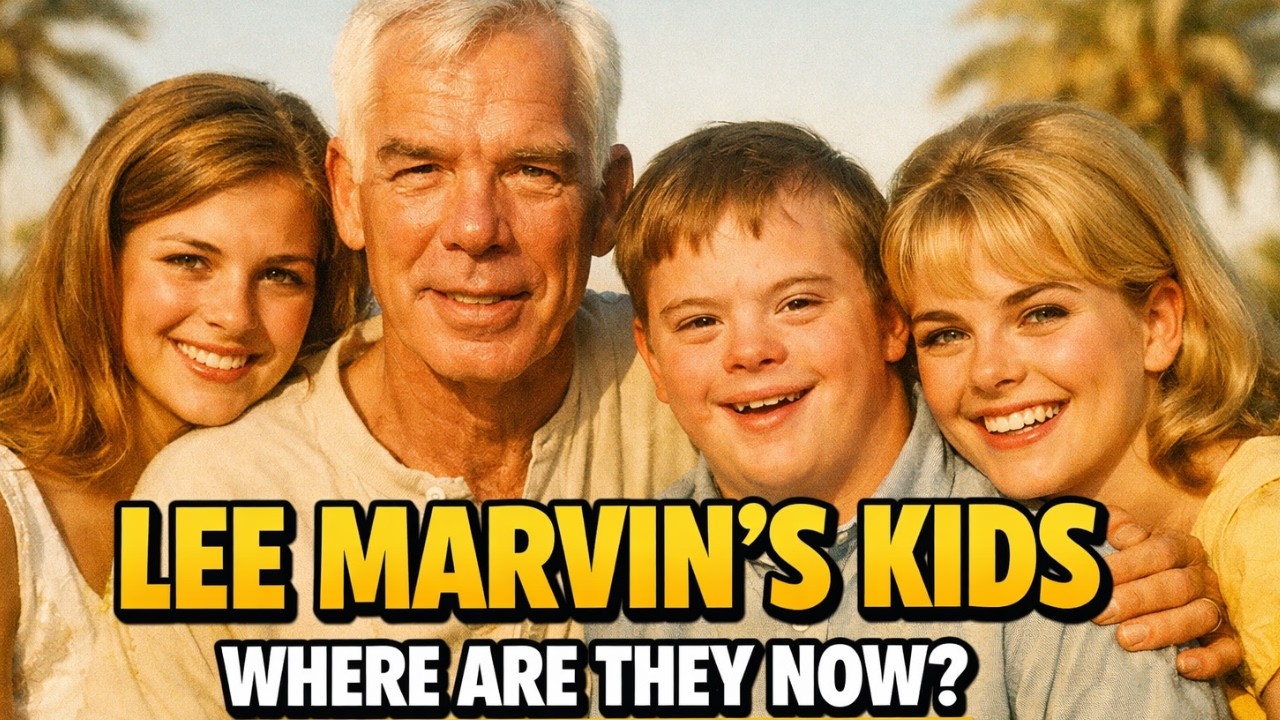
The parts fit him, and he made them feel real. His personal life took shape around the same time. In 1952, he married Betty Ebling. They had four children: a son, Christopher, and three daughters, Courtney, Cynthia, and Claudia.
From the outside, it looked like the beginning of a stable family life, but stability was never Marvin’s natural state. His career grew, and so did the distances. Filming meant long absences, and people who knew the family later said that even when he was home, he was often emotionally far away. By the late 1950s and early 1960s, his career took off with films like The Big Heat and The Man Who Shot Liberty Valance.
Directors discovered he could play cruelty, cynicism, and danger better than almost anyone else. In 1965, he starred in Cat Ballou, a strange western comedy in which he played two roles, a drunken gunfighter and a ruthless killer. The performance won him the Academy Award for Best Actor. Overnight, he became a star, not just a reliable character actor.
From that moment, he became the face of a certain kind of American masculinity: rough, ironic, dangerous, and strangely charismatic. Films like The Dirty Dozen and Point Blank cemented the image. But success did not calm him. The long shoots, the pressure, and the expectations fed habits that were already there.
He drank heavily for years. He could be charming, but he could also be distant, unpredictable, and difficult. His marriage to Betty slowly fell apart, and they divorced in 1967. His children grew up with a father who was often away and, when present, often emotionally elsewhere.
Christopher became a professional drummer, building a life in music rather than film. People who knew him said he inherited his father’s intensity but not his need for attention. He lived quietly, far from Hollywood, and died in 2013 without headlines. Courtney worked in the film industry, appearing in small roles in several big productions in the 1990s, but those who knew her said she had little interest in fame itself.
Cynthia chose almost complete privacy, and very little is known about her. Claudia, the youngest, lived far from the spotlight and died in 2012. In the late 1960s, at the height of his fame, Marvin met Michelle Triola, an actress. They never married but lived together for several years, and she took his name, calling herself Michelle Triola Marvin.
The relationship was intense and often stormy. When it ended in the early 1970s, she sued him, claiming she had given up her career to live as his partner and deserved financial support despite the lack of a marriage certificate. The case became a public spectacle, and a new term entered the American vocabulary: palimony. Marvin denied that he had ever promised her anything.
He later spoke about the case with bitterness and irony, once saying that everyone involved had lied at some point, including himself. The court ultimately ruled in his favor, but the damage to his public image and private peace was done. He resented that a deeply personal matter had turned into a public circus, and he said with dark humor that the only people who really won were the lawyers. By then, he had married again.
In 1970, he wed Pamela Feeley, who stayed with him until his death. Friends said this second marriage was calmer and more stable. Pamela had children of her own, and Marvin became a stepfather as well. In some ways, he was more present in this later family, or at least he tried to be, but by then he was a man in his late forties shaped by decades of habits and experiences.
In interviews late in life, Marvin often returned to a theme: he did not believe in heroes. “I believe in survivors,” he said. The men he played were broken, he felt, because most real men were broken in one way or another. Directors who worked with him later in his career said he had an instinctive understanding of damaged characters.
He did not need to pretend to be tired or disappointed or cynical; he knew those feelings intimately. When a journalist once asked what he did to relax, he joked, “I sit and I think and I drink coffee and sometimes I wonder how I got here. ”
His health declined in the early 1980s. Years of hard living, heavy smoking, drinking, and old war injuries took their toll.
He worked less and spent more time at home. There were no dramatic reconciliations with his children, no big confessions. But there were quieter moments: shared meals, short conversations, the ordinary human contact that does not make it into biographies but stays in families. He died of a heart attack in 1987 at the age of 63 and was buried with military honors at Arlington National Cemetery.
The press wrote about his films, his awards, his war service, and his place in cinema history. According to estimates at the time, he left behind an estate worth several million dollars, accumulated over decades of successful work. But the money was not the most important thing he left. What he left was a complicated legacy: four children, each with a different memory of the same man.
To the world, Lee Marvin will always be the tough guy who redefined strength on screen. To his family, he was something else entirely: a father who could be warm but was often distant, generous but not easy to reach, a man who loved his children but did not always know how to show it. The contrast between the myth and the man defined almost everything about his private life. He never escaped the roles he played, but perhaps that was because those roles were never fully separate from who he was.
As one line from his later interviews put it, the most honest way to understand him may be as a survivor: of a childhood that never quite fit, of a war that never really left him, and of a career that rewarded his darkness as much as his talent.