In 1846, as the Mexican-American War loomed, a 16-year-old Samuel Chamberlain arrived in San Antonio, Texas, after a turbulent journey that began with his expulsion from a Christian school in Boston for repeated fights, some involving his teachers. His route took him through Illinois, St. Louis, and New Orleans before he landed at Port Lavaca, Texas, eventually reaching San Antonio, where his introduction to frontier life would prove brutal and transformative. Chamberlain’s account of these events, written between 1855 and 1861, was published in 1956 under the title *My Confession: Recollections of a Rogue*.
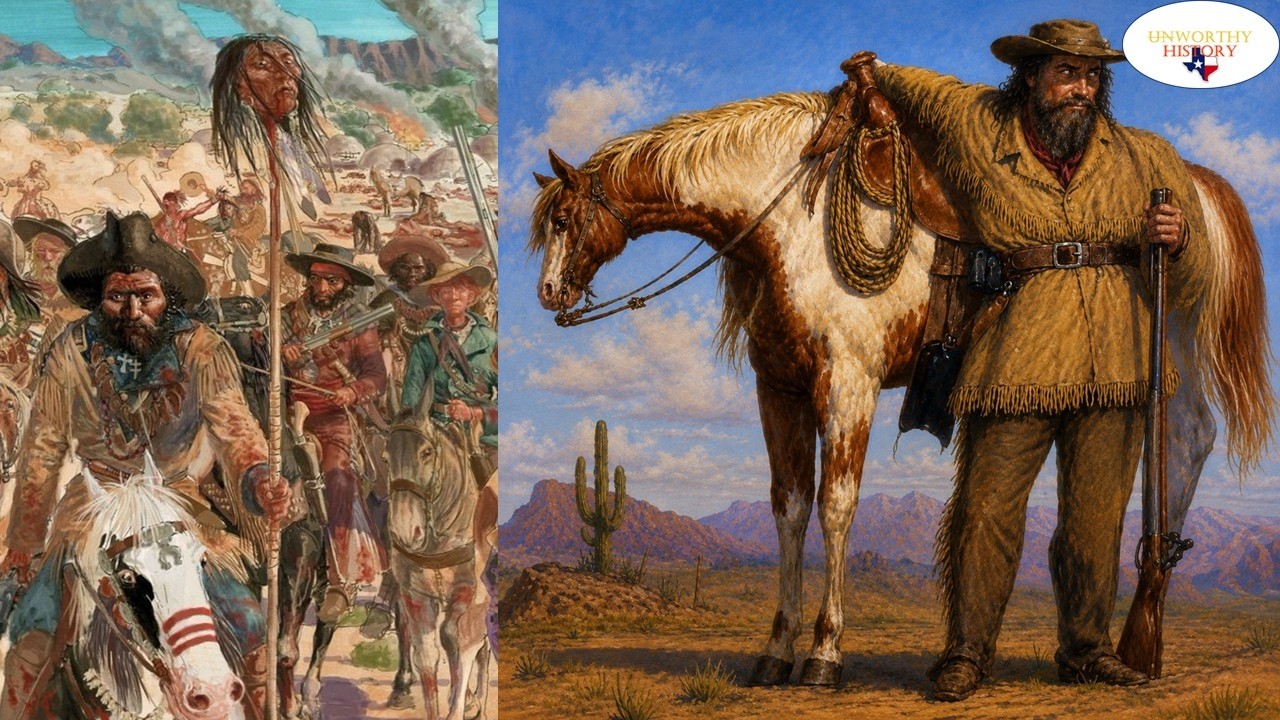
The memoir later served as source material for Cormac McCarthy’s acclaimed 1985 novel *Blood Meridian*. The coming episode details Chamberlain’s first encounter with John Joel Glanton, a former Texas Ranger who became an Indian hunter and later an outlaw leading a notorious gang of scalp hunters from Texas to California between 1848 and 1850. Chamberlain’s military journey began in Alton, Illinois, on May 20, 1846, when news spread that General Taylor was surrounded by Mexican troops on the Rio Grande. General Gaines at New Orleans called for 50,000 volunteers, with 4,000 requested from Illinois.
Within two hours of landing in Alton, Chamberlain enlisted, joining a crowd of recruits amid cheering and whiskey. Within days, the company numbered 100 strong and was named the Alton Guards. The company elected its own officers, with the vote held in a ten-pin alley. Chamberlain, ambitious and eager for a commission, drilled the men in military tactics and spent freely on whiskey while hoping to secure the first lieutenancy.
His hopes were dashed when a man named Peter Goff, a butcher from Middletown, gave a speech boasting that he had shot the abolitionist Lovejoy and promised to treat the men to more whiskey if elected captain. Goff was elected almost unanimously, and Chamberlain lost the lieutenancy to James W. Baker, despite delivering a patriotic speech. The company was quartered in an unfinished church overlooking Alton, composed largely of the floating population of a Mississippi River town.
Chamberlain described the men as wild and reckless but excellent soldier material, while the officers proved incompetent, spending their time drinking and gambling. Disgusted with the debauchery, Chamberlain quit drinking and focused on his duties, but without support from his superiors, he gave up drilling the men. As volunteers continued to arrive, four regiments were organized, and the camp moved to a grove in Upper Alton in June. The Alton Guards chose blue mixed Kentucky jeans with yellow stripes across the breast for their uniforms, while Chamberlain, with permission, wore a neater dark blue cloth version with only his sergeant’s chevron.
Captain Goff rarely appeared in camp, and when he did, he was usually drunk and abusive. On one occasion, he knocked down two privates and then attacked Lieutenant Fletcher before the men subdued him, tying him up and placing a guard over him. When other officers intervened, they were driven from the camp. A committee of the mutineers then offered Chamberlain command of the uprising, a dangerous honor he initially declined but accepted after they promised obedience.
He issued ammunition and was preparing a speech when Colonel Bissell rode up and ordered Goff’s release, only to be hooted at by the mutineers. Chamberlain organized defensive barricades when two companies of rifles advanced, but the standoff was resolved diplomatically when Generals Wool and Shields, along with Governor Ford, arrived. General Wool lectured the mutineers, pardoning them on the condition they return to duty, and Goff apologized. Wool asked who had planned the barricades, and Chamberlain was identified.
After learning his age, Wool remarked that if Chamberlain did not get shot for insubordination, he would rise in the profession if he saw service. Despite the pardon, Chamberlain was broken of his warrant and reduced to the ranks, ending the mutiny. Around mid-July, six companies of the Second Illinois Regiment, with General Wool and staff, embarked for New Orleans. The camp at Chalmette, near the famed battlefield of New Orleans, was marked by drunkenness and debauchery among officers and men alike.
Chamberlain resolved to enlist in the regular army as soon as he could. One night, after winning money at a gaming establishment, Chamberlain was attacked by an old regular named Brown while walking back to camp. Brown dragged him toward the river, apparently intending to rob and kill him. Chamberlain, feigning death, seized Brown by the throat and bit his nose until the man fell in a swoon.
Chamberlain then stabbed Brown with his bayonet, though the wound proved non-lethal, and compelled him to return the stolen money before they returned to camp, claiming they had been in a fight. The Alton Guards subsequently embarked on the brig T. Streets for Port Lavaca, Matagorda Bay, Texas. The passage was fearful, with excessive heat and crowded conditions.
After landing, the men camped on a low, water-covered prairie twelve miles from Lavaca, where mumps, measles, and scarlet fever broke out, and many died due to a scarcity of doctors and medical supplies. General Wool pushed on for San Antonio with men able to march, covering 160 miles. Chamberlain, though hospitalized with a threatened brain fever, joined the marching column, weak and emaciated. Brown, his would-be murderer, stayed with him and assisted him.
Lieutenant Colonel Morrison eventually placed Chamberlain in a wagon, and he reached San Antonio that way. Upon arrival, General Wool worked to instill discipline in the rough recruits. Sick men were examined, and those unfit for the long march were discharged. Chamberlain was among them, receiving mileage back to Alton, Illinois.
Combined with money held by Lieutenant Ferguson, this amounted to nearly 300 dollars, a considerable sum for the time and place. After his discharge, Chamberlain boarded in town, where he regained his health and befriended a gambler named Jim Scott, who taught him the tricks of faro, monte, and poker. One evening, they visited the Bear Exchange, a drinking and gambling saloon crowded with volunteers, regulars, Texas Rangers, Delaware Indians, and Mexicans. Chamberlain described the Rangers as among the most reckless and devil-may-care men imaginable, armed with revolvers and Bowie knives.
At one table, a dispute arose between a short, thick-set man playing euchre and a tall, young ranger. The shorter man threw a glass of liquor in the ranger’s face, and the ranger, drawing his revolver, threatened to shoot him if he did not apologize. The seated man replied, “Shoot and be damned, but if you miss, John Glanton won’t miss you. ” The ranger pulled the trigger, but only the cap exploded.
Glanton sprang up, and with a Bowie knife, cut the ranger’s neck half through, killing him instantly. Glanton then asked if anyone wished to take up the fight, and when no one did, all drank with him at the bar. The body was carried out, sawdust was sprinkled over the blood, and Glanton wiped his knife on his sleeve. Chamberlain, despite his horror, felt a sort of admiration for Glanton, whom he learned was a famous Indian fighter and desperado of the frontier, the hero of many bloody encounters.
Deciding he should go armed, Chamberlain purchased a Bowie knife with a nine-inch blade. A few days later, Chamberlain had trouble with Scotty over the division of money from a rigged poker game. Scotty denied any partnership, and in the ensuing fight, Scotty ran onto the point of Chamberlain’s knife and was badly cut. Chamberlain was arrested, placed in old Spanish irons, and thrown into the calaboose, a twenty-foot-square room inhabited by Indians, Texans, horse thieves, and murderers.
He described the horrors of the old Spanish jail as more terrible than any scene in Dante’s inferno. Covered with vermin and suffering from the chafing irons, he was held for days, with little food and filthy conditions. Scotty recovered and declined to press charges, and Chamberlain was released with nothing but his pants, barely sane from his suffering. He vaguely remembered being pursued by demons before falling into darkness.
He awoke in a clean bed in Castroville, thirty miles from San Antonio, cared for by a German doctor named Carl Ritter, who had found him naked and insensible by the roadside three weeks earlier. Catherine Ritter, the doctor’s sister, was no more than sixteen, and Chamberlain soon realized she had given him her first love. One night, Mrs. Ritter came to his bed, and Chamberlain, fighting his own passions, resisted the temptation, preserving the honor of the Ritter household.
He left early the next morning for San Antonio. Back in San Antonio, Chamberlain reported to regular army headquarters and enlisted for the war in Company E, First U. S. Dragoons, under Captain Enoch Steen.
His account ends there for the moment, with two years passing before his next documented encounter with John Glanton in 1848, when he would eventually join the outlaw gang Glanton formed after the war.