In 1972, a television series about the Korean War became the most-watched program in America. It was not a documentary. It was not a news broadcast. It was a comedy—dark, weary, and heavy with homesickness.
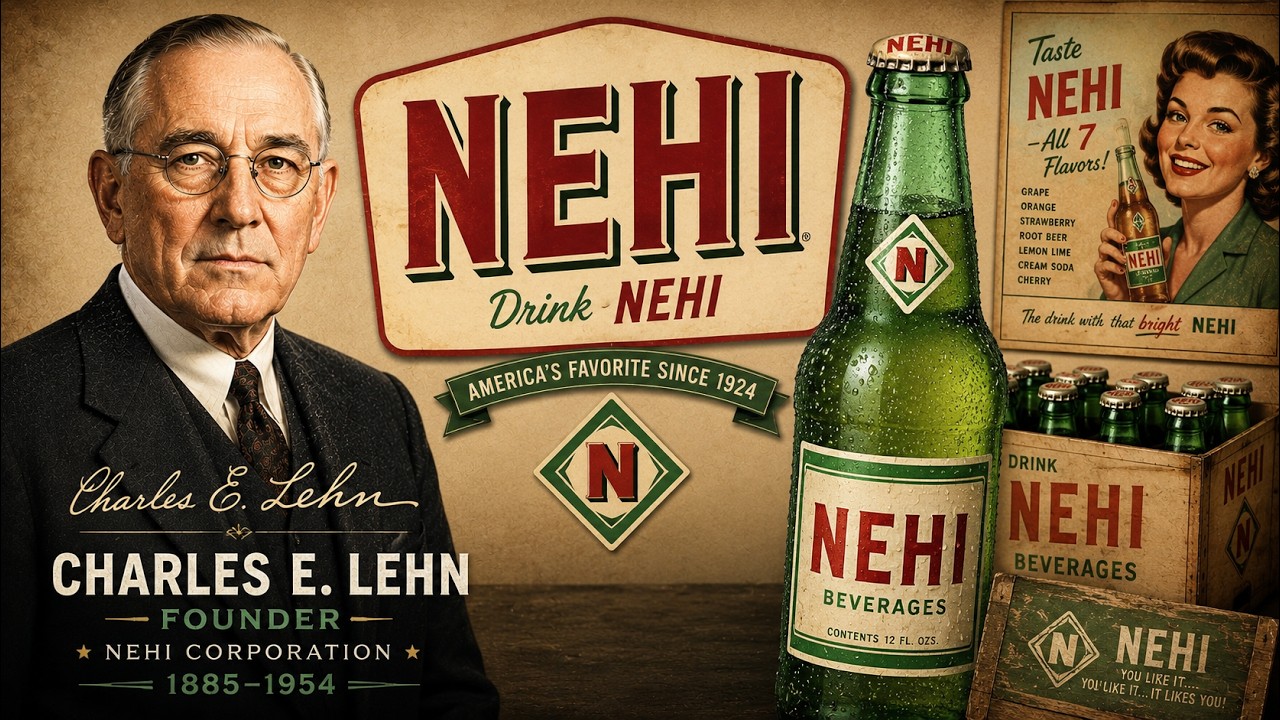
And in nearly every episode, a young army corporal from Ottumwa, Iowa, sat in a canvas chair outside a military hospital tent, holding a bottle of grape soda. Not Coca-Cola. Not Pepsi. Nehi.
Thirty million Americans watched each week. The brand appeared on screen without a single dollar paid for advertising. No contracts, no negotiations, no purchased ad space. A fruit soda made in Columbus, Georgia, by the son of a pharmacist, brewing in a grocery store basement, reached more eyes weekly than any advertising campaign in the company’s history.
The show ran for 11 seasons. Its final episode in February 1983 drew approximately 106 million viewers, still the most-watched episode of a television series in U. S. broadcast history.
Nehi did not survive that decade. By the early 1990s, the brand had vanished from most American store shelves. The bottling network that once spanned 46 states collapsed into a handful of regional agreements. The flavor Radar O’Reilly made iconic—cold, unmistakable grape—survived mostly as a memory in the minds of the men and women who grew up with it, and in the hands of collectors who pay $40 for an empty bottle on eBay.
But the real story of Nehi is not a story of a lost marketing opportunity. It is the story of a man who saw what the soda industry ignored: the rural South, poor workers, gas stations, and general stores. He built something that outlived him. It outlived his company’s name and outlived any logical explanation for why anyone still cares about a fruit-flavored soda discontinued before most of its fans turned 40.
The story begins in Columbus, Georgia, in 1905. Columbus was a mill town. The Chattahoochee River ran along its western edge, powering the textile mills that employed most of the city’s working population. Cotton moved through Columbus like water through a canal—constant, unceremonious, and at a speed determined by someone else.
The men who ran the mills did not live where the men who worked in them lived. That distance was not accidental. It was structural. Claude A.
Hatcher was born into the heart of that structure. His father ran the Union Grocery Company on the commercial side of Columbus. Not a wealthy family, but established—a merchant family in a merchant town. Hatcher grew up behind the counter, learning retail arithmetic before he learned algebra.
He understood profit margins before he understood chemistry. He studied pharmacy, which in the early 20th century meant learning the science of flavors, carbonation, and syrup concentration—precisely the knowledge required to make a soft drink from scratch. He returned to Columbus with that education and went to work in his father’s store. What he saw there was a market the major soft drink companies had not bothered to understand.
By 1905, Coca-Cola was already a national brand, but it was primarily a fountain product. You drank it at a drugstore counter or a lunch stand. You did not take it home. Bottled soda existed, but its quality was inconsistent, it was expensive relative to working-class wages, and it was almost exclusively cola and ginger ale.
Fruit flavors—the flavors that truly reflected what people grew in their yards and bought at roadside stands—were entirely absent from the bottled market. The men and women who worked in the mills and on the farms of west Georgia did not sit at soda fountains. They bought their provisions from general stores, ate on porches, and drank anything cold and affordable. No one was selling them bottled fruit soda.
Not because it was impossible, but because no one had looked hard enough to see that they wanted it. Hatcher looked. In 1905, he began experimenting in the basement of the Union Grocery building on 11th Street in Columbus. The first product was not a fruit soda.
It was a cherry cola, which he called Chero-Cola, priced at five cents a bottle. It targeted directly the working-class customers his father’s store already served. He borrowed $2,500 from his father and two family members to fund the operation. There were no outside investors, no venture partners, no bank loan backed by collateral he did not own.
The entire venture rested on family confidence in one man’s instinct. In the first year, the Union Bottling Works—the name Hatcher gave his company—produced about 1,000 cases, all distributed within Muscogee County. By 1912, the operation had grown enough to be formally incorporated as the Chero-Cola Company. By 1920, Chero-Cola had franchise bottling agreements in several southern states.
But Hatcher was watching the market shift around him, and he saw a problem forming. Chero-Cola was a cola, and the cola war—direct competition between his product, Coca-Cola, and the growing presence of Pepsi-Cola—was a war he could not win on equal terms. Coca-Cola had distribution channels. Coca-Cola had brand recognition.
Coca-Cola had vending machine infrastructure that put its name in front of every American who entered a drugstore. Fighting Coca-Cola with another cola was like fighting a river with a shovel. In 1924, Hatcher changed direction completely. He introduced a line of fruit-flavored sodas under a new name.
The name came from the bottles themselves, which were taller than the standard soda bottle of the era, reaching nearly knee height when placed on a low shelf. He called them Nehi. The word was simple, slightly funny, and impossible to forget. Nehi Orange, Nehi Grape, Nehi Peach, Nehi Strawberry.
Four flavors launched together, targeting every customer who had never been offered a bottled fruit soda. By 1928, the company had grown enough to rename itself the Nehi Corporation. The fruit drinks were not a supplement to the cola business. They became the primary business.
What made Nehi work was not a single innovation. It was four decisions made at once that together created an advantage no competitor could quickly copy. The first was the flavor itself. Fruit soda in the 1920s was generally unconvincing.
The artificial flavors available to most bottlers produced drinks that tasted vaguely of fruit—enough for classification, but not enough for satisfaction. Orange soda tasted vaguely acidic. Grape soda tasted vaguely purple. These were drinks that reminded you of fruit the way a photograph reminds you of a person.
Recognizable, but not the same. Hatcher’s formulas were different in concentration and finish. Nehi Grape in particular was built around a syrup so thick that the finished drink appeared almost opaque in the bottle. A deep, saturated purple that looked, inside a display cooler, like something worth crossing the store for.
The flavor was unmistakably sweet without the tartness of real grape juice. But it had what the industry calls “finish”—a taste that lingers long enough to be remembered. That was not an accident. The drink you remember is the drink you buy again.
Nehi Peach carried a different logic. Georgia was peach country. The flavor referenced something real and local—fruit growing in orchards visible from the roads Nehi delivery trucks traveled. It was regional identity in a bottle, sold to people who knew exactly what it was trying to be.
The second decision was packaging. Standard soda bottles of the early 1920s held six to seven ounces. Nehi bottles held 12. The difference was visible before you picked one up.
The bottles were tall, slender, and color-coordinated to their contents: amber glass for orange, clear glass for grape, so the color advertised itself. The cap carried the Nehi name prominently. The label used bold color blocks and lettering large enough to read from ten feet away, through the glass door of an icebox. This was not random design.
It was a product designed to be seen first and tasted second. Where a general store customer might look at six or eight beverage options in a cooler, Nehi’s visual presence was disproportionate to its price. It looked more expensive than it actually was. The third decision was price, and its arithmetic mattered.
Nehi sold for 10 cents a bottle. So did bottled Coca-Cola. But a Nehi bottle held 12 ounces. A Coca-Cola bottle held six and a half.
For the same dime, a Nehi customer got nearly twice as much. In 1930, a textile worker in Columbus, Georgia, earned about $1. 20 for a day’s work. A bottle of Nehi was one-twelfth of a day’s wages—cheap enough to buy without hesitation, large enough to feel like a real reward.
During the Depression, when hesitation preceded every purchase, that arithmetic was not a minor advantage. It was the entire argument. The fourth decision was where to sell and where not to sell. Hatcher made no serious effort to place Nehi in soda fountains.
That was Coca-Cola’s stronghold, built over decades and supported by relationships and infrastructure a Columbus bottler could not displace. Instead, Nehi went to places Coca-Cola had not yet fully colonized: rural general stores, roadside gas stations, filling stations in the countryside, church social halls, and small independent grocers serving communities too small and too scattered for major distributors to prioritize. Nehi delivery trucks traveled roads no other soda company traveled: gravel roads to farming communities, logging camps, and mining towns in the Appalachian foothills. They went where the customers were, because the customers were not coming to them.
They also went somewhere else—a place the historical record tends to underestimate. In the Jim Crow South, commercial segregation was clear. Black-owned businesses, barbershops, dance halls, small groceries, and boarding houses operated in a parallel economy that major national brands treated as secondary if they considered it at all. Nehi entered those markets not as a matter of principle, but because they were available, and because a franchise bottler working rural Alabama or Mississippi needed every customer he could get.
The result was a depth of brand loyalty in African American communities across the South that no advertising campaign could have manufactured. Nehi was not a drink for any particular race or class. It was the drink for everyone the major brands had not yet reached. In a market defined by exclusion, availability was a form of loyalty.
By 1928, the Nehi Corporation held franchise bottling agreements in 46 states. The fruit soda that began in a Columbus basement was being produced within short distance of nearly every American city. No competitor in the fruit flavor category came close to that reach. By the time anyone thought to challenge it, Nehi had already taken the shelves.
Nehi did not become a cultural institution through a single campaign or a single decade. It became one the way most surviving things do—gradually, quietly, and in places historians did not pay attention to. The advertising came first, and it was bolder than the company’s regional image suggests. Early Nehi campaigns leaned directly on the name.
Print ads in the late 1920s featured women in summer dresses holding Nehi bottles at knee height—a visual pun on the brand name that was deliberately eye-catching by the standards of the era. The ads ran in national publications including The Saturday Evening Post, reaching an audience beyond the southern markets where Nehi’s roots were deepest. The slogan was not complicated. It did not need to be.
“Drink Nehi” said everything the company wanted to say. This is a beverage. This is its name. The name itself was both the joke and the invitation.
By the 1930s, radio had become the primary advertising medium for brands, and Nehi moved with it. Sponsorships on southern regional stations placed the Nehi name inside country music programs, hymn hours, and farm shows—the very formats that reached the rural working-class audience the brand was built to serve. A DJ reading a Nehi spot between songs on a Saturday night barn dance program was not interrupting the evening. He was part of it.
The creative approach was consistent across every medium: no celebrities, no aspiration, no suggestion that drinking Nehi would make you a different person. The product was presented as honest, substantial, and yours. In the 1950s, as television began reshaping American advertising, Nehi highway billboards across the South carried a slogan that stated the value without embellishment: “Nehi, the Big Drink. ” Three words, referencing the bottle size every regular customer already knew.
The company treated its audience as people who already knew what they were buying, because most of them did. The absence of national celebrity endorsements was not a budget constraint. It was a deliberate decision—by design or by instinct—to reinforce Nehi’s identity as a local product. Coca-Cola hired Hollywood.
Pepsi would eventually hire pop stars. Nehi sponsored minor league baseball teams in Georgia and Alabama, regional fairs in Tennessee and Mississippi, and rodeo circuits that traveled the rural South on schedules no New York ad agency would have known how to chart. The brand stayed close to the ground, and in most of the 1930s, the ground was where most of its customers lived. Those customers were living through the worst economic collapse in American history.
Between 1929 and 1939, the Depression reshaped every consumer market in the United States. Luxuries vanished from working-class budgets. Middle-class families recalculated every purchase. The soft drink industry contracted sharply in markets where disposable income evaporated entirely.
Coca-Cola, despite its national infrastructure, saw its fountain business suffer as drugstore foot traffic declined. Pepsi, struggling financially through most of the 1930s, was in no position to exploit any advantage. Nehi held. It held because of the price, because of the places it was sold, and because a 12-ounce bottle for 10 cents was precisely calibrated to the economic conditions settling over its core customers.
A sharecropper family in rural Alabama in 1933 was not making many discretionary purchases. But a cold bottle of grape soda on a Saturday afternoon, bought from the general store where the family also bought flour and salt pork, was within reach. It was one of the few things still within reach. In working-class neighborhoods of Birmingham, Memphis, and Savannah, asking for Nehi was not an expression of preference.
It was an expression of what you could afford—something that still tasted good. And in Black-owned businesses serving communities across the segregated South—barbershops, small taverns, corner groceries, where Nehi had built its distribution carefully because no one else had bothered—the brand gained additional weight. It was available when other things were not. It was cold when ice could not be taken for granted.
It was consistent when consistency was rare. That kind of loyalty does not show up in market research. It shows up in the fact that people, decades later, still remember exactly what it tasted like. The Depression did not break Nehi.
It cemented it. By 1935, the Nehi Corporation was reporting revenues that placed it among the major American beverage companies. Not Coca-Cola’s size, but legitimate, growing, and structurally sound in ways many of its competitors were not. The franchise bottling network Hatcher had built on the same logic he applied to distribution—go where others have not gone and be there first—was generating income from markets the big cola companies had ceded without realizing they were ceding them.
One shadow hung over all of it. Claude Hatcher died in 1933, at age 54. He had built the company from a $2,500 family loan into a national franchise operation in less than three decades. He did not live to see the peak of what he made.
He did not live to see World War II change the bottling industry, or television change the advertising industry, or the company he founded gradually shift its identity from the fruit soda that made it famous to the cola brand that would eventually replace it. He left behind a company that bore his name nowhere, but his fingerprints everywhere. The men who succeeded Hatcher ran a strong operation. They did not have his instinct for underserved markets, but they had his infrastructure.
In the late 1930s, infrastructure was enough. Then came the war. Between 1942 and 1945, the American economy reorganized itself around a single priority, and every consumer industry felt it in resource terms. Sugar was rationed.
Steel was allocated to the military. Glass was prioritized for essential packaging. The soft drink industry faced restrictions on every significant production input: sugar in the bottle, metal in the cap, fuel in the delivery truck. Nehi adapted, as every major bottler did.
The company moved entirely to returnable bottles, eliminating the waste wartime resource allocation could not support. The fruit flavor lineup was streamlined, with grape and orange prioritized because their syrup formulations were the easiest to produce under rationing conditions. Peach and strawberry production was cut. Delivery routes were trimmed to focus on higher-volume accounts, saving fuel and labor at a time when both were scarce.
But the war also opened a new door. Nehi’s bottling plants in Georgia and Alabama sat geographically close to a major concentration of military training facilities. Fort Benning, outside Columbus, was one of the largest military bases in the United States. Camp Rucker in Alabama, Maxwell Field, and naval air stations along the Gulf Coast—the South was a training ground for hundreds of thousands of American servicemen, and those men needed to eat and drink between drills.
The military post exchanges (PX) on those bases, where soldiers bought personal items, snacks, and beverages, became Nehi customers. Nehi Grape, already familiar to the southern soldiers who made up a large share of the army’s ranks, was available in the places where they spent their leisure time. For men from Georgia, Alabama, Mississippi, and Tennessee, it was not just a cold drink. It was a bottle of home, available at the edge of the parade ground in the weeks before they shipped out.
That connection—between Nehi and memories of home, between Nehi and the life waiting on the other side of the war—proved more durable than any advertising campaign the company ever ran. When those men returned in 1945 and 1946, they returned to the brands they had been drinking before they left. Nehi was one of them. The postwar boom accelerated everything.
American consumer spending expanded at a pace the economy had not seen in two decades. Families that had spent the Depression and the war deferring purchases now had the wages and the desire to spend them. Supermarkets were replacing general stores as the primary retail channel in suburban America. Coolers—the refrigerated display cases that determined what a customer chose—became the central battleground of the beverage industry.
Nehi kept substantial shelf space on that battlefield. The franchise network was intact. Brand recognition ran deep in its core markets, and the fruit flavor category—the segment Hatcher had essentially created in bottled soft drinks—had no dominant national competitor. Orange Crush existed, but lacked Nehi’s distribution depth in the South.
The major cola companies were not competing in fruit flavors. Nehi Grape, in particular, held near-total dominance in its category across seven southern states. By the late 1940s, the Nehi bottling franchise system was the third largest in the United States. Only Coca-Cola and Pepsi-Cola operated larger networks.
And in fruit-flavored sodas specifically, Nehi was not merely one of the leaders. It was the leader, by a margin competitors would need years to close. In parts of rural Georgia and Alabama, Nehi Grape outsold Coca-Cola. That sentence deserves a pause.
In Coca-Cola’s home state, in the counties and small towns where the Atlanta company had been building brand loyalty since the 1890s, a fruit soda from a Columbus basement was selling more units. Not in every county, not in the cities, but in enough places, consistently enough, that the sales data was not an exception. It was a pattern. One in every three fruit-flavored soft drinks sold in the American South in the late 1940s was a Nehi.
That was the peak. That was the number. And like most peaks, it was not recognized as a peak while it was happening. The executives at Nehi in 1948 were not scanning the horizon for the forces that would dismantle what they had built.
They were watching the financial records. The records looked good. But they did not stay good for long. Nehi’s end did not come as a single event.
It came as a series of decisions. Each decision seemed logical on its own, and all of them were irreversible in combination. This is how most institutions collapse: not by sudden fracture, but by a slow replacement of priorities, resources, and attention, until the thing being replaced is gone before anyone thinks to mourn it. The first decision had been crystallizing for years before anyone called it a decision.
Royal Crown Cola had been part of the Nehi Corporation’s portfolio since the mid-1930s. Developed as a response to the cola segment that Chero-Cola had failed to dominate, it was a good product. In blind taste tests conducted during the 1940s and 1950s, Royal Crown Cola consistently competed with both Coca-Cola and Pepsi-Cola. It had the formula.
It had the distribution network Nehi had built. What it lacked was the cultural weight of its competitors—the advertising budgets, the soda fountain infrastructure, the association with American identity that Coke had spent half a century building. The executives who inherited Hatcher’s company believed they could close that gap. To close it, they had to concentrate.
In 1955, the Nehi Corporation changed its name to the Royal Crown Cola Company. It was a corporate rebrand, a legal and administrative move most consumers did not notice. But inside the company, the signal was unmistakable. RC Cola is the future.
Nehi is the past. The flagship brand would get the marketing investment, the attention of the sales force, and the priority in shelf space negotiations. The fruit drinks would remain in the portfolio, but they would remain the way an older sibling remains after a new baby arrives. Present, nominally valued, and always secondary.
The advertising budget told the story in numbers. Through the late 1950s and into the 1960s, RC Cola got the television commercials, the national magazine space, the promotional campaigns. Nehi got the remainder—regional print ads, an occasional radio spot, reliance on existing brand awareness in markets where it had sold for three decades. It was not nothing, but it was not enough to compete in an era when national television advertising had become the minimum cost of survival.
And despite all the resources directed at it, RC Cola was fighting a war that could not be won by spending alone. In 1958, the Royal Crown Cola Company introduced Diet Rite Cola, the first diet cola sold nationally in the United States. It was a genuine innovation, arriving four years before Diet Pepsi and six years before Tab. RC Cola had beaten both major competitors to the fastest-growing segment of the industry.
It should have been a decisive advantage. Coca-Cola and Pepsi responded with the full weight of their distribution systems, advertising budgets, and relationships with the supermarket chains that now controlled most of America’s beverage retailing. RC had the idea first. But its competitors had everything else.
Diet Rite gained market share, then stalled, caught between two companies able to sustain a price war and a promotion war simultaneously for as long as it took. While the company fought that battle nationally, Nehi was losing the battle locally. The television era changed the psychology of brand choice in ways regional products could not absorb. A child growing up in Georgia in 1962 watched the same national television programs as a child growing up in Ohio.
They saw the same Coca-Cola commercials, the same Pepsi commercials, the same carefully crafted images of youth, vitality, and modernity. Nehi was not in those commercials. Nehi was not in those images. Nehi was what their parents drank, which for a generation being told by every advertisement that modernity was a virtue meant almost exactly that Nehi was an old person’s drink.
No new generation reached for it. The demographic that had grown up with Nehi in the 1930s and 1940s was aging. The generation that followed had inherited different loyalties from different advertisers. The cultural shift was not dramatic.
It was arithmetic. A slow subtraction of one generation’s preferences without the addition of another. The franchise bottlers felt it first. A Nehi bottler in 1965 was driving the same delivery routes that had made the brand dominant in 1945.
But the accounts on those routes were changing. Supermarkets were demanding slotting fees—payments for shelf space that independent fruit soda brands could not afford on the margins Nehi’s pricing allowed. General stores were closing as rural populations moved toward regional centers. The gas stations that had been reliable Nehi accounts were being replaced by larger convenience stores that stocked fewer items and prioritized brands with bigger promotional budgets.
Each bottler made local decisions that, in aggregate across the network, added up to national decline. Fewer facings on shelves. Fewer slots in coolers. Fewer stops on every route.
The network Hatcher had built by going where no one else went was now contracting by the same logic. There was no longer enough volume to justify the stops. Then the ownership changes began, and they did not stop. In 1984, Victor Posner, a Miami financier, acquired the Royal Crown Cola Company.
His investment record included steel companies and real estate, and a reputation for extracting value from acquisitions rather than building them. Posner had no background in the beverage industry. He had no particular interest in Nehi’s history or its remaining customer base. He was interested in the balance sheet, and the balance sheet of a third-tier soda company with a declining fruit soda sub-brand was not going to reward patience.
In 1989, the RC Cola company was sold to Triarc. Nehi went with it. A small line item in a deal described in the trade press as a cola deal, because that is what it was. No one wrote about Nehi.
There was nothing worth writing. By then it was a brand that existed more on paper than in stores. Each change of ownership contracted distribution further. States fell away one by one.
Georgia held out the longest. The loyalty was deepest where the brand had started. But even there, shelf space shrank. Bottling contracts were not renewed.
The coolers that had held Nehi Grape for forty years were replaced by products that earned retailers more and chains bigger promotional allowances. The end came without announcement. No press release, no ceremonial final run, no acknowledgment from the company that swallowed the brand that anything worth mourning was being allowed to disappear. Supply simply stopped, market by market, until the markets that still had it were too few to constitute a real presence.
Bottling contracts ended. Shelf space vanished. States fell away one by one, then smaller markets, then specialty accounts, then the last regional grocers selling it out of habit and loyalty. Nothing remained.
No celebration, no announcement. Production just stopped. The name stayed on paper. The product did not.
What remains of Nehi today is not the product. It is only the name. And the distance between the two is a measure of what was lost. The Nehi brand now sits within the portfolio of Keurig Dr Pepper, the beverage conglomerate formed through a series of acquisitions that resembles an exercise in corporate archaeology.
The Royal Crown Cola Company absorbed the Nehi brand, then was swallowed by Triarc, which sold its beverage assets to Cadbury Schweppes, which became Dr Pepper Snapple Group, which merged with Keurig Green Mountain in 2018 to form the company that owns the name today. With each transition, Nehi moved as cargo—not as a brand anyone sought to own for its own sake, but as an item on a list of intellectual property that came with everything else being purchased. A few Nehi products appear intermittently in specialty grocery stores, heritage candy shops, and regional distributors catering to the retro soda market. Whether the formulas inside those bottles bear any meaningful relation to what Claude Hatcher developed in a Columbus basement in 1924 is a question the current brand owner has not seen fit to answer publicly.
The label is authentic. The source of the liquid is less certain. This is what ironic revival looks like. Not restoration, but impersonation.
Collectors know the difference. There is a community of vintage soda memorabilia enthusiasts in the United States who approach their subject with the seriousness of museum curators and the spending habits of people who cannot really explain their hobby to anyone who does not already share it. Nehi occupies a significant place in that community. Not at the top, where Coca-Cola collectibles reach prices approaching fine art, but in the middle tier where genuine scarcity intersects genuine affection.
An original Nehi bottle from the 1930s or 1940s in good condition with the original label intact sells for between $15 and $45 on eBay, depending on the flavor and the source. Grape commands a modest premium. Original Nehi tin advertising signs, of the type hung outside general stores and gas stations from the late 1920s through the 1950s, sell for $80 to $200 and move within days of being listed if in good condition. Cardboard displays from the Depression era, when they appear at estate sales in the rural South, sometimes reach prices that would have astonished the store managers who originally mounted them on their walls.
Facebook groups dedicated to old soda bottles and brewery memorabilia have tens of thousands of members. In those communities, Nehi posts generate a particular kind of response. Not the detached appreciation of serious collectors, but the emotional recognition of someone who just received a memory they did not know they still carried. The comments follow a pattern.
“I remember my grandmother keeping those bottles in her icebox. ” “We used to get them at the gas station on Route…” followed by a road number that means nothing to anyone outside a particular county in a particular southern state. That specificity is the point. Nehi’s legacy is not national.
It never was. It is precise, local, and personal in a way the brands that defeated it cannot imitate, because those brands won by becoming universal, and universality by definition does not remember anyone in particular. Then there is television. In 1972, the writers of M*A*S*H made a choice that no one at Royal Crown Cola appears to have realized the value of in time to do anything about it.
They gave Corporal Walter “Radar” O’Reilly—the kindest, youngest, most homesick character in the ensemble—a drink. Not a prop. A character detail. Nehi Grape was what Radar O’Reilly missed most about Iowa.
It tasted like life before the war, before the army, before the horrors he witnessed in the surgical tent every day in Korea. Every time he appeared on screen with that bottle, the grape soda performed a function no advertising campaign in the world could have afforded. It was associated, in front of 30 million weekly viewers, with innocence, longing, and the unretrievable sweetness of home. The show ran for 11 seasons.
One hundred and six million Americans watched the final episode on February 28, 1983, titled “Goodbye, Farewell and Amen. ” It remains the most-watched telecast in American television drama history. Radar O’Reilly and his Nehi were part of that cultural moment, woven into a story the country watched together and did not forget. Royal Crown Cola never exploited this.
There was no promotional campaign tied to the show’s run, no tie-in offer with Radar O’Reilly, no limited-edition M*A*S*H packaging, no evidence in the historical records that the company’s marketing department realized what was happening on CBS every week and moved to convert it into sales. The awareness existed in the minds of 30 million viewers. The mechanism to convert that awareness into a purchase was never built. It stands as one of the most significant failures of omission in American beverage marketing history.
Not a wrong decision. An absence of decision, which at scale produces the same result. The original bottling operation Claude Hatcher founded on 11th Street in Columbus, Georgia, no longer exists in any recognizable form. The building is gone.
The neighborhood has been entirely redeveloped. The city where Hatcher grew up—the mill town on the Chattahoochee, where cotton moved on schedules set by others, and where a grocer’s son learned margin arithmetic before anything else—has been reshaped by decades of economic change that left no visible trace of what was once made there. Columbus, Georgia today is home to the Aflac corporate campus, a cluster of military installations centered on Fort Benning, and a riverfront redevelopment project that has converted former industrial sites into restaurants and event spaces. There is no Nehi museum.
There is no historical marker at the address where the first cases were produced. There is no monument to the man who looked at the rural South and saw, before anyone else thought to look, that the people living there were thirsty for something no one was selling them. Here is what the records suggest about Nehi and what happened to it. A product made for people who were ignored tends to disappear when ignoring those people stops being profitable.
The rural South that Nehi served was not a market the major beverage companies failed to reach out of inability. They reached it eventually, when the economics of national distribution made it worth reaching, and when television commercials—which made Coca-Cola and Pepsi cultural giants—preceded them into every living room in the country. By the time the major brands arrived in force in Nehi’s territories, they brought with them the weight of decades of advertising Nehi could not match, and a generation of new consumers who had grown up watching those commercials and formed their loyalties accordingly. Nehi did not lose because it made a mistake.
It lost because the industry it operated in changed the rules of competition, and the company that owned it chose to meet those new rules with RC Cola instead of the brand that had built the network in the first place. That is not a tragedy born of malice. It is a tragedy of ordinary corporate logic—the kind that seems perfectly reasonable inside a boardroom while meaning nothing at all to the person standing in a general store in 1968, reaching into a cooler to find that the grape soda he had bought since childhood was no longer there. Somewhere in the rural South, there are people in their sixties and seventies who remember exactly where they were the last time they had one.
They remember the bottle so cold it left condensation on their fingers in summer heat. They remember the color—that deep, saturated, almost opaque purple, unlike anything sold under that name since. They remember buying it from a store that no longer exists, in a town changed beyond recognition, during a childhood that now belongs only to them. That is what Nehi was.
That is what it remains. Served cold in the memory of someone who once went out of his way to find it.