For nearly three decades, Delia Caton watched a house from her own back windows. It was the only home in Chicago lit by electricity, and it belonged to a man she could not have. His name was Marshall Field, and the city’s largest store still carries his name today. Everyone in Chicago was convinced he loved her.
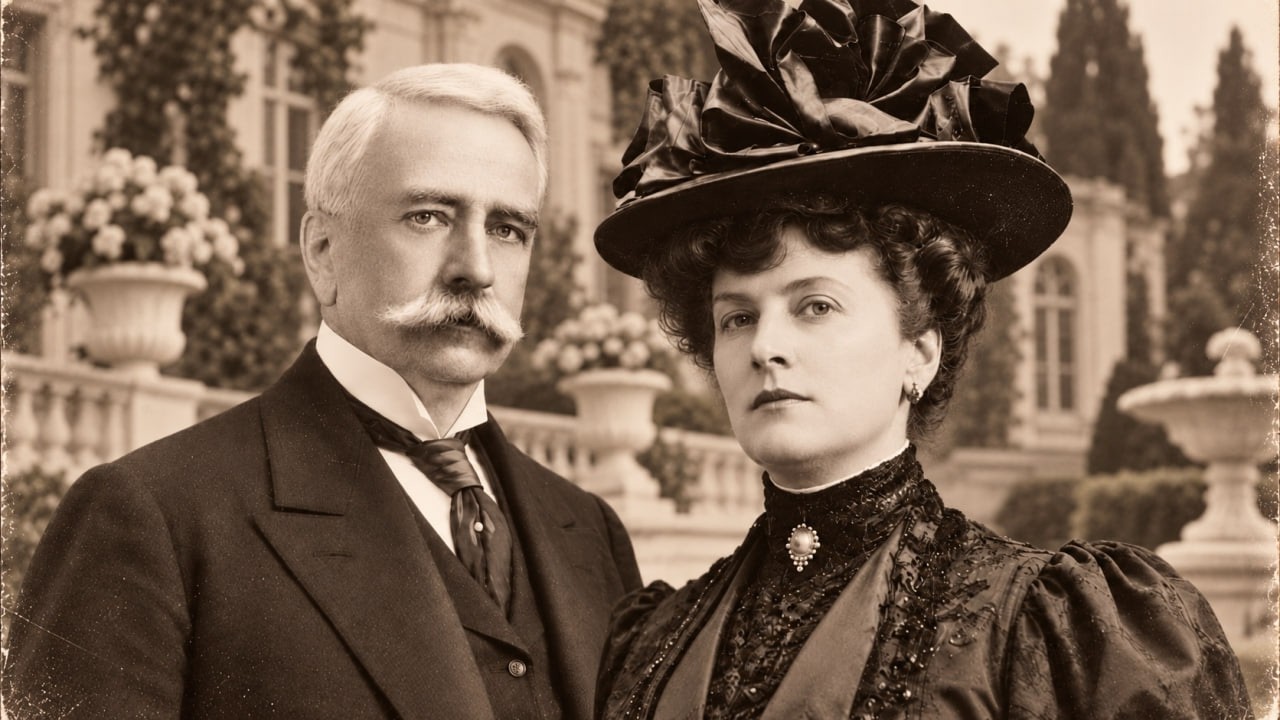
No one could ever say with certainty whether she loved him back. She finally became his wife in 1905. After 133 days, she was his widow. And his will told her, in precise figures, exactly what those thirty years of waiting had been worth to him.
At the Newberry Library in Chicago, boxes hold family documents. Inside one, volume 84 contains a single printed card: a menu for a wedding breakfast held in London on September 5, 1905. Twenty guests sat around the table. The bride was 52, the groom 70, and he was the richest merchant in the United States.
His name was Marshall Field. The bride was Delia Spencer Caton, and almost no one remembers her name today. When that menu was printed, the couple had known each other for nearly thirty years. Their homes backed onto one another, separated by a single street.
Throughout all that time, they never hid. They attended parties together and traveled to Europe together. Chicago watched them season after season without saying a word to their faces, raising a question that hovers over everything that followed: if neither of them was hiding, what exactly were they waiting for? The story begins at a dinner table on Calumet Avenue in the early 1890s.
The Catons were known for such evenings: twenty seats, fine wine, and a table that ran late into the night. Custom required the men to stand one by one and offer a few words. Marshall Field did not rise. He remained perfectly still, as he always did when the room’s attention turned to him, and the silence stretched so long that other guests could feel it.
Before it became awkward, the hostess had already stood. She announced that Mr. Field wanted everyone to remember that the white sail would set off the following Monday. The table erupted in laughter.
The moment closed as if it had never opened. Field said nothing. He did not need to. Delia Spencer Caton had just spoken on behalf of a man who was not her husband, in a room full of people who understood exactly what that meant.
To understand why she had that right, one must go back nine years to two houses built a street apart. In 1876, Marshall Field finished a mansion at 1905 Prairie Avenue. Red brick, stone trim, a tiled roof, and something no other home in Chicago had: electric lighting in every room. At night, the windows glowed in a way no gas lamp could match, visible from several streets away.
A year later, a young bride named Delia Spencer moved into a house on Calumet Avenue with her new husband, Arthur Caton. Her home was directly behind the Field residence. From her back windows, Delia could see that distinctive light on any clear evening. Arthur Caton, by all accounts, was a pleasant companion and nothing more.
He was the kind of husband described as a club man, meaning he was rarely at home. He gambled, socialized, and aged comfortably on money that came mostly from his father. He was not cruel to Delia, but he left a great deal of emptiness inside the marriage. Over the following decades, Marshall Field came to fill most of that emptiness.
Field’s own marriage was not what it appeared from the street. He and his wife, Nannie, argued forcefully enough that servants learned to leave the room before the shouting began. Nannie preferred the south of France to Chicago, and as the years passed, she spent less and less time in the city. Delia, for her part, had no children.
That fact, as a family friend later said, left her free to devote her considerable energy to entertaining everyone else’s children. She became, in the fullest sense, an aunt to her sister’s children, especially a niece named Katherine, whom she adored without reservation. For years, wherever the Catons went, Marshall Field went with them: to the opera, to Newport, and across the Atlantic, sometimes on the same ship. Sometimes Arthur came along; sometimes, as the years passed, he did not.
According to those who knew both households, it was Delia, not Nannie, who arranged seating and chose flowers whenever Field hosted a reception in his home. By that time, Nannie rarely cared about such matters, and no one in Chicago seemed to find it strange that the neighbor did the wife’s work. It was an arrangement small enough to be ignored, but it was also, if anyone stopped to observe it, exactly the shape of a marriage separated by a garden. In the 1890s, the arrangement had taken a form that Chicago could describe in detail without writing a single word about it.
The three dined together so often that hostesses set a third place automatically. They spent summers together. Society columns, which recorded everything about the city’s leading families, mentioned the Field-Caton trio in passing but never put them at the same table in a single sentence, as though an agreement existed that this fact would be noticed but never written. In that silence, the story of a tunnel took root.
It was said that somewhere beneath Prairie Avenue, a passage ran from the Field cellar to the Caton cellar, allowing one owner to visit the other without using the front door. Some told the story with such certainty that they pointed to the cellar wall where the tunnel supposedly began. No one who repeated the story ever saw it. Arthur Meeker, who knew both families personally and wrote about them decades later, called the idea absurd, then admitted that no one still living could confirm whether Delia Caton had ever loved Field.
The tunnel did not need to be real. What Chicago wanted was an explanation for what it watched every night: a lit house, a dark garden between them, and two people behaving in every way, except legally, like a married couple. For a long time, that was how things stood. Field grew richer.
His store flourished. Delia Caton became, by unanimous opinion, the finest hostess in a city that took its hostesses seriously. Nannie Field, quietly, drifted further away. She was ill for years, not dramatically, but steadily, the kind of decline that moves a person away from their world a little more each season.
By the start of the new decade, Nannie no longer visited Europe; she lived there. Chicago did not yet realize, as it sat comfortably around its long dinner tables, that the waiting, thirty years in total, had already begun to consume them. Not everyone in Chicago found the arrangement charming. One unnamed resident, cited years later, summarized what the whispers really meant.
That person said the three were bound by an exhausted relationship devoid of joy, an affair lacking all the lightness such relationships are supposed to have. It was a harsh remark about a woman most of the city admired, but it was also, according to some, closer to the truth than the dinner-party laughter suggested. Delia gave the gossips nothing more to discuss. She kept managing her home and, increasingly, in small and hidden ways, the house behind it as well.
She wrote the invitations. She arranged the seating. She never looked at Field in public more than propriety required. Whatever she was waiting for, she waited for it in plain sight, with an erect back at every important party in Chicago.
That waiting carried an inevitable end, though no one dared say it aloud. In a marriage like Nannie’s, with a wife living permanently on the Riviera, divorce was not an option. For people of the Fields’ and Catons’ standing, divorce was not merely difficult; it was, as one family biographer later described it, simply unthinkable. There was only one way out of such a marriage, and everyone behind those closed doors knew exactly what it was.
Everyone was waiting for someone to die. There was a particular injustice in that waiting. When a wife dies, custom grants the husband the right to mourn publicly: a full year of black, drawn curtains, and the dignified grief of a widower, whether he loved her or not. Field would receive all of that for Nannie.
Delia Caton, who had spent two decades quietly maintaining the traditions of his household, would receive none of that for anyone. Whatever she felt about anyone, she would have to feel it exactly as she always had, behind a face prepared for the comfort of others. In that year, Arthur Caton was in his early fifties and, by every account, still in good health. He still visited his club most evenings and was ready for a round of golf.
If the arrangement’s timetable depended on two deaths falling in a convenient order, only half of that timetable was following the plan. By the mid-1890s, letters arriving in Chicago from the south of France were shorter and less frequent, often written in a hand that was not Nannie’s. A nurse, a companion, or someone paid to hold the pen when she no longer could. During those years, Field crossed the Atlantic personally more than once.
The papers always described it as business, though few who watched him leave believed business was the only reason. He returned each time after a month or two. He said little about the trip, and the dinner pattern on Prairie and Calumet resumed exactly as before, because on paper nothing had changed. The telegram arrived from Nice in February 1896.
Nannie Field had been ill so long that Chicago had stopped asking precisely about her health. The Chicago Tribune, announcing her death, noted only that she had been practically an invalid for fifteen years. What no one expected was the speed of the end. The illness that finally killed her, according to doctors, was peritonitis that lasted only about forty-eight hours.
A week earlier, she had been simply ill, as she had been for fifteen years. She died the next day in a coastal villa she had chosen over her home on Prairie Avenue. Field observed the following year exactly as tradition required. He wore black and kept the curtains on Prairie Avenue drawn.
By every visible sign, it was proper mourning; by every private indication, he had lost her long before the telegram arrived. During that winter, Chicago held its breath. Half of the equation that had kept two households waiting for thirty years had just been resolved. Field was a free man.
Nothing happened. Those who knew him well were not entirely surprised. He was a man who could not stand at his own table and say a few words without his voice failing him. For a man built that way, freedom was not the same as readiness.
The mourning ended as scheduled, and Field quietly returned to the dinner tables he had always occupied. Delia Caton returned as well. She remained married. On paper, she was no different from the woman she had been the week before the telegram arrived.
The pattern simply resumed with one fewer name at the table. Nannie Field was buried in the Field family plot at Graceland Cemetery. It was the first grave in what would, over time, become three, all adjacent in the same quiet ground. Eight more years would pass before Chicago received the rest of what it was waiting for.
When it finally came, it was not in the way anyone expected. During those eight years, Field and Delia Caton crossed the Atlantic together more freely than before, without Arthur, without justifications, without the pretense of a third place at the table. Hotel records in London and Paris show them arriving days apart, sometimes on the same ship. A friend from their social circle later recalled seeing them at breakfast in a Paris hotel, reading two different newspapers at the same table, a sight unremarkable to anyone else as an old married couple.
The secret, if it had ever been one, had worn thin. Chicago stopped whispering and simply began waiting differently. It was no longer a matter of permission, only of paperwork. By the start of the new century, neither was young.
Field was approaching seventy. Delia, in her late forties, had spent most of her adult life circling the same unanswered question. That unresolved matter had a name: Arthur Caton. Throughout it all, he remained as he always had been, pleasant, indifferent, entirely self-possessed, aging at his own quiet pace while two other lives organized themselves around the question of when his would end.
Some who knew him personally wondered whether he understood more than he showed. He gave no sign that it mattered to him. Arthur Caton died on November 18, 1904, in a room at the Waldorf-Astoria in New York City, a city he visited often. The cause was never definitively established.
Some accounts mentioned liver failure; others mentioned peritonitis, the same word that had ended Nannie Field’s life eight years earlier in a different country under entirely different circumstances. One paper printed in Ottawa, Illinois, where the Caton name had meant something for generations, suggested a third possibility that no other paper repeated and no biographer could confirm: that he had taken his own life. No letter was found. No family member spoke publicly about it, then or later.
The story never went beyond that single small-town paper. Whether the man whose death everyone had awaited for three decades understood exactly what his death would permit and decided to grant it remains a question with no answer. The news reached Chicago in a single day. A funeral was held.
Family and old friends gathered in the same halls that had hosted thirty years of dinners, and the proper mourning period was observed for a woman who had become a widow. Stanley Field and the rest of the family arranged what needed arranging. Delia remained where a widow remains. No newspaper account of that day records her saying a single word.
Arthur Meeker, writing decades later with genuine affection for the two women involved, chose a specific word to describe the length of it all. He said Chicago had to wait a long and painful time for Arthur Caton to die. It is a small word to represent the essence of thirty years, but it expresses more clearly than anything else written about the story what the waiting had become during its final decade. It was no longer presented even in private as tragic love hindered by cruel circumstances.
It had become something colder: an obstacle, a delay, a postponed appointment. A living, breathing, entirely harmless man whose only crime in the story was continuing to exist had become, for an entire city and perhaps for the two people who loved each other behind its fence, something to be gotten past. Every account of that love told at the time, and most told since, preferred the gentler version: two people separated by circumstances, patiently waiting for their chance at happiness. Meeker’s single word quietly breaks that version.
Patience is what we call waiting when we can still pretend we are not waiting for anything specific. What Chicago did for most of that decade was measure the remaining years of a man’s life, the way a merchant measures his stock, as though it were a quantity to be used up. Whether Delia Caton herself ever thought of her husband that way is a question no one who loved her was prepared to ask, and she never answered it. Neither Field nor Delia left even one sentence about what that November meant to either of them.
She observed the mourning period as she observed every other rule that governed her adult life, without a single word of pain or relief documented. If thirty years of careful, correct behavior had ever been leading to a moment of private emotion, that would have been the moment for it to surface. Nothing surfaced. Chicago, convinced for three decades that it understood that woman completely, could not after all of it say what she truly carried in her heart.
For the first time in thirty years, there was no one in either house waiting to come home. That left a harder question occupying the place of a simpler one: what kind of beginning is it whose necessary ending was the passing of another person’s life? What happened next moved faster than anyone in Chicago could quite believe. Nine months.
That was all it took. From a death notice in Chicago to a wedding announcement in London, an engagement that had been prepared for three decades. When the news crossed the Atlantic in the summer of 1905, it seemed to surprise even the close friends of both families, which was, in its own way, the strangest detail of the entire thirty years. Everyone knew.
No one had actually been told anything. There is a particular kind of secret that lives precisely because everyone agrees not to test whether it is still a secret. On September 5, 1905, inside the quiet stone Church of St. Margaret in Westminster, Marshall Field and Delia Caton married.
There was no crowd, no advance announcement to Chicago papers, no display befitting the richest merchant in the United States. By explicit decision, it was a small ceremony: a handful of old friends, including the American ambassador to Britain, followed by a wedding breakfast for twenty at Claridge’s. The 70-year-old groom gave his wife diamonds and pearls. On paper, she was 46.
Old friends who had known him for decades said they had never seen him so happy. Thirty years of waiting had finally produced a simple, small, proper wedding, and by everyone’s testimony, one filled with genuine joy. They returned to Chicago as husband and wife, and for the first time in nearly thirty years, Delia entered through the front door of 1905 Prairie Avenue, not as a visitor or a neighbor arranging someone else’s flowers, but as the owner of the place. The electric lights she had gazed at from her back garden for three decades now illuminated rooms she could finally call her own.
She enjoyed that light for only eleven weeks before the house revealed the true nature of that year. On the seventh day of their marriage, gunfire was heard a few doors down the same street, coming from the private residence of Marshall Field Jr. , the newlywed’s only son. A coroner’s jury ruled the wound accidental, from a revolver the deceased was carrying.
He died five days later at Mercy Hospital. He was 25 years old. For a woman married only eleven weeks, still learning the rhythms of a new home, it meant learning the rhythms of a funeral instead. For the second time in less than a decade, Delia found herself observing the proper mourning period, this time not for a husband she had lived with for thirty years of silence, nor for a neighbor’s wife she barely knew, but for a young man who had technically been her stepson for eleven weeks.
Six weeks later, on New Year’s Day 1906, while the family was still in mourning, Field went to the Chicago Golf Club in Wheaton to play a round with three companions: his nephew Stanley Field, Chicago lawyer Robert Todd Lincoln (son of the assassinated president), and businessman James Simpson. The weather was bitterly cold. The ground was frozen so hard that the ball slid rather than rolled. Field, 71, insisted on walking the course rather than using a carriage.
That evening, he caught a cold he never fully recovered from. An ordinary winter ailment that might have meant nothing had his body not been exhausted. There was a business trip to New York on his calendar, one he had made a hundred times before. Nothing suggests Delia tried to stop him.
He had survived harsher winters, and a man who had just buried his only son was, if anything, more determined than usual to maintain his daily habits. The trip was not canceled. Field died in New York on January 16, 1906, at four in the afternoon, in a suite at the Holland House hotel. Pneumonia had taken a body weakened by two months of grief.
At that same moment, bells rang at the store on State Street. Employees drew the curtains down, floor by floor. The lights went out. His body returned to Chicago by train, the same journey his son had made only weeks earlier.
On the day of the funeral, nine hundred businesses in Chicago closed their doors in his honor. For one afternoon, the entire city organized itself around the absence of a single man, just as it had once organized its dinner tables around his presence. The house at 1905 Prairie Avenue, which for thirty years had meant a light Delia could not enter, which for eleven short weeks had meant a home she could finally enter, now meant only one thing: a house of mourning twice in a single year. This time, the black she wore was for a husband she had barely learned to sign her name as.
She had waited thirty years for a marriage that lasted only one season. What she had not yet seen, and what no one outside a Chicago law office had seen, was the true value of that marriage on paper to the man who had spent his brief married life loving her. She was his wife for 133 days. That was the number a Chicago court would find reason to mention in passing among the accounts of a vast fortune.
Thirty years of waiting reduced to a number small enough to fit into a single sentence. The will was read in a Chicago law office shortly after the funeral. Relatives were present. The room was quiet in that special way rooms fall silent when everyone suspects the numbers are about to matter more than the grief.
Drafted under the direction of Field’s longtime trusted attorney, it revealed a fortune so large that the newspapers covering every precise detail of the family’s weddings and funerals declined to fix a single figure on it. Estimates ranged from tens of millions to well over one hundred million. What mattered more than the total was how it was divided. The bulk went to a trust for Field’s two young grandsons, Marshall Field III and Henry Field, sons of the young man who had died eleven weeks after his father’s second marriage.
The grandsons could not freely access the money until they turned fifty. The will left his widow, the woman who had waited three decades for a marriage that lasted a single season, one million dollars. A fortune by any ordinary measure, but trifling compared to the scale of everything in that document. A figure received in Chicago’s parlors not as evidence of generosity, but as a final judgment.
Arthur Meeker’s own mother is said to have summarized an entire social class’s reaction in a single sentence that echoed in Chicago for years: “Poor Delia, she only got a million. ” Chicago did not read that number and think Delia had been treated generously. It read the same number and understood instantly that she had been treated as a category, as a widow to be provided for, not as a partner worthy of being entrusted with the fortune she had spent thirty years helping him quietly maintain. A woman of her social standing, married to a man of his wealth under different circumstances, could reasonably have expected direct control over a fortune many times larger.
Instead, she received a lump sum, and the sentence Chicago chose to remember spoke not of the amount but of what that amount meant: pity, not admiration; a judgment on her place, not a tribute to thirty years of devotion. Then there was the clause almost no one had expected. Hidden in the document was a smaller second provision: an additional million to be paid not to Delia, but to whatever man she might one day marry. When the attorney drafting the documents reportedly asked Field why such a clause was needed, the answer was simple and almost unbearable in its clarity: she would need it, he replied, because she would presumably have to use it to support a wife who could not be trusted to manage her own fortune a second time.
Here, at last, the true foundations of this marriage were revealed. It was not merely love hindered by circumstances, though it was undoubtedly that too. Beneath thirty years of patient devotion lay the same utilitarian caution that had shaped almost everything about how these two families understood money, women, and trust. A man could wait three decades for a woman, grow old wanting only to make her his wife, and still, in the final legal chapter of his life, list her in his will the same way he might price a good on the shelves of his store.
Valuable, certainly, but in need of careful handling and not entirely trusted to manage on her own. That was the answer to the question this story began with, and it was not a comfortable one. A marriage that began as another person’s life quietly ended carried the same cold calculations to its own conclusion. In this story, love was never separate from the ledger; it was simply another line item in it.
Delia never contested the will. She never said anything publicly about the clause, then or ever. She gave no interviews, wrote no response, and staged no scene in any Chicago parlor. Instead, she did something quieter and, in its own way, far more telling.
Before the end of the year, she gave up the house at 1905 Prairie Avenue, the house she had watched glimmer from her back windows for three decades, the house she had finally entered as its owner for less than three months. She did not stay to preside over it as the great widow of Prairie Avenue, the role Chicago had practically written for her. She packed what she wanted, left the rest behind, and never returned. It is the closest thing to a reaction this story offers.
Chicago spent thirty years convinced that Marshall Field loved Delia Caton. What no one ever knew, what no letter or diary or witness ever recorded, was whether she truly loved him, or whether she simply understood better than anyone what a woman in her position could allow herself to wish for aloud. But a woman who waited three decades to obtain a house, and left it before a year had passed since she owned it, was not a woman content to settle for an unexpected fortune. She had every reason to stay: the name, the address, the social position Chicago had practically assigned her.
She left anyway. She was 52 when she closed that door behind her. She had 31 more years to live, and not one of them would be spent as Marshall Field’s wife. Behind her, the house at 1905 Prairie Avenue went dark for the last time under her name.
Before the end of the year, ownership passed to Marshall Field III, a thirteen-year-old boy who inherited a mansion he had barely had time to visit as a grandson. Years later, on Sixteenth Street in Washington, not far from the White House, a four-story Venetian mansion rose in cream stucco and terra cotta. Delia commissioned a new ballroom on the north facade. Her dinner menus were written in French.
Paderewski and Kreisler played there. The Chicago Tribune, watching from afar, reported that her reputation as a hostess reached its peak during those years in Washington. She built all of it herself, under her own name, in a city where no one had spent thirty years watching her from a window one street away. For 25 years, she presided over that pink house the same way she had once presided over the dinner tables on Calumet, with the same quiet authority and the same instinct for saving a dull evening with a well-placed comment.
But now, there was no one beside her whose silence needed filling. She never remarried. The second million that had been waiting since the day the will was read went unclaimed for the rest of her life, 31 years in which no man claimed it because she gave none of them the chance. Whatever that silence meant, she maintained it for three full decades, longer even than the weight that preceded it.
In Chicago, the house at 1905 Prairie Avenue passed to a grandson who barely knew his father. The light Delia had watched every night from her garden was simply something she no longer had any reason to look for. Millions have since passed through the doors of the store that bears his name. Many of them could tell you who Marshall Field was without a moment’s hesitation.
Almost no one has heard of the woman who spent thirty years waiting for him and 31 more learning to live without him, which is, in its own reserved way, the ending this particular story was always destined to have. Delia Spencer Caton Field died on July 23, 1937, at her niece’s summer home in Pride’s Crossing, Massachusetts. She was 84 years old. She left everything she owned to Katherine Eddy Beveridge, the niece who, decades earlier, as a child on a farm outside Ottawa, had called her simply “Aunt” and had never needed anyone to explain anything to her.
She chose to be buried in Graceland Cemetery, in the Field family plot, not in a plot of her own, not at a cautious distance as a second wife sometimes chooses when the first wife’s grave already occupies the ground. She asked to lie there, between them. Marshall Field, who waited thirty years to marry her and then valued her in a lawyer’s office, and Nannie Field, the wife who left Chicago for the south of France and never truly returned, dying across the ocean from a marriage that was already over in every way except legally. Three graves in the same small patch of ground, closer to one another in death than any of them had ever been allowed to be officially in life.
No letter survives explaining why she chose it. No diary explains what she wanted anyone to understand by lying there. She simply went there and stayed, finally beside a man who had once written a clause into his will about what she might be worth to someone else.