In 1758, a raiding party of roughly 50 Shawnee warriors and four French soldiers descended on the frontier settlements near Mill Creek, Virginia, about nine miles south of Woodstock. The attack marked a violent end to 16 years of relative peace for German settlers who had arrived from the Palatinate in 1742 and helped build the small communities of Paintersville and Mill Creek. When the alarm was raised, local families took refuge in the large log home of George Painter. Late in the afternoon, the raiders attacked.
Painter attempted to flee and was shot three times, dying on the spot, after which the others surrendered. The warriors dragged Painter’s body back into the house, plundered it, and set it on fire. While the flames consumed the home and his remains, they tore four infants from their mothers’ arms, hung them from trees, and shot them in what witnesses described as a savage marksmanship contest. They then set fire to a stable containing sheep and calves.
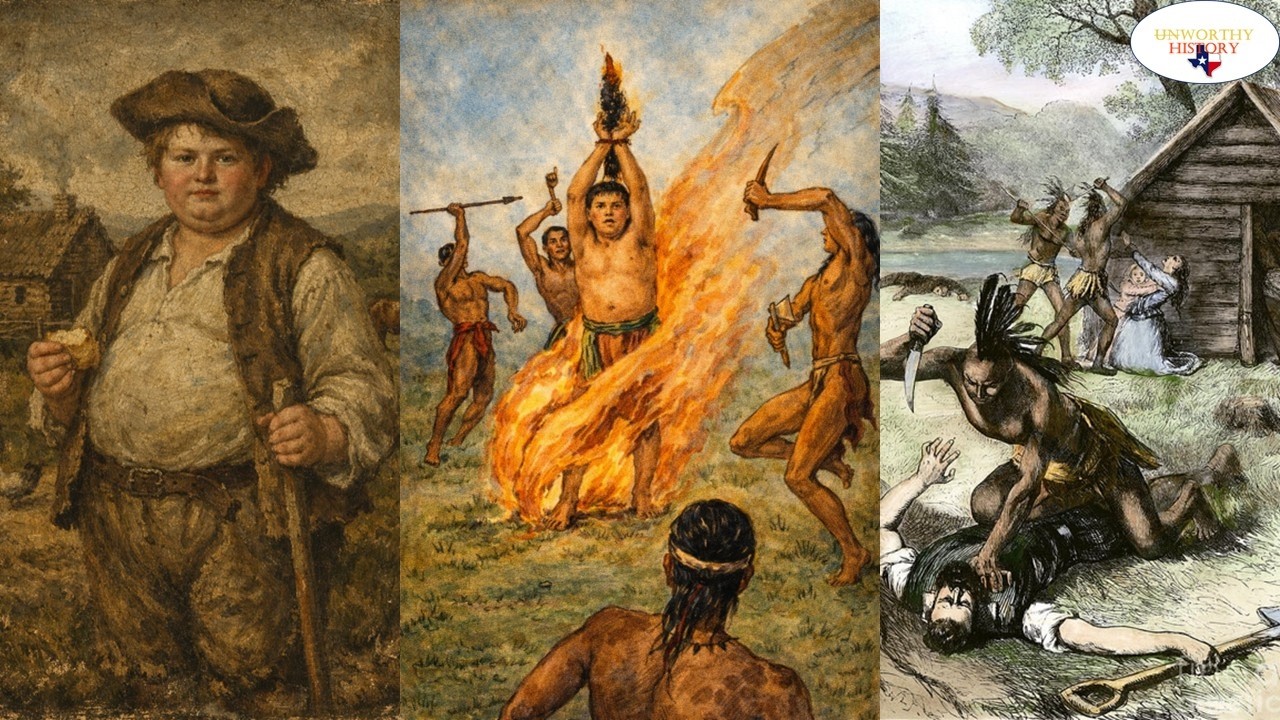
The raiders moved off with 48 prisoners, including Painter’s wife, five of his daughters, and one son, along with a Mrs. Smith and several of her children, and a Mr. Fisher with his children. Among the captives was Fisher’s 12- or 13-year-old son, described as a fine, well-grown boy and remarkably fleshy—a detail that marked him for special cruelty.
Two of Painter’s sons and a young man named Jacob Myers escaped. They ran 15 miles overnight to Powel’s Fort and Keller’s Fort to seek help. A small mounted party set out the next morning but turned back after learning the size of the raiding party. After six days of travel, the Indians reached their villages and held a council, where they decided to execute the young Fisher boy.
They ordered him to gather dry wood. The boy wept and told his father he believed they intended to burn him. His father replied, “I hope not,” and advised him to obey. The warriors tied the boy by one hand to a sapling, cleared a ring around it, and set the wood on fire.
They forced him to run around the ring until the rope wound him to the tree and then back toward the flames, while they drank, sang, and danced around him. The torture lasted several hours. As the men became drunk and fell to the ground, their women kept the fire going and used long poles to prod the boy whenever he slowed, until he collapsed and died in excruciating pain. His father and brothers were compelled to witness the ordeal.
Mrs. Painter, her son, and two of her daughters eventually returned home after about three years. Mrs. Smith also returned and was received by her husband, who never mistreated her over the Indian son she had borne by a distinguished chief, though he held a bitter aversion to the boy.
The young chief grew to manhood, resisted attempts at education, enlisted as a common soldier in the Revolutionary War, and never returned. Three of Painter’s daughters remained with the Indians. One returned after many years of captivity; the other two married and spent their lives among the tribe. The same period saw another tragedy near the Hawksbill settlement.
A man named John Stone was killed by Indians around 1758. His wife and infant child were later murdered on South Side Mountain, while his young son and a 16-year-old named George Grandstaff were taken prisoner. Grandstaff remained captive for about three years. Stone’s son grew up with the Indians, came home, obtained his father’s property, sold it, and returned to the Indians, never to be heard from again.
In May 1758, a party of Shawnees laid siege to Seybert’s Fort on the South Branch of the Potomac, about 12 miles west of present-day Franklin in Pendleton County. After two days of failed attacks, the Indians resorted to strategy and promised the besieged that their lives would be spared if they surrendered. The 30 people inside trusted the promise and gave up the fort. All but 11 were massacred.
According to the most widely accepted account, ten were spared and removed from the fort, while the others were tied hand and foot, seated on a log, and killed with tomahawk blows at a given signal. A youth named Dyer was spared despite not being among those removed, was taken to Logstown and then to the Shawnee towns on the Scioto, and escaped after nearly two years of captivity. That same year, near the present village of Petersburg in Hardy County, a man named Bingaman fought off a nighttime attack by eight Indians on his isolated cabin. Bingaman, known for his determination and Herculean strength, had refused to abandon his home despite warnings.
His wife was shot through the left breast but not dangerously wounded. Bingaman hid his parents, wife, and child beneath the bed and fought in the dark with his heavy rifle as a club. He beat down one attacker after another until seven lay dead. The sole survivor fled, reportedly telling his tribe that he had met a man who was a perfect devil.
The intrepid Virginian had killed seven of his foes in a single-handed fight considered unexampled in frontier history. During the fight, Bingaman had pulled off his shirt, and the Indians frequently grappled with him but could not keep him down. In the morning, finding his wife wounded, he was so enraged at the hired man’s cowardice that he would have killed him had she not intervened. Bingaman later moved to Natchez, where his son Adam had already settled, and died there.
A separate incident described Bingaman defying a captain’s order to guard horses during a pursuit of retreating Indians. He joined the attack, singled out a giant-like warrior, threw aside his rifle for speed, and killed the man with a single hatchet blow. When the captain rebuked him, Bingaman responded harshly, threatening him with the same fate, and the captain held his peace. The two had quarreled a few days earlier.
German settlers in the Shenandoah had lived peacefully alongside the few remaining natives for about a dozen years before 1753, when the natives withdrew over the mountains to the west—an omen the settlers understood as a bad sign. The French and Indian War exploded into open conflict in March 1754, and three years later, warriors returned to raid the settlements. The steep, narrow canyons leading from the mountains into the valley made Mill Creek especially vulnerable. According to a genealogy account, George Painter gathered his family of nine into his cellar when the raiders swept down the canyon, and about 40 frightened neighbors crowded in as well while two of his sons ran for the ridge to hide.
The attack was swift. Painter was shot in the back three times while trying to escape. The survivors watched as the raiders stripped the dwellings, tossed his body inside, and torched the house before turning to the infants and stables. The events of 1758 marked a turning point in relations between settlers and Indians in western Virginia.
After the tribes allied with the French and committed such raids during the French and Indian War, the old pattern of peaceful coexistence became difficult to restore. The book from which these accounts are drawn, “History of the Early Settlements and Indian Wars of Western Virginia,” was published by Wills De Hass in 1851, when West Virginia was still part of Virginia.