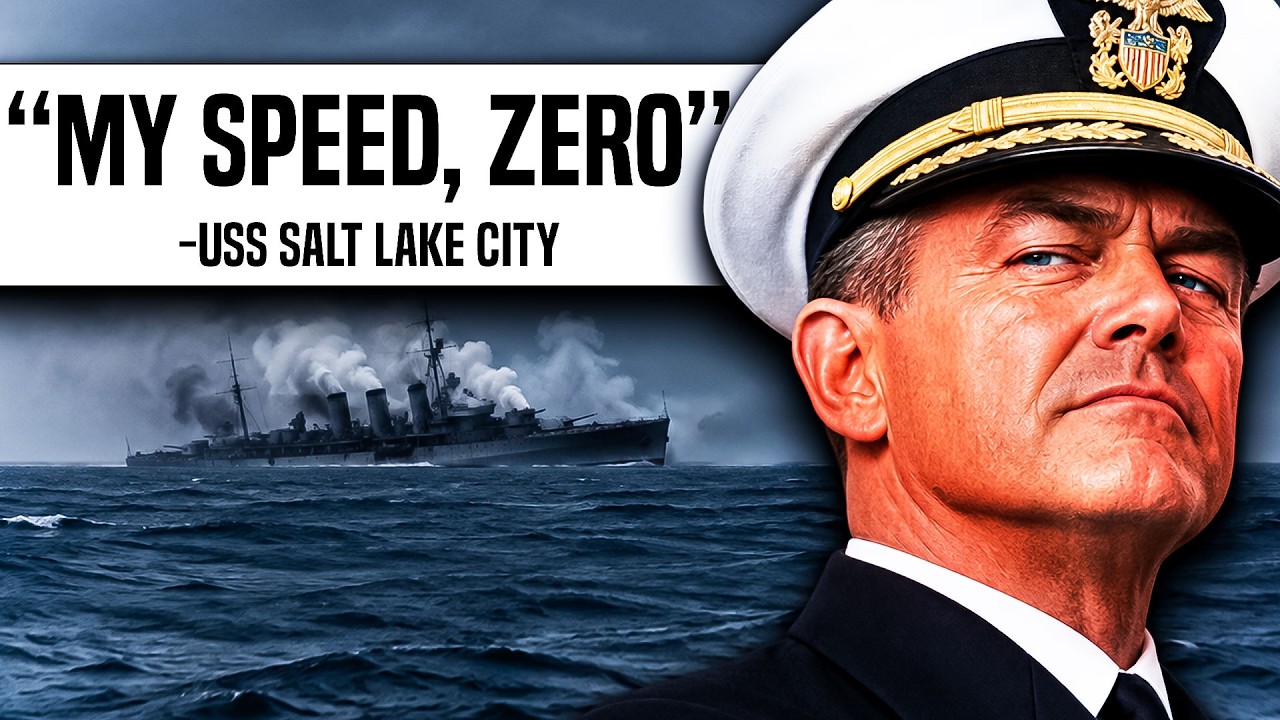
In the open water south of the Commander Islands on March 26, 1943, the heavy cruiser USS Salt Lake City raised a signal flag meaning “speed zero. ” The ship was dead in the water, listing, and surrounded by Japanese warships. According to the Navy’s own account, a Japanese 8-inch shell passed straight through the flag while it hung there. The moment looked like the end of the story, but the Japanese fleet turned west and sailed home, leaving the crippled American cruiser behind.
The Battle of the Komandorski Islands became one of the most unusual naval engagements of the Pacific War—an afternoon of heavy gunnery fought entirely on the surface, with no aircraft taking part until it was over. In June 1942, Japan had occupied Attu and Kiska, the two westernmost islands of Alaska’s Aleutian chain. Every supply they needed had to come by ship from Paramushiro, the Japanese naval base at the northern tip of the Kurile Islands. By March 1943, Rear Admiral Thomas Kinkaid had placed American warships across that route.
A small group was patrolling west of Attu with orders to intercept supply ships when it stumbled onto the entire Japanese Fifth Fleet. The American force was commanded by Rear Admiral Charles McMorris, flying his flag in the old light cruiser USS Richmond, with the heavy cruiser Salt Lake City and four destroyers: Bailey, Coghlan, Dale, and Monahan. The Salt Lake City had come out of the Battle of Cape Esperance off Guadalcanal badly damaged. She left the yard at Pearl Harbor on March 11, 1943, after four months of repairs, with half her crew never having been to sea before—including 70 percent of the men who worked her gunnery system.
On the Japanese side, Vice Admiral Boshiro Hosogaya had put to sea with everything he had to protect two supply ships—the armed merchant cruiser Asaka Maru and the freighter Sakito Maru—carrying troops, artillery, ammunition, food, and construction materials to reinforce Attu. It was their third attempt to get through. Hosogaya’s force included his flagship, the heavy cruiser Nachi, the heavy cruiser Maya, the light cruisers Tama and Abukuma, and four destroyers. A storm on March 25 had delayed everyone, and the whole Japanese force spent the night searching for a slow freighter that had not appeared.
At 6:00 in the morning on March 26, the American ships were making 15 knots on a calm sea under a heavy cloud ceiling. At 7:30, an hour before sunrise, the destroyer Coghlan picked up two ships on radar at 12,000 yards. McMorris ordered all ships to gather on the Richmond. The early reports described merchantmen and a single destroyer.
McMorris later wrote that he felt “a Roman holiday was in prospect. ”
The Japanese column had begun to turn north when masts appeared on the horizon behind it. The watch officer aboard Nachi initially mistook them for the missing freighter and reported them that way. The Asaka Maru counted more masts and flashed an urgent red searchlight warning to the Abukuma, which took about fifteen minutes to acknowledge.
At 8:28, lookouts on the Richmond identified one heavy cruiser, then another. McMorris decided to go after the merchant ships, hoping the Japanese would peel off warships to protect them. At 8:40, the Japanese heavy cruisers opened fire on the Richmond at about 20,000 yards. Their first salvo fell short; the next one straddled her.
The Salt Lake City answered at 8:42. On her third or fourth salvo, at least two 8-inch shells struck the foremost Japanese heavy cruiser and started a fire near its bridge. Hosogaya’s warships were now between McMorris and his bases to the east. He turned west, and the rest of the morning became a chase.
Nachi had hurt herself from the start. Her first salvo wrecked the two spotting floatplanes on her starboard catapult. Then her main guns lost electrical power because the generators had been switched too soon onto a boiler still raising steam. For about half an hour, her 8-inch guns remained at full elevation and could not be aimed.
A 6-inch hit from the Richmond also cut the cables between her fire control station and her turrets. The Maya did most of the heavy shooting. The Japanese heavy cruisers walked their salvos across the Salt Lake City in steps of two to three hundred yards. The Americans could tell the two ships apart by the dye they used in their shell splashes—one a bilious green, the other blue.
Captain Bertram Rogers steered his ship toward each fresh splash, reasoning that the next salvo would fall somewhere else. At 10:09, a shell hit the Salt Lake City below the waterline on the port side. It tore through fuel tanks and burst behind the after engine room. Oil sprayed into the compartment and mixed with water from broken pipes.
Men below stuffed wads of clothing into the torn bulkhead to slow the flooding. The battle was logged on two different dates—the Americans kept Aleutian time and recorded everything as March 26, while the Japanese kept Tokyo time and logged it as March 27. The two sets of records agree almost to the quarter hour on everything but the date. At 10:02, the Salt Lake City’s own gun blast carried away her rudder stops, and she swung hard to the right with the enemy less than ten nautical miles away.
Her crew restored steering from aft—ten degrees either way, and no more. At 10:10, a shell came down at a steep angle through her forward main deck, glanced off the anchor windlass, and went out through the hull two or three feet below the waterline, flooding several compartments. McMorris ordered smoke. The Bailey and Coghlan shuttled around the cruiser, laying banks of chemical and funnel smoke while she steered into it.
At 10:59, an 8-inch shell burst on the Salt Lake City’s starboard catapult. The floatplane sitting on it caught fire and was pushed over the side. One officer and one enlisted man were killed. On the Nachi early in the fighting, a 5-inch shell from an American destroyer struck the after end of the fly bridge.
Hosogaya was standing at the forward center, his staff lined up behind him. The fragments missed every officer. They killed three communications men stationed further aft. Just after 11:00, the Salt Lake City took a hit on the port side aft that drove flooding forward, and she settled into a list of four to five degrees.
Water and cold fuel oil stood five feet deep in the after engine room, and the engines had to be stopped. Speed dropped to 20 knots. A quarter of an hour later, the after turrets began running out of armor-piercing shells. Crews broke open hatches and trundled shells from the forward magazines aft on dollies while a chain of men passed powder bags along below decks.
Turret 3 fired some high-explosive shore bombardment rounds before the chain caught up. They burst so hard that the Japanese heavy cruisers put up a furious anti-aircraft barrage into the overcast sky. There was nothing up there. Then salt water that had leaked into the after fuel tanks reached the burners, and the fires under her boilers went out one by one.
Her engines stopped, and she coasted down through 8 knots. At 11:55, the signal went up: speed zero. Rogers swung the ship left before she lost way so that all her guns would bear, and she fired several full broadsides from where she lay. McMorris ordered a torpedo attack.
Captain Ralph Riggs took the destroyers Bailey, Coghlan, and Monahan straight at what he called “the two big boys,” while the Dale stayed behind to screen the stopped cruiser. They went in at full speed through water thrown up in green and blue columns, guns firing every three seconds. McMorris wrote afterward that it seemed impossible they should survive it. At 12:03, an 8-inch shell burst inside the Bailey, killing one officer and three men who had gathered in a passageway to carry sandwiches up to the gun crews.
Another man died later. At 12:04, the Bailey fired five torpedoes at 12,000 yards. The Japanese were already heading west. Soon after noon, the Richmond, coming back to cover the cripples, could see the enemy going away for good.
The firing stopped. The Americans turned east, the Salt Lake City listing eight or nine degrees and steering by following the flagship because none of her own gyrocompasses worked. American air power never arrived that day. Midway through the morning, Kinkaid had told McMorris that bombers could be expected around 2:30 that afternoon.
When the Japanese heavy cruisers turned away, the Army planes at Amchitka were still on the ground, held there because each needed an extra fuel tank installed. Three twin-engine bombers and eight fighters took off early in the afternoon and reached the American ships just after 4:00. Catalinas were shadowing the Japanese merchant ships by then, but they carried no bombs, and the Army planes lacked the fuel to reach the targets. At noon, when the Japanese broke off the battle, not one American aircraft had left the ground.
Why Hosogaya turned away remains a subject of debate. In November 1945, his officers told their side of the story in Tokyo. Captain Rakuji, chief of staff of the destroyer squadron that morning, said a message had arrived about an hour before the break warning that ten or more planes were on their way. He believed it came from Kiska.
The old destroyers Ikazuchi and Inazuma were low on fuel, and so, to a lesser degree, was everyone else. Nachi and Maya had nearly emptied their magazines. The floatplane reportedly had told the admiral the American cruiser was lying dead in the water. Commander Kanaro Mura, the staff air officer who had stood at the back of Nachi’s bridge, said Hosogaya had calculated that planes from Attu would join the fight about three hours after it began, so he broke off by holding west while the Americans went south.
Mura added that no Japanese air cover from Paramushiro was planned or given. What cannot be settled is the story most people have heard: that Hosogaya saw the colored water splashes or the bursts of the high-explosive bombardment shells and believed he was being bombed. The American official narrative did note the anti-aircraft barrage that followed the high-explosive rounds and concluded the Japanese had thought an air attack was underway. That was an inference made through smoke.
The Japanese accounts differ. The two staff officers describe a radio warning, a fuel problem, and empty magazines. Neither connects the colored water to the decision. The one man who could have settled it—Hosogaya himself—was not among the officers questioned in that series, so his reasoning survives only as his subordinates remembered it.
The American ships reached Adak and Dutch Harbor on March 28 and 29. The Nachi returned to Paramushiro and then Sasebo. Hosogaya lost his command. The Navy handed the Fifth Fleet to Vice Admiral Shiro Kawase, and later that year moved Hosogaya, a regular officer since 1908, into the reserve.
The two supply ships turned back that morning, passed through the oil slick the American cruiser had left behind, and sailed for Paramushiro. Colonel Yasuo Yamasaki reached Attu in April by submarine. On May 11, an American division came ashore on Attu in fog. On the night of May 29, most of Yamasaki’s surviving men charged through the American lines.
The Americans counted 2,351 Japanese dead on the island. Twenty-eight men surrendered. Out of more than 15,000 Americans sent to take the island, 549 were killed. In November 1943, Boshiro Hosogaya became governor of Japan’s South Seas Mandate.
His seat was at Koror in the Palau Islands, thousands of miles south of the water where he had turned for home. He kept the post until the surrender. No cargo ship reached Attu again. The surface route was finished.
What still went north went by submarine. The Asaka Maru remained in those northern waters running cargo until November of that year.