When a messenger pounded on the door of the Tyler home in Williamsburg before dawn on April 5, 1841, John Tyler opened it to learn that President William Henry Harrison had died just 31 days after taking office. Tyler immediately declared himself president, not merely acting president, and moved into the White House. His wife, Leticia, who had suffered a paralyzing stroke two years earlier, now faced a fate she never wanted. She became the first lady of the United States while confined to an armchair, unable to walk and barely able to speak.
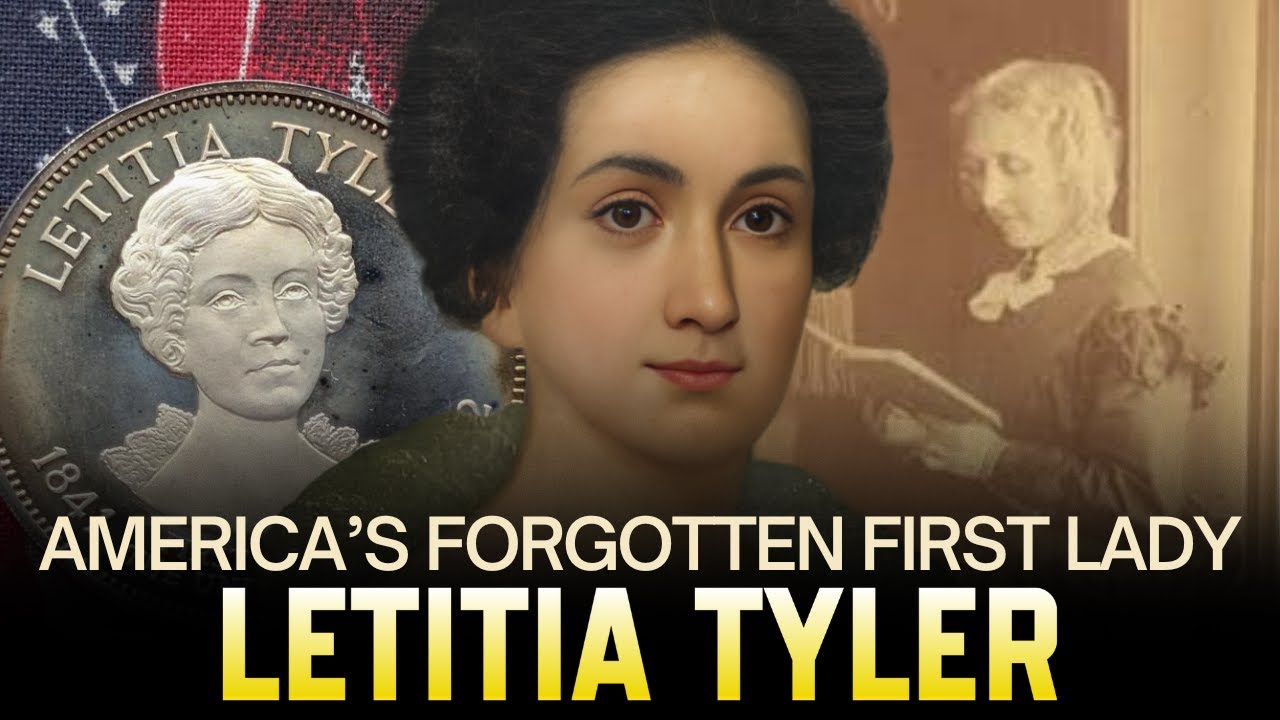
Born on November 12, 1790, into the first families of Virginia, Leticia Christian grew up at Cedar Grove, a prosperous plantation in New Kent County. Her father, Colonel Robert Christian, was a staunch Federalist and a powerful figure in Virginia politics. Leticia received almost no formal schooling, but she was rigorously trained to manage a vast estate. She learned finance, inventory, household medicine, and the logistics of feeding and clothing hundreds of people.
Contemporaries described her as painfully shy, deeply pious, and utterly selfless. In 1808, John Tyler, then 18, met Leticia at a social gathering. He was the opposite of her in nearly every way: charming, impulsive, and ambitious, a fiddle-playing romantic who loved poetry and grand gestures. Their courtship lasted five long years, conducted under the watchful eyes of chaperones.
John Tyler later confessed to his children that in all that time, he kissed her only once, a single kiss on her forehead three weeks before the wedding. They married on March 29, 1813, John Tyler’s 23rd birthday, at Cedar Grove. Leticia brought a substantial dowry of land, enslaved people, and cash, which helped bankroll her husband’s political rise. Almost immediately, John Tyler’s career ignited.
He was elected to the U. S. House of Representatives in 1816, became governor of Virginia, and later served as a U. S.
senator. For the next 25 years, he was largely absent from home, traveling constantly between Virginia and Washington. Leticia was left to run the family. She controlled the purse strings because her husband could not be trusted with money.
Surviving letters show the great statesman writing home to ask his quiet wife whether the budget allowed for new clothes. She was also the disciplinarian, ensuring the children were educated and pious, reading to them from the Bible every evening. She hid the financial strain and the loneliness while maintaining a facade of effortless grace. Between 1815 and 1830, Leticia gave birth to eight children.
Seven survived to adulthood, a remarkable achievement in an era of high child mortality. The strain of constant childbearing and running the plantation alone began to wear her down. By her late 40s, she was exhausted. When John Tyler resigned from the Senate in 1836 over a dispute with the Democratic Party, his political career seemed to be winding down.
They planned to retire quietly in Williamsburg. In the winter of 1839, disaster struck. Leticia, then 48, suffered a massive stroke. Her right side was permanently paralyzed.
She could not walk, and her right arm hung useless at her side. Her speech was slightly impaired but recovered. Her mind, her intelligence, and her financial acumen remained intact. She refused to fade away.
She taught herself to knit with only her left hand and continued to direct the household from her armchair, reviewing the accounts with the books brought to her lap. In 1840, the Whig Party chose John Tyler as William Henry Harrison’s vice presidential running mate. They won in a landslide. The plan was that Tyler would have few official duties and largely remain in Virginia, allowing Leticia to stay in her adapted environment.
But Harrison died, and everything changed. John Tyler’s decision to claim the full presidency sealed Leticia’s fate. The journey to Washington was a nightmare for an invalid. She had to be lifted into a carriage and propped up with pillows to cushion the jolts of rough roads.
When the carriage arrived at the White House, she did not walk up the grand steps. She was carried, her chair borne through the massive doors and up the winding staircase to the family quarters on the second floor. For the remaining months of her life, she would effectively never leave that floor. The White House became her prison and her sanctuary.
While her husband faced a political hurricane downstairs, Leticia remained above. John Tyler had vetoed a bank bill, a central tenet of the Whig platform, and the reaction was volcanic. His entire cabinet, except Secretary of State Daniel Webster, resigned in protest. Mobs gathered outside the gates, shouting for his resignation and burning effigies.
He received hundreds of assassination threats. Every evening, John Tyler climbed the stairs to his wife’s room. She was the calm in the eye of the hurricane. She treated him with the reverence due a head of state, reinforcing his belief in his legitimacy.
She was the only person in Washington who wanted nothing from him but his well-being. While newspapers called him His Accidency, she remained his anchor. Because Leticia could not perform public duties, she deputized her daughter-in-law, Priscilla Cooper Tyler, to serve as hostess. Priscilla was an actress, a background considered shocking to the Washington elite.
But Leticia saw past the prejudice. The two formed a deep partnership. Priscilla wrote to her sisters that Leticia was the most entirely unselfish person she could imagine. Before every major event, Priscilla would go upstairs, and Leticia would inspect her gown, advise her on who needed attention, and who needed to be soothed.
When guests complimented the food or flowers, Priscilla would demur, “It is all Mother Tyler’s doing. ”
For nearly a year, Leticia remained a rumor in Washington. The elite whispered that she was dead or mad or so disfigured that the president hid her away. Then came the wedding.
In January 1842, the Tylers’ daughter Elizabeth was to marry William Waller. It was the social event of the season. Leticia announced she would attend. Her son Robert and John Jr.
lifted her chair and carried her down the grand staircase. She was placed in the East Room, slightly apart but clearly visible. When the hundreds of guests poured in, a hush fell over the room. There sat the invisible first lady.
She looked like a queen in exile, pale and ravaged by illness, but with bright, intelligent eyes. Throughout the ceremony, she held court. The guests came to her. Ambassadors bowed low.
Even the president’s harshest enemies seemed moved by the sight of his frail, dignified wife. As soon as the ceremony concluded and the music began, she signaled her sons and was carried back to the silence of the second floor. It was her only public act as first lady. After January 1842, Leticia’s health declined.
The Washington summer was brutal, hot and suffocating, and the White House, near a stagnant canal, was a death trap for the sick. Most of the political class fled the city, but the president could not leave, and Leticia would not leave him. She spent the summer confined to her room, praying, slowly dimming. Priscilla wrote with heartbreaking candor about those months.
On the evening of September 9, 1842, Leticia suffered a second, catastrophic stroke. She fell into a coma almost immediately. The family gathered. As she lay dying, her functioning left hand unclenched, and someone placed a single fresh damask rose in her palm.
It was a symbol of Cedar Grove, a piece of the earth grounding her as her spirit prepared to fly. She died on the evening of September 10, 1842. She was 51 years old. She was the first wife of a sitting president to die.
Her funeral was held in the East Room, the same room where she had watched her daughter marry eight months earlier. Her coffin was loaded onto a train for the journey back to Virginia. She was buried at Cedar Grove, her birthplace, in the family plot surrounded by her ancestors. After her death, the protective barrier between John Tyler and his worst impulses vanished.
He became more erratic politically. The winter of 1842 to 1843 was a winter of discontent. The president suffered bouts of depression. The White House went into official mourning.
The Tyler children were fiercely loyal to their mother’s memory and expected their father to honor her sacrifice. But John Tyler was not a man of solitude. He needed adoration and noise. Into this grim atmosphere burst Julia Gardiner.
She was 22 years old, younger than three of Leticia’s children. She was wealthy, a city girl, a socialite, and a trendsetter, everything Leticia was not. On February 28, 1844, a horrific explosion aboard the USS Princeton killed Julia’s father. In the chaos, the president became her personal protector, carrying the fainting Julia off the ship.
The tragedy shattered her resistance. On June 26, 1844, a secret wedding took place in New York City. John Tyler was 54; Julia was 24. The wedding was held less than two years after Leticia’s death and only four months after the death of Julia’s father.
Tyler’s own children were not informed until the last possible moment. The shock wave was immediate. The cruelest blow fell on the Tyler children, who had spent two years grieving their mother, only to have their father bring home a stepmother younger than they were. Julia Gardiner Tyler returned to the White House as the imperial first lady.
She introduced a level of pomp America had never seen, receiving guests while seated on a raised platform surrounded by maids of honor in matching white gowns. She hired a press agent and instructed the Marine Band to play a specific tune whenever the president entered a room. The song was Hail to the Chief. It was her invention.
Priscilla Cooper Tyler’s position became untenable. Julia was the undisputed mistress of the house. Priscilla and her husband Robert packed their bags and left. With her gone, the memory of Leticia’s quiet reign left the building.
In March 1845, John Tyler’s term ended. He and Julia retired to a new plantation in Virginia, which Tyler named Sherwood Forest. They had seven children of their own. Julia decorated the walls with portraits of herself.
There were no portraits of Leticia in the main halls. Leticia’s grave at Cedar Grove lay miles away, unvisited by the new mistress of the Tyler clan. As the 1850s progressed, the values Leticia had instilled in her children surfaced. When the Civil War broke out in 1861, John Tyler shocked the world by voting for Virginia’s secession.
He became the only U. S. president to be sworn into the Congress of the Confederate States of America. Robert Tyler fled Philadelphia, losing his home and fortune, to join the Confederacy and became its register of the treasury.
Priscilla Cooper Tyler found herself in Montgomery, Alabama, the first Confederate capital, wrapping bandages for wounded rebel soldiers. John Tyler died in January 1862 in a hotel room in Richmond. He was a member of the Confederate House of Representatives. The federal government ignored his death.
There was no official mourning, no flags lowered to half-mast. He remains the only U. S. president in history whose death was not officially recognized by the federal government.
He was buried in Hollywood Cemetery in Richmond. The family fortune Leticia had so carefully managed was wiped out by the collapse of the Confederate dollar and the emancipation of the enslaved workforce. Today, Cedar Grove, the house where Leticia was born, is gone. It burned down years ago.
The family graveyard remains. Her tombstone describes her as the wife of John Tyler, president of the United States. History has been unkind to the Tylers. John is remembered as a failure and a traitor.
Julia is remembered as a social climber. Leticia is barely remembered at all. But nearly a century before Franklin D. Roosevelt, Leticia Tyler managed the role of first lady while paralyzed.
She lived in the White House, she appeared at a state wedding carried in a chair, and she continued to run the household with one functioning hand. She forced Washington’s elite to bow to a woman who could not stand. That is a form of quiet power rarely celebrated but deeply significant.