For 50 years, the world had an explanation for everything Ken Stabler did—and that explanation was wrong. The man known as “Snake” built a legend as a hard-living, freewheeling quarterback whose charm and late-night habits seemed to cost him nothing on game day. Only after his death did the truth emerge: his brain was severely damaged by chronic traumatic encephalopathy, the disease caused by repeated head trauma. Stabler was born on Christmas Day, 1945, in Foley, Alabama, to Leroy and Sally Stabler.
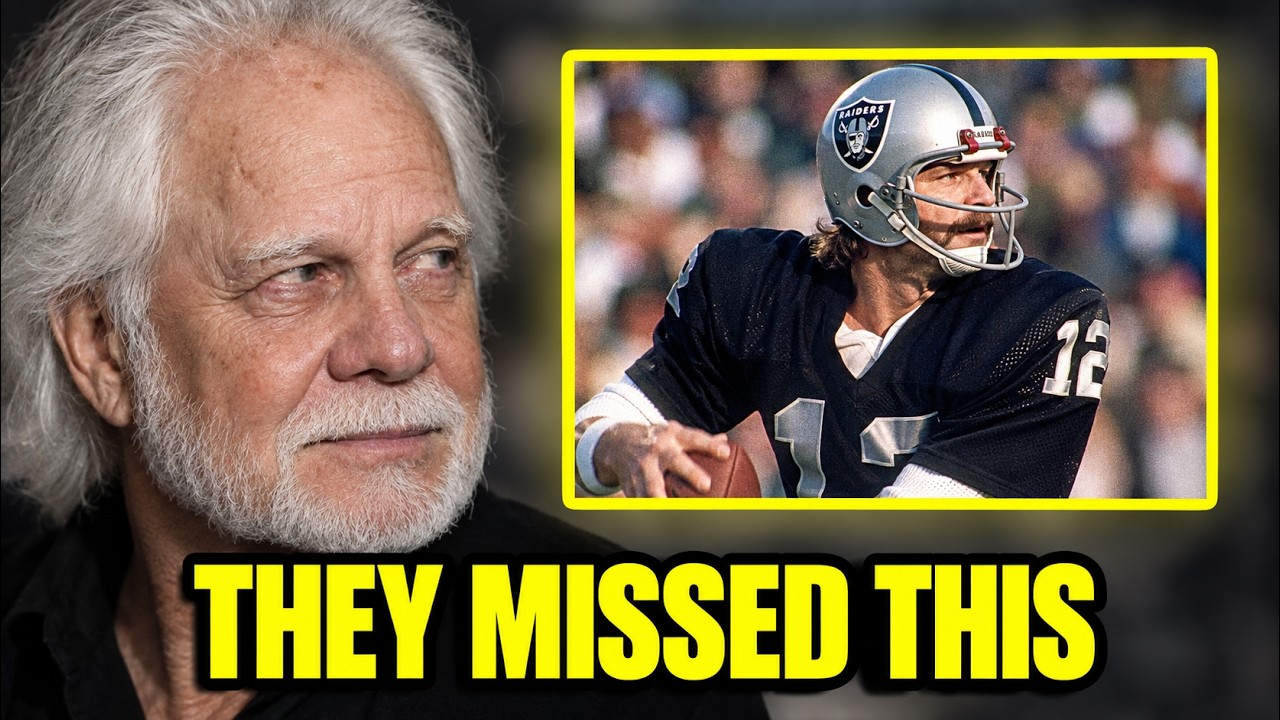
His father, a mechanic known as Slim, ran the household with a rigid hand, which gave young Stabler a lifelong tendency to rebel the moment no one was watching. That tension between discipline and rebellion defined nearly every chapter of his life. The nickname came from a junior high football game when his coach, Denzel Hollis, watched Stabler zigzag through a punt return. “That was when I gave him the nickname Snake,” Hollis said decades later.
At Foley High School, Stabler quarterbacked the Lions to a 29–1 record over three varsity seasons, losing only to archrival Vigor. He was a three-sport star, averaging 29 points a game on the basketball court and striking out 125 batters in his senior year on the mound. The Pittsburgh Pirates offered him $50,000 to sign out of high school—more money than his father made in years—but Stabler turned it down. “I wanted to play for Coach Bryant,” he said.
He enrolled at the University of Alabama in 1964, spending his freshman year watching Joe Namath lead the Crimson Tide to a national championship. By 1965, sharing the quarterback job with Steve Sloan, Stabler helped Alabama win a second straight national title. In 1966, as the full-time starter, he led an undefeated 11–0 season, but Alabama finished third in the final polls, a result many historians still call one of the great injustices in college football history. In 1967, Stabler was kicked off the team by Bear Bryant after being caught cutting class and spending too many nights out.
Bryant eventually let him back. On December 2nd, in a torrential downpour against Auburn, Stabler repaid that faith. Trailing 3–0 late in the fourth quarter at Legion Field, he took off from the pocket and covered 47 yards through the mud for the winning touchdown in a 7–3 victory. Alabama football still calls the play “The Run in the Mud.
”
The Oakland Raiders selected Stabler in the second round of the 1968 draft, but he spent years stuck behind Daryle Lamonica, the reigning AFL MVP. Frustrated, he walked away from the team entirely for a stretch, working construction in Alabama and wondering whether his professional career was a mistake. He returned, but spent most of 1970 through 1972 still holding a clipboard. Not until 1973, five years after being drafted, did Stabler finally take over as the full-time starter at age 27—a late start that would have ended most careers.
He found a perfect home in Oakland. Al Davis had built the Raiders on a defiant philosophy: take the players other franchises considered too much trouble and turn every rejection into motivation. Stabler fit that roster the way a key fits a lock. The Raiders became the signature outlaw team of professional football, and Stabler became its signature outlaw quarterback, unbothered by curfews or reputation as long as the ball found its target.
His career was defined by legendary finishes. In 1974, Stabler won NFL MVP outright, leading the league in touchdown passes as the Raiders finished with the best record in football. In the divisional playoffs, he rolled left under pressure and threaded a pass into a crowd of reaching hands, where Clarence Davis came down with it despite three Dolphins defenders, producing a play known as “The Sea of Hands. ” In 1977, he found Dave Casper streaking 42 yards down the middle in double overtime, a play remembered as “Ghost to the Post.
” A year later, trailing San Diego with 10 seconds left, Stabler shoved the ball forward as he was about to be sacked, and it was batted, kicked, and finally fallen upon in the end zone for the winning touchdown. The sequence was so contentious that the NFL rewrote its rules to make sure it could never happen again. San Diego fans still call it “The Immaculate Deception. ”
Popular legend insists Stabler showed up to Super Bowl XI half-drunk.
The real story, according to teammates and coaches who were there, is the opposite. The Thursday before the game, Stabler practiced so sharply that offensive coordinator Tom Flores told Sports Illustrated the ball touched the ground exactly once—and that was on a drop by a receiver. Two days later, on January 9th, 1977, Stabler completed 12 of 19 passes for 180 yards in a 32–14 rout of the Minnesota Vikings, earning the Raiders their first championship in franchise history. Off the field, his reputation was real enough that no one needed to invent anything extra.
He read game plans by jukebox light in bars the night before games and still showed up Sunday sharper than quarterbacks who had been in bed by 10. He married three times and had three daughters. Actor Tom Hanks later called him “the coolest guy he’d ever seen,” and a biker in an HBO documentary put it even more plainly: Stabler could outdrink an entire room the night before a game and still be the only one capable of playing the next afternoon. Nobody watching from the outside had any reason to wonder what it might be quietly costing him.
By the time he was traded to Houston in 1980, Stabler had thrown for more yards and more touchdowns than any quarterback in Raiders history—19,078 yards and 150 touchdowns across 10 seasons, numbers that still stand today. He played three more seasons in Houston and New Orleans before retiring in 1984, ending a 15-year career with a 96–49–1 record as a starter and a legendary Monday night comeback from a 35–7 deficit against New Orleans to win 42–35 in December 1979. Stabler settled into a long second career as a broadcaster, his gravelly Alabama drawl a fixture on Crimson Tide radio for years. He held the job even through a 2008 arrest and financial troubles that forced the sale of his beach house to cover unpaid taxes.
His daughters started noticing small changes: flashes of temper that didn’t match the man they grew up with, blank looks that lasted a beat too long, a forgetfulness that had nothing to do with simple age. None of it fit the version of their father the rest of the world still saw. Stabler himself also noticed, telling people close to him that something in his own head felt different, without yet having a name to put to it. Stabler died on July 8th, 2015, in Gulf Shores, Alabama, of complications from colon cancer.
He was 69. Years earlier, after watching Junior Seau take his own life and learning afterward that Seau’s brain showed severe CTE, Stabler had told his family plainly what he wanted done with his own. His daughter Kendra, named as the representative of his estate, made sure that wish was carried out. His brain was sent to Boston University’s CTE Center, where Dr.
Ann McKee examined the tissue herself. In February 2016, seven months after his death, the diagnosis came back: stage three chronic traumatic encephalopathy out of a maximum four—“moderately severe disease,” McKee told reporters, with lesions affecting many regions of the brain. Researchers found the damage genuinely surprising given that Stabler played quarterback, a position long assumed to carry less risk of repetitive head trauma. Chris Nowinski, co-founder of the Concussion Legacy Foundation, said Stabler had anticipated the diagnosis for years, watching his own mind change and quietly suspecting why, choosing instead to prepare his family quietly rather than making it a public cause.
His daughter Alexa described the moment plainly after hearing the results: “I knew something was going on,” she said, adding that the family’s primary emotion was relief, gratitude that her father’s suffering could finally be explained and put to a larger use. Stabler became one of the first high-profile examples of a Super Bowl-winning quarterback found to have the disease, a name added to a list that already included Frank Gifford and Junior Seau—proof that no position on a football field offers real protection. In August 2016, Stabler was posthumously inducted into the Pro Football Hall of Fame, 32 years after his last professional snap and 13 months after his death, a wait many former teammates and coaches called long overdue. Hall of Fame linebacker Ted Hendricks said Stabler should have been enshrined years earlier.
His daughters accepted the honor in Canton, Ohio, standing before a bust that represents him the way the public always saw him: the grin, the outlaw charm, the improbable fourth-quarter magic. But what the bronze bust doesn’t show is what his own brain tissue had already confirmed six months earlier. For 50 years, the world had an explanation for everything this man did. It was never the whole explanation.
It just took his own brain, examined after his own death, to finally say so.