On the 4th of July 1973, in the Guard’s Chapel at Wellington Barracks, Camilla Rosemary Shand married cavalry officer Andrew Parker Bowles. The chapel was full. Princess Anne was there, seated among the guests, watching a man she had spent years with marry someone else.
The groom was handsome in the particular way household cavalry officers are trained to be handsome: upright, composed, and entirely unreadable. The bride wore a dress that took the newspapers of the day several column inches to describe.
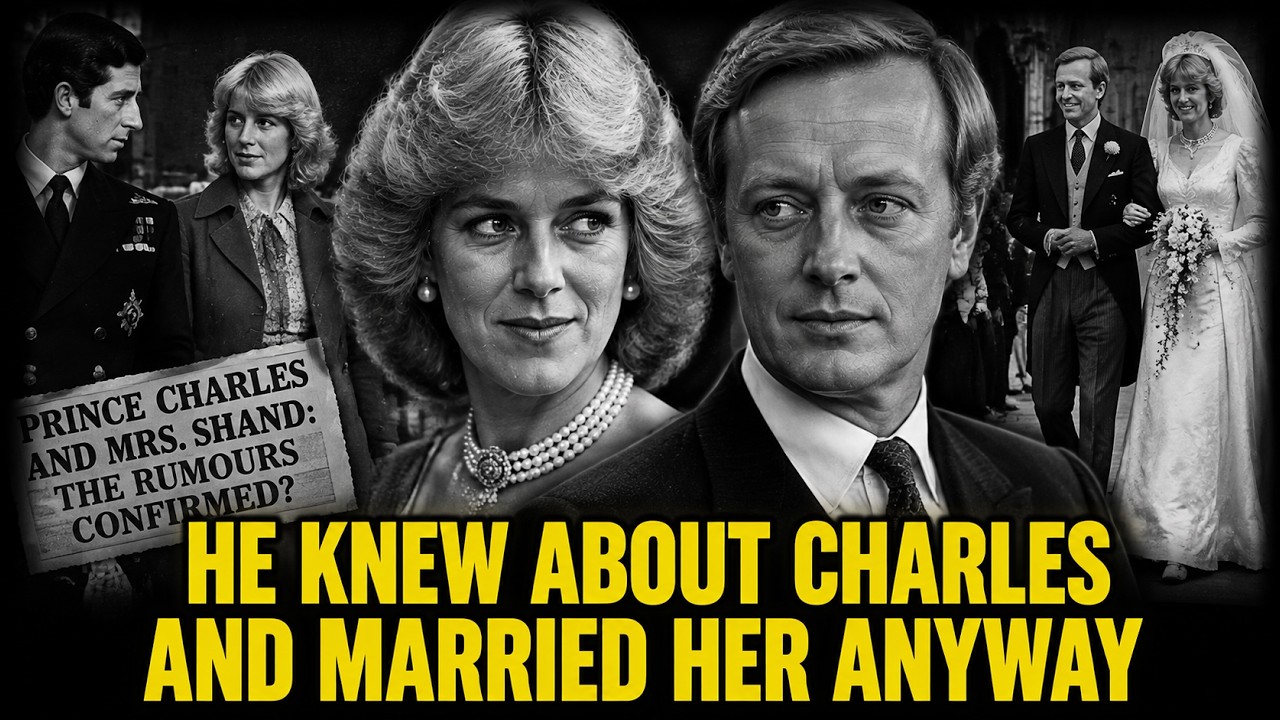
Everyone in that chapel who moved in the right circles understood something about the two people standing at the altar that the wedding photographs do not show. The groom already knew, before he ever asked her to marry him, that his bride had another man in her past who was not entirely in her past.
Friends in his own regiment had mentioned it to him. Friends of hers had mentioned it more directly. He had been told plainly enough that there was no version of events in which he could later claim surprise. The woman he was marrying had spent the better part of three years attached to a young naval officer who happened to be the Prince of Wales. That attachment had not obviously ended so much as gone temporarily quiet while that officer served at sea.
He married her anyway.
The popular account treats Andrew Parker Bowles as a man who was deceived. A decent officer who unknowingly built a marriage on top of somebody else’s unfinished romance and discovered the truth only later when the tabloids forced it into the open. That account is comfortable because it assigns him a single role: the wronged husband.
The documented record says something less comfortable and considerably more interesting. Andrew Parker Bowles did not stumble into this marriage in ignorance. He walked into it with a fairly clear picture of what he was walking into. And he had excellent personal reasons for not minding.
Those reasons had almost nothing to do with generosity of spirit and almost everything to do with the fact that he was doing something remarkably similar himself with a different member of the same royal family at almost exactly the same time.
This is not a story about a deceived man. It is a story about an arrangement between two people who understood each other’s terms from the outset. An arrangement so well suited to both of them that it survived for more than 20 years. And an arrangement that only became a scandal once it stopped being private.
Camilla’s father was Bruce Shand, a wine merchant who had spent the Second World War as a cavalry officer himself. He was decorated twice for gallantry and taken prisoner in North Africa in the same year his future wife was giving birth to their first child back in England. He served with the 12th Royal Lancers and was awarded the Military Cross on two separate occasions, first for actions during the retreat to Dunkirk and again during fighting in the North African desert campaign before being captured near the Egyptian border in the summer of 1942.
He returned home a quiet, self-contained man who rarely spoke about his wartime experiences in any detail. That reticence shaped the household atmosphere Camilla grew up in, one where personal difficulty was managed with composure rather than open discussion.
Bruce and Rosalind Shand’s own marriage was a genuinely happy and stable one, built around a shared love of country life, horses, and settled domesticity. That stability is worth noting because it complicates any simple theory that Camilla’s later comfort with an unconventional marital arrangement grew out of some direct example set by her own parents.
What Camilla inherited from her parents was not a template for infidelity, but something more general: a practical, unflappable temperament and a settled sense of her own place in a particular social world. Those qualities made her remarkably resilient in the face of public pressure that would have broken a less grounded person entirely.
What gave the Shand household its particular social weight was not Bruce’s side, but his wife’s. Rosalind Cubitt was the daughter of Roland Cubitt, third Baron Ashcombe, heir to a construction fortune that had built large parts of Belgravia and Pimlico. Her own mother was Sonia Keppel, who was in turn the daughter of Alice Keppel, the acknowledged mistress of King Edward VII for more than a decade at the start of the 20th century.
That lineage matters enormously to this story. Not because Camilla inherited a title from it, which she did not, but because it gave her family a specific and unusual kind of comfort with the idea of a discreet, long-running relationship with a member of the royal family.
Alice Keppel had managed her position with the king so carefully that she was received by the royal family itself, tolerated by Queen Alexandra, and present at Edward’s deathbed at his wife’s own invitation. The lesson that filtered down through three generations of Keppel women was not a lesson about morality. It was a lesson about method, about how a woman in that position survives and even thrives if she plays the part with enough tact and enough patience.
Camilla was born in London in April 1947, the eldest of three children, and grew up mostly at The Laines, a large house near Plumpton in East Sussex. It was a hunting and shooting household. By every account, Camilla was an easy, popular child, good-humored rather than glamorous, the kind of girl other girls liked rather than envied.
She came out as a debutante in the last cohort of girls to be formally presented, since the Queen ended the presentation parties the year after Camilla’s own season. She spent her late teens and early twenties doing what girls of her set did: working briefly and without much ambition at an interior design firm and then at an auction house, going to the same parties as the same 50 or so families whose children all knew each other from childhood, and attending point-to-points and polo matches on weekends because that was where the men were.
The debutante system functioned as a fairly explicit marriage market. Girls were not generally expected to pursue careers of any seriousness. Young men of the same background were expected to spend their twenties in the army or a similarly respectable holding pattern before settling down once a suitable match presented itself.
Both Camilla and Andrew Parker Bowles were products of a system explicitly built around practical, socially calibrated pairing rather than around the ideal of a single exclusive romantic destiny. Marriage in the world that produced both of them was a serious and largely permanent institutional commitment involving property, children, and social standing. It coexisted for a great many couples of their background and generation with private arrangements that a different generation would have found impossible to reconcile with the word marriage at all.
It was at one of those polo matches, most accounts place it at Windsor in the summer of 1970, that Camilla Shand is supposed to have introduced herself to a young naval officer named Charles. The line, as it has been passed down, has her mentioning that her great-grandmother had been the mistress of his great-great-grandfather, and suggesting with what was apparently a good deal of charm that history might therefore be interested in repeating itself.
The story is almost certainly at least partly apocryphal. Several serious biographers, Sally Bedell Smith among them, treat it with open skepticism while still including it because it captures something true about how Camilla operated, even if the words themselves were invented later.
What is much better documented is that the two of them were introduced that year through a small circle of mutual friends that included Lucia Santa Cruz, the daughter of the Chilean ambassador, who had briefly dated Charles herself and who is generally credited with the introduction. Charles was immediately and lastingly drawn to a woman who treated him almost uniquely among the young women he met as an ordinary and rather awkward young man.
Alice Keppel met the Prince of Wales, the future King Edward VII, in 1898 when she was 29 and already married to a younger son of an aristocratic family with more name than money. The relationship that followed lasted until the king’s death in 1910, and it survived for 12 years precisely because Alice Keppel never once allowed it to become a public embarrassment to the queen.
She was received at country house parties where the queen was also a guest. She was tolerant of and tolerated by Queen Alexandra in a working arrangement that both women appear to have found preferable to open conflict. When the king lay dying, Alexandra herself sent for Alice Keppel so that she could say goodbye to him.
Alice Keppel’s own later verdict on the entire episode, delivered to her daughter Sonia, was blunt. Things were done so much better in her day, she said, meaning specifically that discretion, not abstinence, was the actual rule that governed people in her position, and that the rule had worked.
By the time Camilla was a child, the story of her great-grandmother and the king was not a shameful family secret whispered about in corners. It was a known and even quietly proud piece of family history. Camilla grew up entirely unsurprised by the idea that a woman could occupy exactly the position Alice Keppel had occupied and still be regarded within her own circle as someone of genuine standing rather than disgrace.
This is the actual inheritance Camilla brought into her relationship with Charles. Not a title, not money in any serious quantity, but a specific and unusually well-tested family confidence that the role of the discreet companion to a Prince of Wales was survivable, manageable, and even capable of ending in something like respectability.
Andrew Henry Parker Bowles was born in December 1939 into a family that had served the crown in one capacity or another for generations without ever quite belonging to the highest tier of the aristocracy itself. The Parker Bowles family was Roman Catholic, which in the English establishment of that period was a meaningful distinction since it placed a firm ceiling on how close any member of the family could ever come to the throne through marriage.
Andrew’s mother, Dame Anne Parker Bowles, served for decades as a lady-in-waiting to the Queen Mother. Andrew grew up with an unusually intimate, unglamorous insider’s view of how the royal household actually functioned, not as distant royalty, but as a family his own mother worked for and saw socially.
He was educated at Ampleforth, the great Catholic boarding school in Yorkshire run by Benedictine monks. Then he went on to Sandhurst and was commissioned into the Royal Horse Guards, the regiment known informally as the Blues.
The culture of a regiment like the Blues in this period shaped Andrew’s expectations of marriage and fidelity as thoroughly as any single relationship did. Officers were frequently apart from wives and partners for extended stretches due to postings. The culture that grew up around those absences was widely, almost institutionally, tolerant of discretion rather than exclusivity.
A young officer with Andrew’s charm, connections, and evident ease with women was operating in an environment that offered him very little social pressure toward strict fidelity and very little reason to expect anything different from the woman he eventually married.
By every account of the men and women who served alongside him or moved in his social circle, Andrew Parker Bowles was extremely good at being an officer in a smart cavalry regiment, and extremely comfortable with the idea that fidelity was not a requirement of romantic life among people of his class and generation. He was handsome, athletic, an excellent horseman, socially at ease, and he acquired a reputation early in his career as someone who conducted several relationships at once with a discretion that friends found admirable rather than shocking.
Camilla and Andrew had known each other since the middle of the 1960s, and their relationship over the following years was intermittent rather than steady. Several biographers describe the pattern plainly: Andrew would drift toward Camilla when it suited him and drift away when something else caught his interest. Camilla, rather than treating this as a wound, seems to have absorbed it as simply the way things worked among people she knew.
The relationship that complicates the standard version of this story the most, and the one that most retellings either omit entirely or reduce to a single sentence, is the one Andrew conducted with Princess Anne. The two of them were seeing each other seriously from around 1970, overlapping directly with the period in which Camilla and Charles were falling for each other and with the final stretch of Camilla and Andrew’s own on-and-off courtship.
Anne was reportedly serious enough about Andrew that marriage was discussed within the family. The match was quietly discouraged from above, not because anyone doubted Andrew’s suitability as an officer or a gentleman, but because his Catholicism made a marriage to the Queen’s only daughter constitutionally awkward in a way that nobody at the palace wanted to manage in public.
The specific legal barrier that made Andrew’s Catholicism so constitutionally awkward, the Act of Settlement of 1701, had barred anyone who married a Roman Catholic from succeeding to the throne. It was not until the Succession to the Crown Act passed by parliament in 2013 that the specific bar on marrying a Catholic was finally removed.
Had that reform existed 40 years earlier, Anne’s relationship with Andrew Parker Bowles might have proceeded to marriage without the institutional discouragement that helped end it. That would have removed Andrew from the field entirely before he ever proposed to Camilla.
Andrew’s actual career inside that world is worth laying out in more detail than most retellings bother with. After Sandhurst and his commission into the Blues, Andrew served operationally in several overseas postings typical of a household cavalry officer of his generation, including a period in Southern Africa during the Rhodesian crisis years.
He returned to ceremonial and staff duties in London through the 1970s, rose to command his own regiment once the Blues and the Royal Dragoons merged into the Blues and Royals, and was appointed Silver Stick in Waiting, a ceremonial role with real practical weight that placed him in direct and regular contact with the Queen at state occasions.
He was later appointed General Officer Commanding London District, one of the most senior ceremonial military commands in the country, responsible for ensuring that state functions, royal weddings, and funerals were run with the precision the institution requires. He was appointed to the Royal Victorian Order, an honor granted directly by the monarch for personal service to the crown.
Read together, that record describes an officer who was never at any point pushed to the margins of royal life because of the situation involving his wife. He was, if anything, drawn steadily closer to the center of royal ceremonial function throughout the very decades when Charles and Camilla’s relationship was continuing.
It is difficult to reconcile the image of a betrayed and humiliated husband with a man the institution kept appointing decade after decade to roles of direct personal trust around the sovereign herself.
By the start of 1971, Charles and Camilla had settled into a relationship that both of them and most of the people around them understood to be serious. They saw each other regularly through that year at Broadlands, the Mountbatten estate that Charles’s great-uncle Louis Mountbatten made available as a discreet meeting place.
Mountbatten, who had appointed himself a kind of unofficial romantic adviser to his great-nephew, held a specific and old-fashioned theory about how a future king ought to conduct himself before marriage. A man in Charles’s position, Mountbatten argued, should feel free to have his experience with a series of women before settling down, but should marry, when the time came, a young woman of suitable background with no romantic history of her own to complicate the marriage.
Camilla, 23 years old, with an acknowledged relationship history that already included Andrew Parker Bowles, fell unambiguously on the wrong side of that line in Mountbatten’s own reckoning.
To understand why Charles gave this particular great-uncle so much authority over his romantic life, it helps to understand the shape of Charles’s own upbringing. He had a famously difficult and emotionally distant relationship with his own father, Prince Philip. Louis Mountbatten filled a real emotional gap in Charles’s life, acting as a warm, attentive, endlessly interested older relative who took Charles sailing and shooting and who wrote him long, thoughtful letters.
Mountbatten had a specific candidate of his own in mind for this role: his own granddaughter, Amanda Knatchbull. Much of his advice to Charles through the early 1970s was aimed at keeping the field open for that eventual match rather than at ending the relationship with Camilla for its own sake.
The Navy intervened in a way that functioned almost exactly as Mountbatten might have hoped. Charles had joined the Royal Navy in 1971, and in December of that year he was posted to HMS Minerva for an extended deployment that would keep him away from England for most of the following two years.
It was exactly the kind of separation that made a young relationship difficult to sustain and gave a rival suitor a clear field. Charles and Camilla wrote to each other while he was away, and by several accounts the correspondence was warm and frequent at first.
A persistent story holds that his letters home were somehow delayed or intercepted, and that this delay is what allowed Andrew Parker Bowles to move in unopposed. Serious biographers treat it with real caution, since there is no solid documentary evidence of interference and naval postal delays of that era were routinely slow enough to explain the gap without any conspiracy at all.
What is not in dispute is the outcome. While Charles was at sea, unable to propose even if he had decided to, Andrew Parker Bowles, whose own relationship with Princess Anne had by this point run its course without resulting in marriage, asked Camilla to marry him. She said yes, and the engagement was announced in March 1973.
Andrew Parker Bowles had spent the better part of three years moving in the same tight social circle as Camilla and Charles, a circle small enough that everyone in it knew everyone else’s business in reasonably close detail. He had himself been involved with Charles’s own sister during the very period in which Camilla and Charles were seeing each other.
Friends of his in the Blues were aware of Camilla’s attachment to the Prince of Wales, and are reported in several accounts to have mentioned it to Andrew directly, less as a dramatic warning than as the kind of thing men in that world simply told each other over drinks. There is no reliable account of Andrew ever expressing surprise, hesitation, or concern on hearing it.
No biography produces a named witness who sat Andrew Parker Bowles down and delivered a formal warning in so many words. What the record does support, drawn from Penny Junor’s authorized biography of Camilla, from Gyles Brandreth’s accounts of conversations with people close to both families, and from Sally Bedell Smith’s extensively sourced work on Charles, is a consistent picture of an officer moving through a social world small enough that Camilla’s attachment to the Prince of Wales was common, unremarkable knowledge among the people Andrew spent his time with.
Brandreth in particular has written that friends of Andrew’s regarded the situation with something closer to amusement than alarm. Andrew did not need to be warned in any formal sense at all. The information was simply ambient, available to anyone paying ordinary attention. And Andrew, by every indication, paid exactly that much attention and proceeded regardless.
The wedding took place on the 4th of July 1973 at the Guard’s Chapel at Wellington Barracks, with the reception afterward at St. James’s Palace, a venue that only the royal family’s own approval could have secured for a couple who were not themselves royal. Princess Anne attended along with a substantial cross-section of the same social set that had watched the Camilla and Charles relationship develop over the previous three years.
Charles himself was thousands of miles away with the fleet and did not attend, though he is reported to have sent a message. Several biographers describe him as considerably more affected by the marriage than his public silence suggested, a man who returned from his deployment to find that the woman he had expected in some unspoken way to still be available to him had become someone else’s wife while he was at sea.
Charles’s romantic life through the 1970s and early 1980s included a series of relationships with other women. More than one of those women eventually stepped back from the relationship after concluding in different ways that Camilla’s place in his life was not something they could compete with or displace.
Davina Sheffield, who dated Charles for a period in the mid-1970s, was considered a serious candidate for marriage until a previous relationship of her own became public knowledge, disqualifying her under the same unforgiving standard that had already excluded Camilla years earlier. Anna Wallace, who saw Charles closely in the years just before he met Diana, is reported by several biographers to have confronted him directly about his continued attention to Camila at a party and ended the relationship shortly after on exactly those grounds.
Amanda Knatchbull, Mountbatten’s own preferred candidate, turned down a proposal from Charles in 1979 in the aftermath of her grandfather’s assassination by the Irish Republican Army that same year.
Mountbatten’s death, killed by a bomb placed on his fishing boat off the coast of Ireland in August 1979, devastated Charles more than almost any other single event of his adult life. Several biographers read the speed with which Charles moved toward Diana Spencer barely a year later as connected to this loss.
Diana’s marriage was in some sense the doctrine’s final, hastily assembled application, carried out by a grieving man trying to follow a set of instructions written by someone who was no longer alive to refine or reconsider.
What followed the wedding was not, by the standards either of them had grown up with, a troubled marriage. It was for the better part of a decade a working arrangement between two people who understood each other extremely well and asked relatively little of each other in the way that conventional marriages ask.
The couple settled first at Bolehyde Manor in Wiltshire, close enough to Highgrove for it to matter enormously once Charles bought that house a few years later. Their two children arrived in fairly quick succession: Tom in December 1974 and Laura in January 1978.
Andrew’s career continued its steady rise. He served for a period as an equerry to the Queen herself. Camilla ran the household, rode with the local hunt, and became one of the most popular hostesses in that particular stretch of the Wiltshire countryside.
The geography of the next decade is worth tracing carefully because it shows the relationship’s practical machinery. Bolehyde Manor sat close enough to the part of the county Charles favored for hunting that visits could be arranged under the ordinary social cover of a shared passion for horses and the countryside. Andrew’s own frequent absences on regimental duty gave the household a natural rhythm that made such visits unremarkable to outside observers.
When Charles began looking for his own permanent country residence at the end of the 1970s, he settled on Highgrove House, a property in Gloucestershire that several biographers note was chosen at least partly for its proximity to the Parker Bowles home, which by then had moved a short distance away to Middlewick House.
The purchase of Highgrove in 1980, a full year before Charles ever met Diana Spencer in any romantic context, sits as one of the more quietly telling facts in this entire story. A substantial and permanent real estate decision made by a future king, specifically to keep a married woman within comfortable visiting distance.
Tom and Laura Parker Bowles grew up inside this geography without, by their own later accounts, any dramatic sense of scandal attached to their childhood. Charles himself, once his own relationship with their mother resumed, became a real and consistent presence in their lives, taking on something close to an informal godfather role that both children have spoken about warmly in adulthood.
That Camilla’s life included Charles again from around 1979 onward is not seriously disputed by any credible biographer. Charles’s naval career was winding down. His own search for a suitable bride under the Mountbatten doctrine had produced nothing lasting. He and Camilla resumed a close friendship that most sources describe as having become a full relationship again well before Charles ever met Diana Spencer.
Andrew Parker Bowles’s own conduct through this period is described with remarkable consistency across multiple biographies as tolerant, bordering on indifferent. He continued his own relationships outside the marriage. He did not object publicly or, as far as the record shows, privately to Camilla’s renewed closeness with the Prince of Wales.
Several friends of the couple are quoted in Penny Junor’s biography of Camilla describing the arrangement as simply understood between the two of them, an accepted feature of a marriage that had never been built on the conventional foundation of exclusive romantic devotion in the first place.
This is the piece of the story that most popular retellings compress into nothing. Because a husband who quietly accepts his wife’s ongoing relationship with the heir to the throne is a far less sympathetic figure than a husband who is deceived by it. And sympathy sells better than complicity. But complicity is what the documented pattern of behavior actually shows.
Diana Spencer entered this picture in 1980, introduced to Charles at a house party at Althorp and then more decisively during a stay at Balmoral that summer. The engagement was announced in February 1981, and the wedding at St. Paul’s Cathedral took place that July.
Diana Spencer fit the old Mountbatten requirements with a precision that must have felt almost providentially convenient. She was 19 years old, from an aristocratic family with generations of royal service behind it, and she arrived with no romantic history of any kind that the press or the palace could uncover, satisfying the exact criterion that had disqualified Camilla a decade earlier.
Camilla attended the wedding, seated among the guests. What the wedding did not stop, according to Diana’s own later account and to the reporting of numerous journalists who covered the marriage from the inside, was Charles’s continued contact with Camilla.
Diana’s own words, given years later in a television interview, described a marriage in which there had always been three people. A description that has become so familiar it risks losing its weight, but which was, when she first said it, a direct and devastating public accusation.
Diana has described feeling that Charles’s attention toward her during their brief engagement was warm but oddly distracted. The bracelet episode days before the wedding crystallized something she had not previously had a specific fact to attach her unease to. The bracelet was a gift Charles intended for Camilla, a chain bracelet with a blue enamel disc engraved with initials that referred to old private nicknames between the two of them rather than to Diana at all.
Diana discovered its existence when she came across the piece by accident in Charles’s office at Buckingham Palace. She has said she confronted him about it and that his response, treating the gift as an unremarkable token between old friends, did nothing to reassure her. She nonetheless proceeded with the wedding days later, because by that point calling it off publicly felt impossible.
Diana became pregnant within months of the wedding, and Prince William was born in June 1982. Diana experienced what she later described as a serious postnatal depression following William’s birth. Prince Harry followed in September 1984, and by most accounts the birth of a second son did little to repair a marriage that had already begun fraying.
Diana herself had actually met Camilla socially before the engagement was announced. By Diana’s own later account, the two women were on entirely cordial and even friendly terms in the earliest days of her courtship with Charles. Camilla offered what Diana initially took as genuine, warm encouragement about the relationship and the marriage ahead.
It was only gradually, as Diana pieced together the true extent and continuity of Camilla’s connection to Charles, that this early friendliness curdled into suspicion and eventual open hostility.
Andrew Parker Bowles’s position through the 1980s was on its face an extraordinary one to occupy without apparent strain. He remained married to Camilla, continued his own career and his own relationships, and by several accounts maintained a genuinely cordial, even friendly, relationship with Charles himself throughout this period. Friends of both men have described Andrew’s attitude as one of practical acceptance rather than either approval or suppressed fury.
It is worth saying plainly that this arrangement, however calmly all three principal parties appear to have managed it among themselves, was built on the unhappiness of a fourth person who had not agreed to any of its terms.
The arrangement stopped being private on the last day of 1989, though nobody outside a very small circle knew it yet. A radio scanner enthusiast recorded a telephone conversation between Charles and Camilla that night, an intimate and at times startlingly candid exchange that made clear beyond any further argument that their relationship had continued in full through the entire course of Charles’s marriage to Diana.
The recording sat unpublished for years until it finally appeared in print in January 1993, by which point Charles and Diana’s marriage had already publicly collapsed in every way except the formal paperwork. The recording became known almost instantly as Camillagate.
Its publication did more lasting damage to the public image of both Charles and Camilla than perhaps any single event in the entire history of this story, because it removed the last available shred of deniability.
The press environment of the 1970s and early 1980s operated under conventions that had almost entirely disappeared by the following decade. Fleet Street editors of that era maintained close, largely cooperative relationships with the Palace Press Office. There was a broad, if unwritten, consensus among senior editors that certain aspects of royal private life simply were not reported.
That consensus began breaking down through the 1980s as competition among the tabloids intensified and as photographic technology made it far easier to catch royal figures in unguarded moments. Diana’s own arrival as the most photographed woman in the world accelerated this shift enormously.
Camillagate itself was as much a product of new technology as of changing press ethics. The recording was captured by an amateur radio enthusiast using equipment that could intercept the analog mobile telephone signals of the period. A separate incident, known as Squidgygate, caught Diana’s own private telephone conversations around the same time and was published slightly earlier in August 1992.
Squidgygate captured a call between Diana and a close male friend, affectionate but far less explicit than the Charles and Camilla recording, and yet it was mined by the press for weeks as evidence of Diana’s own supposed unfaithfulness and instability. Camillagate, when it followed months later, containing far more intimate content from Charles himself, produced a wave of embarrassment and mockery aimed squarely at Charles and Camilla.
But the institutional response around Camilla in the years that followed treated her less as a scandal in her own right and more as a problem to be managed and eventually normalized. A markedly gentler trajectory than the one Diana was made to walk.
Royal correspondents covering the story as it unfolded routinely speculated that Camilla’s public standing had been permanently and irreversibly destroyed. That so few observers at the time predicted the actual outcome, a full marriage, a formal royal title, and eventually the crown itself, says something important about how difficult it is to judge from inside a scandal which reputational damage is actually permanent.
Andrew Parker Bowles, by contrast, faced almost no comparable uncertainty about his own reputation at any point across this entire period. Nobody in the 1990s was writing speculative columns about whether history would eventually judge him harshly for the choice he made in 1973, because almost nobody was framing that choice as a choice requiring judgment at all.
The public and press consensus treated him from the very first Camillagate headlines onward as a settled, sympathetic footnote rather than as an active participant whose own decisions deserved the same scrutiny being applied so intensely to Charles, Camilla, and Diana.
Charles’s own reputation, while damaged for years by his admitted infidelity, was never subjected to anything resembling the sustained personal cruelty directed at either Camilla or Diana. Andrew Parker Bowles retained his own military honors, his own ceremonial standing, and his own untroubled place at the center of national occasions throughout.

The two women in this story, whatever their own choices and their own share of responsibility for what happened, absorbed by far the larger portion of the public’s collective anger, humiliation, and scrutiny.
A fair account of this period has to include Diana’s own relationships after her marriage effectively ended in all but name. Diana had a relationship with James Hewitt, a cavalry officer who taught her to ride beginning in the mid-1980s while she was still married to Charles. She later acknowledged this relationship publicly in her Panorama interview with striking candor.
In the final months of her life, she was also linked romantically to Dodi Fayed. It was in a car with Dodi that she was traveling on the night of the Paris crash.
None of this is presented here to suggest any kind of moral equivalence between Diana’s conduct and the arrangement Charles and Camilla maintained throughout the marriage. Diana’s relationships came after the marriage had already been effectively hollowed out for years by Charles’s own continued attachment to Camilla.
Andrew Parker Bowles’s marriage to Camilla ended formally within months of Camillagate reaching print, though the two of them had effectively been living separate lives for some time before that. The divorce was finalized in 1995. Charles and Diana’s own divorce followed the year after, in 1996.
Elizabeth II’s own position across the entire five decades of this story deserves its own attention because she was never a passive bystander to any of it. Through the 1970s and 80s the Queen maintained a policy of studied public silence on the Charles and Camilla relationship that reflected both institutional caution and, by several accounts from former courtiers, a degree of personal disapproval.
1992, the year Camillagate reached print, the year both her son Andrew’s marriage to Sarah Ferguson and her daughter Anne’s marriage to Mark Phillips ended in separation, and the year a serious fire damaged Windsor Castle itself, was the year the Queen described in her own words as an annus horribilis.
The mechanics of the two divorces differed almost as sharply as their public reception. Andrew and Camilla’s divorce was handled quietly and without much public dispute. Charles and Diana’s divorce was a far more public and far more contested negotiation, settled only after months of legal argument over a lump-sum settlement, an annual allowance for Diana’s office and staff, and the deeply symbolic question of whether Diana would retain the style Her Royal Highness.
The Queen’s own intervention settled that last question in the negative, a decision Diana experienced as a genuine and painful demotion.
Diana emerged from her divorce as one of the most sympathetic and beloved public figures in the world. Camilla emerged from hers as the most publicly reviled woman in Britain, blamed by a very large share of the population for the collapse of a marriage that the documented record shows had been troubled by Charles’s own continued attachment from very near its beginning.
Andrew Parker Bowles himself largely escaped this public judgment altogether.
Diana’s death in a car accident in Paris in August 1997 froze the entire question of Camilla’s public rehabilitation for years. The raw public grief that followed in Britain reshaped the entire emotional world Camilla would have to face for the rest of her public life.
In the immediate aftermath, any appearance of Camilla in public risked reopening a wound that a large portion of the British public still felt acutely. The palace’s own communication strategy through the following two years amounted to keeping her almost entirely out of view.
Camilla herself has described this period as one of the loneliest and most difficult stretches of her life. The scale of the public hostility Camilla faced through the 1990s is difficult to overstate. She was booed by crowds on the rare occasions she appeared in public. Protective glass had to be fitted at her home after a brick was thrown through a window.
Charles’s own standing suffered badly through the same period, particularly after his own television confession in 1994 that he had been unfaithful during his marriage.
Andrew Parker Bowles had remarried in 1996 to Rosemary Pitman and settled into a life that kept him largely outside the story’s next chapter, though he remained by every account on genuinely warm terms with both his former wife and the man who had spent decades as the other central relationship in her life.
The rehabilitation once it began was managed with a patience and a discipline that tells you a great deal about how this institution operates when it has decided something is worth protecting. The first carefully staged public appearance came in January 1999 when Charles and Camilla left a party at the Ritz Hotel together through the front entrance in full view of a press pack that had been quietly informed in advance.
The reaction was muted rather than hostile, and that muted response was itself treated internally as a green light. Over the following six years, Camilla’s public profile was expanded in small deliberate increments.
Camilla’s own charitable work, largely focused on osteoporosis, the disease that had killed her mother and her grandmother, gave the campaign a genuinely sympathetic anchor that had nothing to do with her relationship to Charles at all.
Charles’s own sons played a quiet but important role in this same period. Both eventually met Camilla privately and, by most accounts, came to accept her presence in their father’s life well before the wedding made that acceptance a matter of public record.
The wedding finally took place on the 9th of April 2005 at the Guildhall in Windsor, a civil ceremony rather than a full church wedding. The Queen herself made the striking choice not to attend the civil ceremony at the Guildhall, a decision widely read at the time as a signal of the residual discomfort still attached to the union. Though she did attend the service that followed and hosted the wedding reception afterward at Windsor Castle.
The couple followed the civil ceremony with a service of prayer and dedication at St. George’s Chapel, presided over by the Archbishop of Canterbury, Rowan Williams. The service notably included a public act of penitence, a moment in the liturgy where both Charles and Camilla knelt and acknowledged their manifold sins and wickedness.
Both of Camilla’s children by Andrew Parker Bowles were present and involved. Tom Parker Bowles gave a reading at the service.
Camilla’s official title on marriage became Duchess of Cornwall rather than Princess of Wales, a deliberate choice made to avoid the appearance of Camilla claiming or replacing a title still closely associated in public memory with Diana.
Andrew Parker Bowles’s own public statements about all of this, given sparingly across the years since, have been consistent. He has described himself as bearing no lasting resentment toward either his former wife or the man she eventually married.
Colleagues from his later ceremonial career describe a commander who was if anything more relaxed and more good-humored than most men in equivalent positions of institutional authority. Someone who appeared to carry none of the visible bitterness or defensiveness that a lifetime of being cast as the great betrayed husband of modern royal history might understandably have produced in a less settled man.
A man performing forgiveness for public benefit across five decades and dozens of separate witnesses with no single crack in the performance ever surfacing would be a genuinely remarkable feat of sustained acting. A man who simply never needed to perform forgiveness in the first place because he had made his own peace with the arrangement decades before anyone else was watching closely enough to notice is a far simpler and far more plausible explanation.
The coronation itself, held at Westminster Abbey in May 2023, represented the final and most complete stage of a rehabilitation that had been underway for a quarter of a century. Buckingham Palace had announced in a statement issued by the Queen herself on the occasion of her platinum jubilee the year before that it was her sincere wish that Camilla be known as Queen when Charles eventually succeeded her.
At the coronation itself, Camilla was crowned with Queen Mary’s Crown, reset for the occasion, in a ceremony that placed her formally and permanently in exactly the position Alice Keppel had occupied only informally and only ever behind the scenes more than a century earlier.
Andrew Parker Bowles attended in his own right, seated among the invited guests rather than anywhere near the center of the ceremony. An 83-year-old former cavalry officer watching from what was by then a considerable personal distance the final formal outcome of a story that had begun with his own wedding 50 years before.
It is difficult to imagine a more complete confirmation of the thesis this article opened with. A man who had genuinely been deceived does not typically arrive at a scene like that with warmth rather than bitterness. A man who walked into the marriage already understanding its terms because he was living by the same terms himself arrives at exactly that scene with something closer to quiet satisfaction that the whole complicated arrangement worked itself out in the end.
The English upper-class world that produced Camilla Shand and Andrew Parker Bowles operated through most of the 20th century on an unwritten but widely understood code around marital fidelity. One that tolerated a considerable amount of private conduct as long as it was managed with discretion and never allowed to embarrass a spouse in public.
The clearest illustration of how much that unwritten code actually mattered is the case of Edward VIII, Charles’s own great-uncle, who abdicated the throne in 1936 rather than give up his relationship with Wallis Simpson. The establishment of that era judged that a twice-divorced woman simply could not become queen. Edward was forced to choose between the crown and the marriage.
Set beside that outcome, the eventual acceptance of Charles’s marriage to a divorced woman with a former husband still living looks less like simple modernization and more like a specific, hard-learned institutional lesson.
George IV offers an even older and in some ways more instructive precedent. As Prince of Wales in the late 18th century, he secretly and illegally married Maria Fitzherbert, a Catholic widow, in a ceremony that violated both the Royal Marriages Act and the Act of Settlement. He continued seeing Mrs. Fitzherbert on and off for years afterward regardless, treating his sanctioned marriage as a formality and his illegal one as the real attachment.
None of this makes the arrangement admirable, and it certainly did nothing to protect Diana, who came from a different generation with different expectations of what marriage was supposed to mean, and who was never given the chance to consent to the terms everyone else around her had apparently already agreed to.
Diana’s account, when she finally gave it, deserves to be heard in something closer to its own terms. The interview was filmed in secret at Kensington Palace, arranged by the BBC journalist Martin Bashir without the knowledge of the palace press office, and it was broadcast on the Panorama program in November 1995.
Diana spoke for close to an hour, addressing her own difficult early years in the marriage, her mental health struggles, her relationship with James Hewitt, and near the center of the interview, the marriage’s third party, whom she declined to name directly.
It was crowded, she said, describing her marriage in a phrase that has outlived nearly every other single sentence spoken by a member of the royal family in the 20th century.
The manner in which Bashir had secured the interview, using fabricated bank statements to convince Diana’s brother, Charles Spencer, that people close to the royal household were spying on her, became its own major scandal decades later. An independent inquiry led by Lord Dyson concluded that Bashir had acted deceitfully to obtain the access, a finding that led the BBC to issue a formal apology in 2021.
That later scandal complicates any simple reading of the interview, since deceitful methods do not make Diana’s own testimony about her marriage untrue. What she said about the marriage being crowded is corroborated independently by a wide range of other sources.
Weighing the case against Andrew Parker Bowles honestly requires holding two things at once. He was not an active architect of Charles and Camilla’s relationship, and there is no evidence he encouraged it or profited from it in any direct sense. But his willingness to marry Camilla with a clear understanding of her continuing attachment to the Prince of Wales, and his subsequent tolerance of that attachment continuing throughout their marriage while he conducted relationships of his own, made him a necessary and knowing enabler of an arrangement that caused real and lasting harm to a fourth person who never agreed to any part of it.
The case in his favor is equally worth stating plainly. Andrew Parker Bowles operated within the code of his own class and generation with a consistency that at least avoided the particular hypocrisy of demanding fidelity from his wife while refusing to offer it himself. He never, as far as the record shows, tried to turn Camilla’s history with Charles into money or advantage. He raised two children who by every account grew up loved and reasonably well adjusted. And he maintained across five decades a genuinely civil and by most accounts warm relationship with both his former wife and the king she eventually married.
Princess Anne’s own subsequent path adds a final layer of context. Despite sitting in that chapel on the 4th of July watching her own former partner marry someone else, Anne went on only months after Andrew’s wedding to marry Mark Phillips. That marriage, like her brother’s, eventually collapsed under strain that included well-documented infidelity on both sides, ending in divorce in 1992. Anne remarried the following year to Timothy Laurence, and that second marriage has lasted for decades without any of the public turbulence that characterized her first.
Seen from this angle, the Parker Bowles and Windsor marriages of the 1970s begin to look less like isolated failures and more like a generational pattern. A cohort of young aristocrats and royals who married quickly in their early twenties under enormous family and institutional pressure to partners chosen as much for suitability as for compatibility, and who then spent their thirties and forties working out, often painfully and often in public, that suitability and compatibility are not the same thing.
The pattern was not unique to Britain. Norway’s Crown Prince Haakon married Mette-Marit Tjessem Høiby, who had a young son from a previous relationship. Spain’s Crown Prince Felipe married Letizia Ortiz, a divorced television journalist, in 2004. Britain’s own eventual acceptance of Camilla arrived only after three decades of scandal, secrecy, and carefully managed public rehabilitation.
Prince Harry’s own account, published in his memoir Spare in January 2023, complicates the tidy ending this story appeared to have reached at the coronation. Harry wrote about Camilla in openly critical terms, describing her as a woman who had in his account actively built relationships with journalists in order to rehabilitate her own image. He described his own difficult relationship with his stepmother and revealed that he and his father had a serious argument about the possibility of Camilla becoming Queen rather than the more limited Queen Consort.
Harry’s book is his own account, contested in places by other parties. But leaving it out entirely would suggest a level of unanimous family peace around Camilla that the most recent and most directly sourced evidence available does not actually support.
A generation that met this story primarily through streaming dramatizations, retrospective documentaries, and social media discussion tends to arrive with far less emotional investment in Diana as a living contemporary figure and far more willingness to evaluate Camilla, Charles, and Andrew Parker Bowles on the specific documented facts.

This has produced a more forgiving reassessment of Camilla specifically. But it has also, somewhat counterintuitively, produced a sharper and more explicitly feminist critique of exactly the pattern this article has been tracing: the specific and durable willingness of the press and the public to blame the women in this story more harshly than the men whose choices actually drove most of the consequential decisions.
Andrew Parker Bowles, the man whose choice to marry with open eyes actually opened the entire subsequent chain of events, has never faced anything resembling the scrutiny either woman faced.
The popular memory of this story has always needed a villain and a victim to make emotional sense of a genuinely complicated situation. For most of the last 30 years, the assigned roles were straightforward: Diana the victim, Camilla the other woman, Charles the weak husband, and Andrew Parker Bowles the forgotten, faintly pitiable figure standing off to the side of the main drama.
Every piece of documented evidence complicates that assignment in a specific direction. Andrew was not standing off to the side by accident. He was from the very moment he proposed marriage to a woman he had every reason to know still loved someone else an active participant in the arrangement that eventually damaged Diana.
The counterfactual question of whether Charles might simply have married Camilla in the first place deserves a serious rather than a wistful answer. In 1970 or 1971, Camilla had no prior marriage or divorce standing against her, which removes the most obvious obstacle that would later apply. But she did carry an established and, in Mountbatten’s own explicit terms, disqualifying romantic history.
The Charles of 1971 was 22 years old, newly commissioned in the Royal Navy, and by his own later admission deeply uncertain of his own authority to resist the combined weight of his family’s expectations. The Charles who eventually did marry Camilla more than three decades later was a man in his fifties who had already weathered a failed marriage, a public scandal, his former wife’s death, and years of his own son’s growing independence.
It took every one of those intervening years to build the personal authority within his own family and the accumulated public tolerance within the country to finally make the choice that in a less rigid institution he might plausibly have made at 23 instead.
Andrew Parker Bowles’s own life after the divorce deserves more attention than the single sentence most retellings give it. He married Rosemary Pitman, herself divorced from a previous marriage, in a quiet ceremony in 1996, only months after his divorce from Camilla was finalized. By every account available, the marriage has been a stable, contented one, conducted almost entirely outside public view.
He continued his ceremonial military duties for years afterward, remained a fixture at major royal occasions, and by the time of the 2005 wedding was able to attend as a welcome guest rather than an awkward footnote.
Camilla has given remarkably few substantive interviews across the entire span of her public life. In the rare instances when she has spoken at length, she has consistently declined to discuss Diana directly, avoided any suggestion of self-justification, and focused instead on her own charitable interests.
Friends have described this reticence as a genuine personality trait rather than pure media strategy. Whatever its origin, the strategy worked in practical terms, since Camilla has never given the press a single dramatic, quotable moment of self-justification or attack on any other party in this story.
The formal distinction within the royal household between working members of the family and those who hold royal connections without formal royal duties matters enormously to understanding where Andrew Parker Bowles actually sat. Andrew was never at any point a working member of the royal family in the sense that term carries within the institution. His connection to the royal household came entirely through his professional role as an army officer performing ceremonial duties.
This distinction explains a great deal about why Andrew was able to remain a comfortable, largely unexamined figure throughout this entire saga, while Camilla, once she formally joined the working royal family through marriage, became subject to a level of institutional and public scrutiny that Andrew was simply never required to withstand.
Before moving to a final judgment on everyone involved, it is worth being explicit about which parts of this account rest on solid, multiply sourced documentation and which parts remain genuinely contested or unverifiable.
The core sequence of events is documented across multiple independent biographies with broad general agreement. Several specific quotations and anecdotes rest on much thinner ground and have been flagged as such throughout, including the exact wording of Camilla’s supposed introduction at the 1970 polo match, the precise mechanism by which Charles’s wartime correspondence allegedly went astray, and Andrew’s own private emotional reaction to the marriage, which he has simply never discussed in the kind of detail that would allow a confident account of his interior state at the time.
Anyone using this article as a starting point for further reading should treat Sally Bedell Smith, Penny Junor, Gyles Brandreth, and Andrew Morton’s respective books as the strongest available sources for the documented core of the story.
Charles’s own most consequential public admission came from Charles himself in a television documentary and an authorized biography by Jonathan Dimbleby released in 1994. Asked directly whether he had been unfaithful to Diana, Charles answered that he had, but only in his own careful phrasing, after his marriage had irretrievably broken down.
The book itself went further, suggesting through Dimbleby’s own interpretation of the material Charles had shared with him that Charles had proposed to Diana without being what the book called genuinely in love with her.
Friends who remained close to Diana through her final year have described a woman who had by 1997 reached a kind of hard-won equilibrium about Camilla, less bitter and more resigned than the woman who had given the Panorama interview two years earlier.
Bringing all four of the principal figures in this story together for a final assessment requires resisting the temptation to flatten four complicated adults into a simple morality tale with one clear victim and one clear villain.
Diana was genuinely and severely wronged, entering a marriage without full knowledge of the attachment that would define its entire course. Charles bears the largest single share of direct moral responsibility in this story, since he was the one person who made an explicit marriage vow to Diana specifically while continuing a relationship he had never fully set aside.
Camilla occupies the strange dual position of having been treated unfairly by the same system in her own youth that she later helped operate unfairly against someone else. And Andrew Parker Bowles, the man this article set out to examine, was neither an innocent bystander nor a primary architect of the damage, but something the popular telling of this story has never quite had room for: a fully informed participant who made his own calculated choice to marry into a situation he understood, profited from the social and institutional standing that marriage provided him for over two decades, and walked away from it in the end without ever having to answer publicly for the part he played in enabling everything that followed.
Charles’s own health has, in the years since his coronation, added an unexpected final chapter to Camilla’s role in his life. Buckingham Palace announced in early 2024 that Charles had been diagnosed with a form of cancer. Camilla took on a visibly expanded public role during this period, appearing at engagements her husband could not attend.
Whatever else this 50-year story has been about, secrecy, betrayal, institutional self-protection, and slow public forgiveness, its final and perhaps least examined chapter has simply been about two people in their late seventies, married for two decades after knowing each other for more than 50 years, looking after one another through the ordinary difficulties that eventually reach every marriage.
The institution’s actual priority across every decade of this story was never fairness between its own members. Its actual priority was stability, protecting the monarchy’s own long-term standing against whatever threat happened to be most acute at a given moment. Its method for achieving that stability was patience, measured in decades rather than years.
Andrew Parker Bowles never became a target of that machinery because he was never at any point a threat to the institution’s stability. He was, if anything, one of its most useful and cooperative long-term participants. A man whose willingness to marry into an already complicated situation and then quietly step aside from it decades later without public complaint made the entire 50-year rehabilitation project considerably easier to manage.
The nicknames that attached themselves to both women during the worst years of their rivalry capture the emotional temperature of this story better than almost any formal account can. Diana is widely reported to have referred to Camilla privately as the Rottweiler. Camilla is reported by some of the same sources to have used equally dismissive language about Diana in private conversation, though considerably less of that private commentary ever made it into print.
That asymmetry in what leaked and what did not is itself revealing. Camilla’s social world was better practiced across three generations, stretching back to Alice Keppel, at keeping its private conversations private. Diana’s own circle proved far more porous.
Diana and Camilla’s contrasting approaches to public engagement offer a final useful lens on how differently they each understood the job of being a prominent royal figure. Diana’s style was tactile and immediate, built on physical proximity to suffering and on an evident unguarded emotional openness. Camilla’s style has been quieter and more procedural, built around sustained institutional patronage.
Charles’s own reign as king has been shaped in its broader institutional priorities by a stated ambition to run what he and his advisers have described as a slimmed-down monarchy. Camilla’s own formal position within that simplified structure as Queen Consort was itself a deliberate simplification compared to the far more layered, decades-long ambiguity that had defined her earlier status.
The annus horribilis year produced concrete institutional reform as well as a memorable phrase. In the aftermath of 1992, the Queen announced that she would begin voluntarily paying income tax on her personal wealth for the first time, and the government subsequently overhauled the civil list funding arrangement.
Highgrove itself deserves a closer look, since the house and its grounds functioned for Charles as something closer to a genuine personal refuge than any of his official residences ever did. Charles began an ambitious organic garden at Highgrove almost immediately after buying the property. Camilla has spoken about the garden functioning as a source of genuine calm for both of them during even the most difficult years of public scrutiny.
Camilla’s own personal wealth throughout this story has been considerably more modest than her aristocratic lineage might suggest. Camilla herself lived throughout her first marriage and for years afterward on a fairly ordinary upper-middle-class income relative to the circles she moved in, which is part of why the Duchy of Cornwall’s financial support became so practically important once her relationship with Charles resumed.
Camilla’s own siblings add a further largely overlooked dimension to her family story. Her younger brother Mark Shand became a well-known travel writer and elephant conservationist before dying suddenly in New York in 2014 after a fall. Her younger sister Annabelle has kept a far lower public profile.
Tom Parker Bowles has spoken publicly on a handful of occasions about growing up inside this story. He has described his parents’ divorce as something he processed without lasting trauma, framing his childhood as fundamentally happy despite its unusual circumstances. He has spoken warmly and consistently about his relationship with Charles. He has also notably defended his mother publicly against the harshest tabloid coverage of the 1990s.
William and Kate’s own approach to public life was shaped in ways both of them have acknowledged directly and indirectly by watching exactly the sequence of events this article has traced. The caution and control that have characterized William and Kate’s own approach to press access, image management, and the pacing of their public relationship reads as a direct and deliberate response to everything William watched happen to his own parents.
There is a case to be made that the entire institution of the British monarchy has survived into the 21st century precisely because it has proven, across centuries and through crises considerably more severe than this one, remarkably good at absorbing exactly this kind of scandal without ever quite breaking.
The specific tools available for managing this particular crisis were more advanced than anything George IV or even Edward VIII had access to. But the underlying institutional instinct, protect the crown first and worry about individual fairness only afterward, if at all, has remained essentially unchanged across four centuries of British royal history.
It is worth asking directly and plainly whether Andrew Parker Bowles actually had a real alternative in the spring of 1973. He was 33 years old, a decorated and well-connected officer with an established social position entirely independent of Camilla, and by every account of his own romantic history before and after her, a man who had no shortage of interested women in his own social circle.
He was not cornered into this marriage by any lack of other options. He proposed to Camilla because he wanted to marry her, fully aware of who she was and what she carried with her into the marriage. There is no evidence anywhere in the documented record that he ever seriously weighed walking away.
He was not a man swept along by circumstances beyond his control. He was a man who looked at his available options, understood exactly what he was choosing, and chose Camilla anyway.
The other women Charles was linked to before Diana went on to lives entirely separate from the royal family. Anna Wallace married the Marquis of Hartington, becoming Duchess of Devonshire. Davina Sheffield eventually married and settled into a quieter private life. Amanda Knatchbull went on to marry Charles Ellingworth, and she has spoken with evident warmth about Charles as a lifelong friend while making clear she has never regretted her own decision not to marry him.
Taken together, these later reflections from the women who came closest to marrying Charles before Diana add real weight to the argument this article has made throughout: that the women in Charles’s orbit who kept their eyes open about what a marriage to him would actually require consistently made the choice to walk away, while the one woman who was never given full information about what she was entering, Diana, was also the one who ended up paying the highest personal price of anyone in this entire story.
Picture that chapel on the 4th of July 1973 again now, with 50 years of documented context sitting behind every face in the room.
Princess Anne sits among the guests watching a man she once expected to marry commit himself to someone else, herself only months away from her own wedding to a different man. Bruce and Rosalind Shand watch their eldest daughter marry an officer whose own regimental culture regarded fidelity as an option rather than an obligation, carrying with them three generations of family history with exactly this kind of arrangement. Dame Anne Parker Bowles watches her son marry a woman whose own family had produced a royal mistress two generations earlier.
And somewhere at sea, a 24-year-old naval officer who will one day be king of England goes about his ordinary shipboard duties on a day he will later describe to people close enough to him to hear it as one of the more painful of his young life.
Every one of those people in that story on that specific day was operating with more information and more agency than 50 years of tabloid simplification has generally allowed them.
Andrew Parker Bowles was not a dupe. He was a clear-eyed participant in an arrangement whose terms he understood at least as well as anyone else standing in that chapel. Camilla was in her own right a woman genuinely and painfully separated from a man she loved by a naval posting and a piece of matchmaking advice she had no say over. And Charles was not at that specific moment a villain at all, since nothing he had done by 1973 had yet caused Diana any harm.
That is in the end the most useful way to hold this entire story in your head. As a sequence of individually reasonable choices made by individually complicated people operating inside a social world with its own specific and largely unwritten rules, that accumulated decade by decade into consequences none of them could have fully predicted on the day each choice was actually made.
Andrew Parker Bowles chose with open eyes to marry a woman he had every reason to know still loved another man. That choice did not by itself doom Diana’s future marriage to failure. It simply removed one of the few remaining obstacles that might otherwise have kept Charles and Camilla permanently apart.
He married her anyway, not because he was tricked, but because he wanted to, and he spent the following five decades demonstrating through his own conduct and his own evident equanimity exactly how little that original choice ever actually cost him.