In October 1887, a telegraph operator named Vernon Caulfield was sent into a remote section of the Ozark Mountains to repair a disrupted line. The assignment took him to a place called Harrow Valley, a location that did not appear on any current map and was known to locals only through whispered warnings.
Caulfield was 38 years old, a quiet and solitary man who had worked for the railroad for three years. He lived alone in a cabin near the small settlement of Thorngrove, Arkansas. His supervisor in Little Rock sent a telegram ordering him to investigate a signal disruption on the Harrow Valley line. The message was marked urgent.
Before Caulfield left, the local station operator, Silas Pemberton, warned him about the valley. Pemberton said an old settlement had been abandoned there before the Civil War. He said hunters avoided the area and that animals refused to enter it. He described a feeling of wrongness that drove people away. Caulfield dismissed the stories as superstition and prepared for the job.
He left Thorngrove on the afternoon of October 3rd, 1887, with his horse, Bess, and a full pack of tools and supplies. The first day of travel was uneventful. He made camp beside a creek and slept without incident.
The second morning was different. Caulfield woke to an unnatural silence. There were no birds, no insects, no wind. Bess was trembling and wild-eyed, staring at something he could not see. He spent 20 minutes calming the horse before continuing on.
As he traveled deeper into the mountains, the forest changed. The trees grew closer together. The undergrowth became sparse. The light took on a greenish, dim quality. The silence persisted. Bess remained agitated, shying at shadows and starting at sounds he could not hear.
Around midday, Caulfield checked his compass and found the needle spinning in circles. His pocket watch had stopped at 11:23, even though he had wound it that morning. He continued on, trusting his sense of direction and the angle of the sun.
He found the first telegraph pole an hour later. The wire had been cut cleanly, not frayed by weather or snapped under tension. The cut was precise, as if made with heavy shears. The next pole was also cut, and the next, and the next. Someone had systematically severed the line for miles.
By late afternoon, Caulfield crested a ridge and saw Harrow Valley below him. The valley was roughly circular, about three miles across, surrounded by steep ridges. The forest stopped abruptly at the valley’s edge. What covered the valley floor was gray and colorless, and thick banks of mist hung low to the ground.
Bess refused to go any farther. She planted her feet and trembled violently. Caulfield dismounted, hobbled the mare near a patch of grass, and continued on foot.
The descent took nearly an hour. The temperature dropped steadily. By the halfway point, his breath was misting in front of his face. When he reached the valley floor, he found the vegetation was gray and brittle, more like wire than plant matter. The mist carried a smell of ashes and rust.
Visibility was about 50 feet. The telegraph poles emerged from the mist like sentinels, each one visible from the last. Caulfield followed them because they were the only landmark. The silence in the valley was absolute. His footsteps made almost no sound. When he called out once, the word fell flat and was absorbed by the mist.
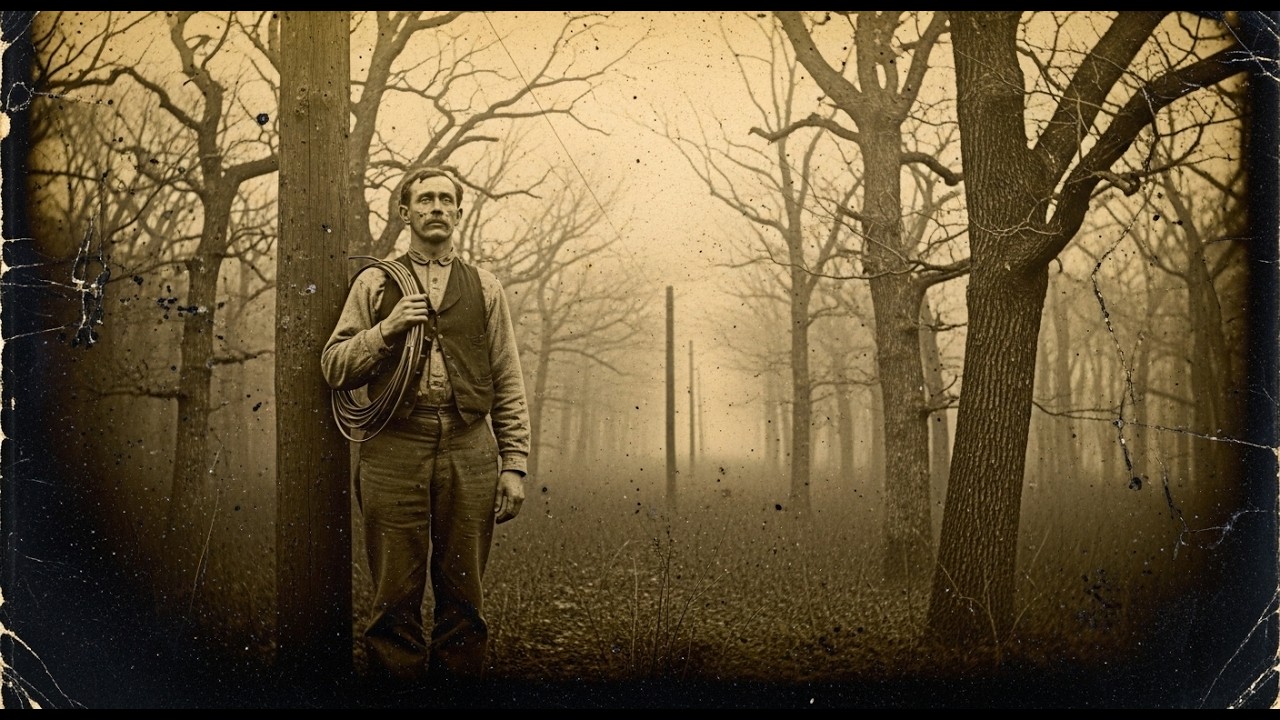
He walked for what felt like an hour. Then he saw the first structure. It was a barn, weathered to the same gray as everything else. The doors hung open, perfectly parallel to each other. The darkness inside was absolute, and it seemed to have depth, as if it extended far beyond where the back wall should have been.
Caulfield heard a sound from inside the barn. It was not distinct, just a sense of movement, as if something large had shifted in the darkness. He kept walking, giving the barn a wide berth.
More structures appeared as he moved forward. Houses. A church with a leaning steeple. A general store with black windows. A blacksmith’s shop with the anvil still in place. Caulfield realized he was walking through a town that was not on any map.
The town was eerily preserved. Rocking chairs sat on porches as if someone had just stood up. Curtains were pulled aside as if someone had been watching the street. Laundry hung on lines, faded but not rotted. Everything was arrested in a moment, like a photograph slowly dissolving.
Caulfield entered one house. The front door stood ajar. Inside, a table was set for a meal that had never been eaten. A Bible lay open on a side table. The bed was made, the blankets pulled tight. In the kitchen, pots hung from hooks and a pump stood over a dry sink. Everything was neat and in its place, as if the occupants had intended to return.
At the center of the town, he found a stone well. The rope and bucket looked new. Caulfield looked over the edge and saw nothing. Not darkness, not water, not an empty shaft. Just nothing. An absence so complete that it hurt to look at, like a hole punched through reality itself.
He stumbled back from the well and continued following the telegraph line. It led him to a two-story building with a sign above the door. It read Harrow Valley Hotel. The door stood wide open.
Caulfield stepped inside. The interior was darker than it should have been, even though it was still afternoon. Books covered the floor, scattered everywhere. He picked one up. The pages were blank. He checked another. Also blank. Hundreds of books, all blank, all scattered as if thrown in a frenzy.
Then he heard footsteps from upstairs. Slow, measured, deliberate. Walking back and forth across the floor directly above his head. The rhythm was subtly wrong, as if the thing walking had legs that bent at different angles than human legs.
Caulfield looked at the walls. They were covered in handprints. Hundreds of them, pressed into the wallpaper and wood paneling. The fingers were too long, and the number of fingers varied from print to print. Five here, seven there, six, eight. And every single handprint was pointing toward the staircase.
He ran. He burst out of the hotel and ran down the main street, following the telegraph line in reverse. When he finally stopped to look back, the town was gone. The mist had thickened, and the buildings had vanished. He knew they were there. He had just been walking through them. But he could not see them anymore.
Night was falling, and Caulfield realized he could not make the climb back up the ridge in the dark. He found a telegraph pole that was still standing straight and sat down with his back against it. He forced himself to eat some hardtack and drink from his canteen.

As darkness fell, he saw shapes moving in the mist. They were human-sized but moved with that same wrong gait he had heard in the hotel. They circled him all night, coming closer as the hours passed. Sometimes he could see features, pale elongated faces with dark holes for eyes, hands reaching, limbs with too many joints.
He fired his rifle once at something that came within 10 feet. The shot was swallowed by the mist without an echo. Whatever he had aimed at melted away, but others took its place. He realized his bullets could not hurt these things.
Caulfield did not sleep. He kept his eyes moving, never focusing on any single shape. He had the terrible certainty that if he looked too closely, he would understand what they were, and that understanding would break something fundamental in his mind.
As the night wore on, a theory formed in his mind. The town was not a real town. It was a construct, a trap meant to draw the things in the mist to one place. The buildings were bait. The telegraph line was a warning system. Someone had discovered this valley and tried to contain what lived there. Something had gone wrong.
Dawn came eventually. The shapes retreated as the light increased. Caulfield stood on legs that barely held his weight and started walking toward the ridge. He did not follow the telegraph line. He did not care about the job anymore. He just wanted out.
He reached the ridge top and found Bess exactly where he had left her. He saddled the mare and rode hard, not stopping until the forest around him sounded normal again, until he could hear birds and wind and the rustling of small animals.
He reached Thorngrove four days later, coming in from the west. Silas Pemberton saw him first and asked what had happened. Caulfield only said that the line could not be repaired and recommended abandonment.
He sent a telegram to his supervisor in Little Rock. It read: “Harrow Valley line irreparable. Recommend permanent abandonment. Do not send anyone else. Request immediate reassignment.”
His supervisor demanded a full report. Caulfield ignored the demand. He packed his belongings, sold Bess to a local farmer for half her worth, and bought a ticket on the next train heading east.
Before he left, he went to the town’s small library and searched through old documents. He found a survey from 1862 that showed the valley marked clearly. Beside it, in faded ink, someone had written: “Site of settlement. Population est. 83. Abandoned autumn 1861. Cause unknown. Area considered dangerous.”
He found a journal entry from a circuit preacher who had traveled through the region in 1857. The preacher wrote about locals calling the valley cursed. He described a hunter who had gone in and seen shapes moving in the mist that looked human but were not. The hunter said he could feel something chasing him, could hear footsteps that matched his own but were slightly off rhythm.
Then Caulfield found a letter dated April 6th, 1883. It was from someone identified only as J. Mordecai, Chief Engineer, Department of the Interior, addressed to Colonel Ashford Thorne of the War Department. The letter discussed containment measures enacted at a site called Harrow Valley. It mentioned the construction of structures meant to attract and centralize anomalous entities. It described the installation of a telegraph-based early warning system.

The letter ended with a recommendation that the site be classified and that civilian access should never be permitted.
Caulfield sat holding copies of these documents with trembling hands. Someone had known. The government had known. They had built that fake town as a trap or a cage. And the warning system had failed, and he had been sent in to repair it without any idea what he was walking into.
He left Thorngrove on a Tuesday morning in mid-October. He ended up in St. Louis, where he found work as a telegraph operator for a shipping company. He took a room in a boardinghouse and kept to himself. He never spoke of what he had seen.
But he never forgot. Some nights, when mist rolled in off the Mississippi River, he would stand at his window and watch it move through the streets. He would remember the shapes that circled him in the darkness, the hotel full of blank books, the well that opened onto nothing.
In 1902, 15 years after his experience, a telegram came through addressed to him personally. It was unsigned, sent from a telegraph station in Little Rock. It contained only six words: “The wire has gone silent again.”
Caulfield burned the telegram in his ashtray. That night, he pulled out the notes he had made in the Thorngrove library and read through them again. He found nothing new. Just fragments.
Over the following weeks, he tracked news from Arkansas. He found small items about hikers going missing near the Ozarks, livestock disappearing from farms near the mountains, a surveyor who abandoned his job after experiencing what he called unnatural phenomena. Nothing concrete. But Caulfield knew. The valley was growing.
Vernon Caulfield died in 1923 at the age of 74. The doctor said it was heart failure. But those who found him said his face was twisted in an expression of terror, and his eyes were open, staring at something in the corner of the room that no one else could see.
Among his belongings, the boardinghouse owner found maps covering the walls of his room. Each one showed the Ozark Mountains with a certain area circled in red ink. In the center of all those circles was a valley. The Harrow Valley.
The boardinghouse owner thought they were the scribbles of an old man losing his mind. She burned them along with his notes. She had no way of knowing she had destroyed the only remaining detailed record of a place the government had been trying to erase from official documents since 1883.
The Harrow Valley still exists. The entire region was purchased by the federal government in 1938 and declared a protected wilderness area, permanently closed to public access. The official reason was conservation.
But there are reports from park rangers stationed at the boundary. Reports of signal disruptions that cannot be explained by weather or equipment failure. Reports of sections of forest where wildlife refuses to go. Reports of mist that pools in the valley floor even on clear days, moving against the wind.
There are incident reports about hikers who crossed the boundary and came back changed, unable to articulate what they experienced, waking up screaming for months afterward. Some of them walked back into the woods weeks or months later and were never seen again.
A memo from 1987, exactly 100 years after Vernon Caulfield’s visit, recommended that the exclusion zone be tripled in size and that aerial surveillance be increased. The memo does not explain what necessitated these measures.
The Harrow Valley is waiting. It has all the time in the world.