In Nazi propaganda, Magda Goebbels was presented as the perfect mother and the first lady of the Reich. Her six blonde children and her household were held up to the German public as the model of Aryan family life. On the night of May 1st, 1945, she murdered all six of them in Hitler’s bunker.
The horror of Magda Goebbels is not what most people assume. Many believe her husband, the propaganda minister, drove the decision to kill the children. He did not. She did. Understanding why she made that choice reveals a story stranger than a simple Nazi fanatic going down with the ship.
Before she was Magda Goebbels, she was Magda Friedländer. Born in Berlin in November 1901 as Johanna Maria Magdalena Behrend, her early life pointed toward a very different future. In 1908, when she was seven, her mother remarried a wealthy Jewish businessman named Richard Friedländer. He adopted her, gave her his name, and for the next decade she was known as Magda Friedländer.
Her upbringing was cosmopolitan. She attended a Catholic Ursuline convent school in Belgium, learned fluent French, and moved in circles that were the exact opposite of Nazi ideology. As a teenager, she fell in love with Haim Arlosoroff, the brother of a classmate. He was a brilliant young Jewish student who would become a prominent Zionist leader.
According to people who knew them, Magda wore a Star of David around her neck. She began learning Hebrew. She wanted to marry him and convert to Judaism. For a brief moment, she even considered following him to the Middle East to help build a Jewish homeland.
Of every Nazi wife who ever existed, not one has a biography that makes her eventual ideological commitment more incomprehensible than Magda’s. She was the Nazi wife who, on paper, should have been anything but a Nazi wife. The question of what she did in that bunker does not start with her fanaticism. It starts with how she ever got to fanaticism in the first place.
There is a second assumption worth breaking. Most people assume Joseph Goebbels was the zealot who decided the children had to die. The surviving record does not support that version. SS dentist Helmut Kunz, who was in the bunker during the final days, testified after the war that it was Magda who pulled him aside on April 27th, 1945, and asked him to help kill the children.
According to her former sister-in-law, Ello Quandt, Magda had been contemplating it a full month before. It was Magda who refused every offer to get the children out of Berlin. Her own farewell letter, written from the bunker, opens with an admission that she was staying against her husband’s will. Joseph had wanted her to leave. She refused him.
On the question of whether the children lived or died, Joseph Goebbels was not the driver. He was the follower.
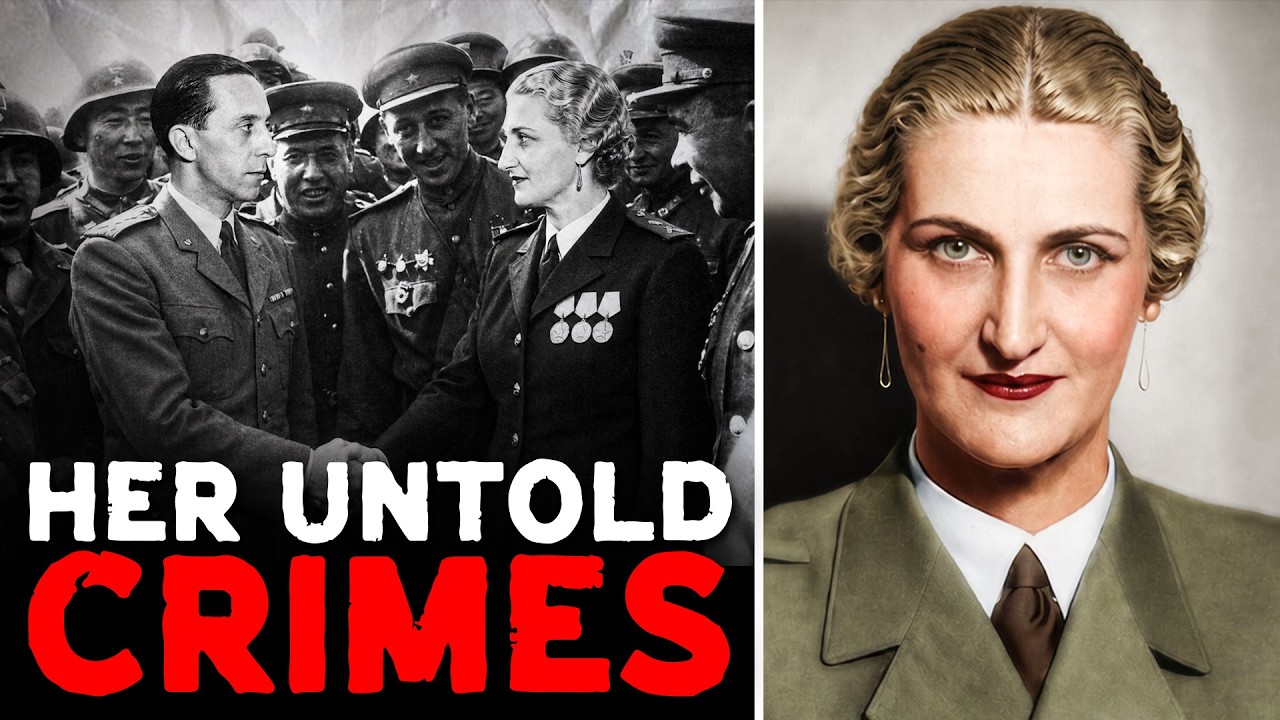
So how does a woman who learned Hebrew for her Jewish first love end up murdering her six children for the Führer? The answer is a decade-long conversion that starts with boredom. At 19, Magda married Günther Quandt, one of the wealthiest industrialists in Germany. He was more than twice her age. Before the wedding, he insisted she drop the Jewish-sounding Friedländer name.
She became Magda Quandt. For most of the 1920s, she lived the life of a rich German wife, had a son named Harald, and slowly stopped loving her husband. The divorce came in 1929. What she did next, she did by her own later description, out of restlessness.
In 1930, adrift in Berlin and looking for something to believe in, she started attending Nazi rallies. She heard Joseph Goebbels speak. The chemistry was immediate and intense. But the moment she walked into the inner circle, she became fixated on Hitler himself.
She and Goebbels married in December 1931 with Hitler serving as one of the two official witnesses. The children began arriving almost immediately. They were photographed, displayed, and folded into the regime’s image making from the moment they were born.
Hitler had no wife and no family of his own to hold up to the German public. The Goebbels family was engineered to fill that gap. The children Magda would later kill were, from the moment they were conceived, political objects.
The names tell the story. Helga, Hildegard, Helmut, Holdine, Hedwig, and Heidrun. Six children, every one with a name starting with H. The pattern has been read as a tribute to Hitler. Historians have noted one complication: Magda’s first husband also named his sons with H names, so the pattern may have started innocently before she leaned into the symbolism.
What is not contested is how those children were used. The Goebbels family was the most photographed household in Germany. They appeared on magazine covers, in newsreels, and at state occasions in matching outfits with matching hair. Magda sat at the center of that image like a marble statue. The children were the proof of concept for everything the regime claimed to be.
They had become the Reich’s children. Their value in Magda’s worldview was inseparable from the regime that had elevated them. If the Reich ended, what the children represented ended. And if what they represented ended, in her thinking, so did any reason for them to continue.
By late April 1945, Berlin was falling. The Red Army was closing in from the east, the Americans and British from the west. Inside the bunker, offers started arriving. Albert Speer offered to take the children out of the city himself. Magda turned him down. Karl Gebhardt, an SS-Gruppenführer, also offered to evacuate them. She refused.

According to Magda’s own farewell letter, Hitler tried on the final Sunday of his life to get her to leave. He wanted her out. She told him no.
On April 26th, test pilot Hanna Reitsch landed near the Brandenburg Gate and made her way into the bunker. She spent two full days below ground. She sat with the children and sang with them. She begged Magda to let her fly them out in her small aircraft. Magda refused her too.
According to Reitsch’s later testimony, Magda did something stranger than refuse. She asked Reitsch to stop her if she wavered. At the moment when every human instinct should have been pulling in one direction, Magda was worried about being pulled toward her children’s survival. She was pre-arming the people around her to prevent it.
What happened in the bunker on May 1st was not a last resort. It was a choice made with alternatives on the table and people pleading with her to take them.
The clearest window into her thinking is a letter she wrote in the final days of April. It was addressed to Harald Quandt, the 23-year-old son from her first marriage. Harald was sitting in an Allied POW camp in North Africa. He had no idea what was about to happen.
In the letter, Magda told him that the world coming after the Führer and National Socialism was no longer worth living in. She wrote that she was going to take the children with her because they were too good for the life that would follow. She wrote that a merciful God would understand her when she gave them, as she put it, the salvation.
The language is the language of sacrament, purity, and grace. She framed what she was about to do as the final act of loyalty. There was no wavering, she told Harald, because being able to end their lives alongside the Führer was, in her own words, a grace of destiny.
Read that again with what she was actually describing. She was describing the premeditated murder of Helga, aged 12, Hildegard, aged 11, Helmut, aged nine, Holdine, aged eight, Hedwig, aged six, and Heidrun, aged four.
This is the part of the story most people get wrong when they imagine her collapsing under strain. She wasn’t collapsing. The letter is composed and clear. She had decided, and having decided, everything that followed was logistics.

The Goebbels children had been moved into the bunker on April 22nd, 1945. For nine days, they lived underground. They sang, played, and wrote notes to their father. The adults around them described them as cheerful. They did not know what was coming.
Hitler killed himself on the 30th of April. The following evening, around 20 minutes to nine, Magda went to the children’s room. She dressed the girls in long white nightgowns. She combed their hair and tied ribbons. She told them that because they would have to stay in the bunker for some time, the doctor was going to give them a vaccination against an illness going around.
Helmut Kunz, the SS dentist, administered morphine injections to put them to sleep. Once the children were unconscious, Magda, accompanied by Hitler’s physician Ludwig Stumpfegger, placed a cyanide capsule between each child’s teeth and crushed it. She did this six times.
Witnesses who saw her come back up afterward described her as pale and silent, her face frozen. She sat down at a table and began sorting out a game of playing cards. She did not cry.
The Soviet forensic team that entered the bunker on May 2nd opened autopsy file number 1477. Five of the six children showed signs of having died in their sleep. The sixth, Helga, the eldest at 12 years old, had visible bruising on her face. Investigators interpreted that bruising as evidence that she had woken up, or partially woken up, while the cyanide was being administered and had to be physically overpowered. She was old enough to understand what was happening.
Helmut Kunz did not die in the bunker. He was captured above ground by the Red Army on May 2nd, 1945. He spent seven years in Soviet investigative detention. In February 1952, a Moscow military tribunal sentenced him to 25 years in a labor camp. He served three of those years.
In October 1955, as part of a negotiated repatriation of German prisoners of war, Kunz was released and returned to West Germany. A new investigation was opened against him in 1959 on six counts of aiding and abetting homicide, one for each child. The West German court declined to convict.
Kunz returned to his dental practice in the small Black Forest town of Freudenstadt. By his patients’ accounts, he was well-liked and gentle. He died a free man on September 23rd, 1976.
The deeper point is about Magda. Ideology strong enough to override the most primal instinct a mother has is not the mystery of some rare, uniquely evil human being. It is a mechanism. And it is a mechanism available to ordinary people.
Magda’s worldliness, her Catholic education, her Jewish adoptive father, her Zionist first love. None of those things turned out to be protection. Whatever protection exists, it was never going to live inside her personal history.
There is one person left in this story. Harald Quandt, her surviving son, was the one child who lived because he happened to be somewhere else when the bunker went dark. He received his mother’s farewell letter in captivity. After the war, he came home, inherited a piece of the Quandt industrial empire, and became one of the wealthiest men in post-war Germany.
For the rest of his life, he kept photographs of his half-siblings on display. He died in a plane crash in 1967 at the age of 45.