The story of Dunkirk is often remembered as a story of defiance and heroism. While the evacuation of hundreds of thousands of troops was a monumental feat, the reality around the city was far darker. The beaches were scenes of chaos, but the fighting inland was brutal, and for many British soldiers, the war ended not in rescue, but in execution.
While around 330,000 soldiers were saved to fight another day, the cost was immense. The British Expeditionary Force was forced to abandon vast amounts of tanks, vehicles, and equipment to the advancing enemy. For every seven men who escaped the shore, one became a prisoner of war. These prisoners were subjected to brutal treatment and forced marches toward Germany, with many killed along the way.
There were also specific accounts of British soldiers being executed by German forces, particularly the SS, in the area surrounding Dunkirk. To allow the evacuation to succeed, troops had to hold the line against a rapidly advancing German army. The situation was desperate, but a strange order from Hitler halted the ground advance, leaving the Luftwaffe to destroy the trapped Allied forces from the air.
On May 27, 1940, as the British fought to reach the Dunkirk perimeter, the SS Division Totenkopf carried out the Le Paradis massacre. They used machine guns to execute 97 British and French prisoners near the La Bassée Canal. The prisoners were from the 2nd Battalion of the Royal Norfolk Regiment. The SS lined the men up against a barn wall and opened fire, leaving only two survivors.
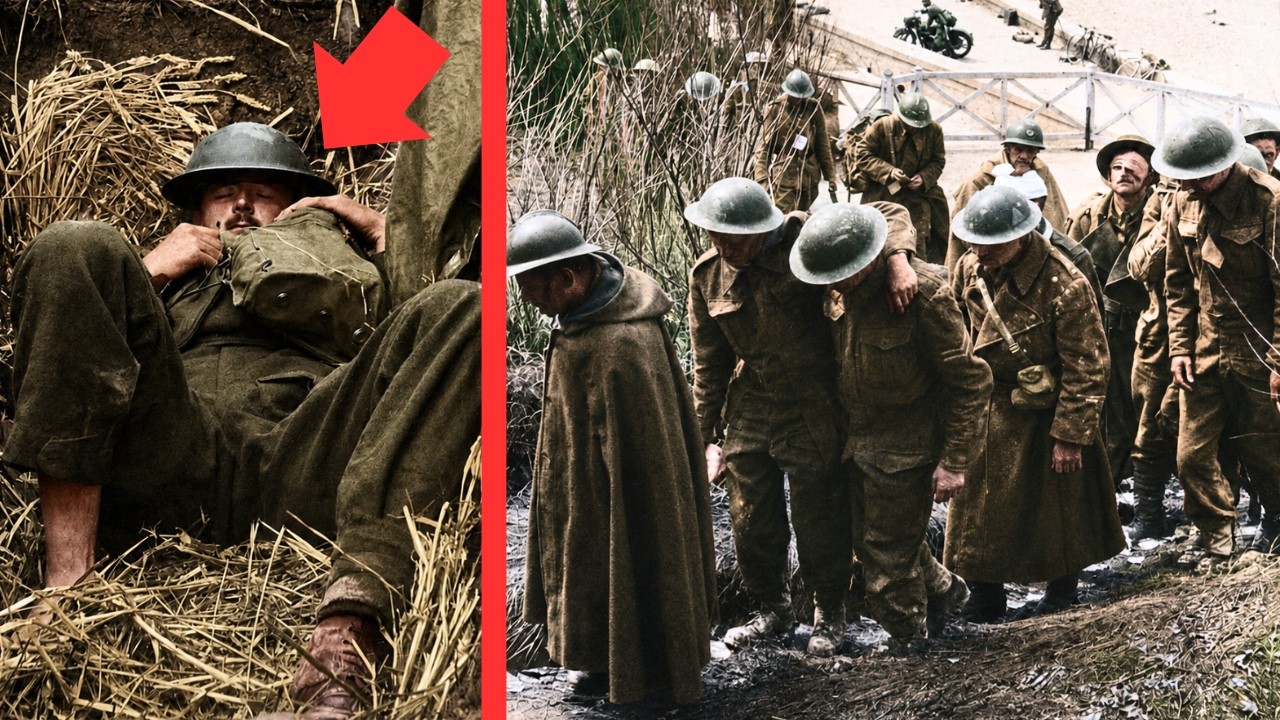
One survivor recalled the moment of terror, describing how the column was turned into a meadow where heavy machine guns were aimed at them. As the guns opened fire, men fell like grass before a scythe. The wounded men’s cries mixed with the gunfire, and the survivor fell beneath a pile of dying men, vowing that the perpetrators would pay if he ever got out alive. The executed men were unarmed and posed no threat whatsoever.
After the massacre, the Germans forced French civilians to bury the bodies in a shallow mass grave. A witness later described seeing the British bodies lying in the yard, their uniforms indicating they had been killed by machine gun fire. The dead soldiers were not wearing helmets and had no equipment.
The fighting around Dunkirk continued fiercely. German General Erwin Rommel proved effective, surrounding five divisions of the French First Army. These men defended for four days, saving an estimated 100,000 Allied soldiers. The Germans even acknowledged their defense, with General Kurt von Wagen honored them with a salute.
The perimeter held until the end of May, but the situation was dire. In one instance, two British commanders operated a Bren gun themselves, with one firing while the other loaded. Near Veurne, British forces were defeated, and panic set in. The Coldstream Guards had to restore order, forcing retreating men back at bayonet point and even firing on those who refused to hold the line.

In total, between 30,000 and 40,000 French soldiers were forced to surrender, many arriving at the port too late to be evacuated. The last British troops to leave were part of the rearguard fighting German attacks on June 1, with these forces evacuated on the evening of June 2.
There were other executions of British troops after capture. For a long time, it was believed the only victims of the SS Totenkopf were the 97 men killed at Le Paradis. However, French civilians later uncovered a mass grave containing the bodies of Scottish soldiers. All the men showed signs of execution, having been shot in the head or the back of the neck.
This method of shooting, known as *Genickschuss*, was used by the Germans during the war to execute prisoners and innocents. An officer of the Royal Norfolk Regiment later documented this in his war diary. A German postman also claimed a colleague told him about the capture of 17 British soldiers hiding in an area occupied by the Royal Scots.
After their capture, the prisoners were taken to an SS battle headquarters. A witness claimed to have seen them all killed, meaning they were shot and executed in the field. Another German soldier later reported a field execution of a single British soldier near Le Cornet Malo, a village in the Royal Scots’ sector. The man was reportedly a sniper who had shot at SS soldiers before being overpowered. He was executed because his skills were considered too dangerous.

These actions were clear war crimes. The Royal Scots were part of the 4th Brigade, one of the rearguard units that stopped the German advance at the Dunkirk perimeter. Few of these men returned to Britain, and by the end of the evacuations, 292 Royal Scots had been captured and became prisoners of war.
The men fought hand-to-hand in horrific conditions, inflicting heavy losses on the enemy and damaging the morale of the SS Totenkopf division. This may have been another reason the German forces executed their prisoners, perhaps as revenge for the casualties they had suffered.
Later, SS commander Fritz Knöchlein was tried for war crimes for his involvement in the Le Paradis massacre. He was accused of ordering the executions that killed around 90 prisoners of war. He was sentenced to death and hanged within the walls of Hamelin Prison. He was the only man ever convicted or tried for his involvement in that specific massacre.
Dunkirk was a war zone in every sense. While 330,000 soldiers were successfully evacuated, the city witnessed immense horror, death, and executions. German forces carried out repeated massacres of prisoners, possibly driven by frustration after being held off by Allied defenses. The executions at Le Paradis and later against the Royal Scots were examples of the brutality and war crimes committed by the SS from the very beginning of the conflict. This pattern of terror would continue as SS divisions committed further atrocities wherever they went.