Farah Pahlavi was crowned empress of one of the world’s most affluent thrones. Four decades later, she had buried two of her four children. One died in a London hotel room at 31. The other took his own life in a Boston-area home at 44.
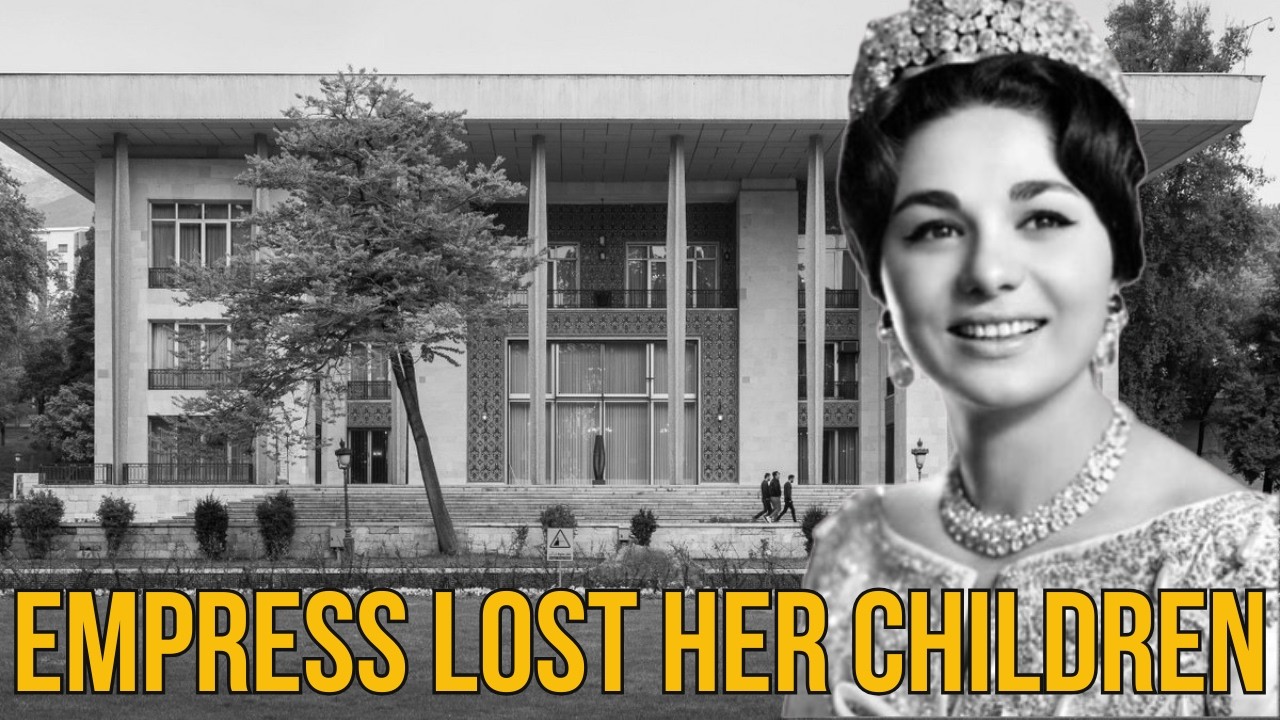
The same mother traveled to both places, carrying the same grief and the same impossible question that no crown, fortune, or title has ever been able to answer: how does a woman outlive children she once watched run through palace gardens that no longer exist? Farah was the last Empress of Iran. She had four children: a crown prince, two princesses, and a quiet, scholarly prince. They were born to inherit an empire that had stood for 2,500 years.
Instead, they inherited exile, silence, and a grief that would follow them one by one once the world stopped looking. Farah was not born into royalty, a fact that shaped everything that followed. She arrived in Tehran on October 14, 1938, into a comfortable but ordinary family. Her father, Sohrab Diba, was an army officer educated in France.
Her mother, Farideh, came from a respected Azerbaijani family. They were not poor, but they were not monarchs either. When Farah was nine, her father died. The money ran out and the big house disappeared.
Farah and her mother moved in with relatives, sharing rooms and counting expenses. The girl who would one day own some of the world’s most precious jewels learned early what it meant for everything to collapse beneath her family’s feet. She threw herself into her studies instead of self-pity. She was tall, athletic, intelligent, captain of her school basketball team, and a determined student.
In 1957, she did what few Iranian women of her generation had done: she traveled to Paris alone to study architecture at the École Spéciale d’Architecture. She wanted to design buildings. She lived on a student budget in a cold city, drawing plans by lamplight. Then in 1959, the most powerful man in Iran walked into the room.
Mohammad Reza Shah was visiting Paris, carrying his own private crisis. He had been married twice. His first wife gave him a daughter before they separated. His second wife, Soraya, was beautiful and deeply loved, but she had not produced a son, and the empire needed an heir.
He divorced the woman he loved for the future of his dynasty. He arrived in Paris wounded, looking for a partner and desperately wanting a child. He met Farah at a reception. She was 20; he was 40.
The courtship moved quickly. By November they were engaged, and on December 21, 1959, they married in Tehran. She wore a dress designed by Yves Saint Laurent for Dior and a crown of diamonds. The scholarship student who had shared an apartment became Queen of Iran.
But everyone—the court, the country, the Shah himself—asked only one question: would she produce a son? On October 31, 1960, came the answer. Royal births were announced by cannon fire: 21 shots for a daughter, 101 for a son. Across Tehran, people stood in the streets counting.
The crowd held its breath as the shots continued past 21, past 60, into the 80s and 90s, until the 101st shot rang out. Farah had given birth to a son, Crown Prince Reza. The dynasty had its heir. Over the next ten years, Farah gave the Shah three more children: Princess Farahnaz in 1963, Prince Ali Reza in 1966, and the youngest, Princess Leila, in 1970.
Four children in a golden nursery at the heart of the Peacock Throne. But Farah refused to be merely decorative. She built schools and clinics, championed Iranian art, and brought ancient artifacts back from foreign museums. In 1967, the Shah did something no Iranian monarch had done in modern history.
At his coronation, he placed a crown on her head, named her Shahbanou, Empress, and declared her regent—the woman who would rule if he died before their son came of age. She had risen from a shared room in mourning to the second most powerful position in the Middle East. Then came the day she would later describe as the happiest of her life. October 1971, Persepolis.
The ruins of the ancient Persian capital glowed in the desert night. The Shah staged a celebration of 2,500 years of Persian rule—the most lavish event of the century. A tent city rose from the sand, designed by French decorators. Food was flown in from the finest Parisian restaurants.
Sixty kings, queens, and presidents arrived to honor Iran. There, surrounded by emperors, stood Farah with her husband on his throne and her four young children in white as the desert glittered gold behind them. In that moment, she believed completely. That this would last forever.
That her children would inherit everything. It was the last time the family would be whole, safe, and untouchable. Beneath the gold, the ground was already cracking. The celebration that dazzled the world enraged millions of Iranians living on far less.
The spending, the foreign guests, the vast distance between palace and street—all of it hardened into deep resentment. The four children grew up behind walls and under heavy guard, tutored in French and English, moving between armored cars, showered with love but kept at a cautious distance from the country they were promised. They knew the palaces but barely knew Iran. Meanwhile, the Shah himself kept a secret.
In the mid-1970s, French doctors privately told him he was ill. Cancer. He told no one for years—not his ministers, not his generals, not even Farah. He smiled for cameras while the disease grew inside him, ruling an empire running out of time faster than he was.
For a few more years, the illusion held. In the mid-1970s, oil money flowed into Iran, and the family lived in abundance. Reza, the heir, was a confident teenager already training as a fighter pilot. Farahnaz was quiet and cautious.
Ali Reza was bright and restless, the boy who asked too many questions. Leila was the sparkling youngest child, doted on by everyone, a little girl dancing through palace halls that seemed as though they would be hers forever. They had private tutors, horses, summer palaces, a mother who adored them, and a father who was king of the world. The revolution began in 1977 with protests and strikes, crowds that grew instead of dispersing.
By 1978, the country was burning with anger—students, clergy, workers, all turning against the regime at once. On September 8, 1978, soldiers fired on demonstrators in Tehran. The day became known as Black Friday. After that, there was no turning back.
The Shah, the man who was supposed to be unyielding, was collapsing physically and mentally. The cancer he had hidden for four years was consuming him. He hesitated when he should have moved, softened when his generals begged him to be firm, and the revolution read his weakness like a headline. The children watched their father, the King of Kings, grow pale and indecisive at the dinner table.
On January 16, 1979, it was over. The Shah and Farah boarded a plane to leave Iran, officially for a vacation. Everyone at that airport knew it was a lie. An officer threw himself at the Shah’s feet, kissing them and begging him not to go.
The Shah bent down, weeping, and scooped up a handful of Iranian soil to carry with him. Farah climbed the stairs in a dark coat and turned once to look at the country she had ruled. Then the door closed. None of them would ever see Iran again—not the parents, not one of the four children.
What followed was not exile in the grand sense but a humiliating search from country to country for anyone willing to host a fallen king. Egypt received them briefly, then Morocco, then the Bahamas, where rent was high and the welcome cold. Then Mexico. The family that had hosted sixty heads of state now packed and unpacked like migrants, dragging four frightened children across borders and watching former friends stop taking their calls.
Then the cancer forced the worst decision of all. In October 1979, gravely ill, the Shah was admitted to the United States for treatment. Iran exploded. Enraged that America had taken in the man they had overthrown, students stormed the U.
S. Embassy in Tehran and took 52 American hostages. Overnight, the dying man became the most radioactive person on earth. The United States, which had just admitted him, began looking for a way to expel him.
The family fled to Panama, then back to Egypt, where President Sadat, almost alone in the world, gave them dignity and a place to stop running. There, in Cairo, came the first death. On July 27, 1980, Mohammad Reza Pahlavi died. Cancer, exile, and exhaustion had finally finished what the revolution began.
He was 60. Farah was at his side. So were the children: Reza, 19; Farahnaz, 17; Ali Reza, just 14; and Leila, only 10, standing at her father’s funeral in a black child’s dress, watching soldiers carry the body of the man who had once been the center of her world. Imagine what that day did to those four.
They lost not just a father but the only fixed point in a life that had already lost its country, its language, its future, its home. Their father was the last proof that the old world still existed. Now he was in a grave in Cairo, and they were teenagers and children without a nationality, carrying famous names and no country to belong to. Each of them carried that burden differently, and how they carried it would silently determine who survived.
Reza, the eldest, turned it into a mission. At 20, he declared himself his father’s heir and built his entire life around the promise of return. He had something to fight for. Perhaps that saved him.
Farahnaz withdrew into herself. The cautious girl became a reclusive woman studying psychology, avoiding cameras, building a wall of silence so complete that the public still knows almost nothing about her inner life. Ali Reza absorbed it like a wound that would not heal. Brilliant and sensitive, he threw himself into the study of ancient Iranian history—the civilization his family had ruled and then lost.
He went to Princeton, then Columbia, then Harvard, surrounding himself with the glory of ancient Persia precisely because the living version had been taken from him. The grief did not fade; it deepened and waited. Leila never left her father. She was 10, old enough to remember the gardens, the dancing, the palaces, and young enough to have all of it torn away before she could understand why.
She idolized the man in the grave. She measured every year against the perfect childhood that had ended without warning. Outwardly, Farah managed the family with extraordinary composure. She wore black and kept her back straight.
She moved them to the United States, established a home in exile, preserved the family name. Before cameras, she was the dignified widow, calm, unyielding. Behind that composure, the wounds went untreated. There were no more thrones to fight for, so grief had nowhere to go but inward.
The press lost interest. The Shah’s death was old news, and his children were just sad remnants of a fallen regime. No one was watching the two youngest. No one saw the little girl push her food around her plate and then push it away.
No one counted the years depression was quietly taking root in a teenager in a New England library. The family that had survived the revolution convinced itself the worst was over. They had buried the father. They had escaped with their lives.
Surely this was the bottom. It was not, because losing their father was not the worst thing that would happen to this family. Two of the four children were carrying a wound that neither exile, nor doctors, nor passing years would heal. For a time, exile settled into something that looked like peace.
By the 1990s, the family had homes in the United States and Paris. Reza married, started a family, began his political life. Farahnaz studied and kept to herself. There were birthdays, dinners with everyone at one table, photos of the four adult children standing around their mother, smiling.
Some of those smiles were real. Leila was the brightest in those rooms, the youngest, now tall and striking with her mother’s dark eyes. She briefly worked as a model for Valentino. She moved between Paris, London, and New York—the beautiful exiled princess the magazines loved to photograph.
From the outside, she seemed to have landed gently. She had not. It began with food, as it often does. Gradually, a meal would be skipped, a plate pushed half an inch away, then farther.
Leila carried something from that childhood the others could not reach: the memory of standing at her father’s funeral at age 10, and the palace gardens that existed only in her mind. She worshipped the dead Shah. She measured her entire life against the perfection that had ended in childhood. The gap between the two kept widening, and food, sleep, and stability sank into it.
By her late 20s, she was being treated for severe depression and an eating disorder. She moved between clinics and hotels. She grew thin, then terrifyingly thin. Her mother traveled to her, sat with her, begged the doctors, begged her daughter.
Farah later wrote that watching Leila disappear was an agony she had no power to resist. Then came June 2001, London, the Leonard Hotel in Knightsbridge. Leila checked into a quiet suite. She was 31.
She was so exhausted that sleep would not come. Over the following days, she took her prescribed pills—and more than prescribed. On the morning of June 10, she did not come down. She did not answer.
They found her in her bed. She looked, they said, as though she were sleeping. The coroner’s report was precise and brutal: Leila died from the effects of an overdose of barbiturates with cocaine. One of the drugs in her system was about five times the therapeutic dose.
The verdict stopped short of suicide. A young woman, severely ill, deeply depressed, had finally taken more than her body could bear. In her hotel room, she kept photographs of her father near her. The little girl from Persepolis, in white dresses amid the desert gold, had carried that lost world for 30 years until it reached a hotel bed in a strange city.
She never let it go. In the end, its weight was more than she could carry. Farah received the call. The Empress who had buried her husband now had to travel to London to bury her daughter.
Leila was buried in Paris at the Passy Cemetery, on the soil of the cold country that had sheltered her family but was never her home. In public, Farah did what she had always done. She stood straight. She thanked people for their condolences.
She maintained the family’s dignity with the same iron self-control she had learned in Tehran 22 years earlier. In private, something broke that would never mend. A mother who had lost her child. And at the heart of that grief was a second, heavier fear she would not voice, because Leila was not the only child still carrying the wound of that lost childhood.
There was another son, quieter, older, more like her in his sensitivity. He traveled to his sister’s funeral, stood at her grave in Paris, then returned to America carrying her death on top of his own grief. The family watched him. But Leila’s death was not the worst thing that would happen to this family.
Ten years later, in a house outside Boston, the brother who had buried her made a decision so devastating that his own family explained it to the world in one carefully written sentence and refused to say anything else. Ali Reza Pahlavi was born on April 28, 1966, the second son. Where Reza chose politics and Leila chose the surface, Ali Reza chose the past. He became a serious scholar, studying at Princeton, Columbia, and Harvard, focusing on ancient Iranian languages and philology—the languages and history of pre-Islamic Persia.
His entire adult life was spent trying to recover that civilization on paper, word by word, because it could no longer exist in any other way. He surrounded himself with the glory of ancient Iran precisely because the living homeland had been stolen from him. He was brilliant, gentle, intensely private. He rarely spoke to the press, and after Leila’s death in 2001, those close to him noticed his light gradually dim.
He had loved her. He traveled to London, stood at the Passy cemetery, and absorbed her death into a grief he was already carrying: father, homeland, exile, now the youngest sister. He kept working. He kept living, outwardly.
For ten more years he held that grief. He could not hold it forever. January 4, 2011. South of Boston.
Ali Reza Pahlavi was 44. He was alone in his house. That morning, he took a gun and ended his life. There was no long note explaining a decade of pain.
There was only the silence that followed, and a family too far away to stop a pain they had grown accustomed to. The second son of the Peacock Throne, the scholar, the keeper of a lost language, was gone in a moment. His mother was not in the room again. Once more, the phone rang.
Now watch how this family, trained from childhood to suppress the message and hide the wound, chose to tell the world. His older brother, Reza, the heir, issued a statement. Instead of hiding the reason, instead of inventing a softer story, he did something almost unbearably honest. He named the grief directly.
He said Ali Reza, like millions of young Iranians, was deeply troubled by the tragedies that had befallen his beloved homeland, and that he had carried the burden of losing a beloved father and a dear sister in the prime of his youth. Despite years of trying, he finally surrendered to his sorrows. Read that again. Surrendered to his sorrows.
A royal family that had spent half a century projecting strength stood before the world and admitted that one of its sons had been slowly killed by grief, by exile, by a wound that began when he was a boy watching his father’s coffin in Cairo and never healed. That single sentence is the truth the entire story had been building toward. The tragic fate of Farah Pahlavi’s four children was not bad luck, and it was not a scandal. It was a long, patient grief, the kind that follows a family across decades and oceans and weights.
By January 2011, Farah was 72. She had buried her husband and her youngest daughter. She is the dignified empress in exile, the woman who never collapses in public. This is the loss that broke her.
She does not give long interviews. She does not perform her grief. What we know emerges gradually in later years through her memoirs, in her rare quiet conversations. She describes a darkness that will not lift.
She describes the unique horror of a mother who has lost two of her four children, standing at two graves she was never supposed to stand at. She who once counted cannon shots in Tehran, waiting to learn her child’s fate, now counts the children she has left behind. Reza and Farahnaz: two survived, two did not. A detail from that period says more than any words.
Those close to her described her as a woman living her days by willpower alone—answering letters, preserving the family name, maintaining composure in public, then stopping abruptly in private. A mother sitting with photographs. The same photographs, over and over. Persepolis, the white dresses, the desert gold, the four small children promised an empire.
She kept that photograph for 40 years. The way Leila kept it, the way Ali Reza kept it. The happiest day of her life had become the most painful thing in her life because it showed her all four of them together on the single night she believed nothing could touch them. When Ali Reza died, the press covered it simply.
The fallen prince, the second lost child. “The tragic Pahlavi curse”—that phrase began to appear. A lazy, cruel shorthand that turned a family’s real grief into a scary headline. A cursed dynasty, the hapless Pahlavis.
As if depression, exile, and the loss of a homeland were superstitions rather than causes and effects. That framing did something quietly damaging. It let the world look away. A curse is no one’s fault and no one’s lesson.
It is something you can shudder at and forget. But there was no curse. There were four children ripped from their home, their language, their future, their father before some of them were old enough to understand it. Two of them never found their way back from that.
The family understands the difference. That is partly why their silence is so total. Why Farahnaz, the surviving sister, has spent her entire life behind a wall of silence. Why Farah, when she speaks, speaks with such care.
They are not hiding a scandal. They are protecting their two remaining children from becoming headlines. But if you think this story ends with death, you are not ready for what comes next. There is a side of the Pahlavi story the survivors rarely speak about.
A child born after the tragedies, carrying the name of an empire that no longer exists, and a question Farah Pahlavi had to answer in the quietest years of her life: when you lose all of this, what is left to live for? The answer is the part almost no one knows. Who remained? Reza and Farahnaz, the eldest son and the second child, the two who found a way to carry the same wound that killed their siblings and keep walking.
Reza Pahlavi turned his grief into purpose. He never stopped advocating for a free Iran. He built his life as an exiled figurehead of an alternative future for the country that expelled him, witnessing, organizing, speaking decade after decade. A king without a kingdom who decided the work itself was worthwhile.
Whether he ever sees Iran again, his mission is almost certainly what kept him on the other side of the line his brother and sister crossed. Farahnaz chose the opposite path, also a path of survival. The cautious girl became an intensely private woman. She studied psychology.
She stayed out of the spotlight. She has revealed almost nothing to the public. That silence is not coldness; it is armor. She watched what the spotlight did to her family and decided not to feed it.
She is still here. Sometimes survival looks like refusing to perform. Then there is the part almost no one knows. The answer to the question left hanging when Ali Reza died in January 2011.
His partner, Raha Didevar, was pregnant. Six months later, on July 26, 2011, a baby girl was born. A daughter Ali Reza would never meet, born into the same exiled family, carrying the same vanished name. They named her Iryana Leila Pahlavi.
Leila. They gave her the name of the aunt who had died in a London hotel ten years before her birth. The bright light of the family was gone, and now her name was gently placed on a new life that came after the family’s darkest year. Imagine what that child meant to Farah Pahlavi.
In her worst years, she counted her remaining children: two alive, two gone. Then, out of her son’s death, a granddaughter was born. She had never expected proof that the family does not end at the graves. The empress who buried a husband and two children became a grandmother again at the exact moment she most needed a reason to continue.
That is the answer to what is left to live for. Not a throne. Not a return to Iran. A child named after the daughter she lost, born to the son she lost.
The future of this family was never going to be an empire. It was going to be these children carrying the names of the dead, and a grandmother determined that they know they are loved. Farah Pahlavi is still alive today. She is 87, dividing her time between the United States and Paris, near the cemetery where Leila rests.
She has outlived her husband and two of her four children. She has lost a homeland, a crown, two homes, and half her family. And still, by the account of everyone who meets her, she remains composed, gracious, and solid. She wrote her memoirs.
She tells her children’s stories so the world remembers them as people, not as a curse. She keeps the photographs. She keeps the names alive. When asked how she bears the pain, she does not pretend she is not hurting.
She has said, briefly, that a mother who loses a child loses a part of herself that never returns, and that she lives with that absence every day. But she also speaks of her surviving children, her grandchildren, and her hope for Iran. She refuses to let despair be the end of the story. That is the true legacy of the last Empress’s four children.
Not jewels, not a throne. A mother who decided to remember them with precision and tenderness, aloud, as the final act of love available to her, and she has spent the rest of her long life performing it. Two of her children were lost to the world far too early. Two are still alive, and a little girl born from grief, named after her late aunt, carries it all forward.
So return to that photograph. Persepolis, 1971. The desert glittering gold, the Shah on his throne, Farah surrounded by four small children in white, on the night she believed nothing could touch them. She was right about one thing.
That night would last forever. But not the way she meant. It would last as a photograph she would hold onto in the hardest moments of her life. The last time they were all together.
Leila, the tender one, who carried the weight of her lost childhood until it crushed her. Ali Reza, the scholar, who tried to recover a vanished world but finally surrendered to its loss. Reza, who turned his grief into a message. Farahnaz, who turned her grief into silence.
Four children who inherited an empire, were exiled instead, and a mother who buried two of them and refused to let the world turn them into a curse. It was never a curse. It was generational grief.
And the only thing stronger than it, in the end, was a mother who kept calling their names.