At age 77, Helen Clay Frick walked into a Pennsylvania courtroom to sue a historian over three sentences in a 400-page book. Her father, Henry Clay Frick, was the steel tycoon held responsible for one of the deadliest labor strikes in American history. She had inherited a fortune larger than that of any other unmarried woman in the country—enough to build a park, a library, and an entire museum. But there was something all that money could never buy.
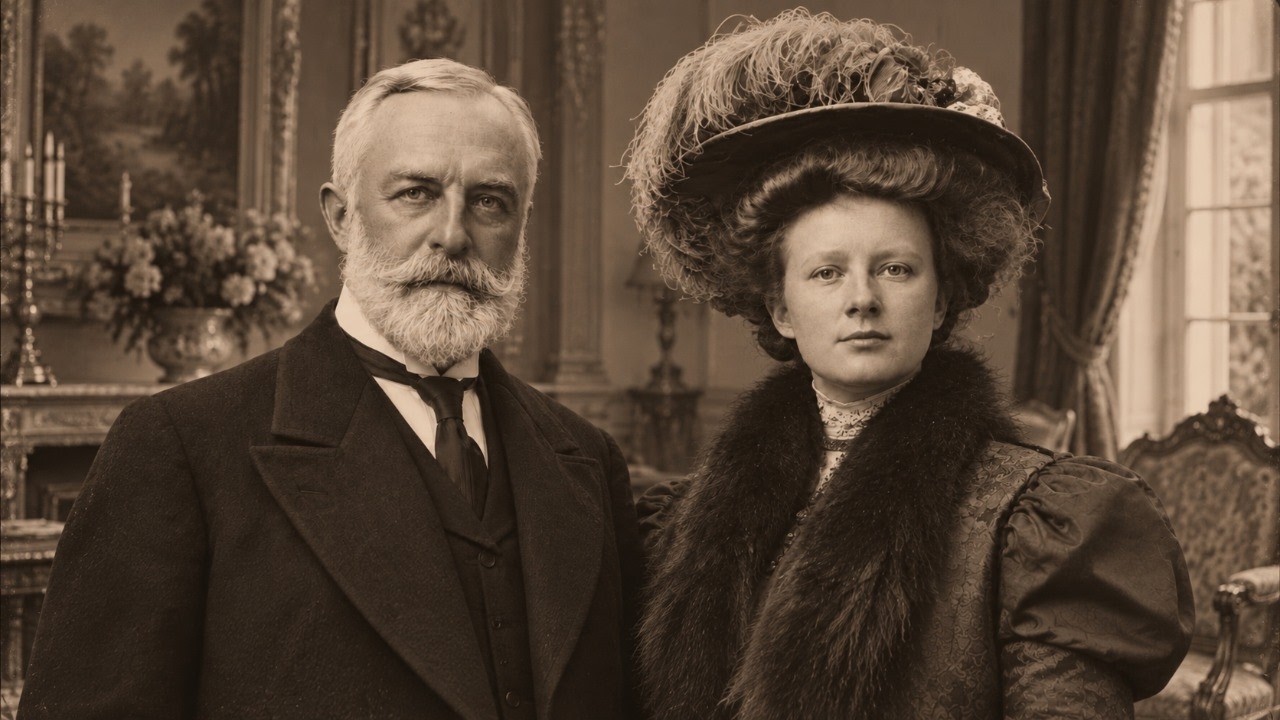
The story begins in Pittsburgh, in a 23-room house on a street once known as “Millionaires’ Row. ” The home has remained unchanged for more than a century in every way that truly matters. Its owner died in 1919, yet the house never stopped obeying him. Upstairs, a bedroom remains exactly as it was in 1891, when a child of the family died there and her father issued a single instruction: nothing in that room was ever to be moved.
The man who gave that order was one of the most powerful industrialists America ever produced, and for a time, one of the most hated. A year after his daughter’s death, an assassin entered his office with a gun and a knife. He survived. Within a week, he was back at his desk.
Twenty-eight years later, in 1919, a single line in that same father’s will divided his two surviving children forever. Neither ever publicly explained why. Helen Clay Frick was born in September 1888, the third of four children and one of only two who reached adulthood. Her sister Martha, the eldest, swallowed a pin when she was very young, and years later her health slowly declined until she died in the spring of 1891 in an upstairs room at Clayton, the family home in the Pittsburgh suburbs.
Accounts differ on exactly where it happened or how old she was. But all versions agree on what happened next. Her father walked through the room once after the funeral and gave the staff a single order: the dolls were to remain exactly where she had left them. The bed was made weekly for someone who did not exist for the rest of her father’s life, and for much of the life of the daughter who came after.
Helen was not yet three years old when her sister died. A second brother, born in 1892, did not survive infancy. Her older brother Charles was often away at school. So by the time Helen was old enough to remember her childhood clearly, she was practically the only child in the house.
Her mother, Adelaide, rarely appears in family accounts of those years, and when she does, she is described in the same words: reserved, withdrawn, ill. Biographers who read her surviving letters describe a woman consumed by grief. The daily care of the children increasingly fell to hired staff. The year 1892 was also the year of Homestead.
Workers at the family’s steel mills went on strike over wage cuts. Three hundred armed guards were transported across the river on barges to force the men back to work. The strikers met them at the dock with gunfire while the barges burned on the water. Ten men died when the smoke finally cleared.
Dozens more were wounded, and it took two months and state troops to end the conflict. On July 23, an assassin entered her father’s office in Pittsburgh armed with a pistol and a blade. Helen had not yet turned four. Two days later, in the same house where Martha’s room remained intact, Helen’s baby brother stopped breathing.
The two events were almost certainly unrelated, but to those who lived in that house, they never felt disconnected. That same year, the family expanded Clayton itself, the only kind of change they seemed to allow themselves. An architect added two full floors, transforming an 11-room Italianate country house into a 23-room mansion topped with towers. The house grew larger around a family that was, in every respect, growing smaller.
In the nursery created by that expansion, a Swiss governess named Marie Aughes taught Helen her lessons: languages, mathematics, history. The room contained three beds arranged in a careful row. One for Helen, one for the governess who slept beside her. The third, the smallest, was prepared with bedding for two French dolls from the Jumeau house in Paris, named Shepherd and Shepherdess.
A girl cared for with such attention usually does not need three beds to feel less alone. But this girl apparently did. Downstairs, the drawing-room walls were covered in red damask silk. Above that silk ran faint but permanent smudges of soot, carried by Pittsburgh air from the very factories that paid for the silk in the first place.
No one ever cleaned those marks. No one left a written record of whether that was neglect or a kind of honesty. They are still there today. By the time Helen was nine or ten, she was doing more in that room than looking at the paintings.
She began expressing opinions about the artworks her father brought home, evaluating acquisitions like an adult expert—a habit that astonished her father’s visitors and clearly delighted the one man in the house whose approval she seemed created to seek. In 1905, when Helen was sixteen, the family left Pittsburgh for New York, moving into a rented mansion at 640 Fifth Avenue formerly owned by the Vanderbilt family. They did not sell Clayton, did not even empty it. Furniture sat under dust covers.
Paintings hung in place. A house built around loss waited, fully furnished, for no one. Three years later, at her formal debut at age 19, Helen stood in a ballroom built for such evenings. She was offered a jewel befitting the occasion, something that would have stolen the spotlight in every photograph.
She refused it. Instead, she asked her father for something entirely different: about 61 hectares of land in Pittsburgh to give to the city as a public park dedicated to children who would never set foot in a house like Clayton. He agreed without much debate. Frick Park opened shortly afterward and still stands today, free and used by exactly the kind of people who could never have afforded an invitation to the ball where the idea was born.
The following year, for her 21st birthday, the offered gift was a pearl necklace, the kind expected of a young woman in her position. Helen refused that too. What she asked for instead was a farm in Wenham, Massachusetts, where young women working in nearby textile mills could spend a week away from the machines, free of charge, breathing air that had not first passed through factory furnaces. She named it Iron Rail.
It operated quietly for years without her name attached. Her biographer, Martha Frick Sanger, offered a gentler interpretation. “She was not the happiest person in the world, and nature was her refuge,” she said of Helen. The parks, the farm, the acres she donated—these were not apologies but the closest thing to peace Helen Clay Frick seemed able to build for herself.
Meanwhile, her father was documenting his own legacy in a different currency: art. By her mid-20s, Helen was doing most of that documentation herself—photographing pieces, tracing provenance, learning which certificates of authenticity could be trusted and which could not. She attended negotiations most daughters of her social class were never permitted to enter. It was preparation for a job that did not yet exist, inside an institution that had not yet been built, and which she would spend the rest of her life defending.
Henry Clay Frick died on December 2, 1919, at his New York home, aged 70, leaving a fortune built on steel, coal, and a partnership with Andrew Carnegie that made the two men richer than almost anyone alive. Helen was 31. His will made her almost overnight the wealthiest unmarried woman in the United States, with $38 million—a sum that had almost no equivalent among women who had never held a husband’s name. It also did something else.
Charles, the eldest son, who might logically have expected to inherit the bulk of his father’s fortune, received far less than his younger sister. The reasons were never officially recorded, but they were not hard to imagine for anyone who had watched the family for 30 years. The brother and sister never spoke again—not at family gatherings, not at important moments in their lives, and, so far as any surviving records show, not at any time for the rest of their lives. In the basement of a rented mansion at 1 East 70th Street, Helen began converting a bowling alley into something entirely different.
Cards and black-and-white photographs of paintings piled onto shelves built where the bowling lanes had been. That was the first room of what would become the Frick Art Reference Library. By 1924, the archive had outgrown the basement and moved into its own two-and-a-half-story building on West 71st Street. Eleven years later it moved again, into the 13-story building that still stands there today.
Floor after floor of photographs, provenance records, and auction records, most of it assembled under Helen’s direct supervision. Researchers with nowhere else to verify the lineage of a disputed artwork began writing to that address routinely. In 1935, the mansions on Fifth Avenue opened their doors as a public museum. The Frick Collection was born from the house where the family lived.
Galleries filled with works by Vermeer, Rembrandt, and Titian, which her father had spent 30 years collecting. The popular account claims Helen fought to keep the museum exactly as her father left it, driven by loyalty or grief or both. But the truth of what she actually defended, meeting after meeting and decade after decade, was more specific and more interesting. She did not just want the paintings to stay in place.
She wanted the furniture to stay where it was—the chairs people actually sat in, the desk her father wrote on with its ink stains, the worn rugs on the paths where feet had walked for 30 years. She did not want a carefully curated arrangement of masterpieces on clean gallery walls, but a house that still felt inhabited on some basic level. The men she argued with, a board that included John D. Rockefeller Jr.
, whom her father himself had appointed, wanted something closer to a traditional museum. Art should take center stage, the domestic clutter should be minimized, and the boundary between collection and home should be clear to the paying public. On the surface, it was a debate about interior design. At its core, it was not a debate about interior design at all.
Helen also made her views on modern art unmistakably clear, reportedly rejecting it wholesale as lacking both beauty and educational value. The museum existed to preserve beauty and to teach it. Anything failing either function, in her view, had no place on the walls her father had chosen. In 1961, after years of friction with a board that increasingly saw her vision of the house as an obstacle rather than an asset, Helen Clay Frick resigned from the institution her father built and which she had spent four decades defending.
What she was really fighting for, in the will, in the library, in those boardrooms on Fifth Avenue, was something much harder to rebuild through argument once events had passed. She was fighting to preserve the physical evidence that a family once lived fully in a place before things went wrong. The furniture, the fingerprints of soot on the silk—those things institutions call clutter and children who lost loved ones call home. Twenty years before the conflict with Rockefeller reached its breaking point, in 1941, Helen had already shown how far she was willing to go to preserve evidence intact.
She ordered the library’s complete photographic archive copied onto microfilm—every negative, every provenance card, years of irreplaceable documentation. She then moved the film first to an underground bank vault in Manhattan, and later deep inland, away from any coast a bomb might reach. This time she was not protecting the objects. She was protecting the documentation of those objects, the proof they had really existed, in case the originals did not survive whatever came next.
In 1962, construction began on a new building at the University of Pittsburgh: the Henry Clay Frick Fine Arts Building, funded largely by Helen herself to house the art history department she had helped found in 1926. She had firm opinions about every detail, down to the stone itself. The design, inspired by a 10th-century Roman villa, featured white limestone, a clay roof, an open courtyard surrounded by copies of Italian frescoes, and an octagonal dome rising about 14 meters above the courtyard. The building opened in May 1965, three years and a vast amount of Helen’s own money after work began.
Above the entrance, a limestone bas-relief depicted Henry Clay Frick, commissioned from sculptor Malvina Hoffman, then 79 and one of the most respected portrait sculptors of her generation. Helen did not know that about 160 kilometers away, a very different portrait of her father was already sitting on several desks—a portrait she had not commissioned, would never approve, and could not cover with another sculpture. The previous year, 1964, a book had been published as part of an official history of Pennsylvania, a volume intended for schools and libraries across the state. Commissioned by the state historical committee from a professor named Sylvester K.
Stevens, it carried the institutional authority that a family history or museum plaque could never quite reach: the authority of a textbook, and the presumption of neutrality that comes with an official state seal on the cover. Somewhere between its 400 pages, in a few sentences about the summer of 1892, Stevens wrote about wages at the Homestead steel mills. A specific, debatable figure presented in a way that made Helen, when she finally read it, feel it was not merely inaccurate but almost dismissive, mentioned casually as though it required no more care than any other fact in a 400-page book. Three paragraphs describing wages set by her father during a strike her father lived through, in a summer that also took her baby brother.
For most families, three paragraphs in such a volume would pass without a single letter written in response. But this was not most families. By 1965, Helen was not a woman prepared to let three paragraphs sit on a shelf, acquiring that kind of silent, unquestionable permanence she had spent her whole life trying to prevent from leaking into any other part of her father’s history. She began making calls.
She began arranging meetings, not with historians or curators this time, but with lawyers. Word spread quickly through Pittsburgh’s legal circles. Miss Frick wanted the book stopped, not corrected, not revised in a future edition, but stopped entirely before it could reach another library shelf or classroom. She was 77 years old.
She had never sued anyone in her life. The lawsuit was filed in the Court of Common Pleas of Cumberland County, Pennsylvania, in 1965. Helen Clay Frick versus Sylvester K. Stevens and Random House, seeking to stop publication of “Pennsylvania: Birthplace of a Nation” before it reached another school library.
Helen was 77 when she filed. She would be 79 when it was finally resolved. Cumberland County was not New York. There was no board to win over or outlast.
There was a court in Carlisle, Pennsylvania, and inside it a judge who owed nothing to the Frick family—no gratitude for a library, no admiration for a park, not even familiarity with the family name. Her lawyers were good enough to keep many of the era’s most respected historians from taking the witness stand during the early stages of the trial, successfully arguing that their testimony about Homestead wages represented opinions presented as facts rather than the kind of direct evidence a court could properly evaluate. It was a genuine victory on genuine legal grounds, and for a time it seemed to prove that this system too could be managed the way she had managed every other system in her life. The disputed passage, when finally read in court, occupied very little space on the page.
Three sentences from a 400-page book. Stevens had essentially written that Henry Clay Frick reduced wages to about $160 per day around the time of the 1892 strike. That was it. Both sides brought their own historians, their own account books, their own versions of what $160 might or might not have meant to a steelworker’s household.
Wage tables from 1892 were entered into evidence. Company ledgers from decades earlier were discussed line by line. The judgment came in 1967. The court ruled in favor of the defendants.
The judge wrote that there was no evidence of malice in the case. Five words that struck down in one blow 65 years of a family’s insistence that the world must treat the memory of Henry Clay Frick with a special kind of care. Under Pennsylvania law, in the absence of malice, a historian’s account of a dead man’s actions, however unsatisfactory or controversial, creates no legal liability. It was just history, debatable as all history is debatable, revisable as all history is revisable, and beyond the reach of any lawsuit a family might file in the name of a dead man, however much money backed that lawsuit.
The court did not merely disagree with her. It said, in the most formal language Pennsylvania had available, that she had no legal standing to bring the suit in the first place. The reputation of a dead man, once buried, belongs to no one—not even the daughter who loved him most, who devoted four institutions and a lawsuit to trying to prove otherwise. The press was not kind either.
While the case was still underway, the Washington Post published an editorial on the subject, warning that the erasure of history represented a contradiction within a free society. The paper did not name her directly in that particular sentence, but the principle hit its mark exactly as intended. A Washington newspaper looked at Helen Clay Frick’s lawsuit and saw not a grieving daughter, but a warning about what happens when private pain tries to use public law to control a shared past. Helen Clay Frick was not really trying to protect her father’s reputation.
It turned out that reputation was never hers to protect. The court had just told her so in writing, with a judge’s signature at the bottom of the page. What she had actually spent 65 years defending was something smaller than that, more fragile, and much harder to put into a lawsuit: the last moment when her family was whole. Before the pin, before the room that could not be changed, before a brother who stopped speaking to her over a paragraph in a will neither dared discuss aloud, before a mother who withdrew behind a closed door and never fully came out, before an infant who did not breathe long enough to receive a name anyone could remember.
That year, she returned to Pittsburgh and did not go back to New York to fight again. There would be no more lawsuits, no more boardroom campaigns, no more buildings raised specifically to answer someone else’s version of history. Any will to fight she still had, and by all accounts she had plenty, she gathered quietly for the first time in her life and did not use it again. She did not entirely stop building.
In 1970, after years of disagreements with the university over how to use and manage her father’s name, Helen Clay Frick severed ties with it. Instead, she built another institution: a small art museum on the grounds of Clayton. Close enough to walk to from the house where she was born, dedicated to housing what remained of her personal collection. In scale, it was her least ambitious project.
Compared to a 13-story library or a limestone building with her father’s face carved above its entrance, it was quite modest. But it was perhaps also the most faithful to what she had actually wanted all along: not a monument in a city where she never fully felt she belonged, but something within sight of her own home. Her later years grew quieter, by all accounts—not empty, but narrower in scope, as lives naturally narrow toward their center near the end. There were no more lawsuits, no more buildings.
In 1981, at age 93, she left the Bedford County farm and the various temporary residences she had kept for decades and returned permanently to Clayton, to the house where she was born 93 years earlier. She spent the last three years of her life there, in rooms that had not noticeably changed since her father’s death, inside a house that had waited for her, in one way or another, through her entire adult life. She died at Clayton on November 9, 1984, at age 96. She was buried in Homewood Cemetery beside her parents, in the home she had refused to change for nearly a century.
Her biographer, working decades later with access to family documents never before seen by anyone outside the family, ended up describing her as a deeply wounded woman forced to confront the sexism of her era. It was not quite an excuse, but a context—not an apology for a difficult life, but an explanation of where that difficulty first arose, long before there was a name for any of it. Clayton opened to the public in 1990 after years of careful restoration. Ninety-three percent of what is inside today is original.
The furniture she fought to preserve, the paintings her father chose, 10,000 objects placed exactly as they were when the place was still a family home rather than a museum. Every exterior doorknob carries a single engraved letter: “F. ” Visitors now follow through the house, room by room, past the nursery with its three small beds, then through the drawing room, while guides explain that the house preserves its condition as of 1900—the year before the family left permanently for New York, long before the boardrooms, the trials, or any of the buildings that came after. In that drawing room, the walls are still covered in red damask silk.
The stains are still there. No one has ever cleaned them in more than 100 years. Most people walking through that room today have never heard of the lawsuit Helen Clay Frick filed in defense of her father’s memory, or her lawyers, or the professor who defeated them decades ago in a Cumberland County courtroom. They come for the paintings, or the gardens, or simply because a guide told them Clayton is the last fully intact Gilded Age mansion still standing in the city.
They stay in the room, look at the walls, and move to the next room, not even noticing the stains. In its own way, that constitutes a kind of verdict—quieter than the one handed down in 1967, and in some sense, more decisive. Under the terms of her will, Helen asked only that the house be preserved so visitors could see something real about the kind of life its occupants lived within its walls. Not a perfect life, not even a particularly happy one by most standards, but a real life, preserved even in the details of the silk.
She inherited a fortune large enough to buy almost anything in the United States. She spent most of it, in one way or another, trying to buy what was never actually for sale: the definitive account of a man the world had already decided how to remember. To this day, no two accounts agree entirely on how her sister died or exactly how old the child was when it happened. A small permanent gap in the records that even Helen Clay Frick, with all her money and lawyers, could never fill.
The house remembers what it can. The rest, it seems, was never hers to keep.