Just before midnight on September 2, 1997, Jocelyn Wildenstein, a Swiss-born socialite, climbed the steps of a 14-room stone house on East 64th Street in Manhattan, flanked by two bodyguards. Her husband had faxed her three days earlier, warning her not to come home because he would be busy entertaining guests. She went anyway.
At the top of the stairs, she found Alec Wildenstein wearing a towel and holding a 9mm semiautomatic pistol. According to her account, a naked blonde woman was in the room behind him. Police were called, and the heir to one of the largest and most secretive art fortunes ever assembled was led out of the house in handcuffs, reportedly shouting that he would make his wife end up homeless on the streets.
The divorce that followed produced a settlement estimated at up to $3.8 billion, a collection of tabloid nicknames that followed Jocelyn Wildenstein to her grave 27 years later, and a series of French criminal investigations that revealed exactly how a 150-year-old dynasty had hidden its wealth from every government that tried to count it.
The fortune Jocelyn married into began with an incidental deal in the 1870s, when an Alsatian tailor named Nathan Wildenstein helped an aristocratic client sell an Old Master painting and discovered he had a talent for it. Nathan fled Alsace during or after the Franco-Prussian War between 1870 and 1871, and educated himself by wandering the Louvre, absorbing what he later called the “celestial order” of accumulated knowledge about painting.
By the end of the century, he opened a gallery on Rue La Boétie in Paris, initially specializing in 18th-century French paintings before expanding into major Italian, Dutch, Flemish, and Spanish works. He proved shrewd and almost ruthless, buying masterpieces and simply holding them, sometimes for generations, to control supply and maximize eventual returns. It was a strategy that treated paintings not as cultural objects but as inventory, stored until the market was ready to pay what the Wildensteins believed they were worth.
In 1903, sensing the American market was the future, he partnered with dealers Ernest and René Gimpel to open Gimpel & Wildenstein in New York. The client list eventually included J.P. Morgan, Henry Clay Frick, and the Kress, Rockefeller, and Mellon families. A London branch opened in 1925, and another in Buenos Aires in 1929. By the time Nathan died in 1934, the family ran an art dealership network spanning four countries and three continents.
Nathan’s son Georges took over and added Impressionist and Post-Impressionist works to the inventory, a decision that defined the family and eventually produced its billion-dollar fortune. Georges also founded the Wildenstein Institute, which published comprehensive catalogues raisonnés, the definitive, documented research lists of artists’ works. These publications became the final authority on the authenticity of major French painters, giving the family power no other dealer in history had possessed: the ability to decide, as a binding scholarly standard, whether a painting was genuine.
When Daniel, Georges’s son, took the helm in 1963, he became one of the most successful and secretive figures the art market had ever known. His fortune was estimated at over $5 billion, described in one report as the only one of that size ever amassed from the art market. The secrecy with which he managed it was the operating principle of the entire enterprise.
By 1978, the family’s New York vault alone was said to hold 20 Renoirs, 25 Corots, 10 Van Goghs, 10 Cézannes, 10 Gauguins, two Botticellis, eight Rembrandts, eight Rubens, nine El Grecos, and five Tintorettos. That represented a fraction of a total inventory reportedly reaching about 10,000 paintings. Documents that surfaced during Jocelyn and Alec Wildenstein’s divorce proceedings in 1998 and 1999 showed the family collection was worth around $10 billion.
When Alec inherited half of his father’s empire after Daniel’s death in 2001, his share alone was estimated at $10 billion, including what was believed to be the largest private collection of major artworks in the world. The family’s reputation for secrecy matched their business model, because the entire Wildenstein strategy depended on knowing what they owned and ensuring no one else did.
Into the middle of this fortress of art, money, and silence, the daughter of a department store salesman from Lausanne was about to walk. Jocelyn Wildenstein was born Jocelyne Alice Périsset in Lausanne, Switzerland. Even her birth date was something she never allowed to be pinned down precisely. Her partner told a news agency she was 79 at the time of her death, while other sources said 84.
Before turning 20, she moved to Paris, discovered the world of nightlife, danced in clubs, and mixed with wealthy expatriates while nurturing a childhood passion for Africa that would shape the rest of her life. She lived for a time with Italian director Sergio Gobbi, and through that relationship became a skilled huntress and pilot, spending nearly a decade traveling across the African continent before the meeting that changed everything.
The Wildenstein family bought a 49% stake in what would become the 66,000-acre Ol Jogi ranch in Laikipia, Kenya, in 1977, and by 1985 owned it outright. Alec Wildenstein traveled there in 1977 to inspect the family’s new acquisition. Jocelyn was there as a guest, and Saudi arms dealer Adnan Khashoggi reportedly introduced her to Alec during a hunting weekend.
A lion had been killed at a neighboring ranch, and the night before, Jocelyn asked if she could accompany the hunt. Alec agreed on the condition that she remain silent. At dawn, they waited in silence until the lion appeared. Alec made the kill, and that same day they rode motorcycles to a ridge overlooking the ranch and shared their first kiss. Each had other partners at the time, but the connection between the Swiss adventuress and the wealthy heir was immediate.
They married secretly in Las Vegas on April 30, 1978, with a second ceremony later for family and friends in Lausanne. One person was notably absent from the Lausanne ceremony: Daniel Wildenstein, the family patriarch, who opposed the marriage generally according to his son, though Jocelyn and others believed he opposed her specifically. She had married into the most secretive art fortune on earth, and the guardians of that fortune had already decided she was unwelcome.
For nearly two decades, Jocelyn Wildenstein lived at the peak of private wealth. The accounts she later gave under oath gave that lifestyle a precision gossip alone would never have revealed. The couple’s total monthly spending approached $1 million. Their annual food and wine budget alone ran between $547,000 and $700,000. One haute couture Chanel dress, created with Karl Lagerfeld, cost $350,000. Total jewelry purchases reached $10 million. When their daughter Diane turned 17, her birthday gift was a $3 million house built for her at Ol Jogi.
The couple initially settled in a penthouse at the Olympic Tower in New York before moving into the Wildenstein family’s 14-room house on East 64th Street. Jocelyn kept homes on three continents simultaneously. But she was happiest at the Kenyan ranch, where she claimed credit for overseeing about 200 buildings, two swimming pools, 55 man-made lakes, and a staff of between 300 and 366 servants. She kept a lynx as a pet and built a bulletproof glass enclosure near one of the pools for two pet tigers.
The first cracks in the marriage, according to Alec’s own account, began with a joint decision about a year into the marriage. Jocelyn told him his eyes looked puffy, and the two underwent what he described as a shared eyelid lift together. For Alec, that was the end. For Jocelyn, it was the beginning of something she could not control, in his words. She thought she could fix her face like a piece of furniture, but skin does not work that way, and she would not listen.
By 1996, according to Jocelyn’s later court testimony, Alec told her he no longer wished to be intimate, and she filed for divorce on grounds of constructive abandonment in April 1997. What followed was not a quiet separation.
Accounts of the September 2 confrontation differ sharply. According to Jocelyn, she went upstairs to the master bedroom where Alec appeared in a towel, then grabbed a loaded gun and pointed it at her, continuing even after her bodyguards identified themselves. She also said she glimpsed a naked blonde woman in the room behind him. That detail, whether true or fabricated, became the image tabloids used to tell the story for the next quarter century.
In Alec’s version, he insisted Jocelyn was downstairs when she first encountered the bodyguards, whom he mistook for burglars, and that he put the gun away once he realized who they were. What is undisputed is that police were called, Alec was arrested on charges of threatening, and he was led out of his 14-room home in handcuffs. He spent nearly 16 hours in custody, some of it in Manhattan’s Tombs prison. The other woman was later identified in press reports as Elena Garić, a Russian-born aspiring model said at the time to be either 19 or 21. Alec, then in his late 50s, had met her about a month before telling Jocelyn the marriage was over.
The legal proceedings that followed took two years, cost both sides millions in legal fees, and produced a settlement whose exact value remains disputed a quarter century later. But the real cost was not financial, because the divorce exposed a family whose entire business model depended on secrecy. The confrontation turned a private fortune into a public story overnight.
The two-year proceedings were bitter, and both sides used tactics designed to inflict maximum damage. Alec’s family cut Jocelyn’s monthly allowance from $150,000 to just $50,000, canceled her credit cards, fired her personal accountant, changed the codes to the house safes, barred her from Ol Jogi where her Alzheimer’s-stricken mother was receiving care, and instructed staff to ignore her. Jocelyn’s lawyer demanded $200,000 a month in temporary support, $500,000 in legal fees, and a $50 million bond.
Alec’s lawyer, celebrity divorce attorney Raoul Felder, initially argued that a 1978 prenuptial agreement stripped Jocelyn of any claim to the family fortune, and that Alec himself earned only $100,000 a year while all real assets belonged to Daniel Wildenstein. It was a common defense structure among powerful families, keeping a spouse legally poor while living amid lavish wealth.

On March 5, 1998, Judge Marilyn Diamond issued a ruling on temporary maintenance that became the most famous and most distorted detail of the entire story. The judge awarded Jocelyn $200,000 a month and ruled that she had to fund any further cosmetic procedures from her own money, not from the maintenance award. That limited ruling about temporary support payments is the real basis for the repeated claim that the judge banned her from having plastic surgery, a version that exaggerates what the court actually ordered.
What tipped the scales in Jocelyn’s favor was the documented threat of exposing financial secrets. Forensic scrutiny in an American court was intolerable for the Wildenstein family, because their entire business model depended on no one outside the family knowing what they owned. The divorce was finalized on April 21, 1999, on grounds of constructive abandonment. The announced settlement terms, confirmed across several contemporary reports, were a lump sum of $2.5 billion plus $100 million per year for 13 years. The $3.8 billion figure that appears in some historical reviews conflicts with the more documented $2.5 billion figure. The most logical explanation is that the larger number represents the total value of the lump sum plus the 13 years of payments, not a separately verified amount.
Jocelyn also won the right to keep the Wildenstein name, a point she fought for specifically and would use for the rest of her life. In the world she inhabited, the name itself was an asset worth more than any single painting in the family vault.
Alec married Russian-born model Liouba Stoupakova in 2000. She survived him when he died of prostate cancer in 2008. She would later become, like Jocelyn and Sylvia before her, another woman who married into the Wildenstein fortune and ultimately helped expose its secrets to authorities.
For nearly 15 years after the divorce, it appeared Jocelyn’s settlement would fund the rest of her life at the level she had grown accustomed to during two decades of marriage. What no one outside the family knew was that the financial structure under the settlement was already damaged, and that the collateral meant to secure Jocelyn’s payments was based, according to her later account, on a painting that turned out to be a forgery. A Velázquez painting that secured part of the trust was, according to her later account, fake. A Cézanne that secured another part was worth far less than originally expected.
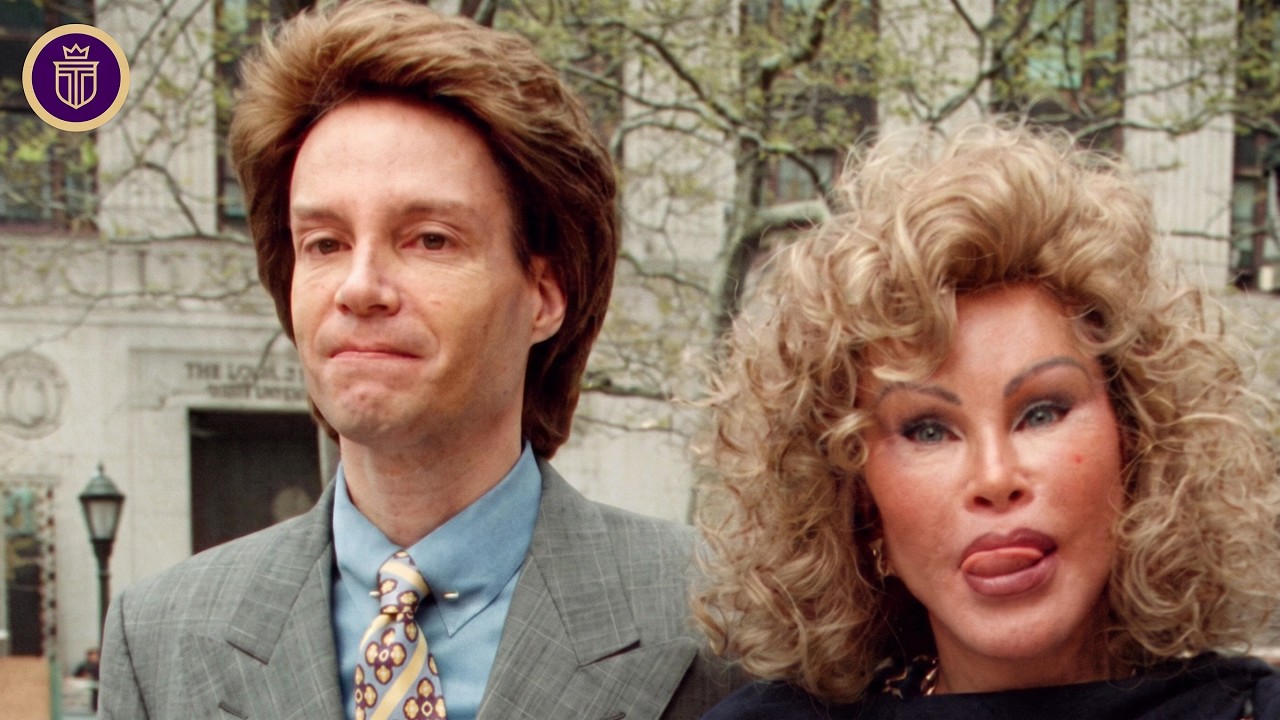
The tabloid treatment that pursued Jocelyn Wildenstein for the last 27 years of her life began with a single columnist’s phrase. The “Bride of Wildenstein” nickname is credited to George Rush of the New York Daily News, coined at the height of the divorce coverage. Over the following years, “Catwoman” and “Lion Queen” joined the list, driven by her distinctively pulled, upswept eyes and prominent cheekbones, features the press linked to her declared love of big cats.
A popular narrative claimed she changed her face specifically to please Alec’s alleged obsession with cats, and numerous reports claimed she spent between $2 million and $5 million on surgeries, though these figures circulate widely without independent verification through court records or medical documents. What is better documented is the contradictory record of her statements over 25 years. In 1998, she insisted her feline features were partly genetic, pointing to her grandmother’s eyes and prominent cheekbones, and added that Alec never forced her into surgery. In 2006, she offered a more philosophical take: if you are comfortable with your flaws, do nothing; otherwise, it is about choosing the right doctor. In 2018, she told an interviewer she had nothing to prove, and in November 2024, months before her death, she claimed categorically that she had never had any plastic surgery at all.
There is a gendered pattern worth naming directly, because the Jocelyn Wildenstein divorce was, by any factual measure, a scandal caused by her husband’s behavior. A gun, an affair with a woman decades younger, and a family machine that spent two years trying to isolate the wife financially and force her into submission. Yet the enduring cultural memory of the case is built around the wife’s face rather than the husband’s behavior. Alec Wildenstein, despite being the party who was arrested and charged, and despite pursuing the relationship that ended the marriage, largely escaped the decades of mockery that defined Jocelyn’s remaining life.
Her partner Lloyd Klein offered the most direct criticism after her death, calling the “Catwoman” label evil and arguing that Jocelyn did not deserve to be mocked. He also argued she was ahead of her time, noting that today, if you walk through New York, Palm Beach, or Los Angeles, everyone has had surgery. That argument has uncomfortable force, because the cosmetic procedures the press mocked Jocelyn for in 1998 became so normalized in the following decades that the mockery itself now looks like a relic of the past.
In May 2018, Jocelyn Wildenstein filed for Chapter 11 bankruptcy in Manhattan, listing a zero balance in her Citibank account and stating her only income was about $900 a month in Social Security payments. Her bankruptcy filing showed total assets of $16.39 million against liabilities of $6.38 million. She had combined three units on the 51st floor of Trump World Tower into a single five-bedroom residence and listed the combined property for sale at $17.5 million in 2015. By 2020, all three apartments had been fully repossessed.
Her explanation for her financial collapse centered on the trust fund created as part of her divorce settlement. She claimed the trust was partly secured by a Diego Velázquez painting later found to be fake, along with a Cézanne valued far below initial expectations. She also claimed Alec deliberately planted stories in the media about her cosmetic surgeries to portray her as monstrous and improve his position in the divorce case.
In her final decade, Jocelyn experienced an unexpected rehabilitation in the world of high fashion. The magazines that would not have published her photos in the 1990s embraced her as a “camp” icon, photographing her in elaborate editorial shoots that treated her appearance as a deliberate aesthetic choice rather than a cautionary tale. By 2023, the woman one gossip columnist had called the “Bride of Wildenstein” in 1997 was being photographed for the very magazines that once used her image as mockery. She attended Klein’s fashion shows regularly, reportedly obtained a commercial pilot’s license, and continued traveling between Miami, New York, Paris, and Canada.

While Jocelyn’s divorce case dominated New York tabloids, a much larger legal drama was quietly taking shape in France, initiated by a woman the public had never heard of. Sylvia Roth, Daniel Wildenstein’s second wife, met him in 1964 while working as a model in Paris, married him in 1978, and spent over 40 years with him until his death from cancer in 2001. He left her a relatively modest collection of racehorses, and things began to unravel, strangely, because of horse racing lists.
About a year after Daniel’s death, Sylvia’s trainer noticed that her stable results in the racing paper were no longer attributed to Madame Wildenstein but to an Irish company controlled by her stepsons. She hired a lawyer in Paris who discovered that Sylvia owned no documents of her own, no proof of ownership, no estate records, nothing, despite a four-decade marriage to one of the richest men in Europe. While Daniel lay in a coma for 10 days before his death, his sons arrived at the hospital with lawyers from Switzerland, the United States, and France. Weeks after the funeral, they told Sylvia the estate was in financial collapse and she must renounce her inheritance immediately to avoid catastrophe. She signed everything put before her, including documents written in Japanese.
Sylvia filed her first criminal complaint against her stepsons in 2001 and died in 2010 without seeing the case resolved, but she left a will instructing her lawyer to continue the fight. He did so for more than a decade. In 2011, the case Sylvia began produced a discovery that would change the family’s public image. French police searching the Wildenstein Institute in Paris uncovered a vault containing about 30 artworks long reported lost or stolen from a larger inventory of about 300 pieces stored there. Among the recovered works were sculptures by Raimondo Buggiati, drawings by Degas, a pastel by Delacroix, and a Berthe Morisot painting independently valued at over $1.1 million, all belonging to the estate of a family whose art was looted during the Nazi occupation and whose patriarch died at Auschwitz.
Guy Wildenstein was detained for 36 hours and charged with concealing stolen or missing property, a crime carrying a maximum sentence of 7 years. His defense was astonishing in its simplicity. He told investigators he had never examined the vault, and that the family had never kept an inventory of it. The investigating judge noted pointedly that a second safe in the institute had a complete inventory because Wildenstein had explained that this safe saw frequent movement of artworks in and out.
Three women who married into the Wildenstein family, Jocelyn, Sylvia, and Liouba, each discovered separately that they had been deliberately kept ignorant of the wealth they lived amid. Each of them, in her own way, helped expose that wealth to public view. The strange irony of this story is that a family famous for controlling information ended up being brought down by the women the family had systematically excluded from that information.
The vault discovery contributed directly to a criminal case that took more than two decades and three full trials to resolve. French prosecutors alleged that Guy and Alec Wildenstein had systematically hidden a large portion of Daniel’s estate from French tax authorities using a complex structure of offshore trusts, with the concealed value estimated at around €550 million. In September 2016, the first trial began in Paris with Guy and seven other defendants in the dock. But in January 2017, the court acquitted all defendants, acknowledging an obvious attempt at concealment but ruling that loopholes in French tax fraud law at the time made conviction impossible. An appeals court upheld the acquittal in July 2018.
In January 2021, France’s highest court overturned the acquittal and ordered a full retrial, finding that the lower courts had erred. The third trial took place in Paris in autumn 2023. On March 5, 2024, 23 years after the first complaint was filed, a Paris appeals court finally convicted Guy Wildenstein of tax fraud and money laundering. The sentence was 4 years in prison, 2 years suspended and 2 years under house arrest with an electronic bracelet, plus a €1 million fine and confiscation of assets worth nearly €3.5 million. Alec Junior, Jocelyn’s son who managed the Ol Jogi conservancy in Kenya, received a 2-year suspended sentence and a €37,500 fine. Liouba Stoupakova, Alec Sr.’s widow who had herself reported some of the family’s financial transactions to authorities, received a 3-month suspended sentence for complicity in money laundering. The presiding judge delivered a phrase that became the case’s epitaph in the French press: the powerful cannot escape the law.
In December 2025, Guy Wildenstein announced his retirement after 35 years as head of Wildenstein & Co., handing control to his son David and daughter Vanessa. He insisted the transition had nothing to do with his legal troubles, describing it as a carefully planned generational handover driven by trust, a characterization that required a certain selectivity the Wildenstein family had always possessed in abundance.
Jocelyn Wildenstein died on New Year’s Eve, December 31, 2024, in a hotel suite in Paris, from a pulmonary embolism caused by phlebitis that had produced severe swelling in her legs. Lloyd Klein’s account of her final hours was intimate and specific. The couple had dinner at the Ritz two days earlier and attended a Chanel fashion show. On the night of her death, they lay down for a nap before New Year’s Eve. When he woke and told her they needed to get ready, she was cold, and she was gone. They had been together for over 21 years.
Her funeral, held at Père Lachaise Cemetery in Paris, was attended by Klein and a circle of close friends, but neither of her two adult children, Diane and Alec Junior, attended. They had been estranged from their mother for more than a decade. Klein attributed the estrangement to family and financial pressures dating back decades. He claimed Alec Junior was pressured by his grandfather Daniel at age 17 to distance himself from Jocelyn to protect his inheritance. The rift with daughter Diane deepened after Alec Sr.’s death in 2008, when regular financial support to Jocelyn stopped, and worsened after Jocelyn discovered Diane maintained a friendly relationship with Elena Garić, the woman at the center of the 1997 affair. The last known contact between mother and daughter was believed to have occurred around 2010 or 2011.
Major media outlets published detailed obituaries treating her as a genuine, if tragic, cultural figure. Those obituaries described a woman whose lavish lifestyle, staggering financial settlement, and late-life rediscovery as a fashion icon told a larger story about wealth, aging, and the cruelty the press reserves for women who age and spend money visibly. Klein insisted in his tribute on reframing the “Catwoman” story one last time, saying Jocelyn did not deserve the mockery, and that people should respect the human being.
Reports of her age at death varied even in the obituaries, a final example of the ambiguity with which Jocelyn had surrounded her life throughout her career. She married into a fortune built on silence, fought to win one of the largest divorce settlements in history, watched most of it evaporate through the family’s very ability to hide money, became the most mocked woman in New York tabloid history, and outlasted the mockery long enough for the fashion world that once treated her as a cautionary tale to reclaim her. She died in a Paris hotel suite on the last night of the year, while the man who loved her slept beside her, and the children she raised refused to answer the phone. The fortune remains hidden, the face remains famous, and the woman behind them both finally stopped explaining herself.